Enhancing Circularity, Sustainability, and Innovation
La Marjal Floodable Urban Park. Alicante
The “La Marjal” Floodable Urban Park is a prominent example of a nature-based solution
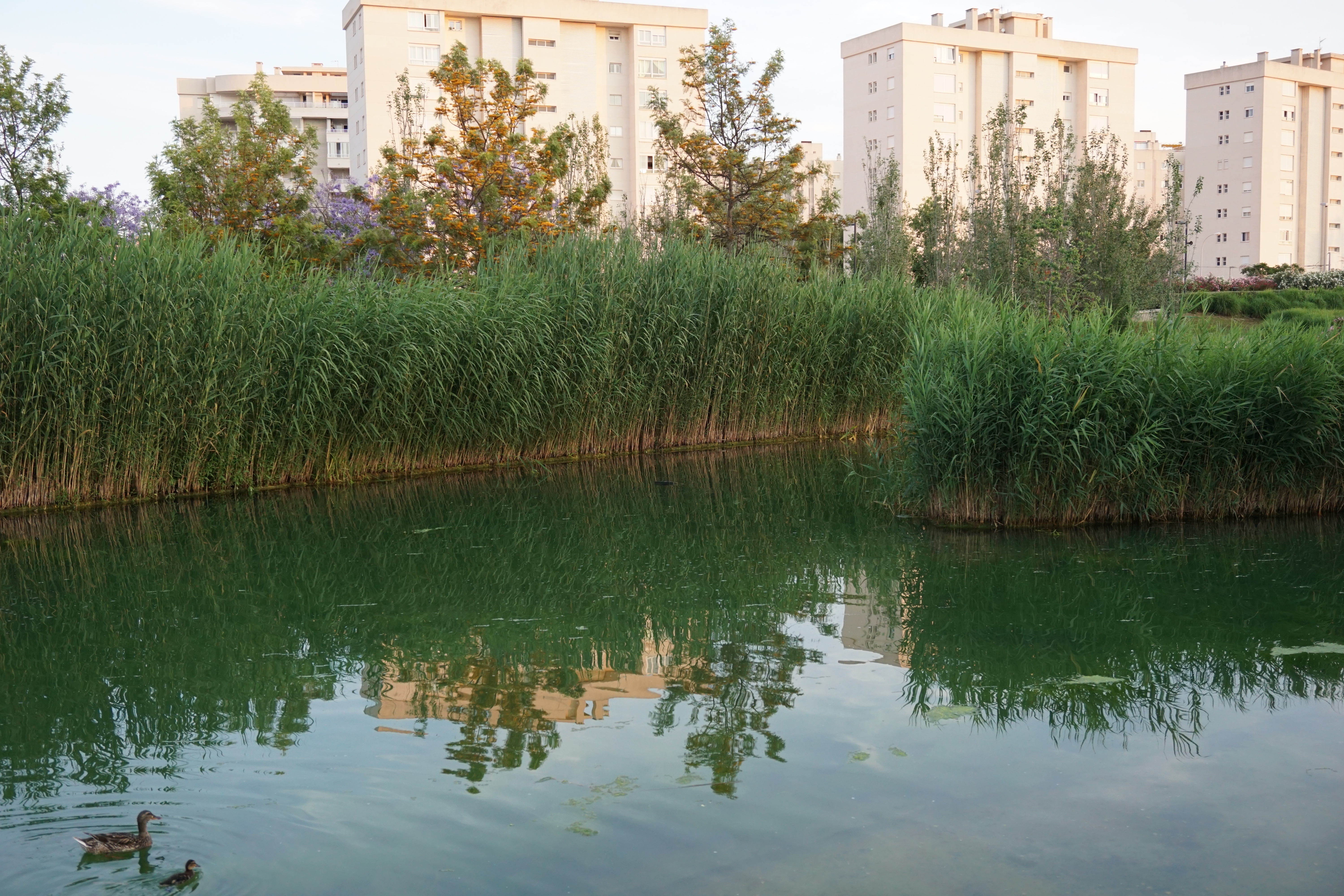
La Marjal Floodable Park in Alicante, Spain, merges ecological resilience with urban beauty. Designed to absorb stormwater through natural wetland systems, it transforms flood risk into a vibrant public landscape. Native vegetation, biodiversity corridors, and accessible pathways create an inclusive green space where sustainability meets community life. A pioneering example of regenerative urban design, it embodies the New European Bauhaus values: beautiful, sustainable, and together.
Spain
Local
Alicante
Mainly urban
It involves a physical transformation of the built environment (hard investment)
Yes
2015-03-28
Yes
Project BIOVERA (ERDF): Green infraestructures assessment
Project IRIS (CDTI): Monitoring and digital management of nature based solutions
No
Yes
Organisation
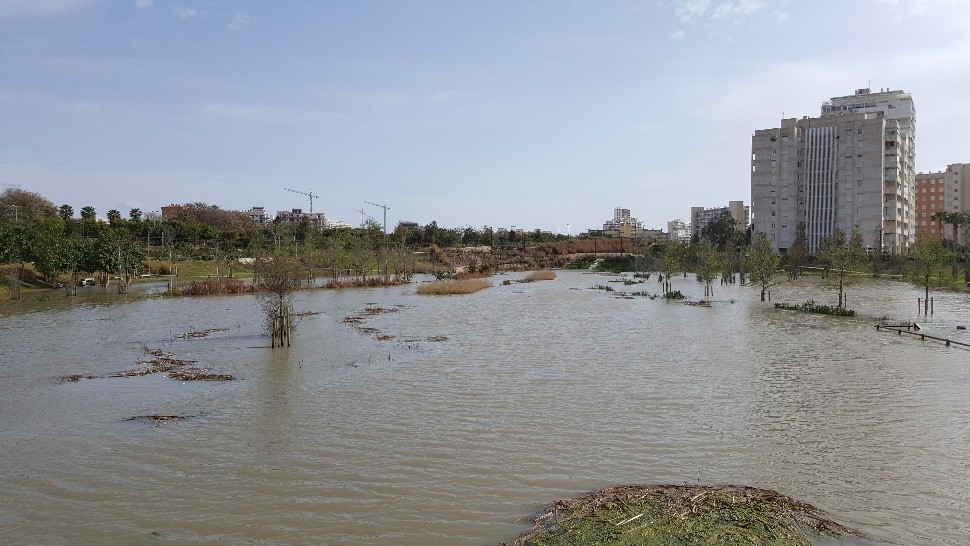
La Marjal is an innovative and sustainable urban floodable park in Alicante, Spain, designed as a Nature-Based Solution (NBS) to tackle severe, recurring floods in the low-gradient San Juan Beach area. Inaugurated in 2015, the 3.6 ha park mimics native Mediterranean wetlands and functions as a massive stormwater retention basin with a capacity of 45,000 m3.
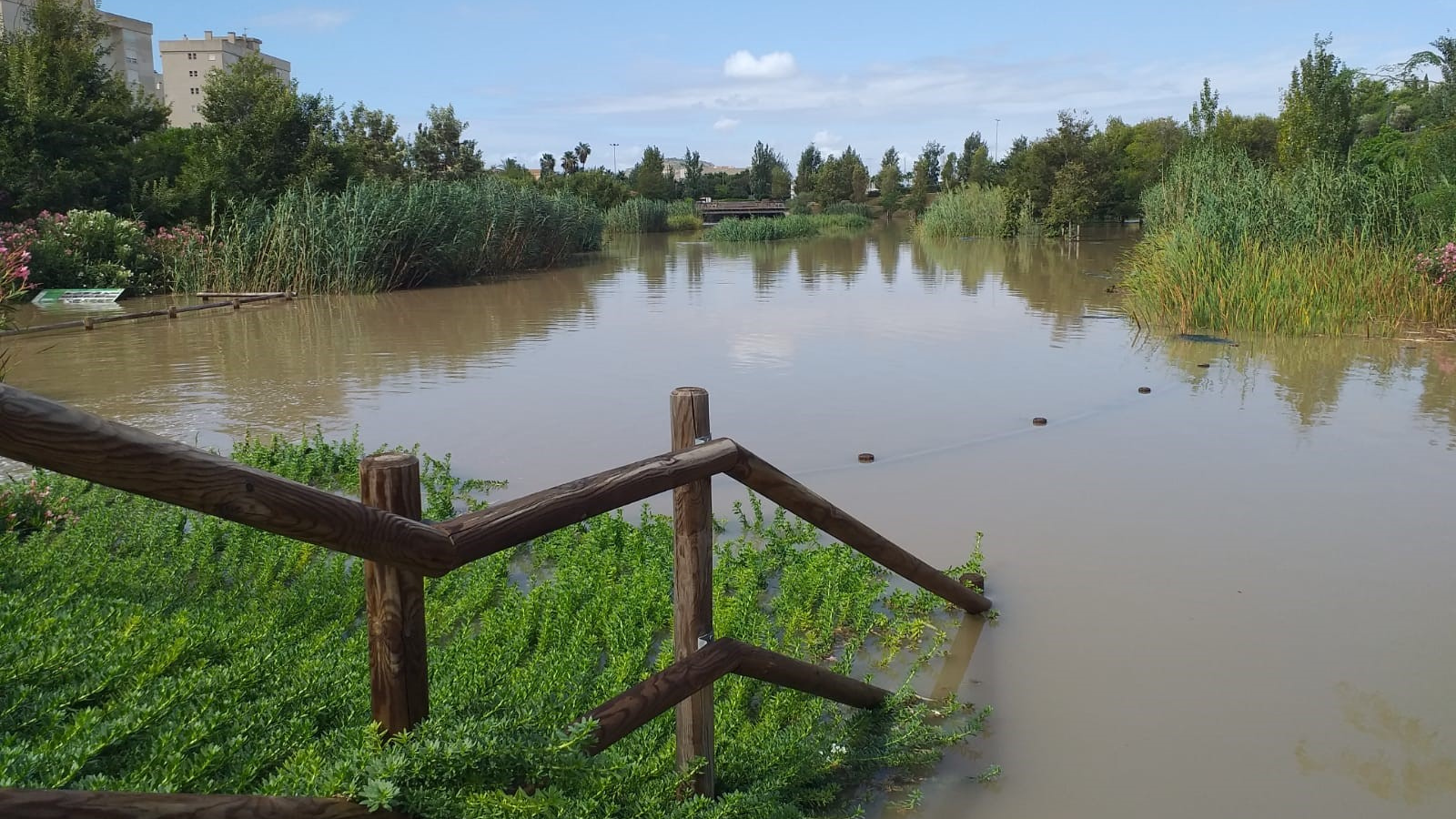
Achieved Results: Since its opening, La Marjal has successfully averted numerous flood events. Notably, it retained 15,500 m3 during historic rains in March 2017 and 22,000 m3 in August 2019, completely protecting the surrounding urban areas from flood damages. Economically, the €3.67 million project proved highly cost-effective, costing nearly four times less than a traditional underground storm tank alternative. Socially, it transformed a vulnerable flood zone into a highly accessible public recreational space that physically connects previously isolated neighborhoods. Environmentally, the park utilizes reclaimed wastewater to sustain its permanent ponds and irrigation, and has rapidly become a thriving sanctuary for over 120 bird species, including several protected ones.
Long-Term Impacts: In the long term, La Marjal acts as a vital climate change adaptation tool. It actively mitigates the urban heat island effect, demonstrating local temperature reductions of up to 5ºC, and provides continuous carbon sequestration. By deeply integrating circular economy principles—such as repurposing all excavated earth into a recreational hill to completely avoid landfill transport—it guarantees sustainable urban growth. Its tremendous success has established it as a pioneering model for urban resilience, leading to the approval of three additional floodable parks in Alicante and inspiring replications across other Mediterranean municipalities.
Achieved Results: Since its opening, La Marjal has successfully averted numerous flood events. Notably, it retained 15,500 m3 during historic rains in March 2017 and 22,000 m3 in August 2019, completely protecting the surrounding urban areas from flood damages. Economically, the €3.67 million project proved highly cost-effective, costing nearly four times less than a traditional underground storm tank alternative. Socially, it transformed a vulnerable flood zone into a highly accessible public recreational space that physically connects previously isolated neighborhoods. Environmentally, the park utilizes reclaimed wastewater to sustain its permanent ponds and irrigation, and has rapidly become a thriving sanctuary for over 120 bird species, including several protected ones.
Long-Term Impacts: In the long term, La Marjal acts as a vital climate change adaptation tool. It actively mitigates the urban heat island effect, demonstrating local temperature reductions of up to 5ºC, and provides continuous carbon sequestration. By deeply integrating circular economy principles—such as repurposing all excavated earth into a recreational hill to completely avoid landfill transport—it guarantees sustainable urban growth. Its tremendous success has established it as a pioneering model for urban resilience, leading to the approval of three additional floodable parks in Alicante and inspiring replications across other Mediterranean municipalities.
The San Juan Beach area in Alicante, historically a natural marshland ("marjal"), faced severe flooding due to intense Mediterranean rains and its low-lying, highly urbanized terrain. Existing drainage networks were frequently overwhelmed. Authorities considered building a massive underground storm tank or a new collector discharging directly into the sea, but these options were costly and environmentally invasive. Instead, an innovative Nature-Based Solution was proposed: a floodable urban park mimicking the natural water-regulating function of native wetlands.
The project was executed through a public-private partnership between the Alicante City Council and Aguas de Alicante. Construction occurred between April 2013 and March 2015, costing approximately 3.7 M€. Implementation on the ground required extensive earthworks to create a 45,000 m3 retention basin. To minimize environmental impact, the excavated earth was entirely reused on-site to build a 20-meter-high recreational hill, completely avoiding landfill transport.
Hydraulically, large collectors (up to 2,000 mm in diameter) were installed to divert excess stormwater into the park by gravity when the city's drainage network reaches its maximum capacity. Two permanent ornamental ponds were built at the bottom of the basin, which are sustained by reclaimed wastewater during dry periods. The park was extensively landscaped with native Mediterranean vegetation to foster local biodiversity.
To ensure public safety, a smart, remote-controlled system was implemented, equipped with radar weather forecasting, water level sensors, and visual and acoustic evacuation alarms.
Finally, pedestrian pathways and a bridge were constructed to connect previously isolated neighborhoods, transforming a vulnerable flood zone into a highly resilient and accessible public space.
The project was executed through a public-private partnership between the Alicante City Council and Aguas de Alicante. Construction occurred between April 2013 and March 2015, costing approximately 3.7 M€. Implementation on the ground required extensive earthworks to create a 45,000 m3 retention basin. To minimize environmental impact, the excavated earth was entirely reused on-site to build a 20-meter-high recreational hill, completely avoiding landfill transport.
Hydraulically, large collectors (up to 2,000 mm in diameter) were installed to divert excess stormwater into the park by gravity when the city's drainage network reaches its maximum capacity. Two permanent ornamental ponds were built at the bottom of the basin, which are sustained by reclaimed wastewater during dry periods. The park was extensively landscaped with native Mediterranean vegetation to foster local biodiversity.
To ensure public safety, a smart, remote-controlled system was implemented, equipped with radar weather forecasting, water level sensors, and visual and acoustic evacuation alarms.
Finally, pedestrian pathways and a bridge were constructed to connect previously isolated neighborhoods, transforming a vulnerable flood zone into a highly resilient and accessible public space.
Nature based solutions
Circular economy
Social Impact
Climate adaptation
Biodiversity
La Marjal floodable park is an innovative NBS that exemplifies urban sustainability by addressing environmental, social, and economic challenges through multi-functional design.
Environmental Challenges: La Marjal primarily mitigates urban flood risks by retaining up to 45,000m3 of stormwater during extreme weather, which prevents flooding and polluted runoff from discharging directly into the sea. It acts as a climate shelter, mitigating the urban heat island effect by reducing local temperature by up to 5ºC. It fosters biodiversity, serving as a sanctuary for over 120 bird species (including protected ones) and features native Mediterranean vegetation.
Social and Cultural Opportunities: Instead of building a closed underground tank, the project created a 3.6ha public park. It connects separated neighborhoods via a pedestrian bridge providing a fully accessible recreational space. It is a cultural hub for environmental education, hosting guided tours, school visits and open days at the bird ringing station to raise public awareness about climate change and biodiversity.
Economic Opportunities: highly cost-effective, cheaper to build than traditional "grey" infrastructure, costing roughly 3.7M € vs 15M € required for a similarly sized underground storm tank. In addition to avoiding costly flood-related damages, it increases local property and tourism value
Exemplary Sustainability: ecosystem in an urban environment that favours biodiversity. For the biological control of insects, bird and bat nests were installed and larval fishes were introduced into lakes. A paradigmatic example of a circular economy. It uses reclaimed wastewater for its permanent ponds and irrigation, and reused all excavated earth on-site to form a recreational hill, completely avoiding landfill transport. Supported by smart digital systems for early flood warnings and remote monitoring, it perfectly aligns with SDGs: protecting citizens, restoring nature, and fostering community well-being
Environmental Challenges: La Marjal primarily mitigates urban flood risks by retaining up to 45,000m3 of stormwater during extreme weather, which prevents flooding and polluted runoff from discharging directly into the sea. It acts as a climate shelter, mitigating the urban heat island effect by reducing local temperature by up to 5ºC. It fosters biodiversity, serving as a sanctuary for over 120 bird species (including protected ones) and features native Mediterranean vegetation.
Social and Cultural Opportunities: Instead of building a closed underground tank, the project created a 3.6ha public park. It connects separated neighborhoods via a pedestrian bridge providing a fully accessible recreational space. It is a cultural hub for environmental education, hosting guided tours, school visits and open days at the bird ringing station to raise public awareness about climate change and biodiversity.
Economic Opportunities: highly cost-effective, cheaper to build than traditional "grey" infrastructure, costing roughly 3.7M € vs 15M € required for a similarly sized underground storm tank. In addition to avoiding costly flood-related damages, it increases local property and tourism value
Exemplary Sustainability: ecosystem in an urban environment that favours biodiversity. For the biological control of insects, bird and bat nests were installed and larval fishes were introduced into lakes. A paradigmatic example of a circular economy. It uses reclaimed wastewater for its permanent ponds and irrigation, and reused all excavated earth on-site to form a recreational hill, completely avoiding landfill transport. Supported by smart digital systems for early flood warnings and remote monitoring, it perfectly aligns with SDGs: protecting citizens, restoring nature, and fostering community well-being
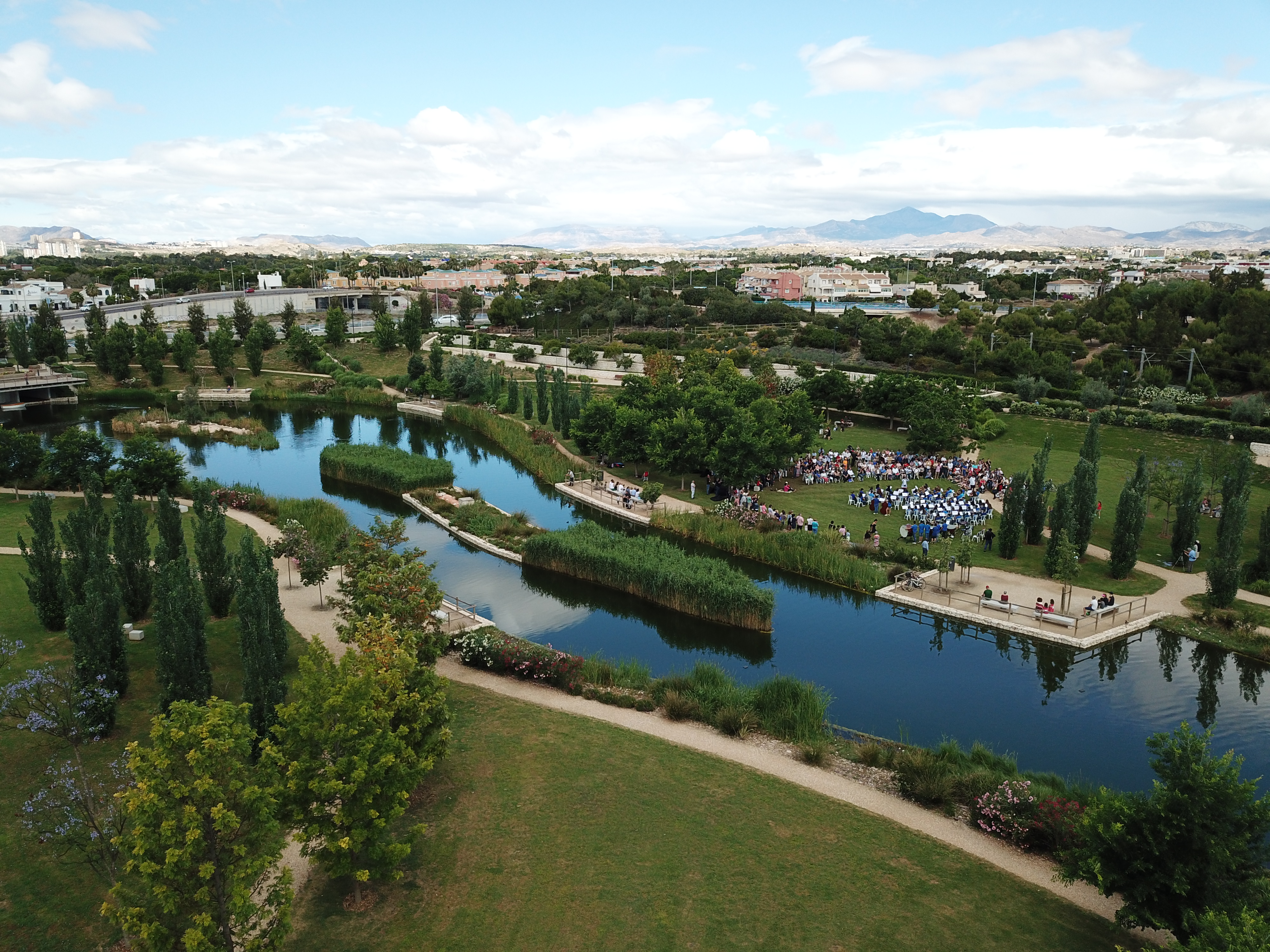
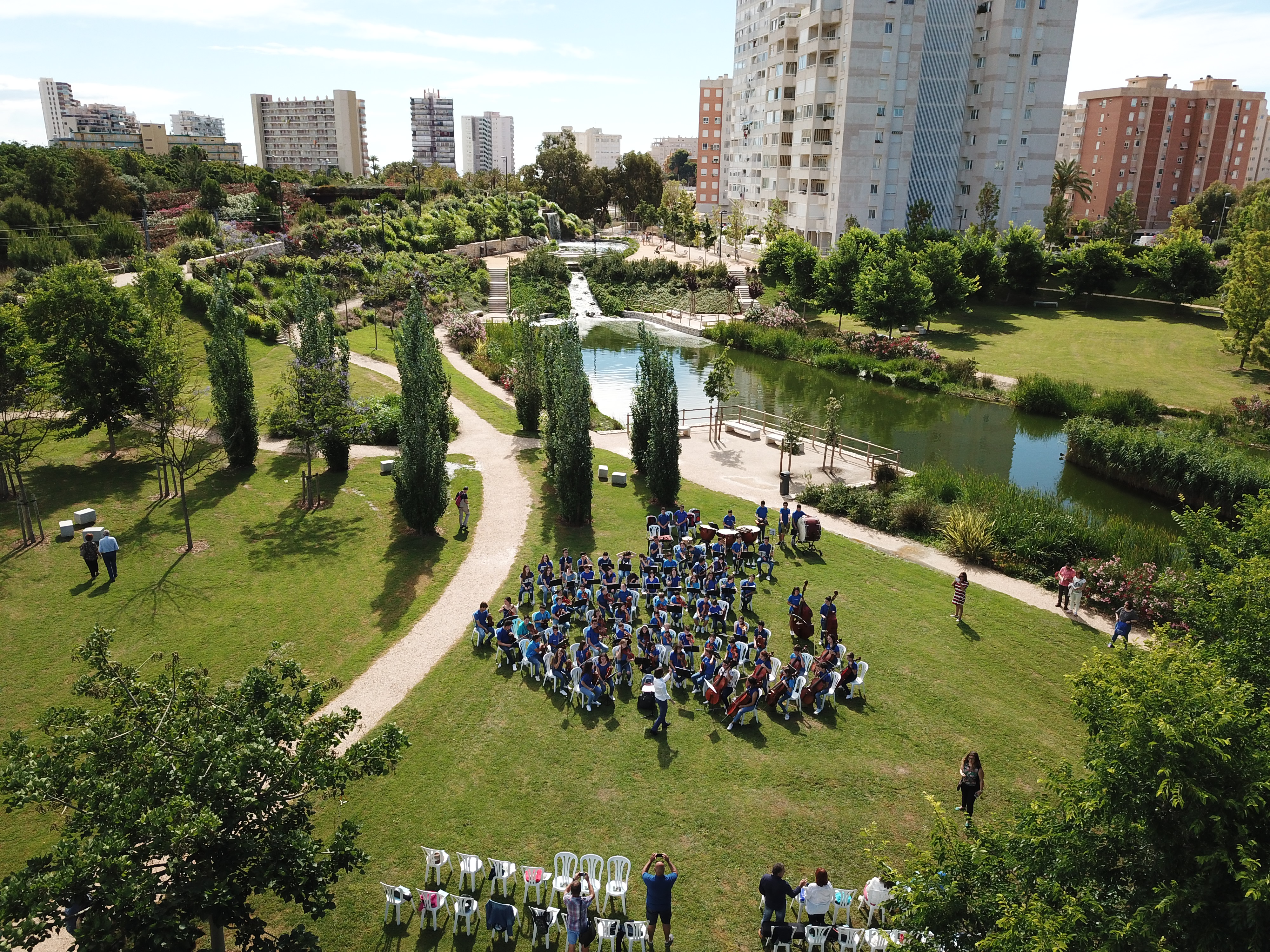
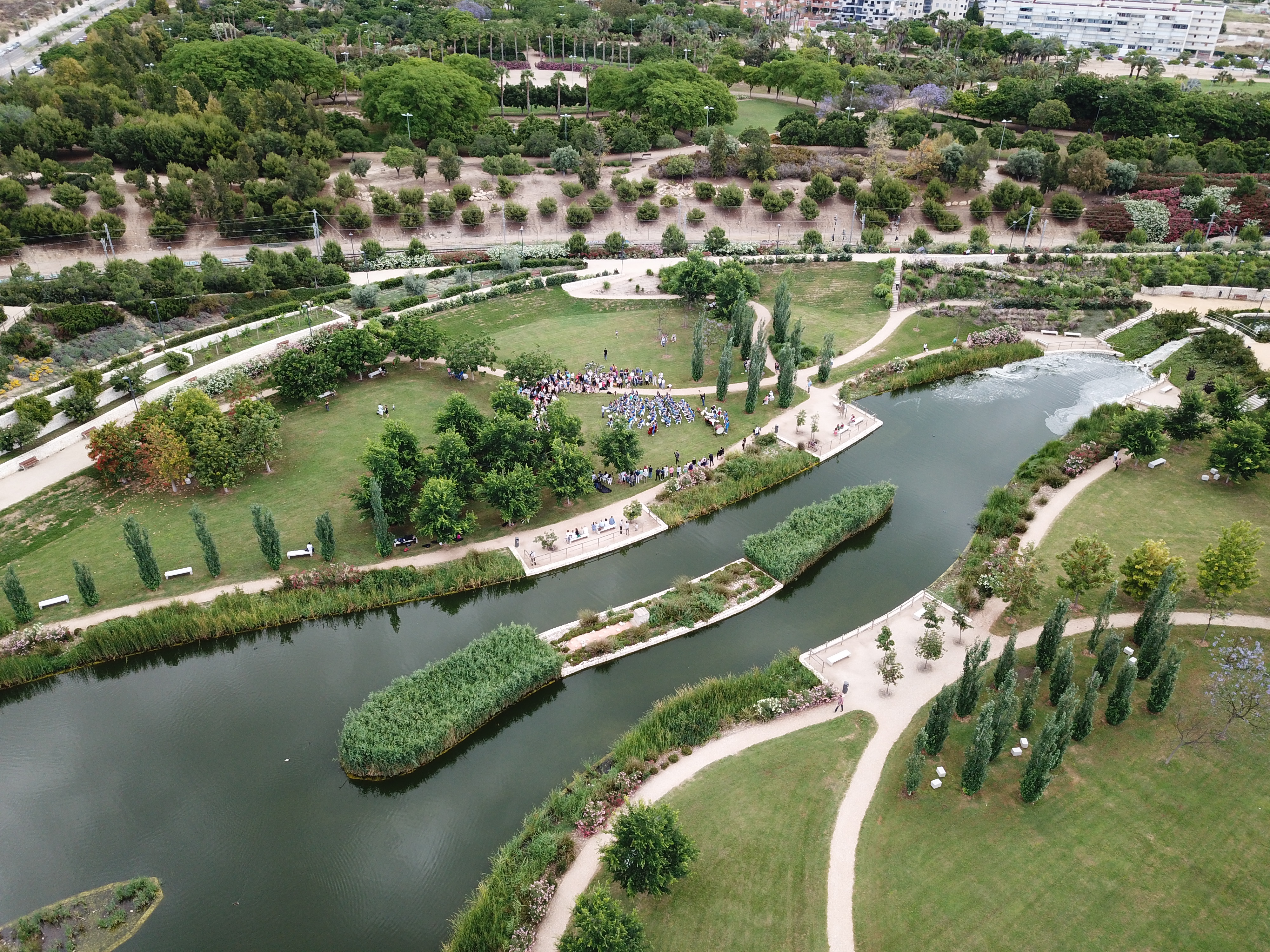
Making life more beautiful: La Marjal transforms a conventional "grey" infrastructure requirement—a massive storm tank—into a beautiful 3.6 ha "blue-green" public park. It brings everyday beauty to the city by faithfully recreating four distinct Mediterranean landscapes: a riparian zone centered around two ornamental ponds connected by a waterfall, riverside vegetation, an agricultural landscape featuring traditional dry-stone terraces, and a 20-meter-high forested hill offering panoramic views. Aesthetic architectural elements, such as a wooden viewpoint and a Corten steel pedestrian bridge integrated with vertical gardens, seamlessly blend functionality with nature.
Sense of belonging and care: By mimicking the natural marshlands ("marjales") that existed before the area's intense urbanization, the park reconnects residents with their lost environmental heritage, providing the neighborhood with a unique local identity. It physically unites the community by linking previously isolated neighborhoods with the PAU 5 park via a new pedestrian bridge, generating continuous, accessible walking routes. Furthermore, the park cultivates community care through environmental education; it features informative panels and hosts regular school visits to teach citizens about native flora, local fauna, and climate resilience.
Exemplary in aesthetics: La Marjal is exemplary because it successfully disguises a massive 45,000 m3 hydraulic retention basin as a highly attractive, naturalized ecosystem. Instead of hiding a costly concrete structure underground, it visibly enhances the urban fabric. This remarkable aesthetic and environmental integration is widely recognized, having won the FOPA Award for the best integration into its environment and the prestigious "Alhambra" National Gardening Award.
Sense of belonging and care: By mimicking the natural marshlands ("marjales") that existed before the area's intense urbanization, the park reconnects residents with their lost environmental heritage, providing the neighborhood with a unique local identity. It physically unites the community by linking previously isolated neighborhoods with the PAU 5 park via a new pedestrian bridge, generating continuous, accessible walking routes. Furthermore, the park cultivates community care through environmental education; it features informative panels and hosts regular school visits to teach citizens about native flora, local fauna, and climate resilience.
Exemplary in aesthetics: La Marjal is exemplary because it successfully disguises a massive 45,000 m3 hydraulic retention basin as a highly attractive, naturalized ecosystem. Instead of hiding a costly concrete structure underground, it visibly enhances the urban fabric. This remarkable aesthetic and environmental integration is widely recognized, having won the FOPA Award for the best integration into its environment and the prestigious "Alhambra" National Gardening Award.
Accessibility and Affordability: La Marjal is a fully accessible public space designed applying "design for all" principles. Its entire network of pathways features slopes of less than 6%, guaranteeing free access for people with disabilities. To overcome historical spatial segregation, the project built a pedestrian bridge over the tram lines. It provides vital economic relief to a vulnerable community by preventing severe flooding that historically caused significant personal and material damage.
Inclusive Governance and New Societal Models: The project relies on a strong public-private partnership between the City Council and Aguas de Alicante. This involves daily coordination, joint municipal meetings and a shared action protocol that integrates municipal services and local police during flood emergencies. Socially, La Marjal promotes a new model of civic engagement by serving as an open-air classroom. It features informational panels and hosts guided tours and regular school visits, involving the local community. Aguas de Alicante collaborates with an ornithology team (Territorio Natura) that provides bio-indicators, highlighting the ecological contribution of La Marjal. Since 2018, 120 bird species have been identified, an impressive amount in an urban area. Through the company's corporate volunteering, employees have built an XL insect hotel to encourage the presence of pollinators.
Exemplary Inclusion: La Marjal revolutionizes traditional urban infrastructure. Instead of spending public funds on a closed, underground concrete storm tank (invisible to the public), it optimized the social return on investment by creating a highly utilized, 3.6ha green space. In 2025, 28 guided tours have been conducted for schools, with 616 participants, and 6 guided tours for associations, with 111 participants.
Inclusive Governance and New Societal Models: The project relies on a strong public-private partnership between the City Council and Aguas de Alicante. This involves daily coordination, joint municipal meetings and a shared action protocol that integrates municipal services and local police during flood emergencies. Socially, La Marjal promotes a new model of civic engagement by serving as an open-air classroom. It features informational panels and hosts guided tours and regular school visits, involving the local community. Aguas de Alicante collaborates with an ornithology team (Territorio Natura) that provides bio-indicators, highlighting the ecological contribution of La Marjal. Since 2018, 120 bird species have been identified, an impressive amount in an urban area. Through the company's corporate volunteering, employees have built an XL insect hotel to encourage the presence of pollinators.
Exemplary Inclusion: La Marjal revolutionizes traditional urban infrastructure. Instead of spending public funds on a closed, underground concrete storm tank (invisible to the public), it optimized the social return on investment by creating a highly utilized, 3.6ha green space. In 2025, 28 guided tours have been conducted for schools, with 616 participants, and 6 guided tours for associations, with 111 participants.
Citizens and Local Communities: Rather than being passive beneficiaries of a hidden underground storm tank, residents actively use La Marjal as a daily recreational space. The project physically connects previously isolated neighborhoods through a new pedestrian bridge built over the tram lines. To ensure safety, citizens are protected by a smart early warning system equipped with acoustic and visual alarms that direct evacuation before extreme floods. Furthermore, the park functions as an open-air classroom. It features informative panels detailing the park's hydraulic operations and native Mediterranean habitats.
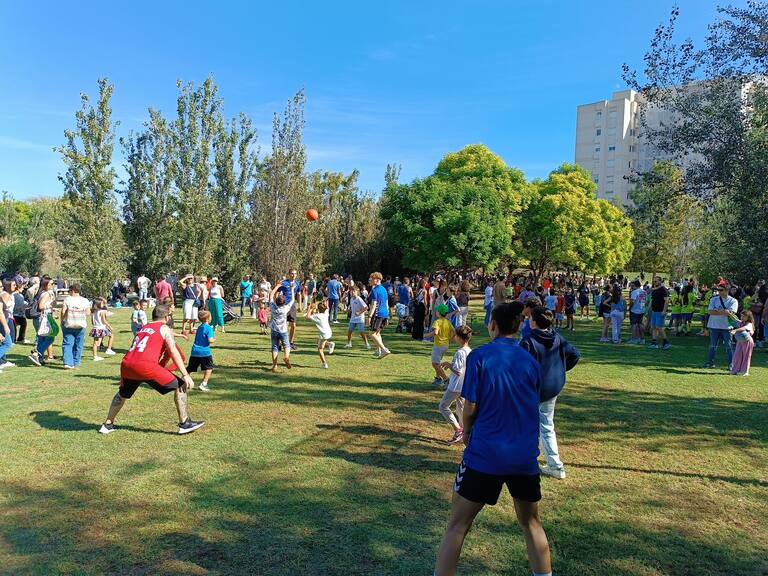
Local schools and citizens actively participate in guided tours and multiple activities organized by Aguas de Alicante, the City Council or the diverse NGOs that collaborate with Aguas de Alicante, to learn about climate resilience and local biodiversity (fauna and flora). The active participation of citizens and schools has deeply connected the community with nature, raised environmental awareness, and transformed a severe climate threat into a celebrated daily opportunity for social cohesion and well-being. Furthermore, La Marjal hosts multiple sociocultural activities: sports activities, photographic exhibitions, concerts, etc.
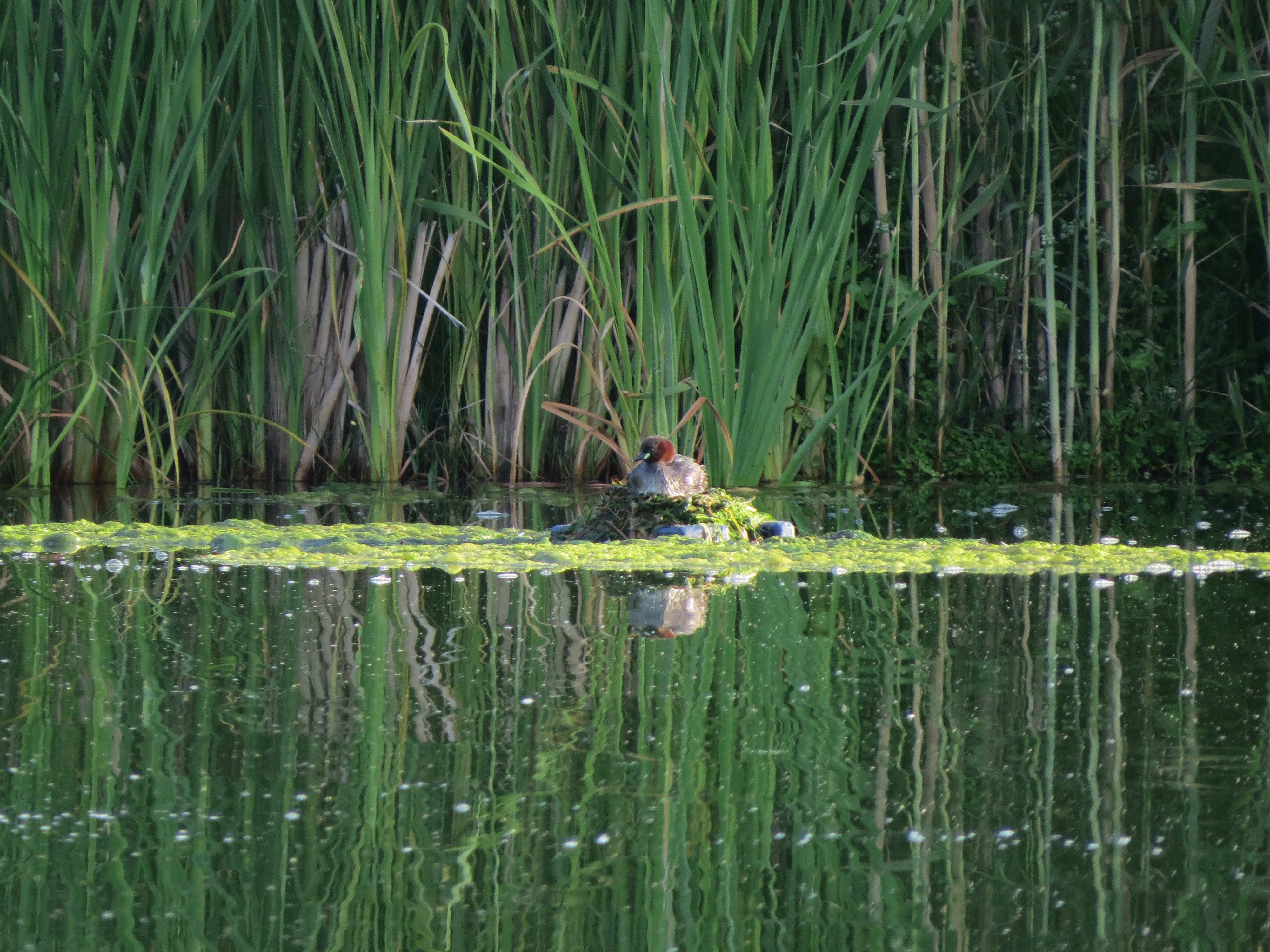
Civil Society Organizations (NGOs): The project directly collaborated with civil society to address ecological challenges. When neighbors experienced mosquito issues during the first summer, the NGO GEA was heavily involved in implementing a chemical-free, biological pest control system. Impact of Involvement: The NGO's intervention successfully controlled pests through the release of larvivorous fish (gambusias) and accelerated urban wildlife colonization by installing artificial nests for bats, swallows, and kingfishers.
Local schools and citizens actively participate in guided tours and multiple activities organized by Aguas de Alicante, the City Council or the diverse NGOs that collaborate with Aguas de Alicante, to learn about climate resilience and local biodiversity (fauna and flora). The active participation of citizens and schools has deeply connected the community with nature, raised environmental awareness, and transformed a severe climate threat into a celebrated daily opportunity for social cohesion and well-being. Furthermore, La Marjal hosts multiple sociocultural activities: sports activities, photographic exhibitions, concerts, etc.
Civil Society Organizations (NGOs): The project directly collaborated with civil society to address ecological challenges. When neighbors experienced mosquito issues during the first summer, the NGO GEA was heavily involved in implementing a chemical-free, biological pest control system. Impact of Involvement: The NGO's intervention successfully controlled pests through the release of larvivorous fish (gambusias) and accelerated urban wildlife colonization by installing artificial nests for bats, swallows, and kingfishers.
Local Level
Alicante City Council & Aguas de Alicante: Public-Private Partnership to co-design and manage the project. The Council maintains the landscaping, while Aguas de Alicante financed the construction and manages hydraulic operations. Added value: Ensured upfront financial viability, highly efficient cost-sharing, and seamless emergency coordination.
Citizens & Schools: Actively use the park for daily recreation and environmental education. The Park has hosted concerts of various types of music, photographic exhibitions such as the 10th anniversary exhibition 'Wetlands of the world: from Alicante to the antipodes', painting activities, sports, etc.
Added value: Fosters community cohesion, raises climate awareness, and transforms a severe flood threat into a public asset.
NGOs: Collaborated directly on the ecological management of the park. Added value: Implemented biological pest control (introducing larvivorous fish and bat nests), boosting urban biodiversity without the use of chemicals, bird identification and ringing.
Regional Level
University of Alicante & FOPA: Climatology experts validated the park's success in preventing disasters, while the Federation of Public Works of Alicante (FOPA) evaluated its impact. Added value: Provided academic and institutional backing, culminating in the FOPA Award for best environmental integration.
Generalitat Valenciana: Inclusion in the portfolio of climate change adaptation solutions
National Level
National Associations: Nationwide recognition (e.g., "Alhambra" Gardening Award, CEOE Good environmental practices, etc.) established it as a replicable Spanish model for urban resilience.
European/International Level
IWA & UN/EU Frameworks: Showcased at the IWA World Water Congress and pre-selected for UN-Habitat Best Urban Practices. Added value: Positioned the project within the global climate dialogue, aligning with UN SDGs and EU urban objectives to share scalable NBSs with other municipalities
Alicante City Council & Aguas de Alicante: Public-Private Partnership to co-design and manage the project. The Council maintains the landscaping, while Aguas de Alicante financed the construction and manages hydraulic operations. Added value: Ensured upfront financial viability, highly efficient cost-sharing, and seamless emergency coordination.
Citizens & Schools: Actively use the park for daily recreation and environmental education. The Park has hosted concerts of various types of music, photographic exhibitions such as the 10th anniversary exhibition 'Wetlands of the world: from Alicante to the antipodes', painting activities, sports, etc.
Added value: Fosters community cohesion, raises climate awareness, and transforms a severe flood threat into a public asset.
NGOs: Collaborated directly on the ecological management of the park. Added value: Implemented biological pest control (introducing larvivorous fish and bat nests), boosting urban biodiversity without the use of chemicals, bird identification and ringing.
Regional Level
University of Alicante & FOPA: Climatology experts validated the park's success in preventing disasters, while the Federation of Public Works of Alicante (FOPA) evaluated its impact. Added value: Provided academic and institutional backing, culminating in the FOPA Award for best environmental integration.
Generalitat Valenciana: Inclusion in the portfolio of climate change adaptation solutions
National Level
National Associations: Nationwide recognition (e.g., "Alhambra" Gardening Award, CEOE Good environmental practices, etc.) established it as a replicable Spanish model for urban resilience.
European/International Level
IWA & UN/EU Frameworks: Showcased at the IWA World Water Congress and pre-selected for UN-Habitat Best Urban Practices. Added value: Positioned the project within the global climate dialogue, aligning with UN SDGs and EU urban objectives to share scalable NBSs with other municipalities
Civil and Hydraulic Engineering: Engineering was foundational for designing the park as a massive 45,000 m3 stormwater retention basin. Hydraulic experts designed a complex drainage system, including large underground collectors (up to 2,000 mm in diameter) and gravity-driven water inlets capable of managing extreme 50-year return period rain events.
Architecture and Landscape Design: Landscape architecture was essential to visually integrate the massive hydraulic infrastructure into the city. Designers creatively shaped the topography to form the basin and completely reused the excavated earth to build a 20m high recreational hill. Architectural elements were seamlessly blended into the natural environment.
Environmental Sciences and Ecology: Biological sciences guided the park's nature-based design, which faithfully mimics native Mediterranean wetlands (marjales). Experts selected native riparian, agricultural, and forest flora to recreate regional ecosystems. Ecological knowledge was also applied to foster biodiversity, utilizing larvivorous fish for biological mosquito control and installing artificial nests for local bird and bat species.
Digital Technologies: The park's operation heavily relies on smart digital systems. Technologies include short-term radar weather forecasting, remote-controlled water valves, and SCADA telemetry to monitor water quality and levels. Furthermore, digital tools power the acoustic and visual alert systems used to safely evacuate the park prior to floods.IRIS project is also focusing on digital management.
Social Sciences and Education: Governance principles shaped the successful Public-Private Partnership between the Alicante City Council and Aguas de Alicante. Educational fields are reflected in the park's use as a space for environmental awareness, featuring informative panels and guided school visits to teach citizens about native habitats, biodiversity and climate resilience.
Architecture and Landscape Design: Landscape architecture was essential to visually integrate the massive hydraulic infrastructure into the city. Designers creatively shaped the topography to form the basin and completely reused the excavated earth to build a 20m high recreational hill. Architectural elements were seamlessly blended into the natural environment.
Environmental Sciences and Ecology: Biological sciences guided the park's nature-based design, which faithfully mimics native Mediterranean wetlands (marjales). Experts selected native riparian, agricultural, and forest flora to recreate regional ecosystems. Ecological knowledge was also applied to foster biodiversity, utilizing larvivorous fish for biological mosquito control and installing artificial nests for local bird and bat species.
Digital Technologies: The park's operation heavily relies on smart digital systems. Technologies include short-term radar weather forecasting, remote-controlled water valves, and SCADA telemetry to monitor water quality and levels. Furthermore, digital tools power the acoustic and visual alert systems used to safely evacuate the park prior to floods.IRIS project is also focusing on digital management.
Social Sciences and Education: Governance principles shaped the successful Public-Private Partnership between the Alicante City Council and Aguas de Alicante. Educational fields are reflected in the park's use as a space for environmental awareness, featuring informative panels and guided school visits to teach citizens about native habitats, biodiversity and climate resilience.
Business Model and Governance: The business model of La Marjal is based on a robust Public-Private Partnership (PPP). The project was developed, promoted, and executed by Aguas de Alicante, a mixed-capital company owned 50% by the Alicante City Council and 50% by Veolia Spain.
Financial Sustainability: The project is financially self-sustaining over time. Rather than relying on fluctuating public subsidies, donations, etc., its financial model is directly integrated into the city's utility management:
Tariff-Based Revenue: The initial construction budget of approximately €3.67 million was fully financed upfront by Aguas de Alicante. To ensure long-term financial sustainability and recover the investment, this cost was strategically passed on to the municipal sewerage tariff. This provides a stable, guaranteed revenue stream paid by users of the water system.
Shared Operational Expenditure (OPEX): The ongoing maintenance of the park—estimated at around €70,000 annually—is sustained through a highly efficient division of responsibilities. The Alicante City Council assumes the cost and management of the park's landscaping, green areas, and general cleaning. Meanwhile, Aguas de Alicante funds and manages the hydraulic operations, the smart telecontrol systems, water quality analytics, and the maintenance of the permanent reclaimed water ponds.
Cost-Efficiency and Avoided Costs: A core pillar of the project's economic sustainability is its massive return on investment. La Marjal was highly cost-effective to build, costing roughly four times less than a traditional underground concrete storm tank. Furthermore, it generates immense indirect economic value by continuously preventing the costly material, commercial, and infrastructure damages historically caused by floods in the area, while simultaneously boosting local property and tourism value.
European funded projects such as Biovera and IRIS are also contributing to improve assessment and management.
Financial Sustainability: The project is financially self-sustaining over time. Rather than relying on fluctuating public subsidies, donations, etc., its financial model is directly integrated into the city's utility management:
Tariff-Based Revenue: The initial construction budget of approximately €3.67 million was fully financed upfront by Aguas de Alicante. To ensure long-term financial sustainability and recover the investment, this cost was strategically passed on to the municipal sewerage tariff. This provides a stable, guaranteed revenue stream paid by users of the water system.
Shared Operational Expenditure (OPEX): The ongoing maintenance of the park—estimated at around €70,000 annually—is sustained through a highly efficient division of responsibilities. The Alicante City Council assumes the cost and management of the park's landscaping, green areas, and general cleaning. Meanwhile, Aguas de Alicante funds and manages the hydraulic operations, the smart telecontrol systems, water quality analytics, and the maintenance of the permanent reclaimed water ponds.
Cost-Efficiency and Avoided Costs: A core pillar of the project's economic sustainability is its massive return on investment. La Marjal was highly cost-effective to build, costing roughly four times less than a traditional underground concrete storm tank. Furthermore, it generates immense indirect economic value by continuously preventing the costly material, commercial, and infrastructure damages historically caused by floods in the area, while simultaneously boosting local property and tourism value.
European funded projects such as Biovera and IRIS are also contributing to improve assessment and management.
Methodology (Nature-Based Solutions): The core concept of replacing traditional, underground concrete storm tanks with multifunctional, floodable public parks is highly replicable. This methodology mimics the natural water-regulating functions of native wetlands ("marjales") to manage urban runoff while simultaneously providing a public recreational space and wildlife refuge.
Processes (Circular Economy & Water Management): The project’s earthwork process is an excellent replicable model: the excavated material used to create the 45,000 m3 retention basin was repurposed on-site to build a recreational hill, completely avoiding landfill transport. The sustainable hydraulic process of temporarily retaining stormwater and later directing it to a wastewater treatment plant for reuse (e.g., urban irrigation) is highly transferable to water-scarce contexts.
Technology & Tools (Smart Management): The park's smart digital management systems can be easily exported to other green infrastructures. This includes remote-controlled water inlets and outlets, telemetric monitoring of water quality and levels, and short-term radar weather forecasting. The automated evacuation tools (which trigger visual and acoustic alarms to safely clear the park before heavy rains) are vital, replicable safety features.
Biodiversity Tools: Ecological management techniques applied in La Marjal are easily reproducible, such as introducing larvivorous fish to naturally control mosquito populations without chemicals, and installing artificial nesting boxes for bats, swallows, and kingfishers to accelerate urban wildlife colonization.
Governance & Key Learnings: The robust Public-Private Partnership model and shared emergency protocols between the municipality and Aguas de Alicante.
Proven scalability: this nature-based solution is significantly cheaper than grey infrastructure and offers immense social returns, prompting Alicante to approve three more floodable parks (Alicante Agua Circular)
Processes (Circular Economy & Water Management): The project’s earthwork process is an excellent replicable model: the excavated material used to create the 45,000 m3 retention basin was repurposed on-site to build a recreational hill, completely avoiding landfill transport. The sustainable hydraulic process of temporarily retaining stormwater and later directing it to a wastewater treatment plant for reuse (e.g., urban irrigation) is highly transferable to water-scarce contexts.
Technology & Tools (Smart Management): The park's smart digital management systems can be easily exported to other green infrastructures. This includes remote-controlled water inlets and outlets, telemetric monitoring of water quality and levels, and short-term radar weather forecasting. The automated evacuation tools (which trigger visual and acoustic alarms to safely clear the park before heavy rains) are vital, replicable safety features.
Biodiversity Tools: Ecological management techniques applied in La Marjal are easily reproducible, such as introducing larvivorous fish to naturally control mosquito populations without chemicals, and installing artificial nesting boxes for bats, swallows, and kingfishers to accelerate urban wildlife colonization.
Governance & Key Learnings: The robust Public-Private Partnership model and shared emergency protocols between the municipality and Aguas de Alicante.
Proven scalability: this nature-based solution is significantly cheaper than grey infrastructure and offers immense social returns, prompting Alicante to approve three more floodable parks (Alicante Agua Circular)