Enhancing Circularity, Sustainability, and Innovation
RE-CORAL by Majuriya
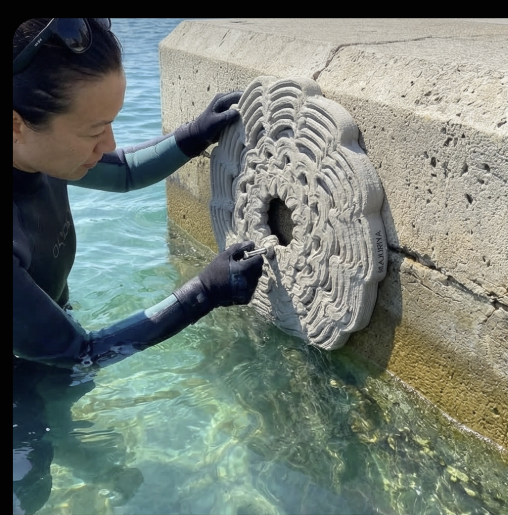
Re-Coral: locally printable, deployable 3D printed habitat system for the restoration of sea walls
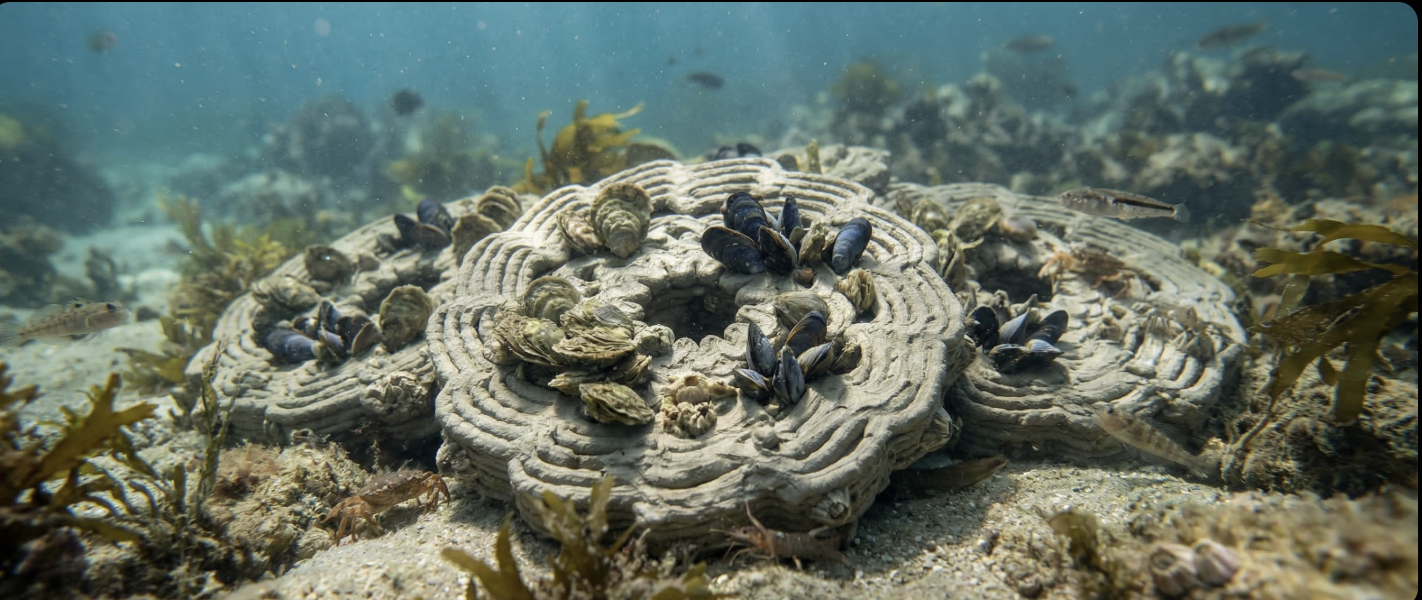
ReCoral is a locally printable, deployable 3D habitat system that emulates the ecological role of reef-forming organisms: creating shelter, settlement surfaces, and flow-buffered microhabitats that increase biodiversity in stressed marine sites like sea walls. Our startegy to combine robotics and biomaterials makes us unique, as ReCoral is formulated to avoid introducing foreign synthetics into marine habitats, using marine-compatible materials such as calcium carbonate, alginate, and cellulose.
France
Local
MARSEILLE / FRENCH RIVIERA
Mainly urban
It involves a physical transformation of the built environment (hard investment)
Prototype level
No
No
No
Organisation
ReCoral is a modular product line across three deployment bands (so MPAs, ports, and field stations can choose what fits their site and logistics): 1) Intertidal / Harbor edges (0–2 m), 2) Tidepool Cathedral Tiles: wall-mounted panels with recessed basins + shaded overhangs to retain moisture and provide refuge, 3) Shallow subtidal / kelp fringe (5–15 m) (primary target band), 4) Holdfast Halo: stable bases on sand/low-relief rock that create boulder-field-like crevices and nursery structures, 5) Vortex Porch Pods: flow-shaped pockets that promote calm micro-eddies and protected settlement zones. Most “reef restoration prints” sell shape. ReCoral sells function + evidence. Our design is behavior-driven: Flow pockets (larval / propagule retention zones), Shelter gradients (microcrevices sized for different life stages), Shade + microclimate (thermal refuge / low-shear areas). Every deployment is paired with a monitoring protocol, producing comparable data across sites and partners. Our target clients & use cases are Marine Protected Areas (MPAs): habitat enhancement and recruitment support in targeted zones, Fisheries / community co-management: nursery microhabitat and local biodiversity resilience, Field stations & universities: standardized experimental modules for restoration research, Restoration sites / coastal infrastructure owners: habitat retrofit (especially intertidal walls). Because we work as an incubator in robotics and bio materials most of our projects involve partnering with university of government lead grants, and in our case the goal is to make our research accesible to all public. ReCoral is built to be printed locally (labs, fabrication partners, field stations), reducing shipping and enabling site-specific geometry libraries. Partners can: 1) Select a module family suited to depth/exposure, 2) Print from validated material recipes,3) Deploy with a simple mounting/anchoring approach,4) monitor using the standardized kit, 5) Report outcomes.
Re-Coral started as a circular bio-architecture initiative to regenerate Bretagne’s coastal ecosystems by transforming oyster shells and algae into 3D printed reef structures. Inspired by coral biomimicry, the prototypes function as both ecological habitats and cultural landmarks, restoring biodiversity while making regeneration visible and engaging. Embedded sensors track salinity, ph, and ecosystem health, enabling adaptive design.
The project embraces New European Bauhaus values: sustainability ( upcycling aquaculture waste, low carbon prefabrication), beauty ( reef inspired computational design, biodiversity recovery as a visible process) , and inclusion (co-design with oyster farmers, artists, schools, and communities, digital twins for accessibility and education). Re-coral build on Majuriya Start Up award-wining Re-Pollen project, which designed pollinator towers for urban biodiversity in Vienna. Extending from land to sea , it addresses the urgent challenges of deciding marine life and the cultural heritage of oyster farming in Bretagne, where shell waste often becomes a landfill. Today, we continue our work in the French Riviera area, and Marseille, as there has been municipal initiatives, welcoming the restoration of sea walls, and under ocean at risk areas. Re-coral closes the loop of turning waste into a living infrastructure, by strengthening blue tourism, local action, and reconnecting communities with their maritime identity. Designed to be replicated along the Atlantic Coast, our sea wall 3d printed tiles offer scalable models for circular and regenerative architecture that unites ecology, culture, and education.
The project embraces New European Bauhaus values: sustainability ( upcycling aquaculture waste, low carbon prefabrication), beauty ( reef inspired computational design, biodiversity recovery as a visible process) , and inclusion (co-design with oyster farmers, artists, schools, and communities, digital twins for accessibility and education). Re-coral build on Majuriya Start Up award-wining Re-Pollen project, which designed pollinator towers for urban biodiversity in Vienna. Extending from land to sea , it addresses the urgent challenges of deciding marine life and the cultural heritage of oyster farming in Bretagne, where shell waste often becomes a landfill. Today, we continue our work in the French Riviera area, and Marseille, as there has been municipal initiatives, welcoming the restoration of sea walls, and under ocean at risk areas. Re-coral closes the loop of turning waste into a living infrastructure, by strengthening blue tourism, local action, and reconnecting communities with their maritime identity. Designed to be replicated along the Atlantic Coast, our sea wall 3d printed tiles offer scalable models for circular and regenerative architecture that unites ecology, culture, and education.
Restoration
Adaptable
Biodiversity
Modular
Biomaterials
ReCoral is formulated to avoid introducing foreign synthetics into marine habitats, using marine-compatible materials such as calcium carbonate, alginate, and cellulose. Calcium carbonate provides a familiar mineral cue;alginate/cellulose act as temporary binders and micro texture carriers (no plastic, no epoxies). ReCoral intertidal tiles create tidepool microhabitats designed to multiply biodiversity presence using ocean-native mineral/biopolymer ingredients. Users can print locally, deploy at a specific site, and generate measurable ecological data (species counts, cover %, recruitment, occupancy), turning every deployment into a monitored restoration micro-pilot.
Most “reef restoration prints” sell shape. ReCoral sells function + evidence. Our design is behavior-driven: Flow pockets (larval / propagule retention zones), shelter gradients (microcrevices sized for different life stages), shade + microclimate (thermal refuge / low-shear areas).
The sustainability of our product is more than just embedded in the product itself but it is measurable. Every deployment is paired with a monitoring protocol, producing comparable data across sites and partners.
Transforming oyster shells, a material rooted in the marine environments, into reef structures, ReCoral turns aquaculture waste into living heritage. The reef tiles merge traditional knowledge, biomimicry, and computational design, embodying a new form of coastal architecture. As both habitats and coastal landmarks, they make biodiversity recovery and restoration visible and participitatory, celebrating the coastal landscape as both ecological and social heritage. By taking inspiration from natural coral and organic shapes found already, the reef tile’s beauty lies in both their sculptural design and sensory experience of biodiversity returning to starved areas. Communities can witness regeneration in real time. By choosing to blend into the natural world the aesthetics of our tile appreciate and uplift the natural beauty of our oceans and marine life.
Reef restoration has historically been the domain of well-funded institutions deploying expensive dive teams, proprietary materials, and research locked behind paywalls. ReCoral was designed to dismantle that model entirely. Because ReCoral is locally printable from open, validated material recipes, there is no barrier to participate. A coastal community in Marseille, a marine biology class in Barcelona, a sustainably passionate 3D printing company in Greece, none of them need to wait for an external institution to arrive with equipment and expertise. They can print, deploy, and monitor with tools and knowledge that belong to them. The monitoring protocol matters here too. By standardizing how impact is measured, species counts, percent cover, and crevice occupancy. ReCoral gives non-specialist communities the same language and credibility as university research teams. A co-managed fishery reporting a 30% increase in recruitment isn’t just a local anecdote; it becomes a data point in a shared, comparable dataset. That’s inclusion through legitimacy, not just access. Inclusion, for ReCoral, isn’t an add-on value. It’s the distribution model. Restoration that can only happen where money concentrates is restoration that will always fall short of the scale the ocean actually needs.
ReCoral is participatory at its core. Local communities,artists, and schools are involved in the design and deployment of our tiles. Employment and training opportunities are created for local workers to physically and/or digitally access our tiles. Our deployment model and “print your own” experience is built to be printed locally (labs, fabrication partners, field stations), reducing shipping and enabling site-specific geometry libraries. Partners can:
1- Select a module family suited to depth/exposure
2- Print from validated material recipes
3- Deploy with a simple mounting/anchoring approach
4- Monitor using the standardized kit
5- Report outcomes into a shared dataset (comparability is the product)
1- Select a module family suited to depth/exposure
2- Print from validated material recipes
3- Deploy with a simple mounting/anchoring approach
4- Monitor using the standardized kit
5- Report outcomes into a shared dataset (comparability is the product)
When you invest in ReCoral, you’re funding a restoration platform—not a single object. Partners can print locally, deploy modules at a targeted site, and collect measurable ecological data to evaluate impact. ReCoral is formulated to avoid introducing foreign synthetics into marine habitats, using marine-compatible materials such as calcium carbonate, alginate, and cellulose. Each deployment is paired with a simple monitoring kit (photoquadrats, settlement tiles, and standardized biodiversity counts) to quantify outcomes, with a goal of achieving an increase in local species presence compared to nearby control surfaces, depending on site conditions and deployment duration. We are adaptable to target at varying levels: Marine Protected Areas (MPAs): habitat enhancement and recruitment support in targeted zones. Fisheries / community co-management: nursery microhabitat and local biodiversity resilience. Field stations & universities: standardized experimental modules for restoration research. Restoration sites / coastal infrastructure owners: habitat retrofit (especially intertidal walls)
The “measurement kit”
- Control vs. ReCoral: 3 control points within 5–20 m (same depth/aspect)
- Metrics (choose 3): 1. Species richness (count of taxa), 2. Abundance/occupancy (individuals per module, or % crevice occupancy), 3.Percent cover (photoquadrat classification: algae/inverts/bare)
- Timing: baseline, 2 weeks, 1 month, 3 months, 6 months (or match your pilot length)
Biomaterial engineering, environmental sciences and restoration, computational design, 3D printing, architecture, visual art
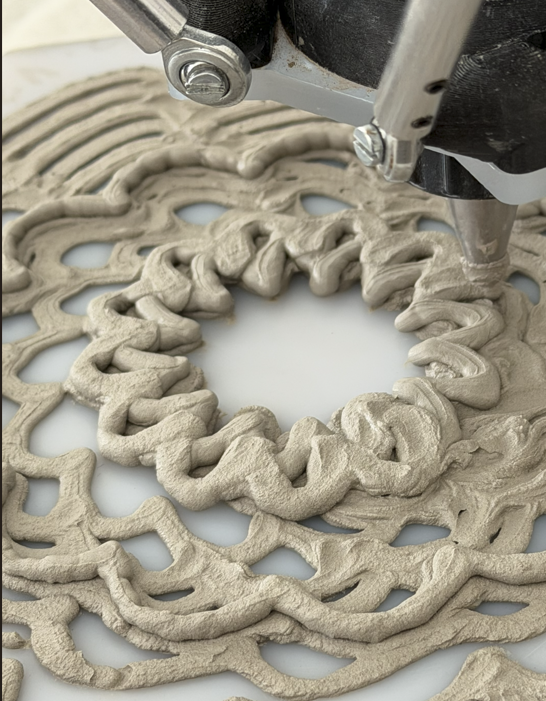
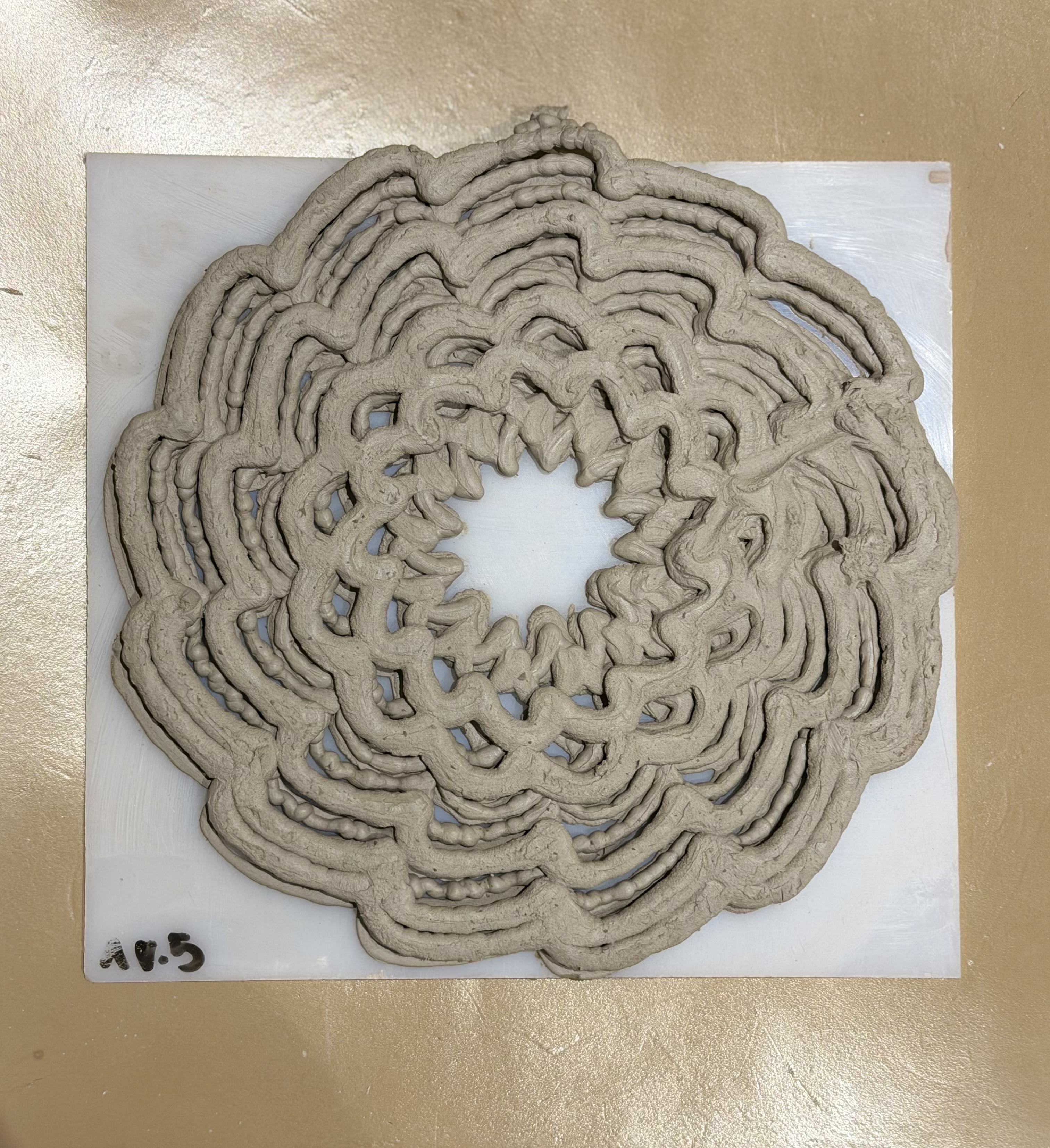
Digitalisation of ReCoral is embedded in the computational design that is based on the growth algorithms for marine biodiversity and informs the tile’s geometry. ReCoral integrates architecture, marine ecology, computational design, and cultural knowledge and is replicable across communities globally. Post installation measurement aids our environmental analysis discipline, by allowing us to gather data, measure impact, and achieve real change. Computers following our generated code controls the 3D printing parameters, directing the machine to precisely extrude and shape reef tiles.Once printed and cured, tile modules can be transported and assembled on site by specialists, creating visually aesthetic, modular, and eco-friendly marine habitat restoration tiles.
Digitalisation of ReCoral is embedded in the computational design that is based on the growth algorithms for marine biodiversity and informs the tile’s geometry. ReCoral integrates architecture, marine ecology, computational design, and cultural knowledge and is replicable across communities globally. Post installation measurement aids our environmental analysis discipline, by allowing us to gather data, measure impact, and achieve real change. Computers following our generated code controls the 3D printing parameters, directing the machine to precisely extrude and shape reef tiles.Once printed and cured, tile modules can be transported and assembled on site by specialists, creating visually aesthetic, modular, and eco-friendly marine habitat restoration tiles.
The concept is based on a hybrid business model combining product sales, public funding, and service-based revenue. Its core offer is the design, fabrication, and deployment of modular bio-based tiles for sea walls and coastal infrastructure, using recycled oyster shells and marine-compatible materials. These tiles can be sold to municipalities, ports, marinas, environmental agencies, and waterfront developers seeking nature-based solutions for biodiversity enhancement and climate adaptation.
In the early stages, the concept would rely on grants, pilot funding, and public innovation support to finance testing, validation, and first installations. Over time, financial sustainability would grow through a mix of tile sales, installation contracts, ecological monitoring services, and impact reporting, especially where clients need measurable environmental results. The project also has potential for licensing local production methods and material recipes to regional partners, as well as generating complementary income through workshops, educational programming, and cultural collaborations.
This diversified model makes the concept financially sustainable by combining circular material production, recurring service revenue, and public-interest funding within the growing field of regenerative coastal infrastructure.
In the long term, the concept becomes financially sustainable by operating as a blended enterprise:
(1) selling modular ecological tiles and installation packages,
(2) offering monitoring and impact-reporting services,
(3) securing public or philanthropic support for pilots and R&D,
(4) licensing production systems to regional partners, and
(5) running educational and public-facing programs that reinforce visibility and partnerships.
The ocean doesn’t have borders, but reef degradation does have patterns, and those patterns repeat. Sedimentation pressure in California looks different from urban runoff in the Mediterranean, but the missing microhabitat is the same: no crevice, no shade, no calm pocket for larvae to settle. ReCoral’s geometry responds to function, not geography, which means the module library travels.
What transfers isn’t just a tile. It’s a complete methodology. Our material recipes are validated for local sourcing, print parameters are tuned for accessible clay extrusion hardware, and our monitoring protocol produces comparable data regardless of who runs it. A field station in Chile, a harbor authority in Marseille, a university lab in Cape Town, each can adapt the geometry library to a fitting modular design for their space and their substrate conditions without rebuilding the system from scratch.
Extending beyond intertidal/harbor marine restoration, the underlying logic is printable, place-specific habitat infrastructure paired with standardized ecological monitoring. These design aspects apply to freshwater systems, urban green infrastructure, and shallow subtitles and even deeper subtidal retrofitting. The methodology is the replicable asset. The tile is just where we start.
The next twelve months are about turning pilots into proof.
Our immediate priority is completing the material and geometrical validation for ocean deployment. This means finalizing our calcium carbonate and alginate formulations and the geometry to survive submersion, biofouling cycles, and mechanical stressors that seawalls face. Alongside material testing, we are building a geometry library to test and edit geometries to implement. Which will then become a set of downloadable, print-ready module files organized by deployment band and substrate type. This library will detail print parameters, material ratios, and the standardized monitoring kit protocol, so any partner can begin a pilot without waiting for us to be physically present.
We are actively pursuing partnerships with research lab spaces to be the body for us to run the first co-monitored deployments, generating comparative datasets that makes every future installation more credible than the last. By month twelve, we are aiming to achieve at least three independent deployments, in at least two geographies, producing data. At that point ReCoral stops being a promising prototype and becomes a platform for marine restoration.