Enhancing Circularity, Sustainability, and Innovation
Signal Garden
Signal Garden Tower – Turning urban radio waves into water, movement and urban biodiversity
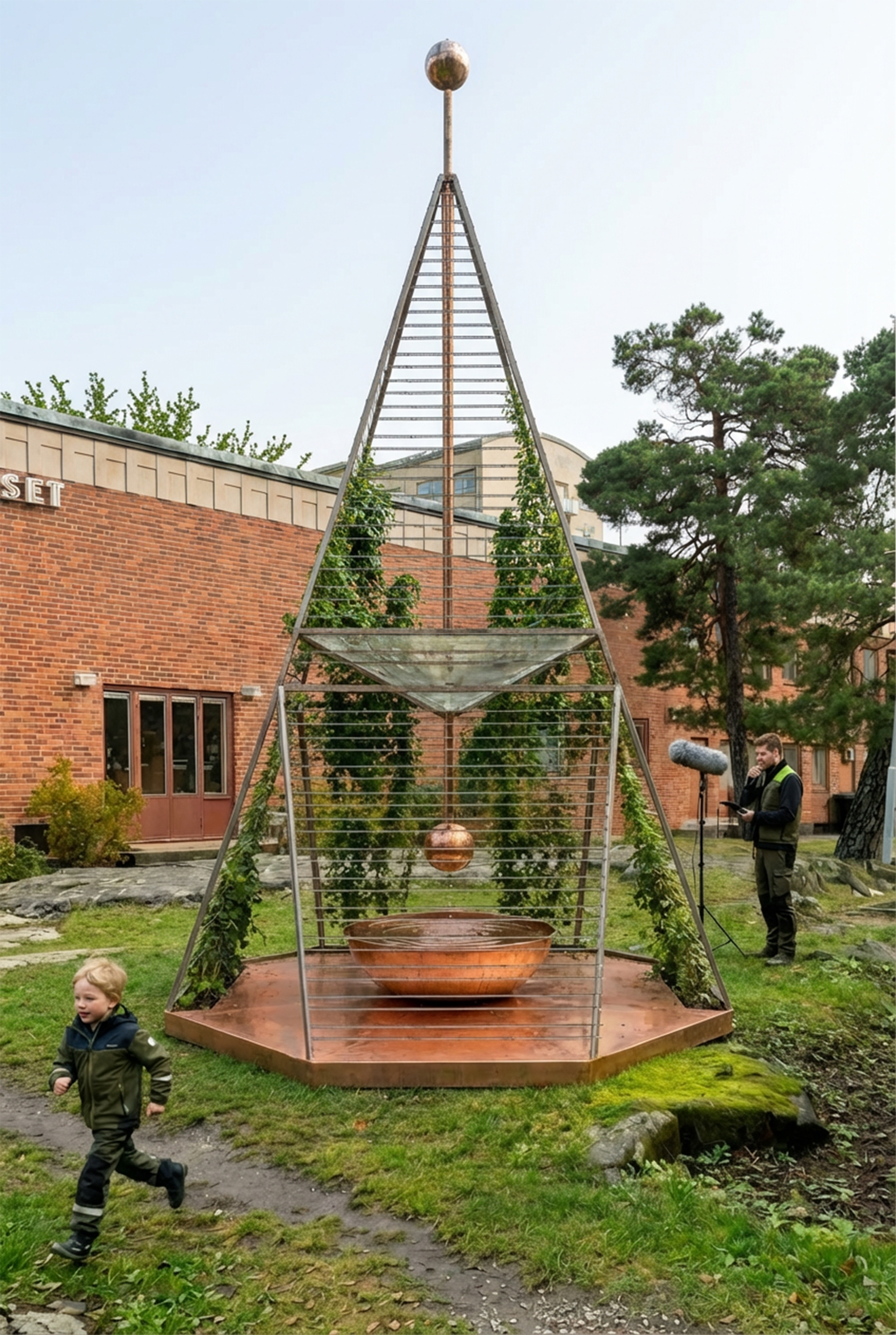
Signal Garden Tower transforms invisible radio and mobile signals into ecological processes. Reused antenna towers harvest and store rainwater, activating a vibrating system that moves water through the structure, nourishing climbing plants and supporting urban biodiversity. The tower invites visitors to climb, observe, and interact with natural phenomena, turning electromagnetic signals into visible and tactile environmental experiences—creating a playful and resilient urban ecosystem.
Sweden
National
Mainly urban
It involves a physical transformation of the built environment (hard investment)
Prototype level
No
No
Yes
Individual
Signal Garden Tower transforms invisible radio and mobile signals into ecological and spatial processes. The project reimagines existing communication infrastructure as a living urban ecosystem where technology, water, vegetation, and human interaction converge.
Constructed from reused antenna tower structures, the installation harvests and stores rainwater within a basin and vertical water system integrated into the tower. When radio or mobile signals interact with the structure, subtle vibrations activate a mechanism that sets the collected water in motion. Water moves through the tower, creating droplets and waves that distribute moisture along the structure and nourish climbing vegetation.
The tower functions simultaneously as ecological infrastructure, public space, and educational environment. The horizontal metal elements support climbing plants while also forming a framework that allows visitors—especially children—to climb, explore, and experience natural phenomena directly. Through visible water movement, plant growth, and vibration, invisible urban signals become tangible environmental processes.
By integrating rainwater harvesting, biodiversity support, and the reuse of obsolete infrastructure, the project contributes to circular and regenerative urban design. The tower creates microhabitats for plants and insects while improving urban resilience through small-scale water management.
Beyond its local impact, the concept is conceived as a replicable prototype that can transform redundant communication structures into ecological public spaces. By translating invisible technological flows into water, movement, and plant life, Signal Garden Tower demonstrates how contemporary infrastructure can become a catalyst for sustainable, inclusive, and beautiful urban environments.
The idea for Signal Garden Tower emerged from reflecting on the invisible technological landscapes that surround contemporary cities. Urban environments are constantly filled with electromagnetic signals from communication networks, yet these infrastructures are typically hidden, inaccessible, and disconnected from everyday urban life.
The project began with a question: Could these invisible flows of energy be translated into ecological processes and public experiences? By combining research into plant responses to vibration, water cycles, and adaptive reuse of infrastructure, the concept evolved into a hybrid structure where signals, water, and vegetation interact.
The design process explored how obsolete antenna structures could be reused as frameworks for ecological systems rather than demolished. The tower structure provides a lightweight scaffold that supports climbing plants, rainwater collection, and a simple vibration mechanism. These elements allow electromagnetic signals to trigger subtle movement within the water system, transforming digital signals into visible environmental processes.
The project was developed through iterative conceptual design, ecological research, and exploration of nature-based urban solutions. Inspiration was also drawn from atmospheric water harvesting systems such as mist catchers, which transform environmental conditions into water resources.
Signal Garden Tower ultimately proposes a new way of understanding urban infrastructure: not as isolated technical systems, but as shared ecological and social spaces. By making invisible signals perceptible through water, plants, and movement, the project invites citizens to engage with the environmental processes shaping their cities.
posthumanist perspective
Water resilience
Circular infrastructure reuse
Urban biodiversity
Interactive public space
Signal Garden Tower addresses environmental challenges by transforming existing communication infrastructure into a regenerative ecological system. Instead of constructing new structures, the concept reuses antenna towers as a lightweight framework for vegetation, water collection, and public interaction. This circular reuse reduces material consumption while extending the life of existing infrastructures.
The tower integrates rainwater harvesting and redistribution, allowing collected water to move through the structure and nourish climbing plants. This supports urban biodiversity by creating microhabitats for insects, birds, and vegetation while contributing to local water resilience. Through nature-based solutions, the project restores small-scale ecological processes within dense urban environments.
The concept also adopts a posthuman design perspective that recognises cities as shared habitats for humans and other species. Rather than focusing solely on human needs, the tower creates spatial and ecological conditions that benefit multiple forms of life. Plants, insects, birds, and microorganisms become active participants in shaping the evolving ecosystem of the structure.
In addition, the project is conceived as a replicable prototype that can transform redundant communication infrastructures into distributed ecological nodes across cities. By combining circular reuse, water-sensitive design, and biodiversity support, Signal Garden Tower demonstrates how urban infrastructures can be reimagined as regenerative systems that contribute to long-term environmental resilience.
Signal Garden Tower explores how invisible urban phenomena—radio signals, vibrations, and water movement—can be translated into sensory spatial experiences. Through subtle vibrations activated by surrounding signals, water begins to move through the structure, producing droplets, ripples, and gentle sounds. These elements create a dynamic and atmospheric environment where technology and nature become perceptible through movement, sound, and light.
The project draws inspiration from biophilic design principles, recognising that human wellbeing improves when people are exposed to natural processes such as flowing water, vegetation, and rhythmic patterns. The tower therefore creates a calming environment where visitors can slow down, observe, and reconnect with natural cycles within the city.
The tower also carries a symbolic dimension. Historically, radio towers functioned as infrastructures of communication, transmitting signals across distance. In this project, the tower becomes a new type of signal—one that communicates the need for ecological awareness and a renewed relationship between technology and the living world. Instead of broadcasting information through electromagnetic waves alone, the structure communicates through water, plants, movement, and shared sensory experience.
Over time, the tower evolves as vegetation grows and seasonal changes shape its appearance. This living transformation strengthens people’s sense of belonging and care for the place, turning technological infrastructure into a poetic and meaningful element within the urban landscape.
Signal Garden Tower promotes inclusion by creating an open and accessible public structure where people of different ages and backgrounds can engage with environmental processes. The tower functions as an interactive landscape that invites visitors to climb, observe, and explore the relationship between water, plants, and urban infrastructures.
The design encourages intergenerational interaction. Children can discover natural phenomena through play and exploration, while adults can experience moments of calm and reflection within a living ecological environment. By making invisible urban systems visible and understandable, the project also acts as an educational platform that fosters environmental awareness and shared responsibility for urban ecosystems.
Affordability and accessibility are addressed through the reuse of existing infrastructure and the use of simple, low-tech systems for water collection and distribution. This approach reduces construction costs and allows the concept to be implemented in different urban contexts without requiring complex technological solutions.
From a broader societal perspective, the project promotes a more inclusive understanding of urban space by recognising cities as shared environments for humans and other species. By creating habitats for plants, insects, and birds alongside human activity, Signal Garden Tower supports a more balanced and collaborative relationship between people, technology, and the living world.
Signal Garden Tower is conceived as a participatory public environment where citizens can directly engage with ecological and technological processes. The structure invites visitors to climb, observe, and interact with the movement of water, vegetation, and vibration, transforming passive spectators into active participants in the evolving ecosystem of the tower.
Particular attention is given to younger generations who grow up surrounded by digital devices and invisible communication networks. The project creates a space where these everyday technologies—such as mobile signals—can indirectly interact with the environment through vibration and water movement. By translating invisible signals into tangible environmental experiences, the tower encourages curiosity, exploration, and environmental awareness.
The concept also responds to a growing sentiment among younger generations that the environmental crisis often lacks a clear and shared voice within society. Many young people experience a tension between living in highly technological environments and recognising the ecological consequences of human activity. Signal Garden Tower therefore proposes a space that questions a purely anthropocentric perspective on cities and instead frames the urban environment as a shared habitat between humans, technology, and other living species.
In this sense, the tower becomes a new type of signal in the city. Rather than transmitting information alone, it communicates environmental processes through water, plants, and sensory experiences. The project invites citizens to reflect collectively on the relationship between technology, nature, and the future of urban life.
Future development will involve collaborations with local communities, schools, and environmental organisations through workshops and educational activities, ensuring that the project continues to evolve through public engagement and shared knowledge.
Signal Garden Tower is conceived as a collaborative project that can involve stakeholders across multiple levels of governance. At the local level, municipalities, urban planners, schools, and community organisations can participate in identifying suitable locations and integrating the tower into public spaces such as parks, squares, or educational environments.
Environmental organisations and biodiversity initiatives can contribute knowledge on urban ecosystems, plant selection, and habitat creation. Their involvement can help ensure that the project supports local biodiversity and ecological resilience.
At the regional and national levels, the project aligns with broader policies related to climate adaptation, water resilience, and sustainable urban development. Public agencies responsible for urban infrastructure, environmental management, and cultural initiatives could support the implementation of pilot installations.
At the European level, the concept reflects the ambitions of the New European Bauhaus and the European Green Deal by combining sustainability, aesthetics, and inclusion within a replicable urban prototype. Collaboration with European research networks, universities, and design institutions could support knowledge exchange and the scaling of the concept across different cities.
The involvement of stakeholders across these different levels strengthens the project’s capacity to become a widely adaptable model for ecological and inclusive public infrastructure.
Signal Garden Tower emerges from a transdisciplinary approach that brings together architecture, ecological design, environmental sciences, digital technologies, and artistic practices. The architectural framework provides the spatial structure that supports vegetation, water systems, and public interaction.
Environmental sciences inform the integration of nature-based solutions such as rainwater harvesting, urban biodiversity support, and the creation of microhabitats for plants and insects. Knowledge from ecological research also guides the selection of vegetation and the development of resilient urban ecosystems.
The project also engages with fields such as acoustics and vibration research, exploring how sound waves and subtle vibrations can influence both plant behaviour and human perception. These elements contribute to the sensory and atmospheric qualities of the installation.
Artistic and cultural perspectives play an important role in translating invisible infrastructures—such as electromagnetic signals—into tangible experiences through movement, water, and sound. Finally, digital technologies and communication infrastructures are reinterpreted as ecological interfaces that connect urban systems with natural processes.
By combining these different fields of knowledge, the project demonstrates how collaborative and cross-disciplinary design can generate innovative solutions for sustainable and inclusive urban environments.
Signal Garden Tower is conceived as a public ecological infrastructure that can be implemented through a combination of public investment, research collaboration, and private partnerships. The first prototype is envisioned next to Hägerstensåsens Medborgarhus in Stockholm, a civic building historically dedicated to public dialogue, cultural exchange, and community activities. Locating the tower in this context strengthens its role as a shared public space where environmental awareness, technology, and social interaction intersect.
The initial development phase could be supported through public funding mechanisms related to urban innovation, environmental design, or cultural infrastructure. Municipal investment from the City of Stockholm would enable the construction of a pilot installation integrated into public space. As the concept explores the interaction between telecommunications signals, vibration, and ecological systems, collaboration with research institutions such as KTH Royal Institute of Technology and design schools such as Konstfack could further develop the project as a research platform investigating the relationship between technology, plants, and urban environments.
Private-sector partnerships could also contribute to the project’s financial sustainability. Telecommunications companies may find value in supporting an initiative that reinterprets communication infrastructure in a socially and environmentally responsible way. Such collaborations could combine innovation funding, sponsorship, and corporate social responsibility initiatives.
Over time, the concept could evolve into a scalable model for ecological public installations that combine infrastructure reuse, biodiversity support, and educational public engagement. Cities, cultural institutions, and environmental organisations could commission new towers adapted to local contexts, creating a distributed network of interactive ecological infrastructures across urban environments.
Signal Garden Tower is conceived as a replicable prototype that can be adapted to different urban contexts. The core elements of the concept—reuse of communication infrastructure, rainwater harvesting, vegetation support, and interactive environmental processes—can be implemented in multiple forms and scales.
One key replicable aspect is the reuse of obsolete or underused telecommunications structures. Many cities contain redundant antenna towers or communication infrastructures that could be repurposed as ecological public installations rather than dismantled. By transforming these structures into frameworks for vegetation and water systems, cities can create new public spaces while reducing material waste.
The idea is inspired by industrial landscapes such as the harbour of Gothenburg, where large cranes have become cultural landmarks and urban ornaments that reflect the city’s history and identity. Although they once served industrial functions, they are now recognised as symbols of a particular moment in the city’s development. In a similar way, radio towers can be understood as time capsules of the communication era. By reinterpreting them as ecological infrastructures and public spaces, the project transforms technological relics into meaningful urban elements that communicate the values of a new environmental transition.
The project can be adapted to different spatial conditions. Towers could be installed near civic centres, public squares, parks, or educational campuses. For example, a pilot installation could be developed near Hägerstensåsens Medborgarhus in Stockholm, while future iterations might be placed in prominent public spaces such as Sergels Torg or in urban parks.
Through this adaptability, Signal Garden Tower can evolve into a network of ecological infrastructures embedded within cities, demonstrating how technological landscapes can be reimagined as spaces for biodiversity, reflection, and collective environmental awareness.
The next phase of Signal Garden Tower focuses on transforming the concept from a master’s project developed at Konstfack University of Arts, Crafts and Design into a research-based prototype.
During the first year following the application, the primary objective is to develop partnerships with local institutions and research environments in Stockholm. Dialogue with Hägerstensåsens Medborgarhus and local community organisations will explore the possibility of hosting the first pilot installation. This phase will focus on understanding local needs and integrating the tower within the social and spatial context of the civic centre.
At the same time, collaboration with academic partners such as Konstfack and KTH Royal Institute of Technology could support further research into the ecological and technological aspects of the project. This includes investigating the effects of vibration on plants, developing the rainwater system, and refining the structural design.
The development phase will also include technical feasibility studies, prototype testing, and the preparation of visual and architectural documentation required for potential funding applications. The project will seek support from public cultural funds, urban innovation programmes, and potential private partners such as telecommunications companies interested in sustainable infrastructure initiatives.
By the end of the first year, the goal is to have established partnerships, refined the technical concept, and prepared the necessary groundwork to realise a full-scale pilot installation in Stockholm.