Arrobitxulo
Arrobitxulo: Usurbil Community Hub (Elkargunea)
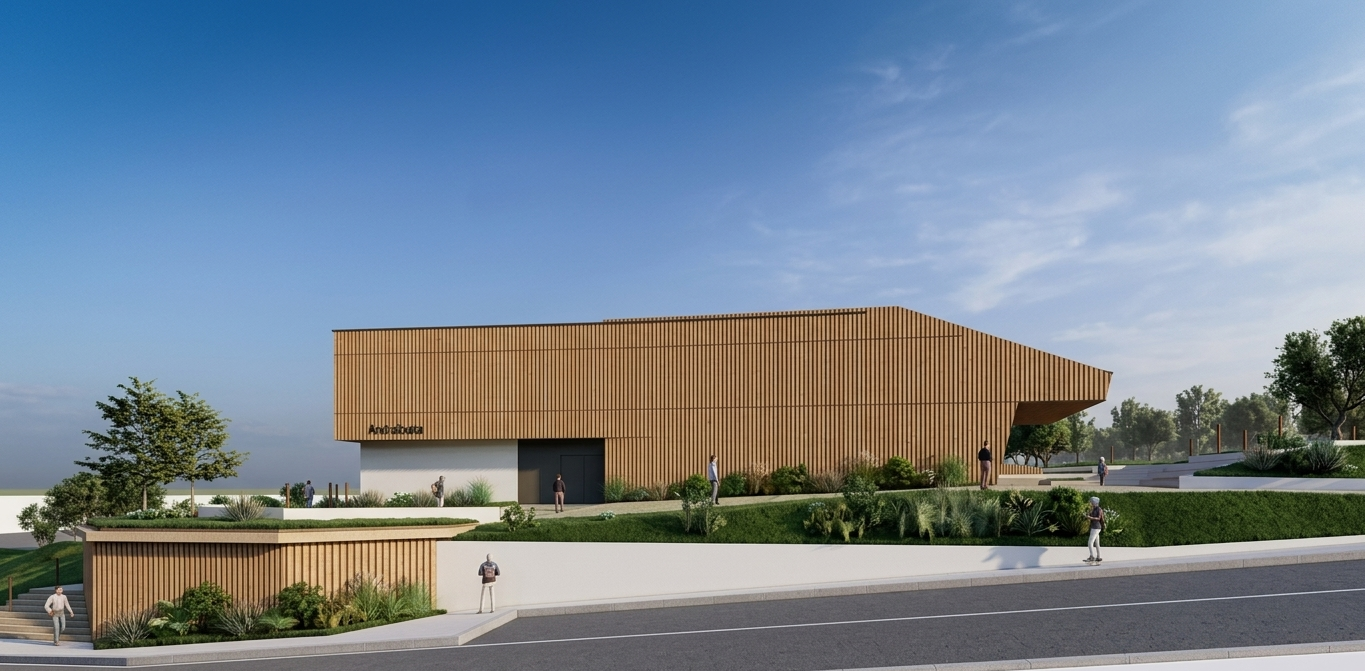
Arrobitxulo is Usurbil's new Community Hub, co-created with its youth to break the mold of traditional civic centers. Driven by eco-feminism, inclusion, and Basque culture, it features innovative areas like a 'messy zone', digital and sound labs, and mirrored rooms. This sustainable, hybrid building opens completely to a dynamic outdoor plaza, tearing down social and physical barriers. It empowers the community to self-manage a creative, safe, and intergenerational meeting space.
Spain
{Empty}
Prototype level
Yes
Yes
Yes
No
No
20073: Usurbil (ES)
Arrobitxulo stands as the new community, youth, and creative heart of Usurbil. This initiative represents a radical shift from traditional civic centers, focusing on a bottom-up approach where creativity and culture become the catalysts for revitalizing local social dynamics. The overall aim is to provide a self-managed, inclusive, and safe encounter space where the community, particularly adolescents (12-17) and youth (18-30), are empowered as active citizens. The project fulfills specific objectives: constructing a bioclimatic building that fuses seamlessly with its green environment through organic volumes; establishing specialized, innovative functional zones such as the 'messy zone' (plastic arts), 'sound spaces' for new bands, and a digital laboratory; and implementing a public-community governance model based on 'autogestión'. Beyond its social role, Arrobitxulo acts as a technical catalyst for local decarbonization. By integrating a District Heating network, the building allows neighboring public facilities—including the Oiardo sports center (the town’s highest CO2 emitter) and Udarregi school—to replace aging gas boilers with clean aerothermal and solar energy. Expected outcomes by 2027 include the consolidation of a vibrant regional reference point for Basque cultural transmission and the significant reduction of municipal emissions. Arrobitxulo is not merely a facility but a regenerative intervention that creates new pedestrian connections and pedestrianized meeting spaces for the entire community. It targets those creators and youth who currently lack dedicated spaces, offering a flexible, polyvalent environment capable of adapting to future generations. This project ensures that Usurbil remains a social innovation leader through community-led infrastructure.
Co-creation
Self-management
Decarbonization
Youth Agency
Intergenerational
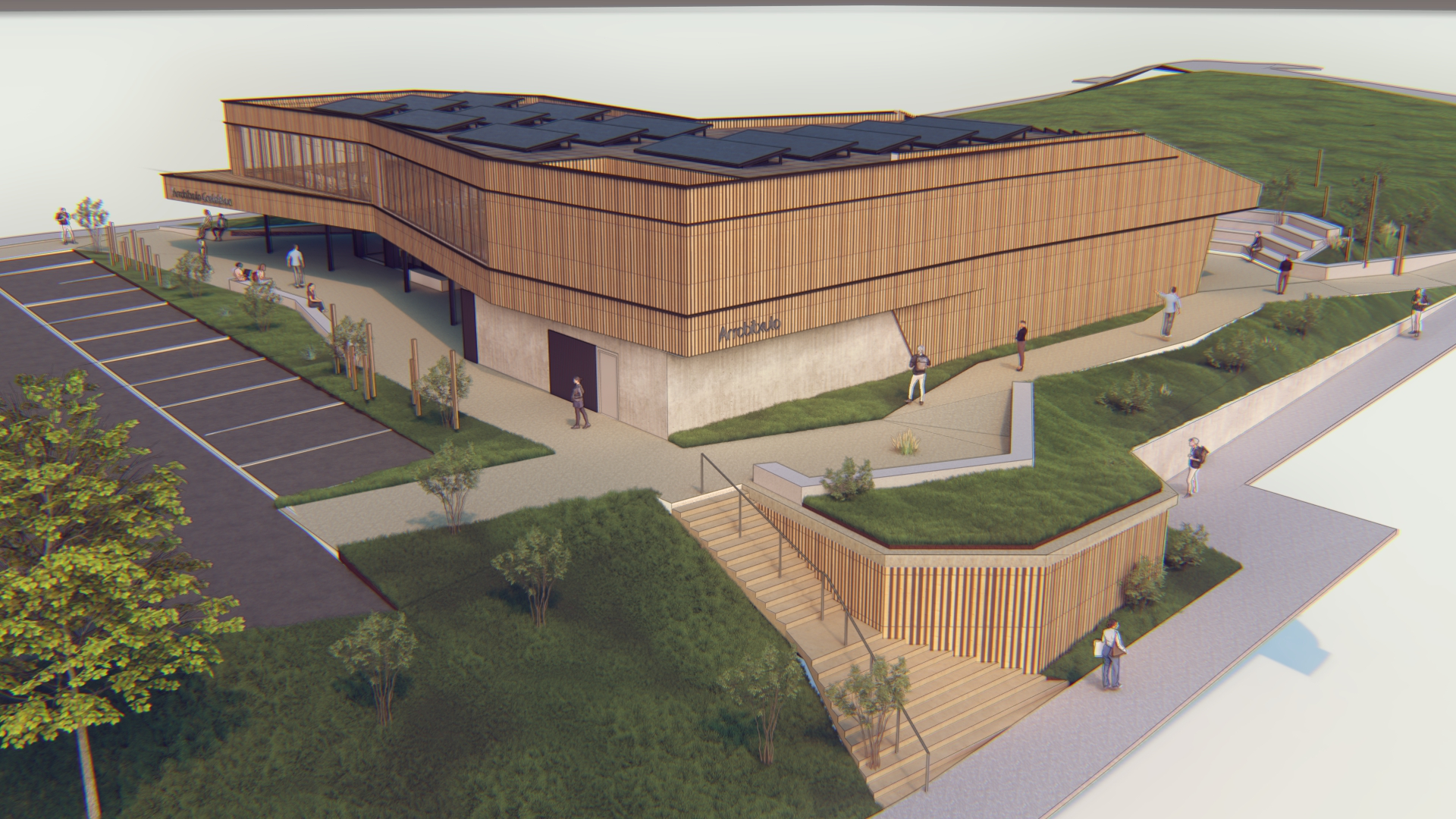
Arrobitxulo redefines sustainability by merging social architecture with municipal energy sovereignty. The primary objective is to achieve a nearly zero-energy building (NZEB) by utilizing high-efficiency criteria and renewable sources, specifically solar panels and aerothermal energy. However, Arrobitxulo’s exemplary nature lies in its role as a "catalyst for decarbonization" for the entire district. It integrates a District Heating and Cooling network that replaces fossil-fuel boilers in neighboring facilities: the Oiardo sports center—Usurbil’s highest CO2 emitter—and the Udarregi school. This synergy between aerothermal systems and photovoltaics ensures a massive environmental improvement for the municipal infrastructure.Beyond technical engineering, the design is a model of biodiversity integration; the building is situated on a green slope, using organic and permeable volumes to fuse with the hillside. This ensures that the park flows into the building and vice versa, regenerating the surrounding space while creating new sustainable pedestrian connections. Sustainability is not just an add-on but a foundational value defined in the project's decálogo, focusing on healthy relationships with the natural environment and sustainable production/consumption models. The project has demonstrated viability through completed energetic and life-cycle cost analysis for the district network. By combining high-tech decarbonization with biophilic integration, Arrobitxulo proves that a youth center can be the energy lung of a smart, sustainable community.
Arrobitxulo breaks the mold of the traditional civic center, prioritizing a dynamic cultural experience and sensory engagement over sterile institutional design.
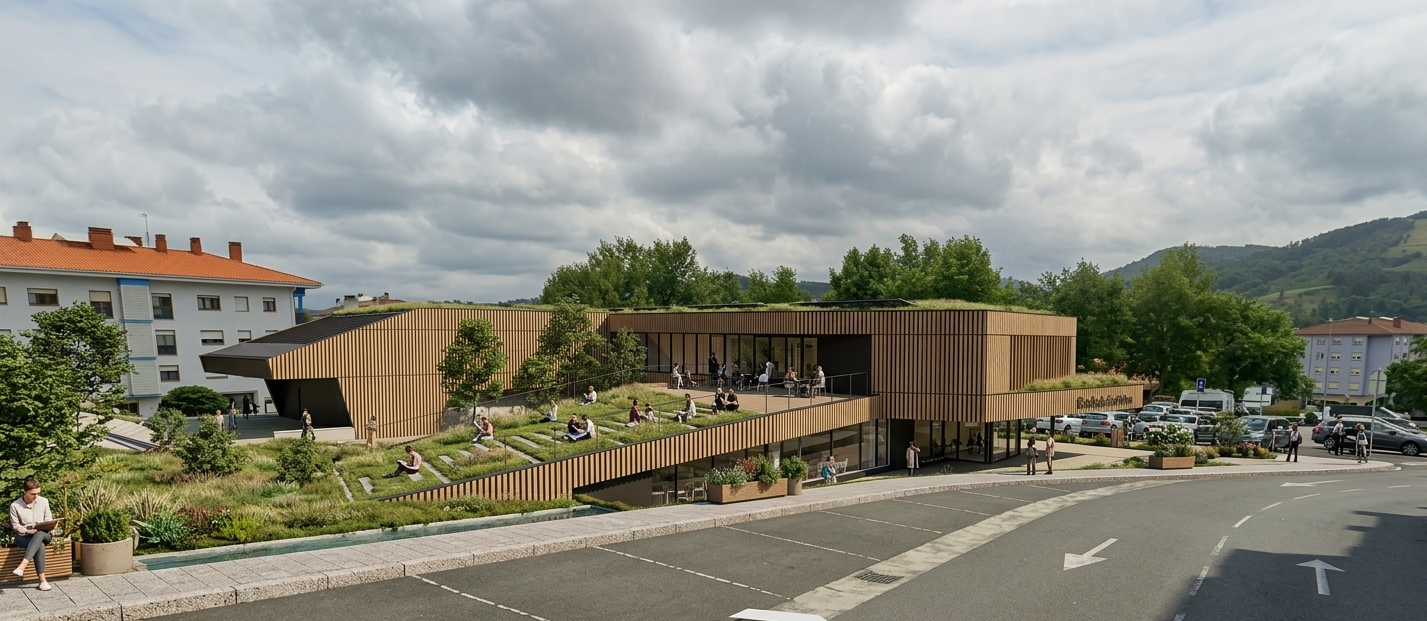
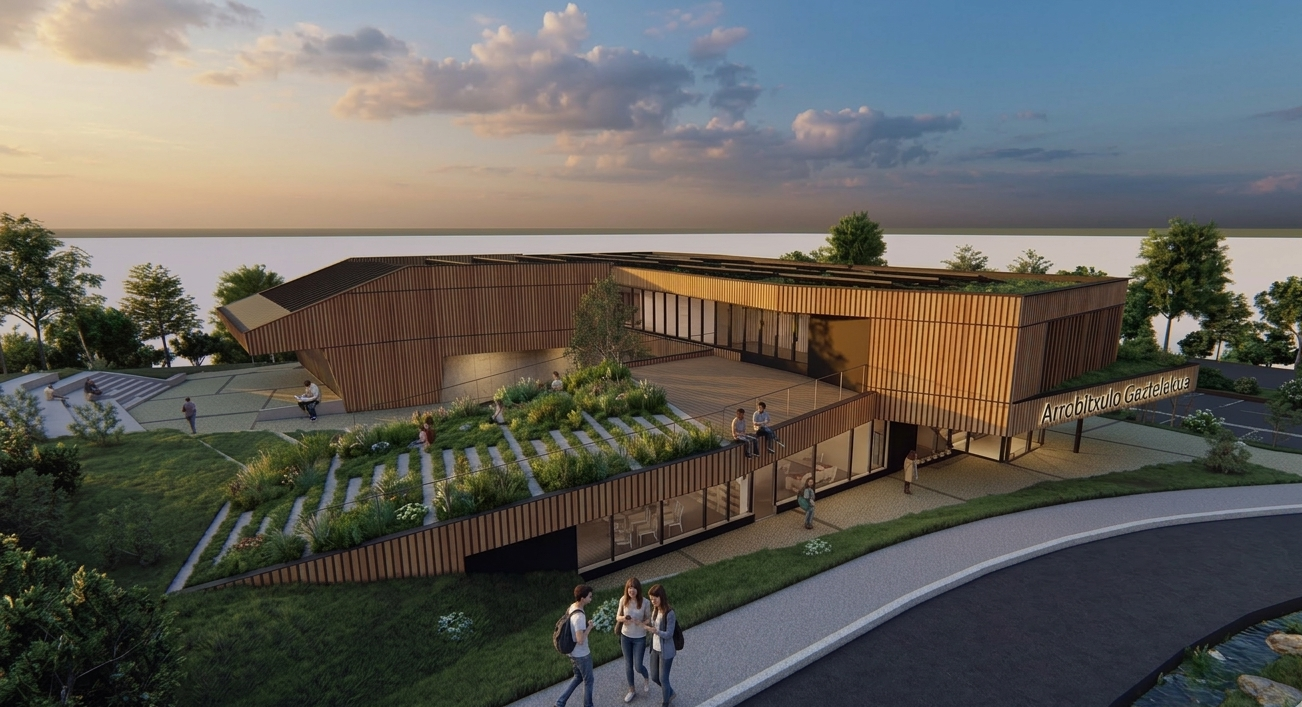
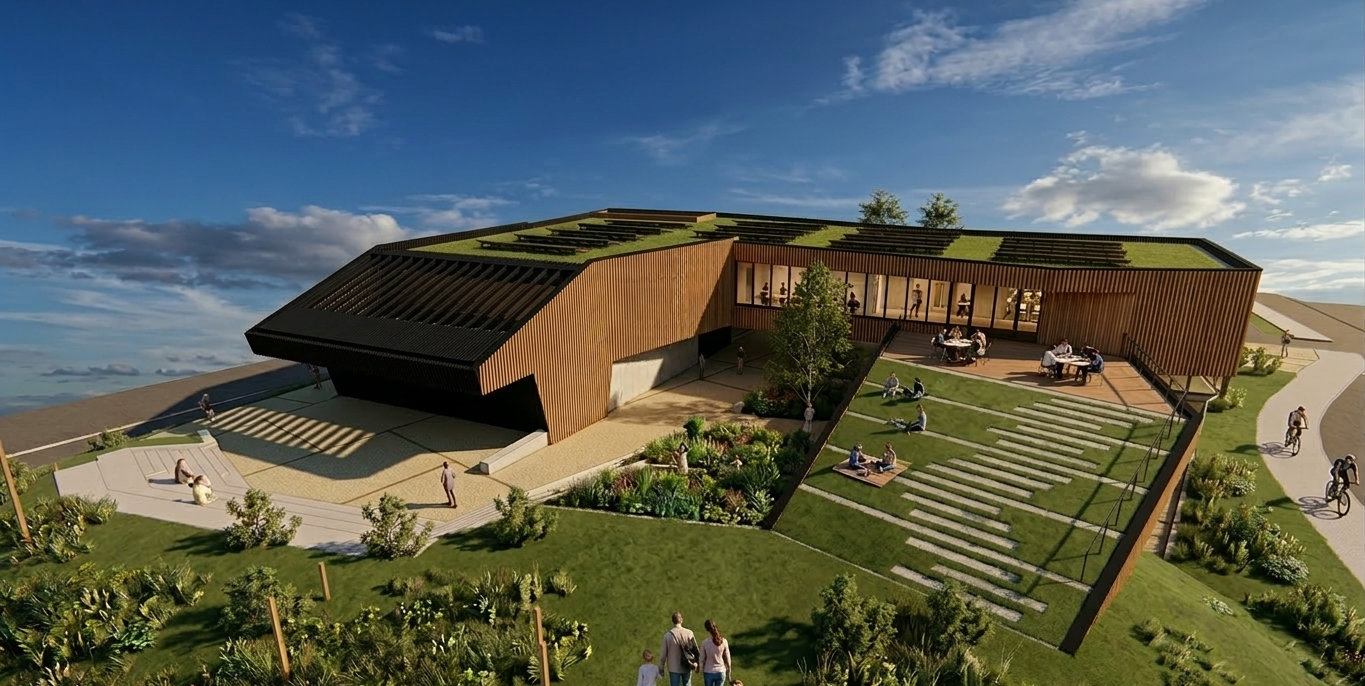
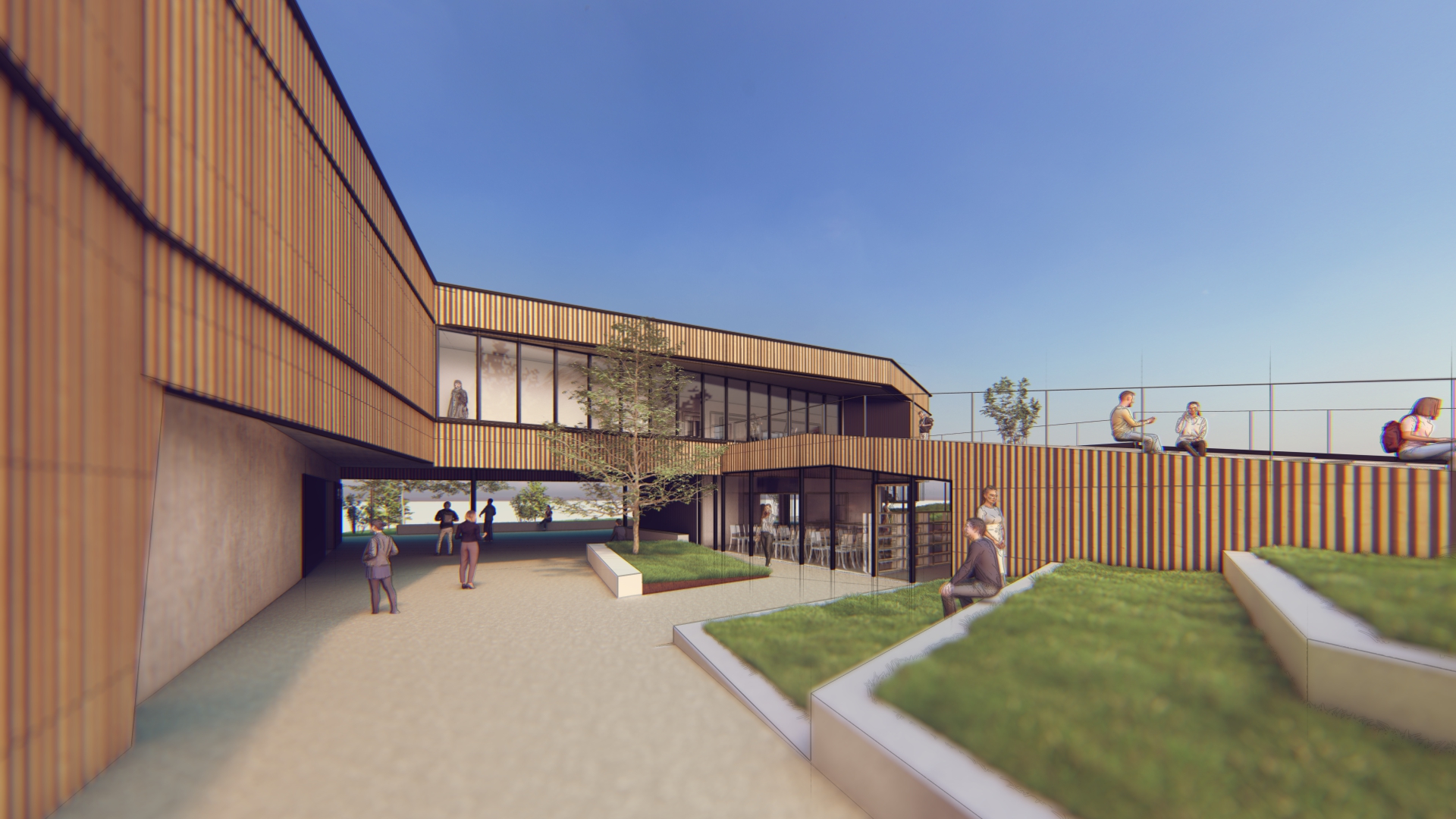
Architectural Aesthetics: The building is conceived as a permeable, organic entity that merges seamlessly with its natural hillside setting. By embedding the structure into the slope, it blurs the lines between indoor and outdoor spaces, allowing the green park to flow into the building's volume and recreational activities to spill out into a dynamic, barrier-free public plaza. This biophilic approach ensures a constant, high-quality connection with nature and regenerates the surrounding urban space.
Innovative Spaces: The quality of experience is elevated by moving away from generic, multipurpose rooms to specialized, highly stimulating creative zones. The design boldly incorporates a "messy zone" for plastic arts, a sound space for emerging bands, a digital lab, and a mirror room. This spatial innovation empowers youth to be active creators rather than passive consumers.
Cultural Identity & Branding: The aesthetic experience is deeply rooted in local heritage. The name "Arrobitxulo" references a historical local quarry, symbolizing a new "quarry" of talent and creation. The visual identity, co-created by local designer Malen Aierbe, features a custom typography where perforated triangles represent the "play" button and stage spotlights, perfectly reflecting the project's inherent musicality and dynamism. Bright colors and bold shapes express a solid personality and collaborative spirit.
Exemplary Nature: By fusing organic architecture with a powerful, co-designed cultural brand and highly specific experiential zones, Arrobitxulo exemplifies how spatial design can actively foster creativity, the transmission of Basque culture, and a profound sense of community belonging.
Architectural Aesthetics: The building is conceived as a permeable, organic entity that merges seamlessly with its natural hillside setting. By embedding the structure into the slope, it blurs the lines between indoor and outdoor spaces, allowing the green park to flow into the building's volume and recreational activities to spill out into a dynamic, barrier-free public plaza. This biophilic approach ensures a constant, high-quality connection with nature and regenerates the surrounding urban space.
Innovative Spaces: The quality of experience is elevated by moving away from generic, multipurpose rooms to specialized, highly stimulating creative zones. The design boldly incorporates a "messy zone" for plastic arts, a sound space for emerging bands, a digital lab, and a mirror room. This spatial innovation empowers youth to be active creators rather than passive consumers.
Cultural Identity & Branding: The aesthetic experience is deeply rooted in local heritage. The name "Arrobitxulo" references a historical local quarry, symbolizing a new "quarry" of talent and creation. The visual identity, co-created by local designer Malen Aierbe, features a custom typography where perforated triangles represent the "play" button and stage spotlights, perfectly reflecting the project's inherent musicality and dynamism. Bright colors and bold shapes express a solid personality and collaborative spirit.
Exemplary Nature: By fusing organic architecture with a powerful, co-designed cultural brand and highly specific experiential zones, Arrobitxulo exemplifies how spatial design can actively foster creativity, the transmission of Basque culture, and a profound sense of community belonging.
Arrobitxulo champions inclusion as a structural pillar, aiming to build a radically democratic, accessible, and safe societal model. It is designed as a 100% public, barrier-free facility that integrates the "Gaztelekua," a free socio-educational service ensuring economic accessibility for all adolescents. The physical design actively eliminates architectural barriers, opening entirely to a dynamic public plaza to welcome diverse social realities regardless of age, origin, or culture.
Crucially, Arrobitxulo pioneers an inclusive governance system through a public-community co-management model based on "autogestión". Decision-making is decentralized via a "General Assembly" and a "Motor Group". To ensure broad participation, it establishes four flexible user profiles—ranging from core members to occasional citizen users—allowing everyone to engage according to their own capacity.Driven by intersectional feminism, the space actively dismantles heteropatriarchal norms to guarantee healthy, safe relational models free from prejudice. Furthermore, the Basque language (Euskera) is strategically positioned as a primary tool for social cohesion and inclusion.
Arrobitxulo is exemplary because inclusion is embedded in its DNA. By transferring real agency to youth through a formal shared-governance framework, and using intersectionality and language as community glue, it offers a highly replicable model for inclusive European municipalities.
Crucially, Arrobitxulo pioneers an inclusive governance system through a public-community co-management model based on "autogestión". Decision-making is decentralized via a "General Assembly" and a "Motor Group". To ensure broad participation, it establishes four flexible user profiles—ranging from core members to occasional citizen users—allowing everyone to engage according to their own capacity.Driven by intersectional feminism, the space actively dismantles heteropatriarchal norms to guarantee healthy, safe relational models free from prejudice. Furthermore, the Basque language (Euskera) is strategically positioned as a primary tool for social cohesion and inclusion.
Arrobitxulo is exemplary because inclusion is embedded in its DNA. By transferring real agency to youth through a formal shared-governance framework, and using intersectionality and language as community glue, it offers a highly replicable model for inclusive European municipalities.
Arrobitxulo perfectly embodies the NEB working principle of participatory co-creation, as civil society is the very genesis and driving force of the project. The initiative did not originate from top-down municipal planning, but from a 2020 research report by the youth movement Aztarrika detailing post-pandemic youth needs. By 2022, a coalition of four local entities—representing youth, cultural creators, leisure, and adolescent social services—united to map shared challenges and demand a new space.
To translate this demand into reality, a formal co-creation process was launched in 2024, elevating citizens from mere consultants to ultimate decision-makers. The methodology included five open community sessions, specific workshops for teenagers, and monthly "Motor Group" meetings, engaging 45 direct participants.
The impact of this deep involvement on the initiative is absolute: the community literally designed the project's DNA. Citizens generated 42 naming proposals, officially selecting "Arrobitxulo". They authored the 10 foundational values, including ecology and feminism. Architecturally, end-users rejected the traditional civic center model, directly instructing architects to include a "messy zone", a digital lab, and sound spaces for emerging bands.
Furthermore, civil society defined the project's future by establishing a public-community governance model based on self-management. The impact transcends the future building; the participatory process itself has already strengthened Usurbil's social fabric, resulting in community-organized markets and workshops under the Arrobitxulo brand, proving a profound, lasting civic commitment.
To translate this demand into reality, a formal co-creation process was launched in 2024, elevating citizens from mere consultants to ultimate decision-makers. The methodology included five open community sessions, specific workshops for teenagers, and monthly "Motor Group" meetings, engaging 45 direct participants.
The impact of this deep involvement on the initiative is absolute: the community literally designed the project's DNA. Citizens generated 42 naming proposals, officially selecting "Arrobitxulo". They authored the 10 foundational values, including ecology and feminism. Architecturally, end-users rejected the traditional civic center model, directly instructing architects to include a "messy zone", a digital lab, and sound spaces for emerging bands.
Furthermore, civil society defined the project's future by establishing a public-community governance model based on self-management. The impact transcends the future building; the participatory process itself has already strengthened Usurbil's social fabric, resulting in community-organized markets and workshops under the Arrobitxulo brand, proving a profound, lasting civic commitment.
Arrobitxulo orchestrates a robust, multi-level stakeholder engagement model, anchoring its transdisciplinary design locally while expanding its impact regionally and aligning with European goals.
At the local level, civil society drives the project. Four core agents—Aztarrika (youth), Kulturgunea (creators), Ziortza (leisure), and Gaztelekua (educators)—form the decision-making "Motor Group". Their involvement is absolute: co-designing the spaces, values, and governance. The Usurbil City Council acts as a facilitator and financial guarantor, shifting from a top-down manager to an enabler of community "autogestión" (self-management). Technical experts—Elhuyar (participation), Rehabite (architecture), and Malen Aierbe (design)—translated these social demands into technical and visual realities. Added value: This guarantees the infrastructure perfectly matches actual needs, ensuring long-term democratic ownership and preventing facility abandonment.
At the regional level, the initiative actively engaged with a network of established creative and youth hubs across the Basque Country, such as Astra, Aiaraldeako Ekintzen Faktoria, and Dinamoa. The Motor Group conducted field visits to spaces like Oñatiko Eltzia to exchange governance models and best practices. Added value: Fostering regional synergies and a shared knowledge base that strengthens a decentralized cultural ecosystem.
At the European level, the project embraces NEB frameworks to serve as a transferable "manual of best practices" for governance and decarbonization. Added value: It scales local climate mitigation and youth empowerment strategies into actionable models for other small European municipalities.
At the local level, civil society drives the project. Four core agents—Aztarrika (youth), Kulturgunea (creators), Ziortza (leisure), and Gaztelekua (educators)—form the decision-making "Motor Group". Their involvement is absolute: co-designing the spaces, values, and governance. The Usurbil City Council acts as a facilitator and financial guarantor, shifting from a top-down manager to an enabler of community "autogestión" (self-management). Technical experts—Elhuyar (participation), Rehabite (architecture), and Malen Aierbe (design)—translated these social demands into technical and visual realities. Added value: This guarantees the infrastructure perfectly matches actual needs, ensuring long-term democratic ownership and preventing facility abandonment.
At the regional level, the initiative actively engaged with a network of established creative and youth hubs across the Basque Country, such as Astra, Aiaraldeako Ekintzen Faktoria, and Dinamoa. The Motor Group conducted field visits to spaces like Oñatiko Eltzia to exchange governance models and best practices. Added value: Fostering regional synergies and a shared knowledge base that strengthens a decentralized cultural ecosystem.
At the European level, the project embraces NEB frameworks to serve as a transferable "manual of best practices" for governance and decarbonization. Added value: It scales local climate mitigation and youth empowerment strategies into actionable models for other small European municipalities.
Arrobitxulo embodies true transdisciplinarity, seamlessly weaving together sociology, pedagogy, bioclimatic architecture, energy engineering, and graphic design. The initiative moves beyond multidisciplinary consultation into active, cross-field co-creation.
Interaction of Fields: Social agents (youth, cultural creators, educators) collaborated with participation experts (Elhuyar) to define the pedagogical and cultural DNA. Crucially, the architectural team (REHABITE AHOLKULARITZA TEKNIKOA, SLP) did not design in isolation; they participated directly in open community sessions, listening to end-users to translate abstract desires into concrete spatial geometries. Simultaneously, energy engineers designed the District Heating network to decarbonize the surrounding public facilities. Their work had to align perfectly with the architects to ensure the youth center could technically house this infrastructure without compromising its social function. Finally, a local graphic designer collaborated closely with the Motor Group to synthesize the project's values into a bespoke brand identity and typography.
Added Value: The added value of this transdisciplinary friction is a holistic infrastructure where "hard" engineering enables "soft" social goals. Technical limitations never overrode the community's vision. Instead, this interaction produced an NZEB building that acts as an urban decarbonization catalyst while perfectly accommodating innovative, citizen-demanded spaces like the "messy zone" and sound labs. It ensures the final product is environmentally exemplary, aesthetically vibrant, and functionally tailored to empower youth.
Interaction of Fields: Social agents (youth, cultural creators, educators) collaborated with participation experts (Elhuyar) to define the pedagogical and cultural DNA. Crucially, the architectural team (REHABITE AHOLKULARITZA TEKNIKOA, SLP) did not design in isolation; they participated directly in open community sessions, listening to end-users to translate abstract desires into concrete spatial geometries. Simultaneously, energy engineers designed the District Heating network to decarbonize the surrounding public facilities. Their work had to align perfectly with the architects to ensure the youth center could technically house this infrastructure without compromising its social function. Finally, a local graphic designer collaborated closely with the Motor Group to synthesize the project's values into a bespoke brand identity and typography.
Added Value: The added value of this transdisciplinary friction is a holistic infrastructure where "hard" engineering enables "soft" social goals. Technical limitations never overrode the community's vision. Instead, this interaction produced an NZEB building that acts as an urban decarbonization catalyst while perfectly accommodating innovative, citizen-demanded spaces like the "messy zone" and sound labs. It ensures the final product is environmentally exemplary, aesthetically vibrant, and functionally tailored to empower youth.
Arrobitxulo radically breaks the mold of the mainstream "traditional civic center". Mainstream practices typically deliver generic, top-down multipurpose rooms. In contrast, Arrobitxulo is defined by three ground-breaking innovations.
First, Typological Innovation: The community rejected standard designs, dictating highly specific, unconventional environments. The facility incorporates a "messy zone" for plastic arts, a digital space, a mirror room, and specialized sound spaces for emerging bands. This recognizes youth as active cultural creators rather than passive consumers.
Second, Environmental and Urban Hybridization: Unlike isolated public buildings, Arrobitxulo acts as a permeable, organic entity that fuses with the natural slope of its green plot. It hybridizes the interior and exterior, turning the surrounding park into an extension of the building. Most innovatively, it pioneers energy solidarity by acting as the technical heart of a municipal District Heating network. While mainstream projects solely decarbonize themselves, Arrobitxulo integrates aerothermal systems and solar panels to decarbonize neighboring high-emission public facilities, such as the Oiardo sports center and the Udarregi school .
Third, Governance and Agency Innovation: It shifts municipal policy from direct institutional management to a public-community shared model. The City Council acts purely as a facilitator, granting true agency and "autogestión" to local youth and cultural agents to run the space. Additionally, it innovates socially by actively building a collaborative network with other regional creative hubs, fostering synergies far beyond local borders.
First, Typological Innovation: The community rejected standard designs, dictating highly specific, unconventional environments. The facility incorporates a "messy zone" for plastic arts, a digital space, a mirror room, and specialized sound spaces for emerging bands. This recognizes youth as active cultural creators rather than passive consumers.
Second, Environmental and Urban Hybridization: Unlike isolated public buildings, Arrobitxulo acts as a permeable, organic entity that fuses with the natural slope of its green plot. It hybridizes the interior and exterior, turning the surrounding park into an extension of the building. Most innovatively, it pioneers energy solidarity by acting as the technical heart of a municipal District Heating network. While mainstream projects solely decarbonize themselves, Arrobitxulo integrates aerothermal systems and solar panels to decarbonize neighboring high-emission public facilities, such as the Oiardo sports center and the Udarregi school .
Third, Governance and Agency Innovation: It shifts municipal policy from direct institutional management to a public-community shared model. The City Council acts purely as a facilitator, granting true agency and "autogestión" to local youth and cultural agents to run the space. Additionally, it innovates socially by actively building a collaborative network with other regional creative hubs, fostering synergies far beyond local borders.
Our methodology relies on three transversal axes: Co-creation, Typological Innovation, and Public-Community Governance . To implement this, we structured a continuous, phased approach from 2020 to 2027 .
Phases 1 & 2 (2020-2023): The project began with grassroots action. The youth movement Aztarrika conducted a post-pandemic diagnostic, defining the initial needs. Four local agents then generated alliances and mapped joint needs to present the "Elkargunea" proposal.
Phase 3 (2024-2025): This was the core participatory process, divided into "Abiatu" (Start), "Elkarrekin Eraiki" (Construct Together), and "Gizarteratu eta Itxi" (Socialize and Close) . A "Motor Group" was established to lead. Through five open community sessions, specialized youth workshops, and visits to other regional hubs, citizens defined the 10 foundational values, the programmatic needs, the public-community management model, and the "Arrobitxulo" brand.
Phases 4 to 6 (2024-2026): Technical translation. A feasibility study for the District Heating network was completed. Public bidding secured the architectural and engineering teams (2025), who are currently drafting the executive project (2025-2026) by strictly integrating the community's demands into the physical building.
Phases 7 to 9 (2025-2027): Implementation. Bidding for construction works will include "Green and Social Clauses". Execution of the physical building will apply strict sustainability and NZEB criteria. Finally, the "Activation and Governance" phase (2027 onwards) will inaugurate the facility and formally launch the citizen-led "Management Board," ensuring the methodology’s ultimate goal: absolute community "autogestión" actively supported by the municipality.
Phases 1 & 2 (2020-2023): The project began with grassroots action. The youth movement Aztarrika conducted a post-pandemic diagnostic, defining the initial needs. Four local agents then generated alliances and mapped joint needs to present the "Elkargunea" proposal.
Phase 3 (2024-2025): This was the core participatory process, divided into "Abiatu" (Start), "Elkarrekin Eraiki" (Construct Together), and "Gizarteratu eta Itxi" (Socialize and Close) . A "Motor Group" was established to lead. Through five open community sessions, specialized youth workshops, and visits to other regional hubs, citizens defined the 10 foundational values, the programmatic needs, the public-community management model, and the "Arrobitxulo" brand.
Phases 4 to 6 (2024-2026): Technical translation. A feasibility study for the District Heating network was completed. Public bidding secured the architectural and engineering teams (2025), who are currently drafting the executive project (2025-2026) by strictly integrating the community's demands into the physical building.
Phases 7 to 9 (2025-2027): Implementation. Bidding for construction works will include "Green and Social Clauses". Execution of the physical building will apply strict sustainability and NZEB criteria. Finally, the "Activation and Governance" phase (2027 onwards) will inaugurate the facility and formally launch the citizen-led "Management Board," ensuring the methodology’s ultimate goal: absolute community "autogestión" actively supported by the municipality.
Arrobitxulo is explicitly designed as a highly transferable "manual of best practices in community youth governance" for other small European municipalities facing youth disengagement and climate challenges. The initiative offers three highly replicable pillars adaptable to various socio-economic contexts:
1. Methodology of Public-Community Governance: The process of mutual knowledge and alliance-building among diverse youth, cultural, and leisure agents establishes a solid foundation for designing projects that truly respond to adolescent needs. The shared governance model, where social agents are active decision-making subjects rather than mere consumers, is a proven process that can be exported to prevent the underutilization of public facilities across Europe.
2. The Co-creation Process & Value System: The structured participatory methodology used to define not just programmatic needs, but transversal objectives and a 10-point value system empowers any community to create accessible, safe, and intergenerational spaces. The transdisciplinary collaboration between cultural creators and youth movements effectively revitalizes social dynamics, offering a replicable blueprint to break the obsolete "traditional civic center" mold.
3. Technological and Environmental Model: Arrobitxulo is a highly replicable model for environmental regeneration and climate change mitigation. The integration of a youth center as the energy heart of a District Heating network offers a unique opportunity to decarbonize surrounding public buildings by replacing existing gas boilers. The scalable combination of aerothermal installations and rooftop solar panels provides a technological solution that generates a strong environmental improvement for any municipality's surroundings.
1. Methodology of Public-Community Governance: The process of mutual knowledge and alliance-building among diverse youth, cultural, and leisure agents establishes a solid foundation for designing projects that truly respond to adolescent needs. The shared governance model, where social agents are active decision-making subjects rather than mere consumers, is a proven process that can be exported to prevent the underutilization of public facilities across Europe.
2. The Co-creation Process & Value System: The structured participatory methodology used to define not just programmatic needs, but transversal objectives and a 10-point value system empowers any community to create accessible, safe, and intergenerational spaces. The transdisciplinary collaboration between cultural creators and youth movements effectively revitalizes social dynamics, offering a replicable blueprint to break the obsolete "traditional civic center" mold.
3. Technological and Environmental Model: Arrobitxulo is a highly replicable model for environmental regeneration and climate change mitigation. The integration of a youth center as the energy heart of a District Heating network offers a unique opportunity to decarbonize surrounding public buildings by replacing existing gas boilers. The scalable combination of aerothermal installations and rooftop solar panels provides a technological solution that generates a strong environmental improvement for any municipality's surroundings.
Arrobitxulo possesses the technical viability, political backing, and budgetary commitment necessary for its full implementation and long-term maintenance. The Usurbil Council demonstrates this firm commitment through approved initial budget allocations for the execution phase. As of 2026, the technical team hired in 2025 is actively drafting the Executive Project.
NEB Values Incorporated So Far: NEB principles are deeply embedded in our progress. The co-creation phase (2024-2025) successfully translated citizen demands into a concrete architectural pre-project and defined the "Arrobitxulo" brand, driven by 10 foundational values including ecology, feminism, and inclusion. Furthermore, a feasibility study for the District Heating network was successfully completed, cementing our robust sustainability and decarbonization goals.
Key Steps and Planned Activities:
• 2026 (Tender Phase): We plan to launch the public bidding for construction works this year. Crucially, to ensure NEB principles guide the physical building process, this tender will include strict "Green and Social Clauses" aligned perfectly with the community's decálogo.
• 2026-2027 (Execution): The construction phase will rigorously apply criteria of sustainability, ecology, and energy efficiency. This includes integrating the solar panels and aerothermal systems to reach nearly zero-energy goals. Concurrently, the citizen "Motor Group" remains actively engaged to finalize the internal regulations and economic co-management models.
• From July 2027 (Activation): Upon inauguration, the project will formally launch the citizen-led "Mesa de Gestión" (Management Board). This ensures the facility operates as a living, self-managed NEB ecosystem promoting continuous youth agency, environmental regeneration, and cultural cohesion.
NEB Values Incorporated So Far: NEB principles are deeply embedded in our progress. The co-creation phase (2024-2025) successfully translated citizen demands into a concrete architectural pre-project and defined the "Arrobitxulo" brand, driven by 10 foundational values including ecology, feminism, and inclusion. Furthermore, a feasibility study for the District Heating network was successfully completed, cementing our robust sustainability and decarbonization goals.
Key Steps and Planned Activities:
• 2026 (Tender Phase): We plan to launch the public bidding for construction works this year. Crucially, to ensure NEB principles guide the physical building process, this tender will include strict "Green and Social Clauses" aligned perfectly with the community's decálogo.
• 2026-2027 (Execution): The construction phase will rigorously apply criteria of sustainability, ecology, and energy efficiency. This includes integrating the solar panels and aerothermal systems to reach nearly zero-energy goals. Concurrently, the citizen "Motor Group" remains actively engaged to finalize the internal regulations and economic co-management models.
• From July 2027 (Activation): Upon inauguration, the project will formally launch the citizen-led "Mesa de Gestión" (Management Board). This ensures the facility operates as a living, self-managed NEB ecosystem promoting continuous youth agency, environmental regeneration, and cultural cohesion.