Enhancing Circularity, Sustainability, and Innovation
BioCactus Water System
BioCactus: Integrated cactus-based system for sustainable water purification in semi-arid regions
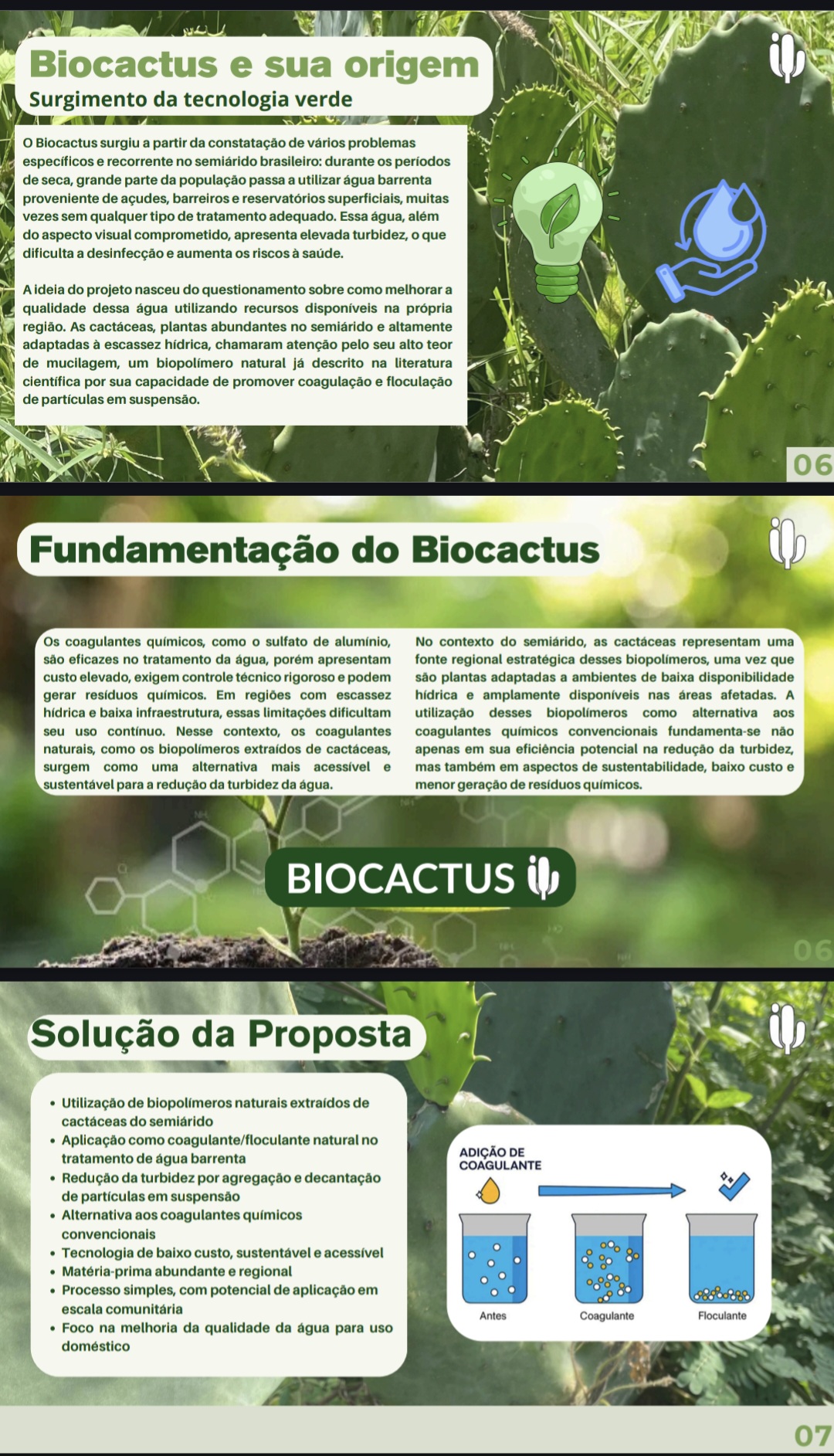
BioCactus is a nature-based water treatment concept designed to improve access to safe drinking water in semi-arid regions. It uses natural biopolymers extracted from cactus species such as Opuntia ficus-indica. The cactus mucilage acts as a bioflocculant, binding suspended particles and reducing water turbidity. This low-cost and locally available solution offers a sustainable way to improve water quality, support water security, and strengthen community resilience.
Brazil
Local
Crateús & Novo Oriente (Semi-arid region of Northeast Brazil)
Mainly rural
It refers to other types of transformations (soft investment)
Prototype level
No
No
No
Organisation
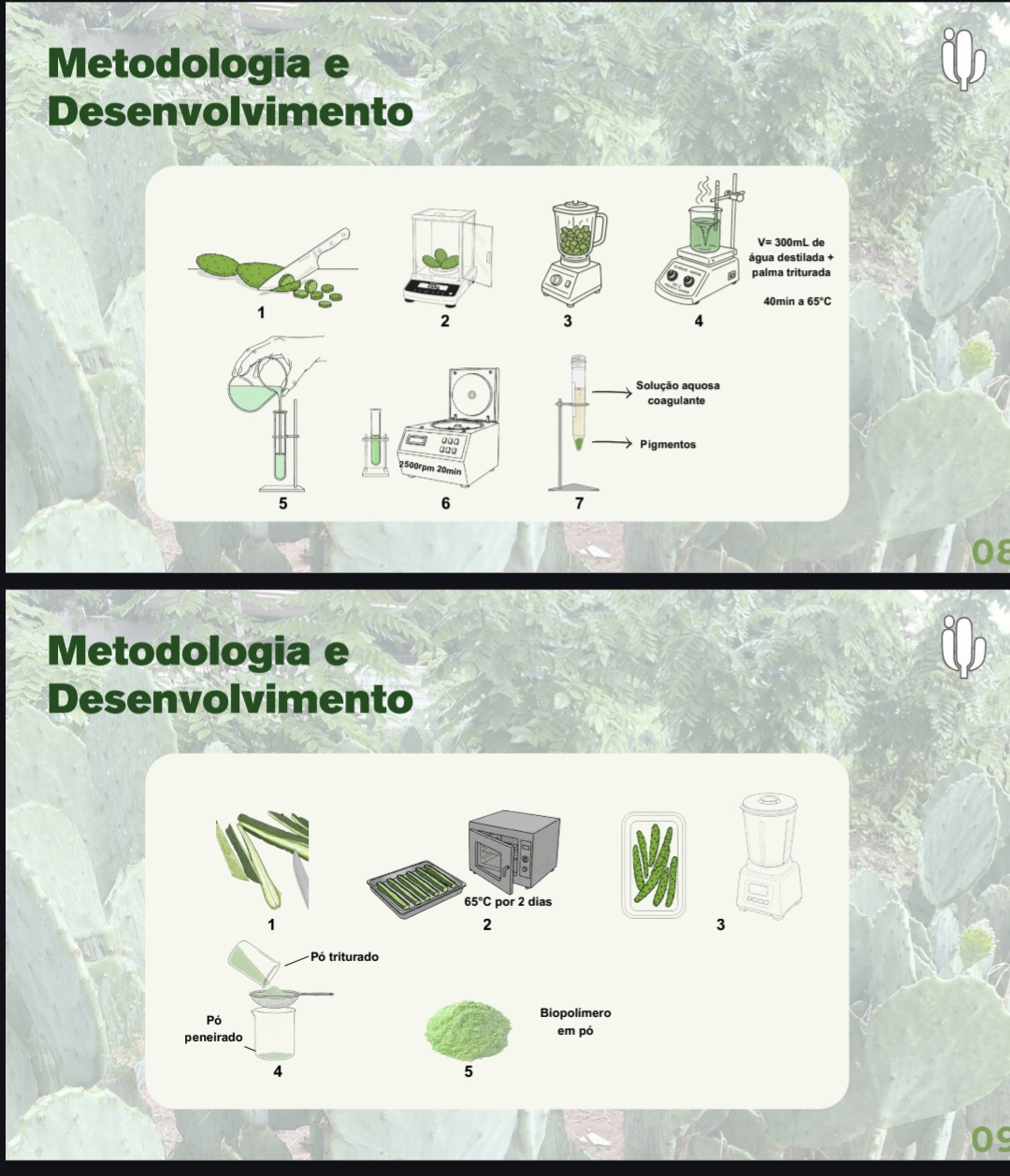
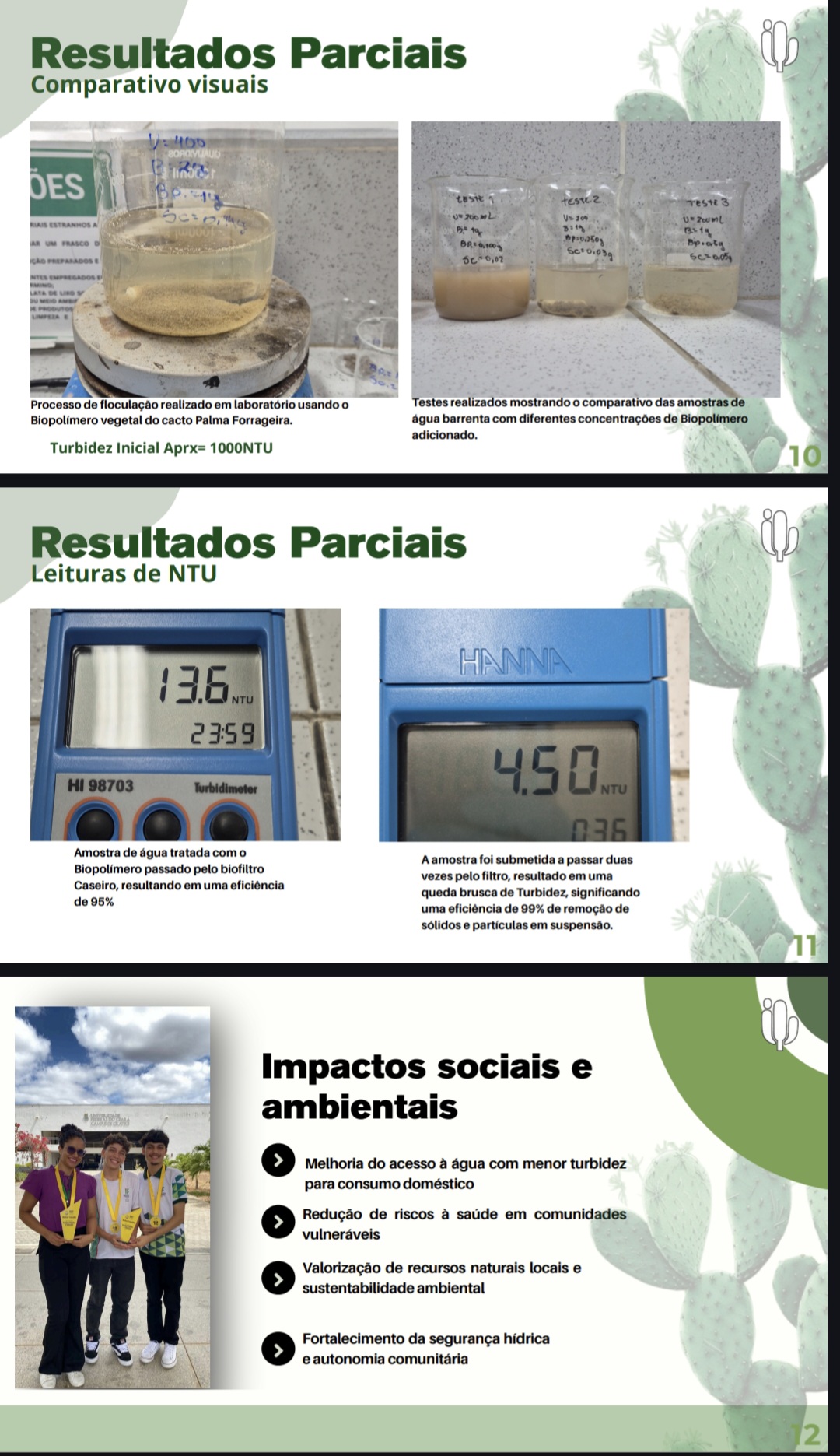
BioCactus is a low-cost and sustainable water treatment system designed to improve the quality of turbid water in semi-arid regions, particularly in communities that rely on reservoirs, ponds, and shallow wells for domestic water supply. These water sources often present high turbidity and potential microbiological contamination, posing risks to public health. The project proposes the use of natural biopolymers extracted from cactus species native to the Caatinga biome as an alternative to conventional chemical coagulants such as aluminum sulfate, which can generate potentially toxic residues and increase dependence on industrial inputs. The system combines three main stages: natural coagulation–flocculation, low-cost filtration, and solar disinfection. The coagulant is produced from Opuntia ficus-indica (forage cactus). The cactus cladodes are processed, dried, and ground into a fine powder that acts as a natural biopolymer capable of destabilizing suspended particles and promoting floc formation. During experimental tests, water samples with simulated turbidity of approximately 1000 NTU were treated with the cactus biopolymer and a small amount of calcium hydroxide as a flocculation aid. After the coagulation process, the water passes through a low-cost biofilter constructed from a reused PET bottle containing sequential layers of gravel, sand, and activated carbon produced from organic residues and cactus waste. This filtration stage removes remaining suspended particles and improves color, odor, and overall water clarity. Finally, the filtered water undergoes Solar Water Disinfection (SODIS), where it is exposed to sunlight in transparent PET bottles for several hours. A simple reflective structure made from reused materials increases solar disinfection stage. BioCactus demonstrates the potential of locally available natural resources to create decentralized water treatment solutions that are affordable, environmentally friendly, and easy to replicate.
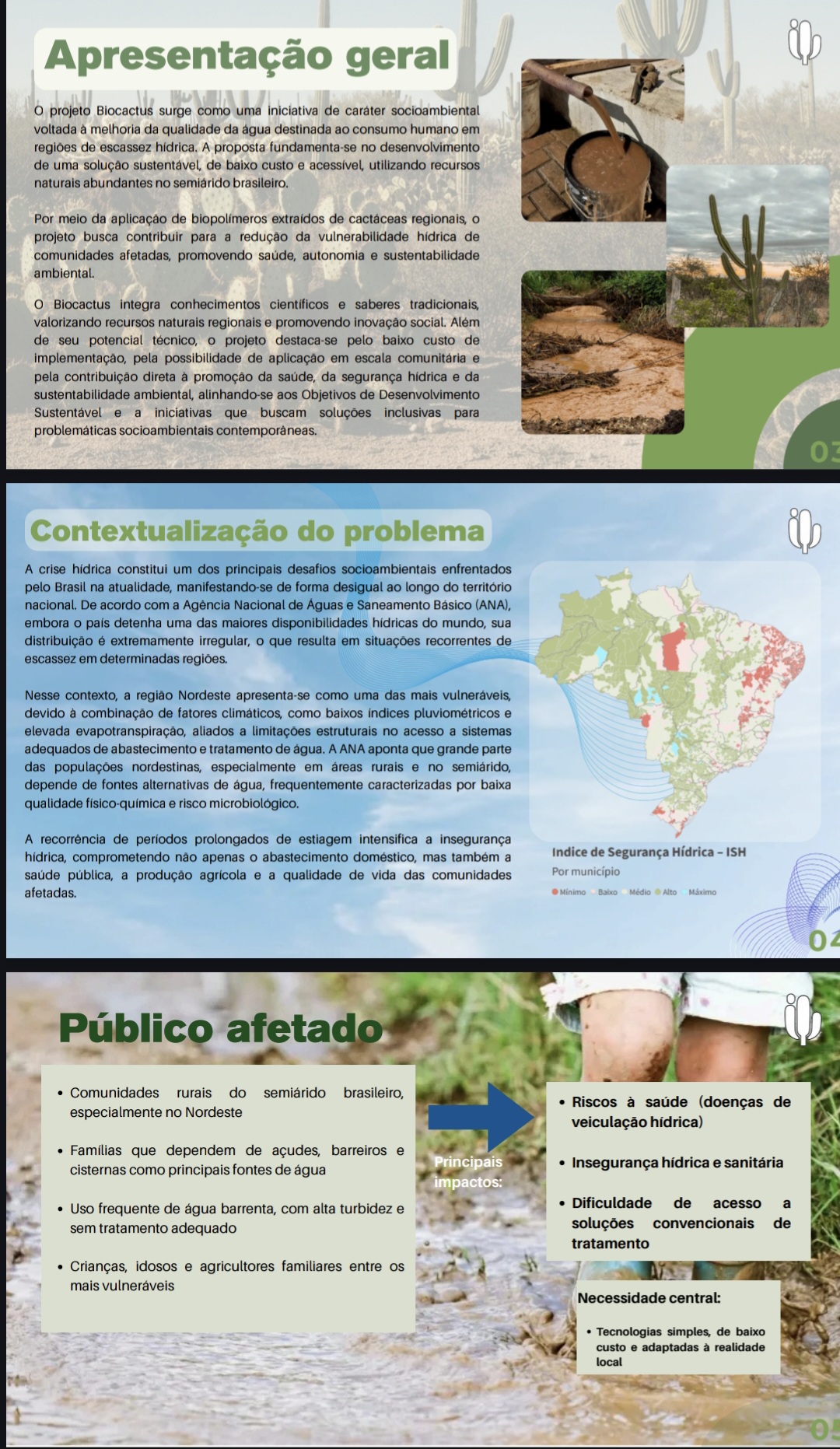
The BioCactus concept was inspired by the water challenges faced by communities in the semi-arid region of Northeast Brazil, where many people rely on reservoirs, ponds, and shallow wells that often contain highly turbid water and potential microbial contamination. Observing this reality motivated the search for a simple, affordable, and locally adaptable water treatment solution.
The idea developed from research on natural plant-based coagulants. Considering the abundance of cactus species in the Caatinga biome, particularly Opuntia ficus-indica, the project explored the use of cactus-derived biopolymers as a sustainable alternative to conventional chemical coagulants.
The concept was implemented through experimental stages: extraction and preparation of the cactus biopolymer, testing its effectiveness in turbidity reduction, development of a low-cost biofilter using reused PET bottles and natural materials, and the application of Solar Water Disinfection (SODIS) to reduce microbiological contamination.
By combining these processes, BioCactus evolved into an integrated, low-cost water treatment system designed to be accessible, sustainable, and easily replicated in rural and water-scarce communities.
Nature-based solutions
Sustainable water treatment
Circular economy
Low-cost environmental technology
Water access for rural communities
BioCactus addresses environmental and social challenges by providing a sustainable, low-cost solution to improve water quality in semi-arid regions where communities often depend on turbid water from reservoirs, ponds, and shallow wells. The concept replaces conventional chemical coagulants with natural biopolymers extracted from locally available cactus species (Opuntia ficus-indica), reducing dependence on industrial chemicals and minimizing potentially harmful residues in the environment.
From an environmental perspective, the system follows principles of circular economy and nature-based solutions. The filtration stage uses locally available materials such as sand, gravel, and activated carbon that can be produced from organic residues and cactus waste, transforming biomass into a useful water treatment resource. In addition, the solar water disinfection (SODIS) stage uses renewable solar energy, eliminating the need for electricity or fossil fuels.
Socially and economically, BioCactus is designed to be affordable and accessible. The system can be built using low-cost materials such as reused PET bottles and locally available filtration media, making it easy to replicate in rural communities with limited infrastructure. This approach promotes local autonomy, environmental education, and community participation in water management.
BioCactus can be considered exemplary in terms of sustainability because it integrates nature-based materials, renewable energy, and circular resource use into a simple and decentralized water treatment system. By combining scientific research with local ecological knowledge, the concept demonstrates how sustainable innovation can emerge from regional ecosystems and respond directly to real social and environmental needs.
BioCactus addresses environmental and social challenges by providing a sustainable and low-cost solution to improve water quality in semi-arid regions. The system replaces conventional chemical coagulants with natural biopolymers extracted from locally available cactus species (Opuntia ficus-indica), reducing dependence on industrial chemicals and promoting the use of renewable natural resources.
The concept also follows circular economy principles by using locally available materials and organic residues, such as cactus waste for the production of activated carbon used in filtration. In addition, the system uses solar water disinfection (SODIS), which relies on renewable solar energy and eliminates the need for electricity or fuel.
Because it is designed with simple materials and low cost, BioCactus can be easily replicated by rural communities, increasing local capacity to manage water resources in a sustainable and resilient way.
BioCactus promotes inclusion by addressing the lack of access to safe drinking water faced by many rural communities in semi-arid regions. The concept focuses on affordability and accessibility by using low-cost, widely available materials such as PET bottles, sand, gravel, and locally available cactus biomass. This allows communities with limited resources to build and maintain the system themselves without requiring complex infrastructure or specialized equipment.
The design is simple and easily replicable, enabling local participation and knowledge sharing. By relying on natural resources from the local environment and straightforward treatment steps—coagulation with cactus biopolymers, filtration, and solar disinfection—the system can be implemented and adapted by communities, schools, and local organizations.
In this way, BioCactus supports a more inclusive approach to water access by empowering communities to actively participate in water treatment and management, promoting autonomy, social equity, and resilience in regions where centralized water infrastructure is limited.
The development of BioCactus was strongly influenced by the realities and needs observed in rural communities of the Brazilian semi-arid region, where access to safe drinking water is limited. The concept was shaped by understanding how people in these communities collect and use water from reservoirs, ponds, and wells, which helped guide the design of a simple and accessible treatment system.
The project prioritizes solutions that communities can easily adopt, using locally available materials and straightforward treatment steps. This approach encourages participation from students, educators, and community members who can replicate, test, and adapt the system to their local conditions.
Through this participatory perspective, BioCactus aims not only to provide a technical solution but also to stimulate knowledge sharing, environmental awareness, and community engagement in sustainable water management.
BioCactus involves and expects to engage stakeholders at different levels to support its development and implementation. At the local level, students, educators, and rural communities play a key role in testing, replicating, and adapting the water treatment system using locally available materials. Their participation helps ensure that the solution is practical and appropriate for real conditions.
At the regional and national level, educational institutions and research organizations contribute through scientific guidance, experimental validation, and dissemination of the technology. These actors support the improvement of the methodology and help expand the project to other regions facing similar water challenges.
At the international level, initiatives and networks focused on sustainability and innovation can support knowledge exchange, visibility, and potential replication of the concept in other water-scarce regions. The engagement of stakeholders at multiple levels strengthens the project by combining local knowledge, scientific research, and broader collaboration to scale sustainable water solutions.
BioCactus integrates knowledge from multiple disciplines to develop a sustainable water treatment solution. Environmental science and chemistry guide the study of natural biopolymers extracted from cactus and their effectiveness in coagulation and turbidity reduction. Engineering principles support the design of the low-cost filtration system using layered materials such as sand, gravel, and activated carbon.
The concept also involves education and social sciences, as the project is designed to be easily understood, replicated, and implemented by students and local communities. In addition, sustainability and circular economy approaches are reflected in the use of local natural resources and organic residues for filtration materials.
By combining scientific experimentation, practical engineering design, and community-oriented education, BioCactus demonstrates how different fields of knowledge can work together to address water access challenges in a sustainable and accessible way.
The BioCactus concept is based on a low-cost and scalable model focused on social and environmental impact. The core idea is to disseminate a simple water treatment system that can be locally produced using accessible materials and natural resources. Financial sustainability can be achieved through partnerships with educational institutions, environmental organizations, and public programs that support water access and sustainable innovation.
In the medium term, the project could generate revenue through training workshops, educational kits, and the dissemination of low-cost filtration systems for schools, rural communities, and social organizations. These activities would support the implementation of the technology while promoting environmental education and community capacity building.
Additionally, the project may be supported by public funding, sustainability grants, and international innovation programs focused on climate resilience and water access. This combination of educational activities, partnerships, and funding opportunities can help ensure the long-term financial sustainability and expansion of the BioCactus concept to other water-scarce regions.
BioCactus has strong potential for transferability because its methodology relies on simple processes, low-cost materials, and nature-based solutions that can be adapted to different contexts. Key elements that can be replicated include the use of plant-based biopolymers as natural coagulants, the construction of low-cost biofilters using widely available materials, and the application of solar water disinfection (SODIS) to reduce microbiological contamination.
These components can be adapted to other regions by using locally available plants with similar coagulating properties and by modifying the filtration materials according to regional availability. The simplicity of the system allows it to be implemented in rural communities, schools, and small decentralized water treatment initiatives.
In addition, the project’s methodology—combining natural resources, low-cost technology, and environmental education—can be transferred to other water-scarce regions around the world, supporting community-based solutions for improving water quality and resilience.
In the year following the application, the next steps for BioCactus focus on improving validation, dissemination, and practical implementation. First, additional laboratory and field tests are planned to further evaluate water quality parameters, including turbidity and microbiological reduction, in order to strengthen the scientific validation of the system.
Another important step is the development of educational and demonstration activities, such as workshops and presentations in schools and community spaces, to share the methodology and encourage the replication of the system using locally available materials.
The project also aims to build partnerships with educational institutions, research groups, and sustainability initiatives to support further development and adaptation of the technology. These actions will help expand the visibility of BioCactus and promote its implementation in communities that face similar water quality challenges.