Enhancing Circularity, Sustainability, and Innovation
Buoono Farm
Turning What Cities Waste Into Food Cities Need.
Brewer's spent grain is one of Europe's most overlooked resources. Italy alone generates 346,000 tonnes per year, yet strict food certification rules prevent its use as animal feed, leaving it as an environmental liability with no clear recovery pathway. Buoono Farm targets this failure: establishing a circular, city-embedded production system that transforms industrial organic waste into premium, accessible nutrition, grown where people live, for the people who live there.
Italy
Local
Milan, Lombardy, Italy
Sesto San Giovanni, Lombardy, Italy
Pavia, Lombardy, Italy
Piacenza, Emilia Romagna, Italy
Sesto San Giovanni, Lombardy, Italy
Pavia, Lombardy, Italy
Piacenza, Emilia Romagna, Italy
It addresses urban-rural linkages
It involves a physical transformation of the built environment (hard investment)
Prototype level
No
No
No
Organisation
Buoono Farm is a Milan-based urban agriculture startup transforming brewer's spent grain into premium, locally grown mushrooms. Our circular production system uses organic waste as a growing substrate, requiring 80% less energy than conventional farming and zero additional water — converting 5 kg of waste into 1 kg of high-quality mushrooms.
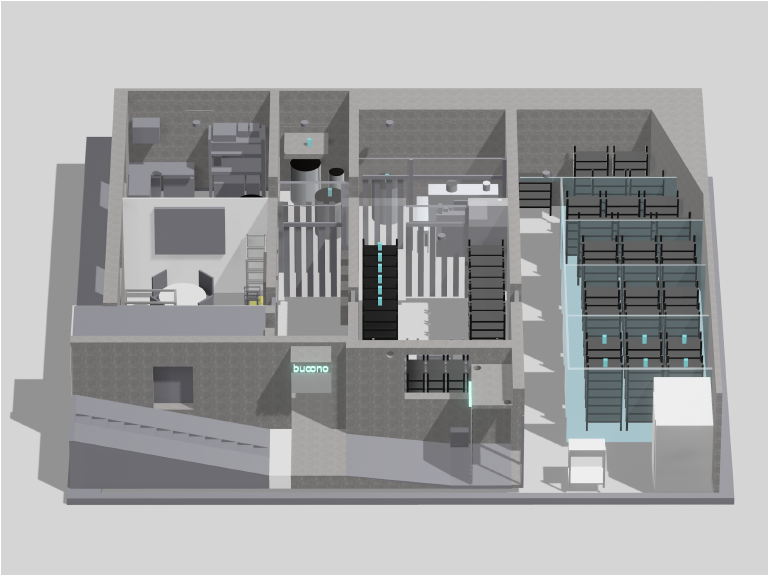
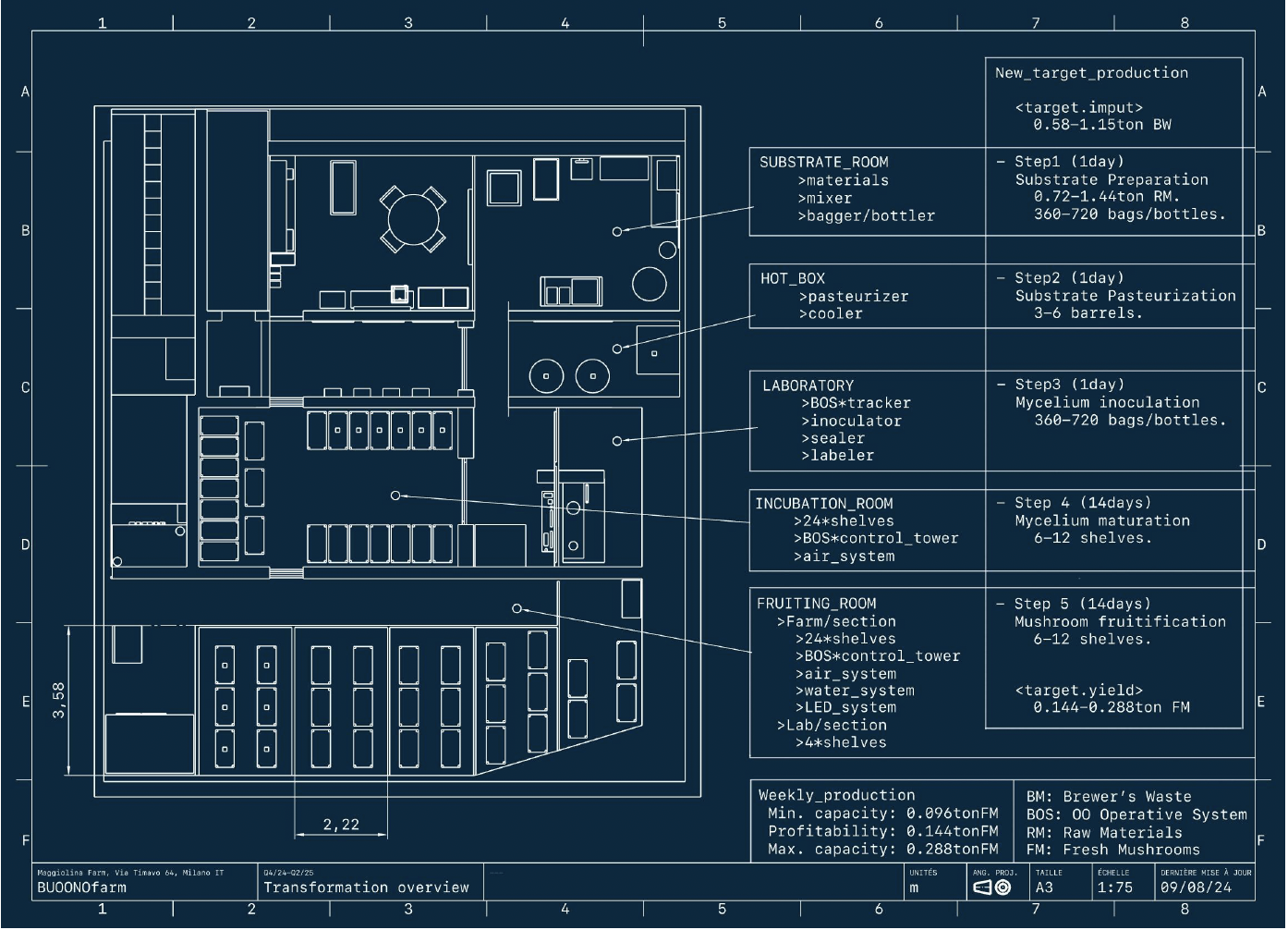
Our compact INFINITE Farm model operates from as little as 148 sqm and produces up to 288 kg of fresh mushrooms per week, harvested and delivered the same day via electric cargo bike directly to restaurants. Independent analysis by the University of Milan confirmed our mushrooms contain up to 3x more protein than market equivalents.
To date, we have invested €110k over three years of R&D and market validation, serving 11 unique clients including Joia, Europe's first Michelin-starred vegetarian restaurant, with a 100% customer satisfaction and retention rate and an average order value of €72.
Our proprietary Buoono Operating System (BOS) monitors and optimises grow room conditions in real time, while our TransfOOrmer technology — currently at TRL 4 — is designed to process 1 tonne of BSG per day directly at brewery sites, decentralising mycelium production at scale.
Looking ahead, revenue is projected to reach €137k in 2025, €870k in 2026, and €4.2M by 2028, as we expand to five Italian cities and six international farms. We are targeting carbon negativity by 2030 and are committed to eliminating single-use plastics from operations by 2026.
The idea for Buoono Farm was born in a field that no longer looked like one. Pietro Trevisan, our CEO, grew up in Piacenza, the son of herbalists, watching the farmland around him slowly lose its vitality to decades of intensive chemical agriculture. That image never left him. When he moved to Milan, he began to see the city differently — not as a place disconnected from food production, but as a place full of untapped potential: empty basements, unused rooftops, and tonnes of organic waste going nowhere.
The breakthrough came when Pietro and Esteban Valenti, our COO, turned their attention to Milan's breweries. Brewer's spent grain — the fibrous, protein-rich by-product of beer production — was being generated in vast quantities with no viable recovery pathway. They had found their substrate. Early cultivation trials, carried out in partnership with local breweries, tested different formulations and species, refining a process that could convert 5 kg of waste into 1 kg of premium mushrooms.
Three years of bootstrapped R&D followed: building and iterating on farm infrastructure, developing BOS to monitor and optimise growing conditions, and forging relationships with Milan's most discerning chefs. A 2022 University of Milan analysis confirmed what the chefs already knew: Buoono's mushrooms contained up to 3x more protein than market equivalents. Joia, Europe's first Michelin-starred vegetarian restaurant, became a client and a symbol of the quality standard we had reached.
Each step has been deliberate. Rather than chasing scale prematurely, we focused on proving the model: nutritionally, operationally, and commercially. With a 100% customer retention rate, a functioning farm at TRL 5, and our TransfOOrmer technology in development at TRL 4, we are now ready to grow — replicating our model across Italian cities and beyond.
Circular bio-economy
Urban food resilience
Waste valorisation
Nature-based urban design
Sustainable urban communities
At the environmental core of our concept is a fully closed loop. Brewer's spent grain, generated in vast quantities by urban breweries with no viable recovery pathway, becomes the substrate for growing premium mushrooms. Once harvested, the spent substrate is further transformed into biochar and compost, returning nutrients to conventional agriculture and ensuring that nothing from our process goes to waste. Along the way, we require 80% less energy than conventional farming, use zero additional water, and run entirely on renewable electricity. We are eliminating single-use plastics by 2026 and targeting carbon negativity by 2030.
But sustainability at Buoono is also deeply social. Urban communities are increasingly disconnected from fresh, affordable food — a problem we address by growing inside the city itself, delivering same-day by electric cargo bike, and pricing our produce up to 30% below what high-end restaurants typically pay for comparable quality. In doing so, we demonstrate that healthy food and economic accessibility are not in conflict.
Culturally, we collaborate with Milan's leading chefs to restore mushrooms to their rightful place in Italian food culture, building consumer awareness of sustainable, local food choices. And economically, our circular model creates value for breweries, farmers, restaurants, and communities simultaneously — proving that environmental responsibility and profitability can grow together.
Beauty, at Buoono Farm, begins underground.
In the basements and forgotten spaces of Milan, our grow rooms quietly transform industrial waste into something extraordinary. Rhythmic rows of mycelium cultures, fruiting chambers alive with colour and texture, the earthy scent of fresh mushrooms ready for harvest — these are spaces that surprise and delight everyone who encounters them. We envision them becoming open to communities: places of curiosity, learning, and connection, where people can witness the city feeding itself for the very first time.
Above ground, beauty takes a different form. Our electric cargo bike, LaBiga, carries fresh harvests directly to the city's most celebrated restaurants — a visible, daily reminder that food can be local, clean, and alive. The chefs we work with, including those at Joia, Europe's first Michelin-starred vegetarian restaurant, transform our mushrooms into dishes that reintroduce forgotten flavours and textures into Milan's culinary culture. Food, we believe, is one of the most immediate and democratic forms of beauty — and when it is grown with care, that care is tasted.
In the longer term, we envision Buoono farms as anchors of neighbourhood identity: places where communities gather, where the boundary between city and nature dissolves, and where the everyday act of eating becomes a source of pride and belonging. The city as a food oasis is not only a more sustainable vision — it is a more beautiful one.
Buoono Farm was founded on a belief that sounds simple but remains radical: healthy food belongs to everyone.
Today, urban communities across Europe are paying more for less. Food prices have risen 47% in a decade, supply chains have lengthened, and the gap between what is nutritious and what is affordable continues to widen. Buoono directly challenges this trajectory. By producing food inside the city — eliminating intermediaries, reducing logistics costs, and pricing up to 30% below market equivalents — we make high-quality, locally grown nutrition accessible to restaurants and, in the next phase of our growth, to consumers directly through local markets and supermarkets.
Inclusion for us is also about who benefits from the work, not just who benefits from the product. Each of our compact urban farms creates local employment — training full-time and part-time farmers drawn from the neighbourhoods we operate in. As we replicate our model across Italian cities and into Europe, job creation and community development scale with us.
Our governance model reinforces these commitments. As a Benefit Corporation, we are legally accountable to social and environmental outcomes, not just financial ones. Our Impact Report is public, our values are binding, and our DomaniOggi programme ensures we continuously research how to deepen our positive impact over time.
We envision our farms as community assets: open, visible, and rooted in the places they serve. Because a city that grows its own food is a city that takes care of its own people.
Buoono Farm has been shaped, tested, and refined in constant conversation with the people it was built to serve.
Our first and most important collaborators were Milan's chefs. Long before we had a polished product, we were in their kitchens, watching how they cooked our mushrooms, listening to what they loved and what frustrated them, and returning to our grow rooms to adjust accordingly. Their feedback guided which varieties we cultivated, how we harvested, and how we packaged our produce. This was not market research; it was co-development. A formal customer study in 2024 confirmed what we already felt: 100% of our clients were satisfied with quality and service and would buy again.
Beyond chefs, our concept was shaped by academic partnership. A research thesis conducted at the University of Milan in 2022 provided independent nutritional analysis of our mushrooms, creating a bridge between scientific rigour and the practical knowledge of the farmers and cooks we work with every day.
Our relationships with local breweries have been equally participatory. Understanding their operational realities, waste volumes, and logistical constraints was essential to designing a system that works at the source, not just in our grow rooms.
As we grow, participation becomes even more central. We plan to open our farms as community spaces, involve neighbourhood stakeholders in the design of new locations, and ensure that each city we enter shapes its own version of the Buoono model: locally rooted, globally replicable.
Buoono Farm operates at the intersection of food, waste, and urban space, and its development has naturally involved stakeholders across multiple levels, each contributing distinct and complementary value.
At the local level, our partnerships are active and operational. Three Milan-based breweries, Zona Mosto, Gimme More Craft Beer, and Muttinik, co-shaped our waste recovery model by providing direct access to spent grain and helping us understand the realities of urban industrial waste streams. Our incubator partners, Bio4Dreams and Simbiosi, have supported our early development with infrastructure, networks, and strategic guidance. GoodFood Consulting ensures our operations remain fully compliant with food safety and agricultural regulations. Together, these local relationships form the living backbone of our circular supply chain.
At the regional level, we are closely attentive to the regulatory frameworks governing organic waste and food certification across Lombardia and Emilia Romagna, the two regions that represent our primary Serviceable Available Market of €283 million. Engaging regional authorities and food bodies is central to our expansion strategy as we grow beyond Milan.
At the national level, we work with Italian food safety and agricultural institutions to validate our production processes and secure approval pathways for new mushroom varieties and novel food applications.
At the European level, our planned expansion into France, Spain, Portugal and Switzerland will require active engagement with local municipalities, regulators, and innovation ecosystems. We see the New European Bauhaus as a governance framework in itself, a community of practice that connects and amplifies pioneering projects across Europe, and one we are proud to be part of.
Growing food inside a city, from industrial waste, for communities that deserve better, is a problem that demands many kinds of knowledge working together.
At its scientific core, our concept draws on mycology, biology, and food science. Understanding how fungi grow, how substrate formulations affect yield and nutritional quality, and how to maintain optimal growing conditions required deep expertise in life sciences. Our collaboration with the University of Milan brought academic rigour to questions our farmers were already exploring intuitively in the grow room. Today we cultivate seven varieties of mushrooms, each requiring distinct biological knowledge and cultivation protocols.
Engineering and technology run through everything we do. Designing our INFINITE Farm model, building the TransfOOrmer waste conversion unit, and developing BOS, our proprietary farm operating system, required mechanical, environmental, and software engineering capabilities. Pietro Trevisan, our CEO, brings hands-on expertise from scaling hardware and software systems at Tesla and Qualtrics, grounding our operational approach in real-world industrial experience. Our advisory board includes a dedicated process engineering expert who supports the technical development of our systems.
Environmental science and circular economy thinking shaped the architecture of our entire supply chain, from brewery to grow room, and onward to anaerobic digestion of spent substrate into biogas and soil fertilisers for conventional agriculture. Every input and output was designed with regenerative intent, supported by our compliance partner GoodFood Consulting to ensure regulatory alignment.
Finally, business design, law, and social science informed how we structured our Farming as a Service model, our Benefit Corporation governance, and our approach to fair employment. Esteban Valenti, our CCO, brings a background in international economic law and client-facing sales.
Our primary revenue stream is the direct sale of fresh premium mushrooms to the B2B HoReCa market, operating on a pay-per-unit model. We currently serve 15 unique clients, including Joia, Europe's first Michelin-starred vegetarian restaurant, with 200 kg per week already pre-booked, a 100% customer retention rate, and an average price of €20 per kg. To deepen these relationships and create predictable revenue, we are introducing a Farming as a Service subscription model, offering recurring weekly orders with preferential pricing for consistent clients.
As we scale, our revenue model expands across two parallel tracks. The first is the development and operation of proprietary INFINITE Farms in urban and peri-urban areas, targeting pilot validation at 1 tonne per month in 2026, market readiness at 6 to 8 tonnes per month generating €1.5M in annual revenue by 2027, and full commercial scale at €5M by 2028. The second is a franchise and management fee model, licensing our technology, processes, and brand to local mushroom growers worldwide, allowing us to scale globally while supporting local economies.
Our gross margin stands at 72%, with a clear and achievable path to profitability at modest scale. Our circular model generates additional value streams as spent mushroom substrate is processed into biogas and soil fertilisers, opening future revenue opportunities in agricultural inputs and energy recovery.
To reach these milestones, we are currently raising a seed round of €800K, allocated across production expansion at 44.4%, team growth at 27.8%, R&D at 16.7%, and marketing and sales at 11.1%. We are eligible for startup investment tax credits and are actively pursuing grant funding, including European innovation programmes, to complement private investment.
Total investment to date stands at €110K, entirely self-funded over three years of R&D and market validation. . Every euro has been invested with intention, and every milestone has been earned.
Every element of Buoono Farm, from its compact farm model to its circular supply chain, was designed with replication in mind.
The most transferable element of our concept is the INFINITE Farm model itself. Starting from just 148 sqm, our compact, modular production units can be installed in basements, warehouses, and underutilised urban spaces in virtually any city. The model is sizable and adaptable to local market needs, and our roadmap reflects this directly: pilot validation at 1 tonne per month in 2026, market readiness at 6 to 8 tonnes per month by 2027, and full commercial scale by 2028. We plan to replicate it first across Italian cities, then across Southern Europe.
Our TransfOOrmer technology adds another layer of transferability. Designed as a compact plug and play module that fits inside small and medium sized breweries, it can be deployed wherever beer is brewed and spent grain is generated, which is to say, almost everywhere. Our existing partnerships with Milan breweries Zona Mosto, Gimme More Craft Beer, and Muttinik demonstrate that this model is not theoretical; it is already operating in the real world.
The full circularity of our process is equally transferable. The same loop, brewery waste into mycelium, mycelium into fresh mushrooms, spent substrate into biogas and soil fertilisers, can be replicated in any city with a brewing industry, adapting to local waste streams, regulatory environments, and market needs.
Our franchise and management fee model is specifically designed to transfer our methodology, brand, and processes to local growers worldwide. Partners benefit from our cultivation techniques, BOS monitoring tools, and market knowledge, while adapting the model to their local context.
Beyond technology and business model, our key learnings are themselves a transferable asset. Any city, brewery, or farming cooperative can adopt and build upon the blueprint we are building in Milan.
The year ahead is the most consequential in Buoono Farm's short history. It is the moment we move from proving the model to scaling it, and every step has been planned with that transition in mind.
Our primary focus is completing pilot validation of the INFINITE Farm, reaching 1 tonne of fresh mushrooms per month and €250K in annual revenue by the end of 2026. This means completing the physical expansion of our Milan facility, acquiring the equipment needed to increase production capacity, and hiring two key team members in technical operations and sales to support consistent, high-quality output at greater volume.
In parallel, we will advance our TransfOOrmer technology from TRL 4 to TRL 5, moving from proof of concept to pilot scale prototype. This involves refining the plug and play module design, conducting extended trials with our brewery partners Zona Mosto, Gimme More Craft Beer, and Muttinik, and validating our capacity to process one tonne of brewer's spent grain per day at source.
On the commercial side, our sales team will focus on growing our recurring HoReCa client base in Milan, implementing our Farming as a Service subscription model, and launching our multi-channel offline and online sales strategy to begin reaching consumers directly through local markets and our e-shop.
To support these steps, we are actively closing our seed round of €800K, combining private investment with grant funding and startup tax credit instruments. Winning the New European Bauhaus Prize would provide not only financial support but the visibility and credibility to accelerate our path to market readiness, targeting 6 to 8 tonnes per month and €1.5M in annual revenue by 2027.
By the end of the year, we aim to be validated, fully operational, and ready to scale.