Enablers for New European Bauhaus Transformation
ALP_MASTER
ALP_MASTER - Scalar Development Model for the Regeneration of Public Buildings in Mountain Areas
ALP_MASTER revitalises unused public buildings in mountain municipalities, transforming them into accessible SportHotels where architecture, landscape and active lifestyles meet. By regenerating existing structures, the project preserves alpine heritage, reduces environmental impact and lowers fiscal burdens for local authorities. Co-designed with communities and sport associations, these vibrant hubs reconnect people with mountain nature and support sustainable year-round tourism.
Italy
Regional
Lombardia
It addresses urban-rural linkages
It involves a physical transformation of the built environment (hard investment)
Yes
2026-02-22
No
No
No
Organisation
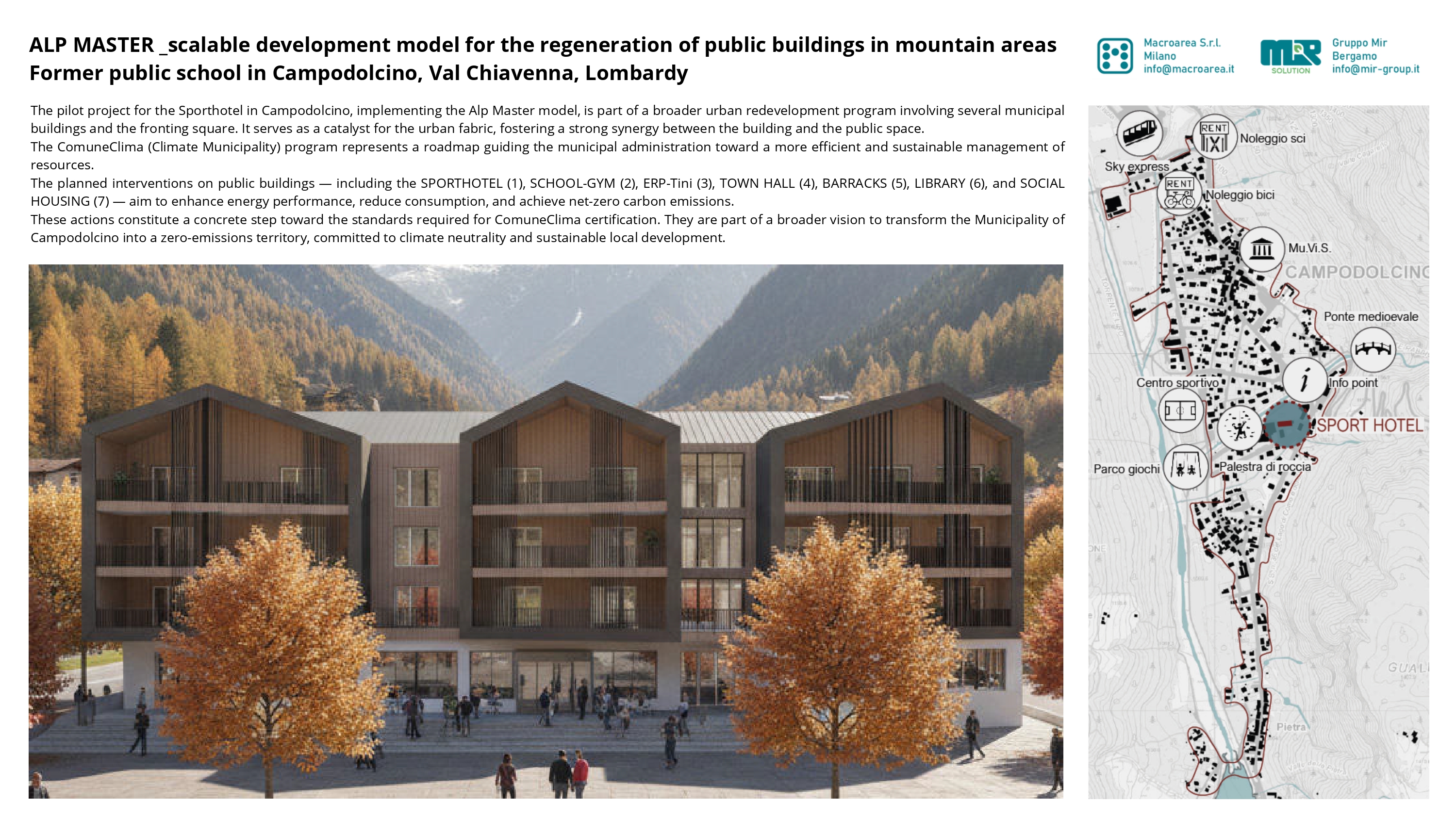
ALP MASTER is a scalable model that regenerates underused public buildings in mountain municipalities by transforming them into affordable Sport Hotels dedicated to active and sustainable tourism. Many Alpine towns face a shared challenge: publicly owned buildings such as former schools or civic offices have lost their function, while demand for flexible accommodation for outdoor tourism continues to grow. The project addresses this challenge through the adaptive reuse of existing structures, reducing the environmental impact of new construction while promoting energy-efficient renovation, low-impact materials, and more resource-efficient use of existing buildings. In this way, ALP MASTER contributes to a climate-conscious transformation of the built environment in fragile mountain ecosystems. Beyond accommodation, the regenerated buildings function as community infrastructure. Ground-floor spaces operate as open social hubs accessible to residents and visitors and co-designed with local stakeholders, sports associations, and community organisations. ALP MASTER combines architectural regeneration with an innovative public–private partnership. Municipalities provide unused buildings, while private partners manage development, financing, and operations through long-term agreements, ensuring professional management and services that support year-round tourism linked to skiing, trekking, climbing, and cycling. The pilot project in Campodolcino (Sondrio, Lombardy, Italy) demonstrates the approach by transforming an existing building into a four-level Sport Hotel connected to the public square and the network of trails and ski facilities. By reactivating unused public assets and strengthening the relationship between architecture, the cultural landscape of the Alps, and the quality of everyday community life, ALP MASTER supports the resilience of Alpine towns and offers a replicable model for mountain municipalities across Europe.
Across many Alpine municipalities, publicly owned buildings such as former schools, administrative offices or summer camps stand empty. Once central to community life, these structures have gradually lost their function and remain dormant within landscapes rich in natural and cultural value. At the same time, mountain territories face growing demand for active and outdoor tourism, while local economies often struggle with limited accommodation capacity and strong seasonal fluctuations. ALP_MASTER emerged from years of research and fieldwork carried out by Macroarea on regeneration processes in mountain regions. Through dialogue with local administrations, tourism operators, community stakeholders and local associations, the project revealed both a recurring challenge and a clear opportunity: transforming dormant public assets into catalysts for sustainable territorial development. Instead of promoting new construction, ALP_MASTER focuses on the adaptive reuse of existing public heritage, applying circular and regenerative principles. The project combines architectural regeneration, public–private partnerships and innovative management tools to convert underused buildings into SportHotels—multi-functional hospitality hubs supporting active tourism while creating welcoming living environments and spaces for community interaction connected to the Alpine landscape. The model is implemented through collaboration between municipalities, private operators and local actors. Pilot initiatives, such as the regeneration of former public buildings in Campodolcino, demonstrate how this approach can reactivate unused heritage while generating economic opportunities and benefits for residents and mountain communities. By combining research, local knowledge and practical experimentation, ALP_MASTER shows how public heritage can catalyse sustainable, inclusive and place-based development in mountain regions.
Sustainable Mountain Regeneration
Inclusive Territorial Innovation
Community-Centered Adaptive Reuse
Resilient Year-Round Tourism
Scalable Alpine Model
ALP_MASTER addresses key environmental, social, and economic challenges in Alpine territories through an innovative model of public asset regeneration and sustainable tourism development. Many mountain municipalities own underused public buildings that have lost their original function while still generating maintenance costs, while demand for affordable accommodation linked to outdoor tourism continues to grow. The project transforms dormant public buildings into energy-efficient SportHotels dedicated to active tourism. By prioritizing adaptive reuse rather than new construction, ALP_MASTER reduces land consumption, lowers environmental impact, and preserves the architectural identity of Alpine villages. Energy-efficient systems, low-impact and locally sourced materials, compact design, and shared facilities minimise resource use and operational costs while supporting a circular and resource-efficient building approach. The pilot project in Campodolcino demonstrates this approach by converting an existing building into a flexible accommodation hub for sport tourists, amateur clubs, professional teams, families, and groups. Shared spaces for training, meetings, and social activities are accessible to both visitors and local residents and are developed with local stakeholders, sports associations, and community organisations. Beyond environmental benefits, ALP_MASTER also generates social and economic value by supporting year-round tourism, reducing seasonal dependency, sustaining local employment, and strengthening the resilience of mountain communities.ALP_MASTER is exemplary in terms of sustainability because it integrates environmental responsibility, social inclusion, and economic resilience into a scalable and replicable model for Alpine and mountain regions across Europe, demonstrating how existing public assets can become drivers of sustainable territorial development.
ALP_MASTER demonstrates how regeneration and architectural quality can make Alpine territories more beautiful, welcoming, and meaningful places for residents and visitors. The project transforms underused public buildings into contemporary SportHotels, combining functional hospitality with a design approach inspired by traditional Alpine architecture. Rather than introducing new developments, ALP_MASTER enhances existing structures, preserving the identity of mountain villages while giving dormant buildings new life. The architectural concept emphasizes compact volumes, natural and locally inspired materials, and warm communal spaces reflecting the Alpine landscape. Natural light, views of the surrounding mountains, and human-scale interiors create welcoming environments that enrich everyday experience. The pilot project in Campodolcino illustrates how aesthetics can improve daily life and strengthen community identity. An existing building is converted into a hub for sport tourism and social interaction. Carefully designed shared spaces—lounges, gathering areas, and service spaces for outdoor activities—encourage encounters between visitors and residents, creating a lively and inclusive atmosphere. In ALP_MASTER, aesthetics goes beyond visual quality. It is expressed through spatial comfort, natural materials, and social spaces connected to the surrounding landscape. By revitalizing an unused building and transforming it into an attractive destination, the project enhances the everyday experience of the place and contributes to the vitality of the local community. ALP_MASTER is exemplary in terms of aesthetics because it demonstrates how architectural quality, cultural identity, and regeneration can create spaces that are both functional and inspiring, strengthening belonging and care for Alpine communities while offering a replicable model for beautiful regeneration across mountain regions in Europe.
ALP_MASTER addresses challenges of accessibility, affordability, and social inclusion in Alpine territories through an innovative model of public asset regeneration and community-oriented hospitality. Many mountain areas lack affordable accommodation for young travelers, sport groups, and families, while numerous publicly owned buildings remain underused and disconnected from community life. The project transforms these dormant structures into affordable SportHotels designed for diverse users, including youth groups, amateur sports clubs, professional teams, families, and active travelers. Flexible accommodation—combining private rooms, shared dormitories, and welcoming communal areas—ensures affordability and accessibility for different socio-economic groups while promoting shared experiences linked to outdoor activities. The design also prioritises accessibility for different ages and abilities, supporting inclusive use of spaces and facilities. The pilot project in Campodolcino demonstrates how this model can support inclusive territorial development. The regenerated building becomes not only a hospitality facility but also a social meeting place where visitors and residents interact through shared spaces and activity-oriented services connected to the surrounding mountain environment. ALP_MASTER also promotes inclusive governance through a public–private partnership in which municipalities provide underused assets while private partners contribute investment and professional management. Local stakeholders, sports associations, and community organisations can actively contribute to the development and use of shared spaces. The project is exemplary in terms of inclusion because it combines affordability, accessibility, and community participation within a scalable model. By reopening public buildings as welcoming shared spaces, ALP_MASTER broadens access to mountain tourism and strengthens social connections in Alpine communities.
ALP_MASTER reflects a participatory approach by involving local institutions, communities, and stakeholders in the regeneration of underused public buildings and the creation of new opportunities for Alpine territories. The project is based on collaboration between municipalities, local actors, and private partners to transform dormant public assets into SportHotels dedicated to active tourism and community life. Municipalities identify suitable buildings and contribute to defining the strategic vision for their reuse, while private partners provide technical expertise, investment capacity, and professional management. Local stakeholders, tourism operators, sports associations, and community organisations contribute knowledge about local needs and co-design the functions of shared spaces and community activities connected to the project. The pilot project in Campodolcino illustrates this participatory process in practice. The municipality and local stakeholders were involved in defining the reuse of the building and identifying opportunities linked to the area’s strong outdoor and sport tourism vocation. Their input helped shape flexible spaces that can host sport groups, families, and visitors while also supporting community initiatives and local activities. As a result, the regenerated building becomes not only a hospitality facility but also a multifunctional meeting place connected to the surrounding mountain environment. Local associations, tourism operators, and residents benefit directly from the revitalization of a previously unused public asset that can host social gatherings, sport activities, and community events.By integrating participatory governance, local knowledge, and professional management, ALP_MASTER demonstrates how collaborative processes can transform dormant public buildings into shared infrastructures that support sustainable tourism, community life, and local development across Alpine regions.
ALP_MASTER reflects a multilevel governance approach by coordinating stakeholders at different territorial levels to regenerate underused public buildings and foster sustainable mountain tourism. At the local level, municipalities play a central role by identifying dormant public assets and defining priorities for their regeneration. In the pilot project in Campodolcino, the municipality supported the conversion of an unused building into a SportHotel dedicated to active tourism and community use. Local tourism operators, sport associations, and community stakeholders contributed to shaping a facility aligned with the area’s outdoor vocation and local development needs. At the regional and territorial level, the initiative connects with broader Alpine development strategies, including sustainable tourism, regeneration of built heritage, and diversification of mountain economies. These links ensure that the project contributes to wider territorial objectives and integrates with regional tourism networks. At the implementation level, private partners provide technical expertise, investment capacity, and professional hospitality management, ensuring operational efficiency and enabling replication in other Alpine locations. The model also aligns with broader European priorities for sustainable tourism and regeneration of existing built heritage, contributing to wider transitions across mountain regions. This coordinated governance model creates clear added value: municipalities reactivate unused public assets without carrying the full financial burden, private actors bring innovation and operational capacity, and communities benefit from infrastructures supporting year-round tourism, social interaction, and local economic development. By linking local initiatives with wider territorial strategies, ALP_MASTER demonstrates how multilevel collaboration can transform dormant public buildings into sustainable and replicable infrastructures for Alpine regions across Europe.
ALP_MASTER reflects a transdisciplinary approach by integrating expertise from multiple disciplines to regenerate underused public buildings and develop innovative models for sustainable mountain tourism. The project combines architecture, design, engineering, tourism management, digital technologies, and territorial development to transform dormant public assets into contemporary SportHotels dedicated to active tourism. Architectural and design expertise shape spaces that are functional, welcoming, and rooted in the cultural landscape of the Alps. Engineering and building technologies support the adaptive reuse of existing structures, improving energy efficiency and reducing environmental impact while ensuring long-term operational performance. Tourism planning and hospitality management contribute to defining flexible accommodation models capable of hosting diverse users such as sport groups, families, amateur clubs, and active travelers. Digital technologies—including online booking systems, dynamic bed-based pricing, and automated access solutions—enable efficient and scalable management of the facilities. At the same time, the project integrates local knowledge and community perspectives, ensuring that spatial design and tourism strategies respond to the cultural identity and development needs of Alpine territories. The pilot project in Campodolcino demonstrates how this multidisciplinary collaboration works in practice by combining architectural regeneration with tourism development strategies and territorial knowledge. By connecting design, technology, tourism, environmental considerations, and territorial development, ALP_MASTER creates strong added value. This integrated approach generates innovative solutions that combine spatial quality, environmental responsibility, and operational efficiency while offering a holistic and replicable model for regenerating public assets and strengthening the resilience of mountain communities across Europe.
ALP_MASTER proposes an innovative and financially sustainable business model combining public asset regeneration, private investment, and professional hospitality management to strengthen the competitiveness of Alpine territories. The model is based on a public–private partnership in which municipalities provide underused public buildings—such as former schools or administrative facilities—while private partners invest in renovation, design, and operational management. This approach allows local authorities to reactivate dormant assets without bearing the full financial burden while ensuring professional long-term management. The regenerated buildings operate as SportHotels dedicated to active tourism, offering flexible accommodation including private rooms, shared dormitories, and communal spaces for sport groups, youth travelers, and families. Revenues are generated through diversified and recurring streams including accommodation services, group bookings, sport tourism packages, equipment services, and complementary hospitality activities such as food services and local experience programs. Digital management systems—including online booking, dynamic pricing per bed, and automated access—optimize occupancy rates and operational efficiency. The pilot project in Campodolcino demonstrates the feasibility of the model in a strategic Alpine destination with strong outdoor tourism demand. Renovation phases may also benefit from regional or European programs supporting sustainable tourism and building regeneration. By supporting year-round sport and nature-based tourism, the facility reduces seasonal dependency and strengthens the local tourism economy. Financial sustainability is reinforced by adaptive reuse, efficient building systems, and scalable operational standards, enabling replication in other Alpine municipalities and the creation of a network of regenerated facilities across European mountain regions.
ALP_MASTER introduces a scalable and transferable model for regenerating underused public buildings while supporting sustainable mountain tourism and strengthening local economic resilience. The project integrates adaptive reuse of public assets, an innovative public–private partnership governance structure and a modular SportHotel hospitality concept designed for active and outdoor tourism. The model has been conceived to be easily adopted by small and medium-sized mountain municipalities facing similar challenges, including dormant public buildings, limited accommodation capacity and highly seasonal tourism economies. The methodology developed within ALP_MASTER provides a clear operational framework that enables municipalities to identify suitable public assets, structure partnerships with private operators and activate sustainable tourism infrastructures without requiring large-scale new construction. The flexible SportHotel concept—combining private rooms, shared dormitories and community-oriented spaces—can be adapted to different building typologies and territorial contexts. Operational tools such as digital booking platforms, bed-based dynamic pricing systems and standardized management procedures support efficient implementation and long-term operational sustainability. The pilot implementation in Campodolcino acts as a demonstrator, generating practical knowledge and transferable practices that can guide other municipalities interested in replicating the model. The project also contributes to knowledge transfer by demonstrating how public heritage can become a catalyst for sustainable tourism development and territorial regeneration. Through its modular structure and adaptable governance framework, ALP_MASTER offers a replicable pathway to reactivate public heritage, diversify local economies and support the sustainable transformation of mountain territories across Alpine and other European regions.