Arts, Culture, and Heritage as Drivers of Change
Guardian of Heritage
Vibroacoustics and heritage: Modern diagnostics for the protection of memorial sites
The project protects tangible heritage from infrastructure vibrations. The objectives are: 1 To build precise and affordable measuring equipment that diagnoses vibrations that have a negative impact on historical objects. 2 To develop a Museum Vulnerability Index that fills gaps in building standards, using the example of the Radegast Station in Łódź. 3 To create a heritage protection tool for cultural institutions, providing them with hard data to fight for the safety of buildings and exhibits.
Poland
National
It addresses urban-rural linkages
It refers to other types of transformations (soft investment)
Prototype level
No
No
Yes
Individual
Heritage Guardian is an innovative vibroacoustic monitoring system designed to protect sensitive cultural objects and memorial sites from the destructive impact of urban infrastructure, like heavy rail traffic. Current building standards focus exclusively on the structural integrity of walls, completely ignoring the slow degradation of delicate exhibits and historical fabric. Our project fills this systemic gap.
Achievements to date:
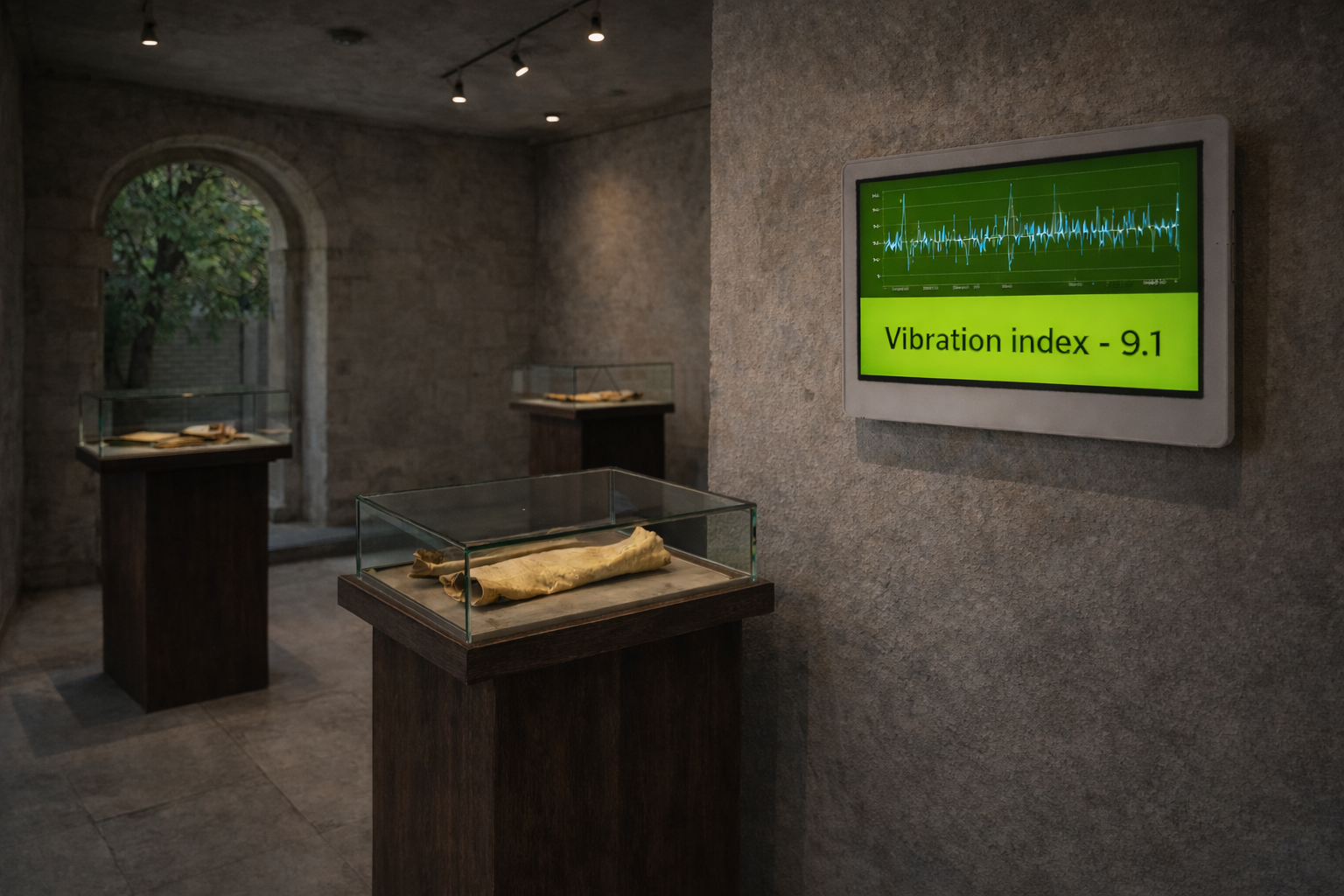
Our team prototypes highly sensitive measurement systems. We have built and field-tested a functional measuring station prototype, powered by a robust computing unit for real-time data analysis. Adapting to the varying characteristics of objects and exhibits, we utilize various sensor technologies, from piezoelectric and MEMS to passive sensors such as geophones. We now aim to expand our prototyping to include advanced Motion Amplification Camera analysis.
We successfully tested the prototype under field conditions at the Radegast Station Museum in Łódź. Measurements clearly showed that vibrations from nearby railways negatively impact the building and its collections, even though the structure itself easily meets broad, general building standards.
Expected results:
The main objective is to collect fixed measurement data and process it to create a "Museum Vulnerability Index." This index will provide an empirical, measurable correlation between environmental vibrations and their impact on heritage sites. We plan to optimize our equipment into affordable diagnostic kits for underfunded institutions. The Index will facilitate easy reporting on vibration hazards. Ultimately, we will provide curators with a robust, engineering-based tool for heritage protection. Hard data will empower them to effectively demand that infrastructure managers implement protective measures like damping mats or anti-vibration screens.
The history of the project began unexpectedly. Our team was working on a vibration measurement system for critical infrastructure. While searching for a location for field tests, we came across the Radegast Station Museum in Łódź. There, during a conversation with the director, we discovered the silent drama of this place: the historic building and exhibition are constantly being degraded by vibrations from the heavily used neighboring railroad tracks.
We quickly diagnosed two main systemic problems. First, museums do not have the budgets to commission extremely expensive commercial vibroacoustic expertise. Second, our consultations with engineers revealed a huge legal loophole. Current building standards are too general and lenient; they protect walls from collapsing, but they do not protect sensitive historical objects at all – especially those built on difficult ground, such as sand. As a result, vibrations pose a real threat of overturning and irretrievable destruction of precious exhibits.
We decided to adapt our technology to solve this problem. Our strategy is based on providing cultural institutions with an affordable measurement tool and new, rigorous standards for evaluating results.
The target process involves conducting a series of studies in many museums. The collected hard data will be used to sensitize legislators, proving that rapid economic and infrastructural development cannot come at the expense of destroying heritage.
Our project responds to a real need, and the team has an engineering solution. As we are at the prototype stage, the award will allow us to finance the necessary research and development work and prepare the system for widespread implementation.
Vibroacustic Monitoring
Social Inclusion
Railway trafic
Heritage Protection
Museum safety
Sustainability in the New European Bauhaus goes beyond ecology alone—it also encompasses the sustainability of our culture and memory. Our concept is based on the principle that the most ecological building is one that already exists. The “Guardian of Heritage” directly responds to cultural and environmental challenges by extending the life cycle of monuments and protecting priceless exhibits from irreversible damage.
Currently, damage to museum infrastructure caused by vibrations leads to extremely costly and invasive renovations. These repairs generate a huge carbon footprint associated with the production and transport of new building materials and place a heavy burden on the modest budgets of cultural institutions. By shifting the burden from costly repairs to inexpensive prevention, we are creating an exemplary model of sustainable resource management. The use of energy-efficient computing units in combination with precise passive sensors and low-current digital accelerometers allows for continuous, multi-month monitoring with minimal power consumption and low implementation costs.
In addition, the project has a systemic dimension. Our target “Museum Sensitivity Index” will become a tool for sustainable spatial planning. By collecting hard data, we will compel modern infrastructure managers to use safeguards such as vibration isolation mats. We are proving that dynamic economic and transport development can coexist harmoniously with fragile historical heritage.
In our Heritage Guardian project, aesthetics is understood on two related levels: as an overarching goal, which is the physical protection of beauty, and as a way of raising awareness of invisible threats (vibrations).
First and foremost, our concept directly contributes to the preservation of the beauty of historic districts and buildings. Vibrations caused by heavy traffic (such as the railway at Radegast Station) lead to slow, silent destruction—cracks in facades, crumbling architectural details, and the degradation of valuable exhibits. By securing these places to rigorous engineering standards, we protect their visual integrity from the need for invasive, often unsightly rescue interventions. Our goal is “invisible protection” that allows monuments to age with dignity while preserving their authentic character. This builds a sense of pride and belonging in the community—residents see that their history is respected and not sacrificed on the altar of uncontrolled infrastructure development.
The second innovative aspect of aesthetics is related to the technology itself. We plan to use dense data packages collected from our seismic sensors and geophones to create a visualization of the “heartbeat of the building.” Invisible and inaudible vibrations will be converted into generative images or light installations, illustrating the impact of the environment on the structure. This combination of analytics and digital art will reveal the beauty and fragility of materials engineering in a way that is accessible to the layman. The “Museum Sensitivity Index” thus becomes not just a dry legal parameter, but a fascinating bridge explaining the complex mechanics of soil and vibroacoustic waves in the language of everyday experience of beauty.
The value of social inclusion in the “Heritage Guardian” project is based on the idea of democratizing access to professional engineering tools and combating power asymmetries in spatial management systems. The current model of vibroacoustic expertise is highly centralized and extremely expensive, accessible mainly to powerful investors, state developers, and railway infrastructure managers. This creates an imbalance—large entities impose development based on general standards, while small cultural institutions, local museums, and housing communities that are confronted with these projects remain defenseless, without adequate funds to prove the devastating impact of the investments.
Our project radically lowers this barrier to entry and promotes inclusive governance systems. The developed, budget-friendly measurement system—based on widely available, sensitive digital accelerometers and open-source software for microcontrollers—provides hard evidence to local activists and museum curators. We are democratizing heritage protection: knowledge is no longer a privilege, but a universal right.
In addition, our concept of the “Museum Sensitivity Index” creates a new participatory model. With clear and standardized data at their disposal, institutions can engage in an equal, merit-based dialogue with legislators and investors, enforcing the implementation of vibration mitigation solutions (e.g., the construction of flexible subgrades). Winning the competition will allow us to optimize the system towards open-source “citizen kits,” supporting the broad protection of collective memory at the local level, which is in line with the deepest sense of spatial justice.
Our concept has been shaped through direct contact with the people and institutions affected by the problem. A key moment was our conversation with the director of the Radegast Station Museum in Łódź, who drew our attention to the ongoing impact of railway vibrations on the historic building and its exhibition. This transformed our project from a general vibration-monitoring idea into a heritage protection solution responding to a concrete and urgent need.
Since then, museums and site managers have not been treated as passive beneficiaries, but as practical partners. Their input helped us understand operational constraints, the sensitivity of exhibits, and the type of evidence institutions need in order to speak with conservators, infrastructure managers and public authorities. This influenced both the technical direction of the project and the way results are communicated.
We have also involved engineers and technical experts, whose participation helped us identify the limits of current standards and refine the measurement approach. Their contribution strengthened the scientific basis of the project and confirmed that structural safety criteria alone are not sufficient for heritage protection.
The participatory dimension of the concept lies in this continuous exchange between users, experts and institutional stakeholders. It ensures that the system is not developed only from a laboratory perspective, but from real conditions, real risks and real decision-making needs.
The impact of this participation has been significant. It helped us define the actual problem, validate the relevance of the concept, improve the prototype and shape the idea of the Museum Vulnerability Index as a tool that is not only technically sound, but also understandable and useful for those responsible for protecting cultural heritage.
Our concept requires multilevel governance because vibration-related risks to heritage sites involve actors from local, regional, national and European levels.
At the local level, the key stakeholders are museums, memorial institutions and site managers. They understand the daily condition of buildings and exhibits, identify urgent risks, and provide real environments for testing and validating the monitoring system.
We also involve engineers, researchers and technical experts. Their role is to develop the measurement system, design monitoring protocols, analyse data and create the Museum Vulnerability Index. Their engagement ensures that the concept is scientifically sound, technically reliable and usable in practice.
At the regional and municipal level, relevant stakeholders include local authorities, heritage protection offices, urban planners and transport-related actors. Their participation is important because vibration risks are closely linked to infrastructure planning, modernization works and local mobility systems. They can help connect monitoring results with concrete mitigation measures and policy decisions.
At the national level, we expect to engage conservation bodies, infrastructure managers and institutions responsible for standards and public policy. Their added value lies in the possibility of translating evidence from the project into improved guidelines, better protection procedures and stronger recognition of vibration risks affecting heritage.
At the European level, the concept can benefit from cooperation with heritage, research and innovation networks. This would support knowledge exchange, validation in other countries and wider dissemination.
The main added value of this multilevel approach is that it connects those who experience the problem, those who measure it, and those who can implement systemic solutions
Our concept is inherently transdisciplinary because it combines engineering, heritage protection, architecture, digital technologies and public-interest advocacy in one practical solution.
At its core, the project is based on mechanical and vibroacoustic engineering. We design and test measurement systems capable of detecting low-level vibrations that are often invisible in standard building assessments but harmful to delicate historical objects and memorial spaces.
The concept is also closely linked to architecture and conservation. We are interested not only in whether a structure remains stable, but also in how vibrations affect the historical fabric of buildings, exhibition interiors and sensitive collections. This requires understanding the specific vulnerability of heritage sites, including age, materials, structural layout and ground conditions.
Digital technologies are another key field. We use sensors, embedded computing, real-time signal processing and data interpretation tools to transform raw measurements into practical knowledge. The planned use of Motion Amplification Camera analysis adds a visual layer that makes subtle dynamic effects understandable for non-engineers such as curators and decision-makers.
The project also reflects environmental and urban knowledge, because it addresses the interaction between built heritage and surrounding transport infrastructure. We study how railway and traffic-related vibrations propagate through soil and structures, and how urban development can unintentionally damage places of memory.
Finally, the concept includes social and civic dimensions. It supports museums and memorial institutions in protecting culturally significant places, strengthens evidence-based dialogue with infrastructure managers and public authorities, and helps raise awareness that development should not come at the cost of heritage loss.
Our envisioned business model combines affordable diagnostic tools, expert services and institutional partnerships. The goal is to create a financially sustainable solution that remains accessible to museums, memorial sites and other heritage institutions with limited budgets.
The first revenue stream would come from low-cost diagnostic kits based on our monitoring technology. These kits would allow institutions to carry out preliminary or continuous vibration measurements without relying only on expensive commercial expertise. Depending on their needs, the offer could include hardware sales, leasing or subscription-based monitoring packages covering software, data analysis and reporting.
The second revenue stream would come from professional services such as on-site measurements, expert assessments, customized reports and support in preparing documentation for conservators, local authorities or infrastructure managers. This is important for institutions facing urgent risks or requiring deeper interpretation of results.
A third element is cooperation with public and academic partners. In the development phase, the project can be supported through research grants, heritage protection funds and public programs related to sustainable infrastructure and preservation. In the longer term, partnerships with municipalities, railway infrastructure managers and conservation bodies may help co-finance monitoring in high-risk areas.
The concept is financially sustainable because it addresses a clear market gap: existing expertise is often too costly, while the need for credible vibration-risk documentation is growing. By offering a more affordable and scalable solution, we can build recurring income from equipment, subscriptions and expert services.
Our concept has strong transferability because both its technology and methodology are designed to be modular, affordable and adaptable.
The measuring system can be replicated in other museums, memorial sites and historic buildings exposed to vibrations from railways, tram lines, metro systems, road traffic or nearby construction. Because the hardware uses flexible sensor configurations and relatively accessible components, it can be adjusted to different building types, risk levels and budgets.
A key transferable element is the diagnostic methodology itself. We combine field vibration measurements, real-time data analysis and object-specific interpretation of results. This approach can be applied not only to memorial sites such as the Radegast Station Museum, but also to archives, libraries, churches, castles, historic stations and other heritage sites where exhibits, interiors or historical fabric may be more vulnerable than the structure alone.
Another highly replicable result is the Museum Vulnerability Index. Although initially developed using data from a pilot site, it is intended as a practical decision-support tool that can be calibrated for different buildings, soil conditions, exhibit categories and vibration sources. This gives it potential for use in other cities and countries facing similar tensions between infrastructure development and heritage protection.
The project also generates transferable process knowledge. We are developing measurement protocols, reporting standards and cooperation models between engineers, museum professionals and public stakeholders. These can be reused in other contexts and sectors, including archives, laboratories or public buildings housing sensitive equipment.
Because infrastructure-induced vibration is an international problem and many institutions face similar budget constraints, our concept has strong potential to be scaled and replicated widely.
In the year following the application, we plan to move from a validated prototype to a practical, field-ready heritage protection system.
Our first step will be to improve the measuring station so that it becomes more compact, reliable, affordable and easier to use by museums and memorial institutions with limited technical capacity. This includes sensor optimization, long-term monitoring, automated data processing and clearer reporting tools. We also plan to expand the system with Motion Amplification Camera analysis to complement point vibration measurements.
At the same time, we will continue field measurements at the Radegast Station Museum in Łódź, our pilot site, and begin testing the concept in additional heritage institutions exposed to traffic-related vibrations. This will allow us to collect a broader comparative dataset covering different building types, soil conditions, exhibit sensitivities and infrastructure environments.
Based on these results, we will develop the Museum Vulnerability Index: a practical tool that translates raw vibroacoustic data into understandable risk levels for curators, conservators, engineers and decision-makers. The aim is to show when vibrations may be acceptable for a building’s structure, yet still harmful to fragile exhibits, interiors and historical fabric.
In parallel, we will promote the concept through pilot partnerships, presentations and outreach to museums, conservation professionals and public stakeholders. We also want to use the collected evidence to open a wider discussion with legislators and infrastructure managers about the need for more precise standards for protecting heritage from vibration impacts.
The award would enable us to finance essential R&D work, expand testing, validate the index and prepare the solution for wider implementation.