Strengthening Local Democracy and Inclusion
HACOY City Hubs - Craft Meets Community
Decentralized Fashion Hubs That Revive Local Craft and Build Inclusive Communities Across Europe
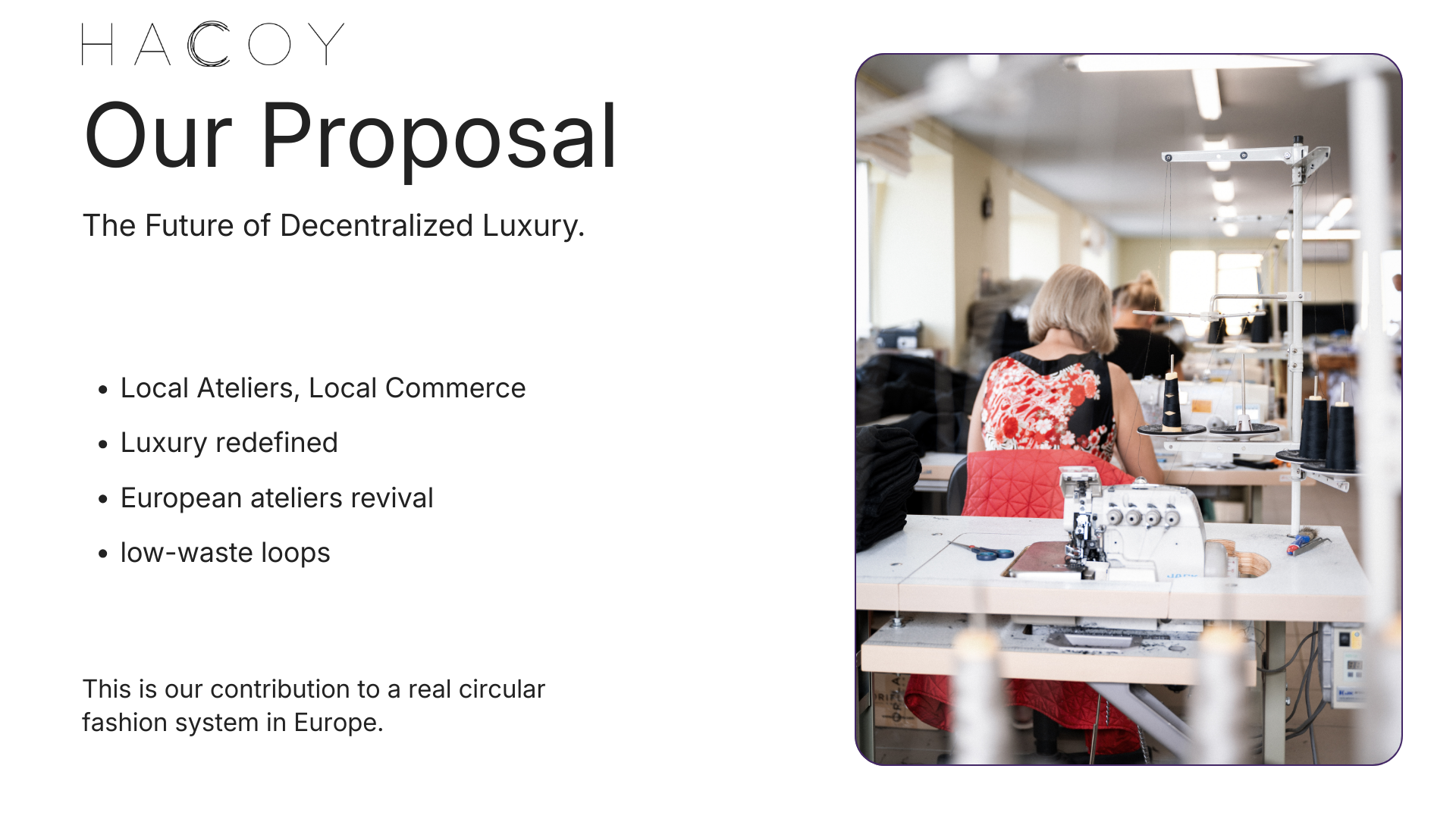
HACOY is building a network of city hubs where slow fashion becomes a vehicle for social inclusion and craft revival. Each hub connects elderly artisans, young makers, and underrepresented communities through workshops, shared wardrobes, and hyperlocal production. Rooted in the principle of Radical Proximity - making and selling within the community - HACOY proves that fashion can rebuild local belonging, preserve generational knowledge, and create a more democratic, human-centered economy.
Germany
Local
Munich
Mainly urban
It refers to other types of transformations (soft investment)
Early concept
No
No
No
Organisation
HACOY is a slow luxury fashion brand from Munich proposing a replicable model for community-centered, locally rooted fashion ecosystems across European cities. The concept is called HACOY City Hubs - physical spaces where fashion becomes a vehicle for social inclusion, craft revival, and cross-generational belonging.Each hub operates on three layers. First, production: working exclusively with local and regional artisans, reviving generational craft knowledge and keeping textile skills alive in European communities. Second, commerce: selling only what is made locally, proving that luxury can be redefined through proximity rather than exclusivity. Third, community: hosting workshops, shared wardrobes, mental health awareness events, and LGBTQ-inclusive programming that makes fashion a gathering point rather than a transaction.The concept is rooted in the principle of Radical Proximity - the belief that where and how something is made matters as much as the product itself. HACOY holds OEKO-TEX 100 certification and 100/100 Ethical Accreditation, and currently produces with family-owned manufacturers in Italy and Lithuania, with an active transition toward fully hyperlocal European production.The first hub is planned for Munich. The model is designed to be replicable - each city hub connects conscious consumers directly to the makers, materials, and communities in their own city. The expected results include preserved craft heritage, new economic opportunities for local artisans, inclusive community spaces for underrepresented groups, and a proven blueprint for decentralized slow luxury that other European cities can adopt.
HACOY was born from a moment of personal crisis and clarity. After working in an industry built on overconsumption and manufactured desire, founder Maximilian Rupp could not sell another lie.
He started HACOY with a simple question: what if a fashion brand was built entirely around the people who make it and the people who wear it, rather than around trend cycles and global supply chains?
The Paris pitch at the New European Bauhaus affiliated event in early 2026 was a turning point. Standing in front of 100 people and articulating the vision of decentralized luxury and local ateliers revival made clear that HACOY is not just a brand - it is a proposal for a different kind of fashion system. One where production, community, and commerce all happen in the same place.
The HACOY City Hub concept emerged from combining three observations. European craft knowledge is disappearing because there is no economic model to sustain it. Young people want to connect with making but have no entry point. And fashion retail has become completely disconnected from the communities it serves.
The hub model solves all three simultaneously. Elderly artisans pass knowledge to young makers. Young makers produce for local conscious consumers. Local consumers become part of a community rather than just a customer base. Fashion becomes a reason to gather, to learn, and to belong.
Munich is the starting point. The model is designed to travel.
Slow fashion
Community inclusion
Craft revival
Radical proximity
Circular local economy
HACOY addresses sustainability across three interconnected dimensions: environmental, economic, and cultural.
Environmentally, HACOY produces exclusively with certified sustainable materials, holding OEKO-TEX 100 certification and 100/100 Ethical Accreditation from the Good Shopping Guide. Every production decision is guided by a low-waste philosophy - we make less, better, and only what is needed. We work with family-owned manufacturers in Italy and Lithuania and are actively transitioning toward a fully hyperlocal European production model.
Economically, HACOY challenges the fast fashion model by creating timeless essentials designed to last rather than trend cycles designed to expire. The HACOY City Hub model proposes a new economic structure for fashion - one where production, retail, and community all happen locally, keeping value circulating within the city rather than extracting it to global supply chains.
Culturally, the most endangered sustainability crisis in European fashion is the disappearance of craft knowledge. Skilled artisans are aging out of the industry with no successors. HACOY's hub model directly addresses this by creating economic structures that make local craft viable again, connecting elderly artisans with young makers, and embedding textile heritage into everyday community life.
The concept is exemplary because it does not treat sustainability as a certification or a marketing claim. It treats it as a structural redesign of how fashion is made, sold, and experienced.
HACOY's founding philosophy is Comfortable Elegance - the belief that beauty and comfort are not opposites, and that truly well-designed clothing makes people feel more human, not more performing.
This aesthetic philosophy extends directly into the HACOY City Hub concept. A hub is not a retail store with a community program bolted on. It is a space designed around the experience of belonging. The physical environment - the shared wardrobe, the workshop table, the garments made by hands you can see - creates a tangible sense of care for place and people that fast fashion retail has made almost impossible to find.
Beauty in this context is not decoration. It is the feeling of wearing something made by someone in your city, knowing exactly where the fabric came from and who cut it. It is the quiet dignity of a 70-year-old artisan passing a skill to a 20-year-old in the same room. It is the design of an experience where fashion becomes a reason to gather rather than a transaction to complete.
HACOY's brand identity - clean, warm, unhurried - reflects this directly. Every visual and material choice is made to create a sense of calm confidence rather than anxious aspiration. This sensibility carries into the hub design: spaces that feel lived-in, crafted, and genuinely local rather than branded and replicated.
The concept is exemplary in aesthetics because it proposes that beauty is not a surface quality applied to products. It is the quality of the relationships and experiences that products can build around them.
The HACOY City Hub model is built on the conviction that fashion has excluded far too many people for far too long - by price, by body type, by age, by cultural background, and by geography.
The hub model addresses inclusion on multiple layers simultaneously.
Cross-generational inclusion: elderly artisans whose craft knowledge is disappearing are given an active economic and social role within the hub. Young makers who want to connect with traditional skills have direct access to that knowledge. The exchange is mutual - neither generation is performing for the other.
Social inclusion: each hub hosts programming that explicitly welcomes underrepresented communities, including LGBTQ individuals, people experiencing mental health challenges, and those who have felt excluded from mainstream fashion spaces. Fashion becomes a gathering point rather than a mirror that reflects narrow standards back at people.
Economic inclusion: the shared wardrobe model makes HACOY's slow luxury pieces accessible to community members who could not otherwise afford them. This is not charity - it is a deliberate reframing of ownership and access. Wearing something beautiful should not require buying it.
Body inclusion: HACOY is actively working to expand its size range and uses the direct community relationships created by the hub model to understand and respond to real body diversity rather than industry standards.
Geographic inclusion: the hyperlocal model means that fashion ecosystems are built in cities across Europe, not concentrated in a handful of fashion capitals. Every city deserves its own slow luxury culture rooted in its own craft heritage.
The concept is exemplary in inclusion because it does not add inclusion as a feature. It builds inclusion into the structural DNA of how the hub operates.
HACOY's concept has been shaped through direct and ongoing engagement with the communities it aims to serve. The participatory dimension operates on two levels: the design of the brand and the development of the hub concept.At the brand level, HACOY has engaged directly with conscious consumers, artisans, and local makers to understand what slow fashion actually means to real people rather than imposing a top-down aesthetic. Customer feedback, ambassador relationships, and direct showroom interactions in Munich have continuously informed product decisions, sizing considerations, and community programming ideas.At the concept level, the HACOY City Hub model was pressure-tested through a public pitch at a New European Bauhaus affiliated event in Paris in early 2026, attended by approximately 100 participants including designers, urban planners, investors, and community leaders. The responses and conversations that followed directly shaped the inclusion layer of the hub concept - particularly around body diversity, mental health programming, and LGBTQ welcoming spaces.The shared wardrobe component of the hub model emerged specifically from community conversations about access and affordability. It was not a design decision made in isolation - it came from listening to people who wanted to engage with slow luxury but felt economically excluded.Going forward, each HACOY City Hub is designed to be co-created with its local community. The Munich hub will involve local artisans, youth organizations, and inclusion-focused partners in shaping both the physical space and the programming calendar from the outset.
The HACOY City Hub concept is designed to engage stakeholders across multiple levels simultaneously, recognizing that a sustainable local fashion ecosystem cannot be built by a single actor.
At the local level, the primary stakeholders are the artisans, makers, community organizations, and conscious consumers who will inhabit and co-create each hub. In Munich, this means engaging with local craft schools, textile workshops, mental health organizations, LGBTQ community spaces, and neighborhood cultural institutions. These relationships are already being initiated through HACOY's existing showroom presence and community network.
At the regional level, HACOY is engaged with the Fashion Council Germany and regional textile and creative economy networks. The FCG membership provides access to peer brands, regional policy conversations, and connections to other makers working toward similar goals across southern Germany and the broader DACH region.
At the national level, HACOY's ethical accreditations and certifications position it within broader conversations about sustainable fashion policy, circular economy standards, and the future of European textile manufacturing.
At the European level, participation in the New European Bauhaus community directly connects HACOY's hyperlocal model to the EU's broader agenda around sustainable, inclusive, and beautiful living environments. The NEB network offers the possibility of connecting Munich's pilot hub to similar initiatives in other European cities, creating a transnational community of practice around locally rooted fashion ecosystems.
The added value of this multilevel engagement is replicability. A model proven in Munich with local partners, validated by regional networks, and connected to European frameworks is a model that can travel.
The HACOY City Hub concept deliberately draws on multiple disciplines and knowledge fields, recognizing that a community-centered fashion ecosystem cannot be designed from within fashion alone.
Fashion and textile design forms the core: the curation of slow luxury garments, the craft of making, the ethics of material sourcing, and the aesthetics of Comfortable Elegance that anchor the brand identity.
Social sciences and community development inform the inclusion architecture of each hub - how spaces are designed to welcome people across age, body type, cultural background, and economic means. The cross-generational workshop model draws on intergenerational learning theory and community co-design practice.
Architecture and spatial design are essential to translating the hub concept into a physical experience. The difference between a retail store and a genuine community gathering place is an architectural and experiential design question as much as a programming one.
Cultural heritage and craft preservation bring in the artisan dimension - understanding how traditional textile knowledge is transmitted, what economic structures make it viable, and how heritage skills can be made relevant to contemporary conscious consumers.
Mental health and wellbeing inform the programming around inclusive spaces, body positive environments, and the relationship between clothing, self-expression, and personal resilience.
Circular economy and sustainability science underpin the material and production philosophy - OEKO-TEX certification, low-waste production loops, and the transition toward hyperlocal European sourcing.
Finally, entrepreneurship and new business models are embedded in the hub concept itself - the membership structure, shared wardrobe economics, and the replicable city-by-city expansion model all require innovation beyond traditional fashion retail thinking.
The HACOY City Hub model is designed to generate revenue across multiple streams simultaneously, reducing dependency on any single source and making each hub financially viable over time.The core revenue streams are:Product sales: slow luxury garments sold directly through the hub, combining the brand's existing e-commerce offering with an in-person showroom experience. The hyperlocal model reduces logistics costs and increases margin compared to traditional retail.Membership: a tiered membership structure offering different levels of access to the hub community, workshops, and shared wardrobe. Three tiers are envisioned - Friend of HACOY (15 EUR/month), Inner Circle (45 EUR/month), and Patron (120 EUR/month). Even at modest initial membership numbers, this creates meaningful recurring revenue independent of product sales.Shared wardrobe access: included in higher membership tiers, the shared wardrobe reduces the barrier to engaging with slow luxury while generating recurring subscription income.Workshop programming: paid workshops hosted by artisans and makers within the hub, open to members and the broader public. These generate revenue while delivering the core inclusion and craft revival mission.Partnership and sponsorship: cultural institutions, mental health organizations, and local businesses aligned with the hub's values can co-sponsor programming, reducing operational costs while deepening community roots.Over time, the replicable hub model creates a licensing or franchise-adjacent opportunity - other cities adopting the HACOY hub framework under shared brand and operational standards, generating revenue beyond Munich.Public funding and EU grants are considered complementary rather than foundational, ensuring the model is not grant-dependent.
The HACOY City Hub model is designed from the outset to be replicable. Every element of the concept is modular and transferable to different European cities and contexts.
The core replicable elements are:
The hub operational playbook: the programming calendar structure, workshop format, shared wardrobe management system, and membership tier model can be documented and reproduced in any city with a local fashion or craft community. The Munich hub serves as the proof of concept from which this playbook is built.
The Radical Proximity sourcing framework: the principle of identifying and partnering with local artisans, textile producers, and makers within a defined geographic radius is a methodology that applies to any European city with a textile heritage. The approach does not require HACOY's specific suppliers - it requires the process of finding and formalizing relationships with local makers.
The membership and shared wardrobe model: the economic structure of tiered memberships and community access to a rotating garment wardrobe is a model that translates across cities and could extend beyond fashion into other slow luxury categories such as craft objects, ceramics, or locally produced textiles.
The cross-generational programming model: connecting elderly artisans with young makers through structured workshop formats is a social design methodology applicable in any community facing craft knowledge loss, independent of geography or fashion context.
The brand framework: Comfortable Elegance and Radical Proximity are values-based design principles that can anchor locally distinct hub identities while maintaining a coherent European network identity.
The concept also has transferability beyond fashion - the hub model could be adapted for other craft sectors including ceramics, furniture making, or traditional food production, wherever generational knowledge transfer and community inclusion are at risk.
The twelve months following this application are focused on proving the Munich model and building the foundation for replication.
March - April 2026: Formalize the LICO hub concept into a one-page operational blueprint covering costs, programming, membership structure, and partner requirements. Begin outreach to potential anchor community partners in Munich across craft, mental health, and cultural inclusion spaces.
April - June 2026: Confirm one anchor community partner in Munich - a craft school, mental health organization, or LGBTQ cultural space. Activate the first HACOY hub programming within the existing Munich showroom space, starting with one monthly workshop connecting an elderly artisan with young participants. Launch the founding membership tier to a small initial cohort of 20 to 30 members.
June - September 2026: Run the first full season of hub programming - minimum one workshop per month, one shared wardrobe activation, and one community event tied to a product moment. Document everything: attendance, participant feedback, revenue generated, artisan engagement. This documentation becomes the replication playbook.
September - December 2026: Present the Munich model results to the FCG network, NEB community partners, and potential investors. Begin conversations with one additional European city for hub replication in 2027, prioritizing cities where HACOY already has brand recognition or artisan contacts.
Throughout: Maintain active participation in the NEB Community, contribute learnings to the network, and seek collaboration with NEB members working on complementary community and craft initiatives.