Enablers for New European Bauhaus Transformation
Predictive Systems for HS
Predictive Systems for Human Sustainability: Predictive Systems for Human Sustainability
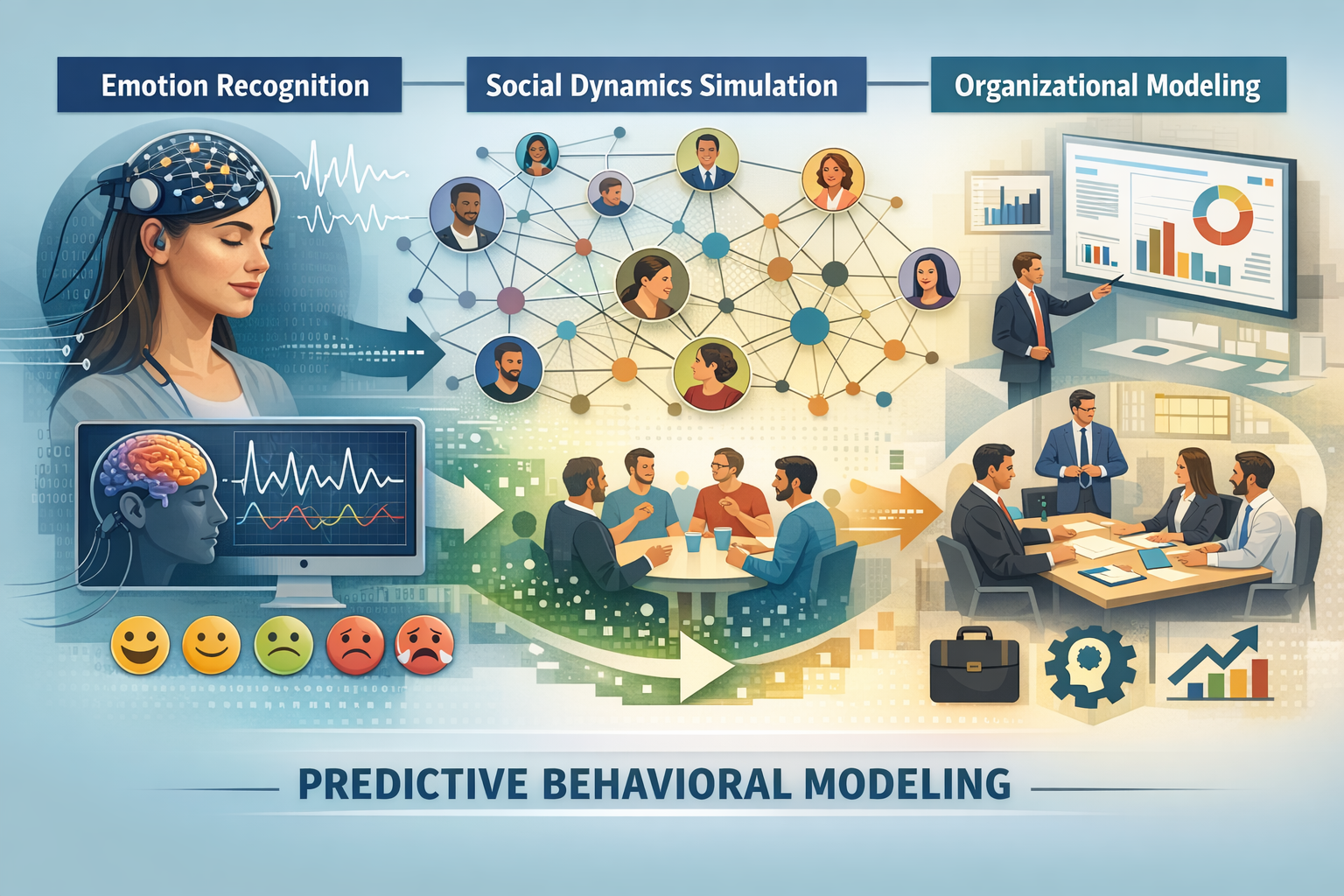
This project develops predictive models of human behavior across three scales individual emotion using EEG and artificial intelligence social dynamics through agent based network simulations and organizational resilience through computational models of error management. Together these systems translate psychological processes into measurable predictors supporting neurodriven technologies that improve media environments mental well-being and long term human sustainability
Greece
National
It addresses urban-rural linkages
It refers to other types of transformations (soft investment)
Early concept
No
No
No
Individual
This project develops predictive models of human behavior across three levels micro meso and macro using measurable psychological variables. At the micro level emotional states are modeled using EEG signals combined with artificial intelligence. Core variables include EEG signal features emotional state classification positive neutral or negative temporal mood transitions personality traits such as empathy and conscientiousness and satisfaction outcomes after media exposure. The system achieved about 91 percent testing accuracy using a hybrid convolutional neural network and transformer architecture while reducing the required electrodes from sixty two to five enabling realistic consumer neurotechnology applications.
At the meso level social dynamics are modeled through an agent based network simulation. Agents are defined by variables including attitude openness to influence assertiveness and relational network structure while a global Net Attitude variable represents the ideological field influencing all agents. More than fifty million stochastic simulations revealed three emergent dynamics a Neutral Attractor pushing opinions toward moderation a Structural Tug of War where belief convergence occurs alongside social fragmentation and a Dynamic Sweet Spot where moderate openness generates maximum system complexity.
At the macro level an organizational simulation models workforce systems using variables such as worker capacity mistake probability resilience thresholds resentment accumulation learning windows monitoring intensity and managerial response style ignoring correcting or punishing errors. Results show punitive oversight increases short term productivity but accelerates workforce collapse while corrective management sustains performance stability and learning.
Together these models demonstrate that emotional social and organizational processes can be translated into predictive computational systems supporting future human centered technologies.
The idea emerged from observing that many systems influencing human behavior such as social media platforms organizations and digital environments optimize short term outcomes like engagement or productivity while neglecting long term psychological sustainability. This motivated the development of a research approach that translates emotional cognitive and social processes into measurable variables that can be modeled computationally.
The concept was developed through three interconnected projects across different levels of human systems. The first step focused on the micro level by modeling emotional states using EEG signals and machine learning. A hybrid convolutional neural network and transformer architecture was trained on aggregated emotion recognition datasets achieving high classification accuracy while reducing the number of required electrodes making future consumer applications more feasible.
The second step expanded the framework to the meso level through an agent based network simulation built in NetLogo. Agents were defined by variables including attitude openness and assertiveness while a global Net Attitude variable represented the broader influence field. Large scale stochastic simulations and sensitivity analyses explored how opinions and social connections evolve and identified emergent patterns in network cohesion.
The third step extended the approach to the macro level through an organizational simulation examining how managerial responses to errors influence productivity learning and workforce stability through variables such as mistake probability monitoring intensity resentment accumulation resilience thresholds and resignation dynamics.
Together these steps combine machine learning computational simulation and statistical analysis to model emotional social and organizational systems and support future human centered technologies.
predictive modeling
existential sustainability
emotion recognition
social dynamics
human sustainability
The concept addresses social, economic and cultural challenges by focusing on the long term sustainability of human systems in digital, social and organizational environments. Many current technological and institutional systems optimize short term outcomes such as attention retention productivity or rapid decision making while neglecting psychological well-being and long term stability. This often produces unintended consequences including emotional instability in digital environments social fragmentation and workforce burnout. The proposed framework addresses these challenges by developing predictive models that allow emotional social and organizational dynamics to be measured and simulated before harmful outcomes occur.
At the individual level the system uses emotion recognition and behavioral modeling to support healthier media consumption patterns. By recommending content based on emotional state and personality traits the approach aims to reduce negative mood spirals and promote more stable emotional environments in digital media use.
At the social level agent based simulations help identify conditions under which societies may experience polarization or fragmentation despite moderate opinions. Understanding these dynamics can support the design of communication environments that preserve social cohesion.
At the organizational level the simulation models demonstrate how management strategies influence workforce resilience productivity and long term stability. The results highlight how corrective learning oriented environments sustain productivity while reducing burnout and turnover.
The concept is exemplary in terms of sustainability because it focuses on designing systems that maintain long term human well-being stability and resilience rather than maximizing short term gains.
The concept contributes to the aesthetic dimension of sustainability by improving the emotional quality of everyday digital and social environments. Today many online spaces and information ecosystems are designed to maximize engagement rather than emotional balance, often amplifying stress, conflict and negative emotional cycles. By integrating emotion recognition and behavioral modeling the project aims to create media environments that are calmer, more supportive and emotionally harmonious. This improves the everyday experience of interacting with digital content, helping individuals maintain healthier emotional rhythms rather than being pushed toward constant stimulation or negativity.
At the community level the social network simulations provide insight into how communication environments influence cohesion and belonging. By understanding how opinions and relationships evolve in networks the research can inform the design of digital and social spaces that encourage constructive interaction and reduce fragmentation. Such environments support stronger connections between individuals and foster a sense of belonging within communities.
In the longer term the project contributes to aesthetic sustainability by promoting environments that align technology with human psychological needs. Rather than overwhelming individuals with information or emotional volatility the proposed systems aim to create balanced digital ecosystems that support reflection, stability and well-being.
The concept can be considered exemplary in terms of aesthetics because it treats emotional experience and human well-being as central design elements. By shaping digital environments that are psychologically supportive the project contributes to making everyday life calmer more meaningful and more harmonious for individuals and communities.
The concept promotes inclusion by designing predictive tools and digital systems that are accessible, affordable and adaptable to diverse populations. A central goal of the research is to reduce technological barriers by developing models that function with simplified and widely available tools. For example the emotion recognition system was designed to operate with a small number of EEG electrodes rather than complex laboratory equipment. This significantly lowers cost and makes future consumer applications more accessible to individuals outside specialized research environments.
The project also supports inclusion through data diversity and open research infrastructure. The development of a new EEG dataset for emotion recognition within the Greek population addresses the lack of representation of smaller populations in existing neuroscience datasets. By making this dataset openly available for future research the project contributes to more inclusive scientific resources that allow comparative studies across cultures.
At the social level the network simulations aim to better understand how communication environments influence polarization fragmentation and belonging. Insights from these models can inform the design of digital platforms and social systems that encourage constructive interaction rather than exclusionary dynamics.
The concept is exemplary in terms of inclusion because it combines accessible technology open scientific resources and modeling approaches that help identify structural barriers to participation. By focusing on affordability representation and equitable design the project aims to ensure that future emotion aware technologies benefit diverse individuals communities and cultural contexts rather than only highly resourced environments.
The development of the concept has incorporated participation from users and research participants throughout multiple stages of the project. Participants have been involved primarily through experimental studies examining emotional responses to media content and through data collection for the development of emotion recognition models. In these studies participants report their baseline emotional state, interact with different types of media content and evaluate their emotional experience and satisfaction. Their responses directly inform the development of the predictive algorithms and help determine how emotional states and personality traits influence media consumption outcomes.
Participation has also played a role in the design of the experimental frameworks. Feedback from participants regarding usability, emotional experience and clarity of the experimental process has been used to refine the structure of the studies and the types of content presented. This iterative process ensures that the models reflect real behavioral responses rather than purely theoretical assumptions.
At the research level collaboration with academic laboratories and research environments provides additional stakeholder involvement. The development of the Greek EEG dataset includes participant recruitment and engagement within the local research community, contributing to the creation of open scientific resources that other researchers can use.
The impact of this participatory approach is that the concept evolves based on real human responses and behavioral data rather than abstract modeling alone. Participant feedback and experimental data help refine both the predictive models and the potential real world applications ensuring that future tools are aligned with the needs and experiences of users.
The concept engages stakeholders across multiple levels of research, education and technological development. At the local level collaboration with the cognitive laboratory of Dr. Irini Skaliora at the Academy of Athens supports the development of experimental studies and the creation of a new EEG dataset for emotion recognition within the Greek population. Local participants contribute data that allow the models to be validated and adapted to real human behavior while also strengthening research capacity within the local scientific community.
At the academic and institutional level universities and research environments contribute to the design and testing of the computational models and experimental protocols. These collaborations support methodological rigor and provide interdisciplinary perspectives combining psychology neuroscience artificial intelligence and computational social science.
At the national and European level the research contributes to broader scientific and technological ecosystems through publications conference presentations and open datasets. Sharing datasets and modeling approaches enables other researchers and institutions to replicate extend and apply the methods across different cultural and social contexts.
In the future the concept could also involve stakeholders from technology development public health and digital platform governance. These actors can help translate research findings into practical tools that improve digital environments and media ecosystems.
The added value of this multilevel engagement is that it connects local experimental research with broader scientific collaboration and potential policy relevance ensuring that the models can be adapted and applied across different social and institutional contexts.
The concept is inherently transdisciplinary and integrates knowledge from several scientific and technological fields in order to model human behavior and develop sustainable digital environments.
Psychology forms the theoretical foundation of the project by providing frameworks for understanding emotion, cognition, personality and social behavior. These psychological variables are translated into measurable predictors that can be used in computational models. Neuroscience contributes through the use of EEG signals to detect emotional states and study how the brain responds to different types of media content.
Artificial intelligence and machine learning play a central role in implementing the emotion recognition system. Neural network architectures are used to extract patterns from EEG data and classify emotional states. Computational social science and complexity science contribute through the development of agent based models that simulate social dynamics within networks and organizational systems.
Computer science and data science support the development of the algorithms, simulations and statistical analyses required to process large datasets and perform large scale computational experiments. These tools allow researchers to observe emergent patterns in complex systems that cannot be easily studied through traditional methods.
Finally the concept also connects with digital technology design and media studies by applying these models to the development of healthier digital environments and content recommendation systems.
By combining psychology neuroscience artificial intelligence computational modeling and digital technology design the project demonstrates how multiple disciplines can work together to better understand and improve human centered technological systems.
The envisioned business model combines a research driven platform with advisory and analytical services built around predictive behavioral modeling. The core offering would be a general modeling platform capable of analyzing emotional social and organizational dynamics using the computational frameworks developed through the research. This model could be applied across domains where human behavior relationships and decision environments play an important role.
One component would be a service allowing companies institutions and organizations to tune the models to their own environments. By integrating organizational or behavioral data the simulations could reflect the structure of a workplace network communication system or institutional environment. This would allow organizations to test management strategies and observe potential long term consequences before implementing them.
A second component would be analytical consulting services. Based on model outputs the project could provide interpretation reports and strategic recommendations. These reports would help organizations detect patterns such as burnout conflict or declining cohesion and identify management approaches that support long term stability and productivity.
The framework could also be used by governmental institutions and policy organizations to analyze social dynamics polarization and communication ecosystems.
Financial sustainability would come from consulting services licensing the modeling platform collaborative research projects public research funding and institutional partnerships. Over time the platform could also expand into subscription based analytical tools for organizations that wish to monitor behavioral dynamics within their systems.
This modeling approach can be applied to many environments where human interaction, decision making and organizational structures play an important role, including workplaces, educational institutions, public organizations and digital platforms.
The technological infrastructure is also scalable. The agent based simulation models and machine learning systems can be adapted to different datasets and organizational structures, allowing the models to be tuned for specific industries or social environments. Because the emotion recognition system was designed to operate with a reduced number of EEG electrodes, the technology can also be integrated into more accessible consumer grade neurotechnology as such devices become more widespread.
Another scalable element is the analytical framework used to interpret behavioral patterns. The same modeling tools can support organizations in identifying risks related to burnout, declining cohesion or inefficient management structures, while also helping policy researchers explore broader social dynamics such as polarization or communication fragmentation.
Finally the project promotes scalability through open scientific practices including the development of new datasets and computational models that can be shared and extended by other researchers. This allows the methodology tools and key insights to be replicated across different countries cultural contexts and institutional environments, increasing the broader impact of the concept.
The concept is already moving from theoretical development toward practical implementation through research, collaborations and dissemination. Several concrete steps are planned for the year following the application.
First the research infrastructure will be expanded in order to scale the empirical component of the project. This includes acquiring additional EEG devices, upgrading computational resources and maintaining access to EEG software subscriptions required for data collection and signal processing. Increasing the number of EEG systems will allow larger participant samples and faster data collection, which is necessary for refining the emotion recognition models and improving their reliability across different individuals.
Second new collaborations with companies and institutions will be pursued in order to conduct applied studies in real environments. Organizations that participate in the research will be able to use the general behavioral modeling framework to analyze emotional and organizational dynamics within their systems. In exchange they will provide access to anonymized data that can help scale and validate the models. This creates a mutually beneficial arrangement where organizations gain insights while the research gains real world data.
Third dissemination through academic publications and conferences will continue in order to strengthen scientific validation and visibility. Research on EEG based emotion recognition has already been accepted for presentation at EMCIS 2025 and is expected to appear in Springer Lecture Notes in Information Systems and Organisation. In addition two papers related to the computational models are currently under peer review at the Journal of Artificial Societies and Social Simulation.
These steps combine infrastructure development partnerships and scientific dissemination to further implement and scale the concept during the year following the application.