Enhancing Circularity, Sustainability, and Innovation
U-BUILD Community
U-BUILD Community – Residrnt-led affordable and sustainable housing model
U-BUILD Community is a citizen-led housing initiative that enables groups of residents to collectively develop affordable and sustainable residential buildings. By removing traditional developer profit margins and using modular architectural prototypes, the model makes housing more accessible while promoting high-quality design, community participation and environmental responsibility.
Montenegro
Regional
The concept is currently being developed in Montenegro with the intention to expand and replicate the model in Serbia and other cities in the Western Balkans.
Mainly urban
It involves a physical transformation of the built environment (hard investment)
Prototype level
No
No
No
Individual
U-BUILD Community is a cohousing initiative that explores new models of affordable and sustainable residential development in Montenegro and Serbia. The concept enables groups of residents to collectively develop residential buildings by sharing investment, planning and decision-making, while removing traditional developer profit margins that significantly increase housing prices.
The initiative addresses the growing housing affordability crisis affecting young people across the Western Balkans. In many cities, residential development is primarily driven by profit-oriented investment, making access to home ownership increasingly difficult for young families and middle-income citizens. U-BUILD proposes an alternative model where future residents become active participants in the development process rather than passive buyers.
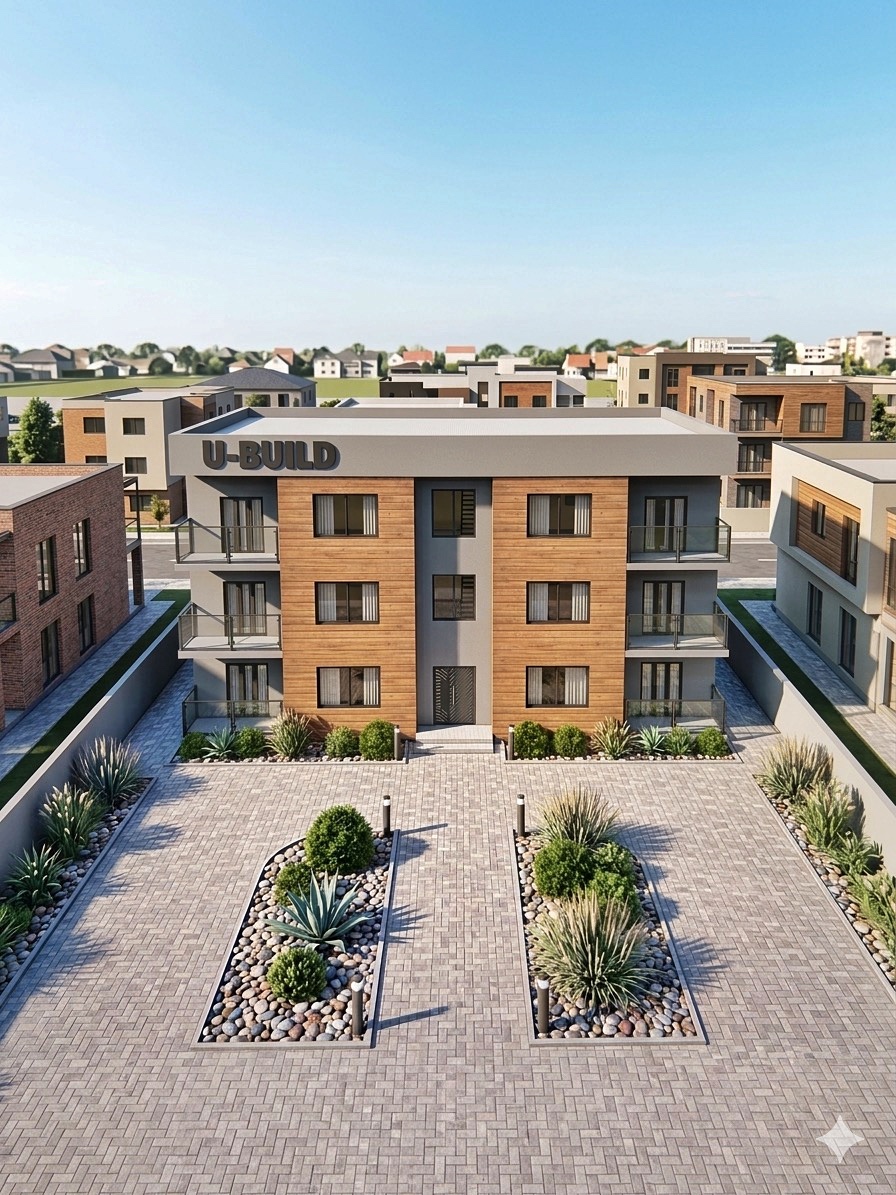
The project is based on modular prototype residential buildings designed to be simple, efficient and affordable to construct while maintaining high architectural quality. The first prototype design has already been developed as a small residential building with six apartments, demonstrating the architectural feasibility of the concept.
The development model involves organizing interested residents around a specific project, estimating construction costs with a building company, and acquiring land collectively or through cooperation with landowners who may participate in the project in exchange for housing units. Financial transparency is ensured through phased payments and escrow accounts during construction.
The concept integrates sustainability through compact architectural design, energy-efficient building envelopes and the use of renewable energy systems such as rooftop solar panels. In the future, the initiative also aims to develop digital tools that would allow participants to follow project development, finances and construction progress in a transparent and collaborative way.
Through this approach, U-BUILD Community aims
The U-BUILD Community initiative began in February 2025 while exploring alternative housing models that could address the growing housing affordability crisis affecting young people in the region.
As a young architecture student, I personally experience the challenges of accessing affordable housing. This motivated the search for alternative models that could enable citizens to collectively develop residential buildings without relying on profit-driven developers.
The concept was further developed through participation in the Social Impact Award program, where the idea was refined with mentorship and feedback related to social innovation and entrepreneurship. In order to further develop the initiative and raise awareness about collective housing models, the non-profit organization Gradimo Zajedno (“Building Together”) was established.
Most recently, the concept was further explored through participation in the UNDP Green Urban Tech Sprint, where the project focused on integrating sustainable architectural solutions and environmentally responsible urban development.
Through these steps, the initiative evolved from an initial concept into a concrete architectural prototype and a structured development model that can be replicated in different cities.
Affordable housing
Sustainable architecture
Resident-led development
Energy efficiency
Community participation
U-BUILD Community addresses sustainability by combining environmentally responsible architectural design with socially sustainable housing development. The concept promotes compact residential buildings that reduce land consumption and construction materials while improving energy efficiency.
The prototype buildings are designed with energy-efficient envelopes, high-quality insulation and optimized spatial organization to reduce long-term energy demand. Flat roofs allow the installation of solar panels that can provide renewable electricity for residents and reduce environmental impact.
Beyond environmental aspects, the concept also contributes to economic sustainability. By removing traditional developer profit margins and organizing collective construction, the model significantly lowers housing costs and makes sustainable housing accessible to a wider group of citizens.
Through efficient architectural design, renewable energy integration and collective development models, U-BUILD demonstrates how sustainable housing can be both environmentally responsible and economically accessible.
U-BUILD Community aims to demonstrate that affordable housing can also achieve high architectural quality and contribute positively to the visual identity of neighbourhoods. The prototype buildings are designed with a contemporary architectural language that combines simple forms, balanced proportions and natural materials.
The design prioritizes natural light, functional layouts and comfortable living environments that improve everyday quality of life for residents. Interior and exterior spaces are carefully designed to create pleasant and welcoming living environments.
By focusing on well-designed, human-scale residential buildings rather than anonymous large developments, the project promotes architecture that strengthens the sense of place and community. The goal is to show that affordability does not need to come at the expense of architectural quality and beauty.
Through thoughtful design and attention to everyday living spaces, U-BUILD contributes to creating neighbourhoods that are visually appealing, comfortable and meaningful for the people who live there.
Inclusion is at the core of the U-BUILD Community model. The project introduces a participatory housing development approach where future residents become active participants in the planning and realization of their homes.
By organizing groups of citizens who collectively invest in and develop residential buildings, the model allows people to access housing at cost price rather than market prices driven by speculative investment. This approach makes home ownership more accessible, especially for young people and middle-income households.
The concept also promotes inclusive governance by involving residents directly in decision-making processes related to design, development and project organization. In the future, the initiative also aims to develop digital tools that would allow participants to transparently follow project progress, finances and construction phases.
Through participatory development, affordability and community involvement, U-BUILD demonstrates a new model of inclusive housing that empowers citizens and strengthens social cohesion.
U-BUILD Community is built on a participatory housing development model where future residents are directly involved in the planning and realization of their homes. Instead of being passive buyers, citizens become active participants in the development process.
The concept encourages the formation of resident groups interested in collectively developing residential buildings. These participants are involved in discussions about architectural design, project organization and financial structure. Their participation helps ensure that housing solutions respond to real needs rather than speculative market interests.
The involvement of citizens also strengthens community bonds even before construction begins. Through shared decision-making and collaboration, participants develop a stronger sense of ownership and responsibility toward their future neighbourhoods.
This participatory approach transforms housing development from a purely market-driven process into a collaborative social initiative where citizens actively shape their living environments.
The development of the U-BUILD Community initiative involves collaboration between different stakeholders at multiple levels. At the local level, the concept engages citizens who are interested in participating in collective housing projects and shaping the development of their homes.
The project was initially developed in collaboration with a university professor, bringing academic knowledge and architectural expertise into the process. Through the establishment of the non-profit organization Gradimo Zajedno, the initiative aims to create a structured platform that can connect citizens, architects, engineers, construction companies and financial institutions.
At the regional level, the concept has been developed through participation in programs such as the Social Impact Award and the UNDP Green Urban Tech Sprint, which provided mentorship, feedback and connections with innovation ecosystems.
In the future, cooperation with municipalities, banks and public institutions could further support the implementation of citizen-led housing projects and contribute to more inclusive housing policies.
U-BUILD Community integrates knowledge from multiple disciplines in order to create a holistic housing model that addresses architectural, social, economic and environmental challenges.
Architecture and urban design play a central role in developing efficient and aesthetically valuable residential prototypes. Engineering and construction expertise are essential for ensuring that buildings are structurally efficient, affordable and feasible to construct.
The concept also incorporates social innovation by exploring new forms of citizen participation and collective housing development. Economic and financial knowledge is necessary to structure collective investment models and ensure transparent project financing.
In the future, digital technologies may also play an important role through the development of online platforms that allow participants to monitor project development, financial contributions and construction progress.
Through the integration of architecture, engineering, social innovation and digital tools, U-BUILD represents a transdisciplinary approach to contemporary housing challenges.
U-BUILD Community is based on a non-profit driven development model supported by the NGO Gradimo Zajedno. The organization acts as a facilitator that brings together groups of citizens interested in collectively developing residential buildings.
Future residents participate in financing the project collectively, allowing housing to be built at cost price without developer profit margins. The NGO coordinates project organization, architectural planning and cooperation with construction companies.
To ensure financial transparency, project funds are managed through escrow accounts and construction payments are made in phases based on completed work.
In the long term, the model aims to develop partnerships with financial institutions in order to provide participants with accessible housing loans. The initiative may also generate revenue through small coordination or facilitation fees related to project organization and management.
By combining collective investment, transparent financing and scalable architectural prototypes, U-BUILD aims to create a financially sustainable housing model that can be replicated in different cities.
The U-BUILD Community model has strong potential for replication because it is based on simple and adaptable principles that can be applied in different cities and regions.
The concept relies on modular architectural prototypes designed to be efficient, affordable and easy to adapt to different urban contexts. These standardized designs allow residential buildings to be replicated with minimal adjustments depending on local regulations and site conditions.
The development methodology can also be transferred to other locations. The process of organizing resident groups, estimating construction costs, acquiring land collectively and managing construction through transparent financial mechanisms can be applied in different housing markets.
The model is particularly relevant for cities facing housing affordability challenges, where citizens are seeking alternatives to speculative real estate development. Because the concept does not depend on a single location or developer, it can be replicated by communities, NGOs or local organizations in different regions.
In the long term, the model could expand through digital platforms that facilitate community organization, project coordination and transparent monitoring of collective housing developments.
The next phase of the U-BUILD Community initiative focuses on moving from concept development to the implementation of the first pilot project.
During the coming year, the initiative aims to organize interested citizen groups and further refine the prototype residential building design in order to prepare it for potential implementation. This includes improving technical documentation, exploring suitable locations for the first project and establishing cooperation with construction companies.
At the same time, the NGO Gradimo Zajedno will continue raising awareness about collective housing models through public communication, workshops and collaboration with local communities.
Another important step will be exploring partnerships with financial institutions that could provide accessible housing loans for participants involved in future projects.
The main objective for the next stage is to prepare the conditions necessary for the realization of the first U-BUILD pilot building, which would serve as a demonstration project and a foundation for further replication of the model in other cities.