Arts, Culture, and Heritage as Drivers of Change
The European Looping Cities Project
The European Looping Cities Project - Co-Creating the Sound of European Communities
What if a city could listen to itself?
The European Looping Cities Project is a mobile performance and archive initiative that gathers the sounds, voices and stories of local communities across Europe, transforms them into live music, and permanently marks the places where they happened — building a transdisciplinary, replicable format for cultural regeneration, one city at a time.
The European Looping Cities Project is a mobile performance and archive initiative that gathers the sounds, voices and stories of local communities across Europe, transforms them into live music, and permanently marks the places where they happened — building a transdisciplinary, replicable format for cultural regeneration, one city at a time.
Italy
National
It addresses urban-rural linkages
It refers to other types of transformations (soft investment)
Early concept
No
No
Yes
Individual
The European Looping Cities Project – Co-Creating the Sound of European Communities is a transdisciplinary participatory art format that transforms European cities into collective musical instruments.
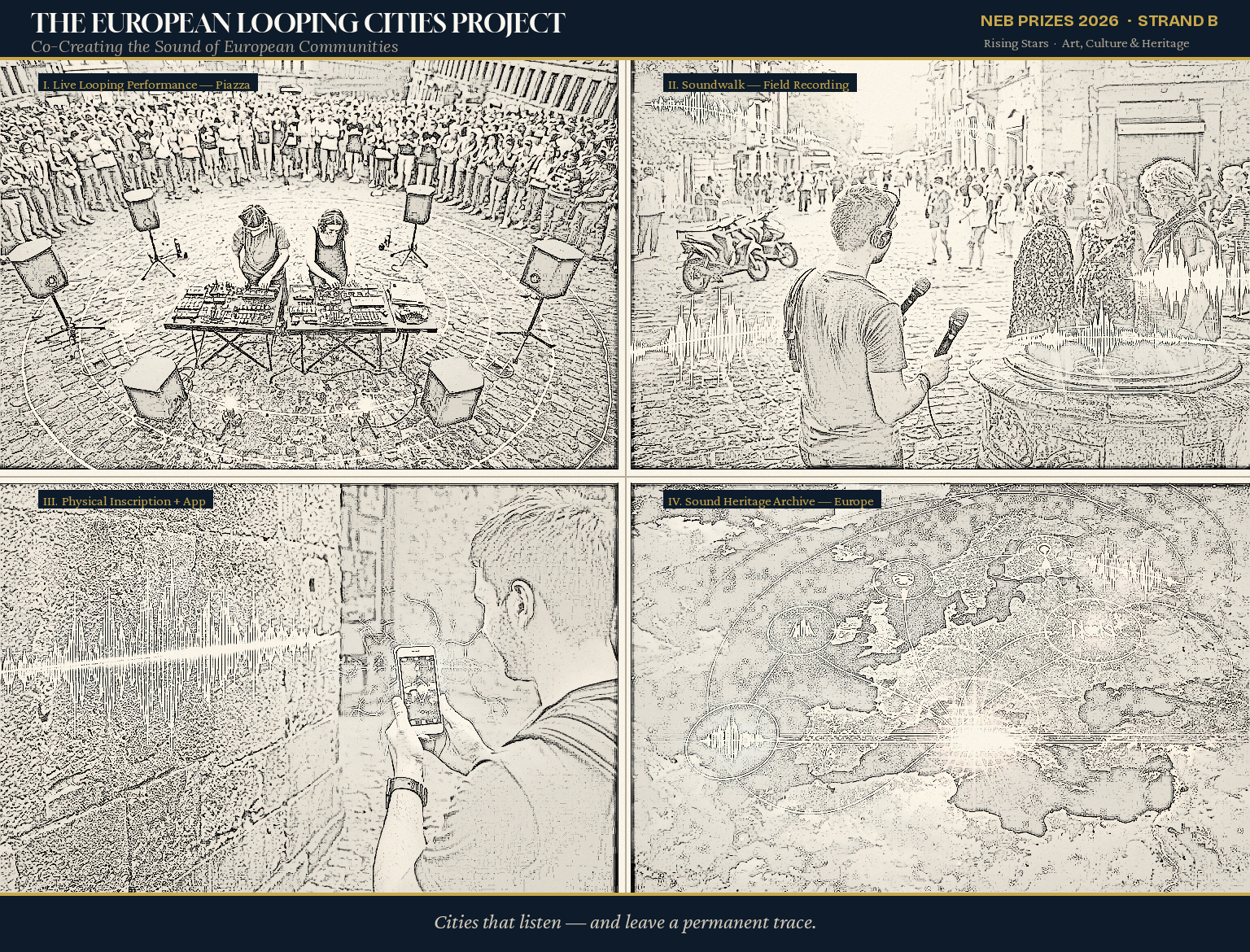
Through soundwalks, community workshops, live looping performances and permanent physical inscriptions, the project co-creates a living sound archive of local cultural identity — accessible through a dedicated open-source app and permanently marked in the urban fabric.
The process follows a replicable format — approximately three months per city edition — structured around four operational phases: soundwalk and field recording; community laboratory; live looping performance in underused urban spaces; and a final collective inscription ceremony. The project leaves two complementary physical marks: during the soundwalk, each collected sound's waveform is discretely inscribed on the wall of its recording site; after the performance, the composition's waveform — built from all gathered sounds — is added to each site and inscribed in the performance space during a collective ceremony. Every mark is scannable via app, creating a permanent, accessible layer of cultural memory embedded in the city.
Expected results per city: one live performance, place-specific sound collections, one collective composition, one sound heritage archive, educational workshops, one permanent urban installation. Across cities, all compositions converge into a final European collective symphony. The expected replicability rate is 3 to 4 city editions per year. The pilot edition will be held in Naples, Italy — a city whose artistic influence on European identity makes it an ideal starting point for a project rooted in belonging, cultural wealth and collective memory.
The European Looping Cities Project was born at the intersection of two inseparable forces: a personal artistic path and a deep bond with a specific place.
Both creators grew up in Naples — a city that has shaped world culture through its music, its people, its streets and its contradictions. Naples is a place of extraordinary sonic richness: its dialect carries centuries of history, its markets and crafts produce sounds that are disappearing, its sense of belonging is unlike anywhere else in Europe. It is a city that has always expressed itself through sound, collectively and instinctively.
From this origin came the central question of the project: what if that collective expression could be listened to, collected, transformed and given back to the community as a permanent cultural act?
The artistic answer was live looping — a practice that builds music in real time by layering recorded sounds, making the process of creation visible and participatory. Combined with an ethnographic approach to urban listening, this became the methodological core: not just recording a city, but involving its people in deciding what deserves to be remembered, transformed and inscribed.
The concept developed through the convergence of sound art, urban ethnography, digital archiving and a concrete question about cultural sustainability: how do we preserve what cities sound like before it disappears?
Participatory soundscape
Urban cultural heritage
Live looping & co-creation
Community-led digital archive
Transdisciplinary regeneration
The project addresses sustainability on three interconnected levels.
Environmentally, performances take place in underused urban spaces, requiring no new construction and contributing to the reactivation of existing built heritage. Energy use is minimised through solar-powered equipment and lightweight, portable technical setup.
Culturally, the project tackles one of the most overlooked forms of heritage loss: the disappearance of urban soundscapes. Dialects, artisanal sounds, oral traditions and community rituals are forms of intangible cultural patrimony that vanish without documentation. The Sound Heritage Archive creates a permanent, community-owned record aligned with the Faro Convention (Council of Europe, 2005), which defines cultural heritage as a right belonging to the communities that recognise it as their own.
Economically, the replicable format minimises per-city costs, the open-source app reduces long-term technological dependency, and the post-funding sustainability model combines institutional partnerships, public grants, and community donations — ensuring the archive survives beyond the project lifecycle.
The European Looping Cities Project treats beauty not as decoration but as a form of civic care.
The live looping performance transforms raw urban sounds — a vendor's call, a loom, a dialect phrase, water running through an old fountain — into music, making the invisible beauty of everyday life audible and collective. The performance space is designed as a minimal sensory environment: spatial sound diffusion, low lighting, site-specific positioning of the audience within the abandoned space itself, so that the architecture becomes part of the composition.
The permanent physical inscriptions are the project's most distinctive aesthetic act. During the soundwalk phase, the waveform of each collected sound is discretely inscribed on the external wall of the exact place where it was recorded — a school, a craftsman's workshop, a market wall. After the performance, the waveform of the live looping composition is added alongside: the same wall carries both the local voice and the collective result. Each inscription is both a visual mark and a sonic one: beautiful as an object, meaningful as an act, transforming ordinary urban surfaces into a distributed public art installation accessible to anyone at any time. The project culminates in a single collective ceremony, held in the performance space, where the composition's waveform is permanently inscribed — the moment a community signs the transformation of its own voice into music.
This aesthetic of quiet accumulation and ceremonial culmination — the idea that a community's voice is literally written into the city, piece by piece and then all at once — creates a long-term sense of care for place that goes far beyond the duration of the project itself.
Inclusion is structural to the project, not supplementary.
The soundwalk methodology is designed to reach beyond traditional cultural audiences: schoolchildren, elderly craftsmen, market vendors, residents of marginal neighbourhoods are all active contributors, not passive spectators. Participation requires no technical skill, no cultural background, no economic resource — only a voice, a story, or a sound.
The physical inscriptions ensure permanent accessibility: they are located on public-facing walls, visible and scannable 24 hours a day, free of charge, without requiring internet connectivity (the app functions offline via local cache). This is particularly significant for communities with limited digital access.
The governance of the archive is community-based: each local community retains custodianship of its own recordings, with the right to preserve, contextualise or — if collectively decided — remove them. Licensing follows Creative Commons principles with community consent clauses, ensuring that cultural ownership remains where it belongs: with the people who created it.
The educational workshops in schools and the involvement of local craftsmen, researchers and architects ensure that the project reaches multiple generations and social groups simultaneously, building intergenerational cultural dialogue as a concrete output.
Community participation is not a feature of the project — it is its method.
The soundwalk protocol is co-designed with local partners before each city edition, identifying priority listening areas, community gatekeepers, and sites of cultural significance that would otherwise remain invisible to external observers. During the soundwalk, residents are invited to contribute not just sounds but context: a sentence they want preserved, a story attached to a place, a memory of a sound that no longer exists.
The community laboratory transforms this raw material collectively: participants listen back to the recorded sounds, becoming aware of their local world and actively contribute to the composition that will be performed publicly. The live looping performance is the culmination of this process — a moment where the community hears itself transformed into music, in a space it helped choose.
The physical inscription ritual is the final participatory act.
The project is designed to engage stakeholders at every level simultaneously.
Local: neighbourhood associations, schools, artisan workshops, cultural centres, and municipal cultural offices provide access to communities, spaces, and local knowledge. In Naples, existing networks and relationships form the foundation of the pilot edition.
Regional: regional cultural institutions and universities provide research support, ethnographic expertise, and technological partnership for app development — ideally through a formal agreement with a faculty of architecture, digital humanities or sound studies.
National: national cultural ministries and creative economy funds provide co-funding pathways and institutional legitimacy for replication across cities.
European: the project is explicitly designed as a European initiative. Each city edition contributes to a shared Sound Heritage Archive and a collective European composition, creating a concrete cultural product that embodies diversity within a common framework — directly aligned with the New European Bauhaus vision of unity through local identity.
The multi-city structure ensures that no single institution controls the project: governance is distributed, with each community holding custodianship of its own contribution.
The European Looping Cities Project is transdisciplinary by design, not by addition.
Its core team combines sound art and live looping performance with urban ethnography and field recording methodology. Around this core, each city edition integrates: architects and urban designers (spatial configuration of performances and inscription placement), researchers in soundscape studies and cultural heritage (methodological rigour and academic anchoring), local craftsmen (instrument building from local materials, inscription techniques), digital developers (app development, GIS mapping, archive infrastructure), educators (workshop design for schools), and visual designers (documentation, video production, social communication).
No single discipline could produce this project alone. The live looping performance only works because the ethnographic soundwalk produced meaningful material. The physical inscription only works because the architect understood the urban context. The archive only works because the developer built an offline-capable, open-source system. The educational workshop only works because a pedagogue translated the artistic process into accessible learning.
This integration is also a replicable model: each city edition activates a local transdisciplinary network, leaving behind not just an archive but a community of practice.
The financial sustainability of the project is built on four complementary streams.
Public funding: European cultural programmes (Creative Europe, INTERREG, Horizon Europe) and national/regional cultural funds provide primary project financing, covering per-city operational costs, equipment, personnel, and app development. The NEB Prize itself is a first step in this direction.
Institutional partnerships: agreements with universities, cultural foundations, and municipal governments provide in-kind contributions (spaces, research support, local networks) that significantly reduce direct costs and increase legitimacy.
Community donations: the app includes an optional donation mechanism — a non-intrusive popup inviting users to support the archive's maintenance. Given the multi-city scale and the app's role as a permanent public resource, even modest per-user contributions create a sustainable maintenance fund over time.
Crowdfunding and community ownership: specific city editions can be co-funded through participatory crowdfunding campaigns, turning local communities into investors in their own cultural archive.
Post-funding, the archive infrastructure is maintained through the donation model and partnership agreements. The open-source nature of the app eliminates licensing costs and allows community-driven updates, ensuring long-term technological resilience without dependency on a single provider.
The European Looping Cities Project is replicable by design.
The core format — soundwalk, community laboratory, live looping performance, physical inscription, archive publication — is a documented, transferable protocol that can be applied in any urban context with minimal infrastructure. It requires no permanent physical installation beyond the inscriptions themselves, no proprietary technology, and no specialised venue.
The elements most directly transferable are: the soundwalk methodology (adaptable to any cultural and linguistic context), the inscription protocol (scalable from a single wall to a network of urban surfaces), the app infrastructure (open-source, offline-capable, reusable across cities), and the educational workshop format (designed for adaptation across age groups and school systems).
Each city edition produces a replication kit: documented process, technical specifications, community engagement protocols, and lessons learned — so that future editions can be led by local organisations independently, transforming the project from a travelling format into a self-sustaining European movement.
Month 1 — Preparation: Formalisation of local partnerships in Naples (schools, artisan networks, cultural associations, municipal contacts). Selection and survey of performance space. Design of physical inscription (materials, technique, aesthetic protocol). Development of app wireframe in partnership with a university or tech partner. Finalisation of soundwalk protocol and consent framework. Legal structuring of archive ownership and Creative Commons licensing.
Month 2 — Naples Pilot Edition. Full application of the format:
Week 1: soundwalk and field recording. Discrete inscription of each sound's waveform on the external wall of the recording site.
Week 2: workshop with the community, systematization of sound material.
Week 3: preparation of the space, rehearsals, setup.
Week 4: public live looping performance. Full photo and video documentation. Collective inscription ceremony in the performance space: the composition's waveform is permanently marked. Return visits to each recording site to add the performance waveform alongside the site-specific inscription. First nucleus of the Sound Heritage Archive goes live.
Month 3 — Post-production and Diffusion: Archive publication. Launch of app prototype. Analysis of pilot results. Refinement of format and protocol. Social media campaign activation. Submission to additional European funding calls. Identification of second city partner.
Month 4 — Second City Edition: Preparation and application of refined format in a second European city. Expansion of Sound Heritage Archive.
NB: According to the project's development plan, the expected replicability rate is 3 to 4 city editions per year.