Enhancing Circularity, Sustainability, and Innovation
Green Island of Safety
Green Island of Safety: Climate-resilient public space for community wellbeing
Green Island of Safety is a concept to transform a public space in Dobroslav community (Ukraine) into a green, climate-resilient and inclusive place for rest and social interaction. Through tree planting, smart irrigation and solar-powered lighting, the project will create a cooler and safer environment for residents. The initiative combines nature-based solutions with community participation to improve wellbeing and everyday life in the community.
Ukraine
Local
Dobroslav
Mainly rural
It involves a physical transformation of the built environment (hard investment)
Early concept
No
No
No
Individual
The concept “Green Island of Safety” aims to transform a public space in Dobroslav community (Odesa region, Ukraine) into a climate-resilient, inclusive and energy-independent green area that supports wellbeing, social interaction and environmental sustainability.
The initiative responds to several pressing challenges faced by many communities today: increasing summer heat, the need for safer public spaces, and energy instability caused by disruptions to electricity supply. The concept proposes a combination of nature-based solutions and sustainable technologies to address these challenges at a local scale.
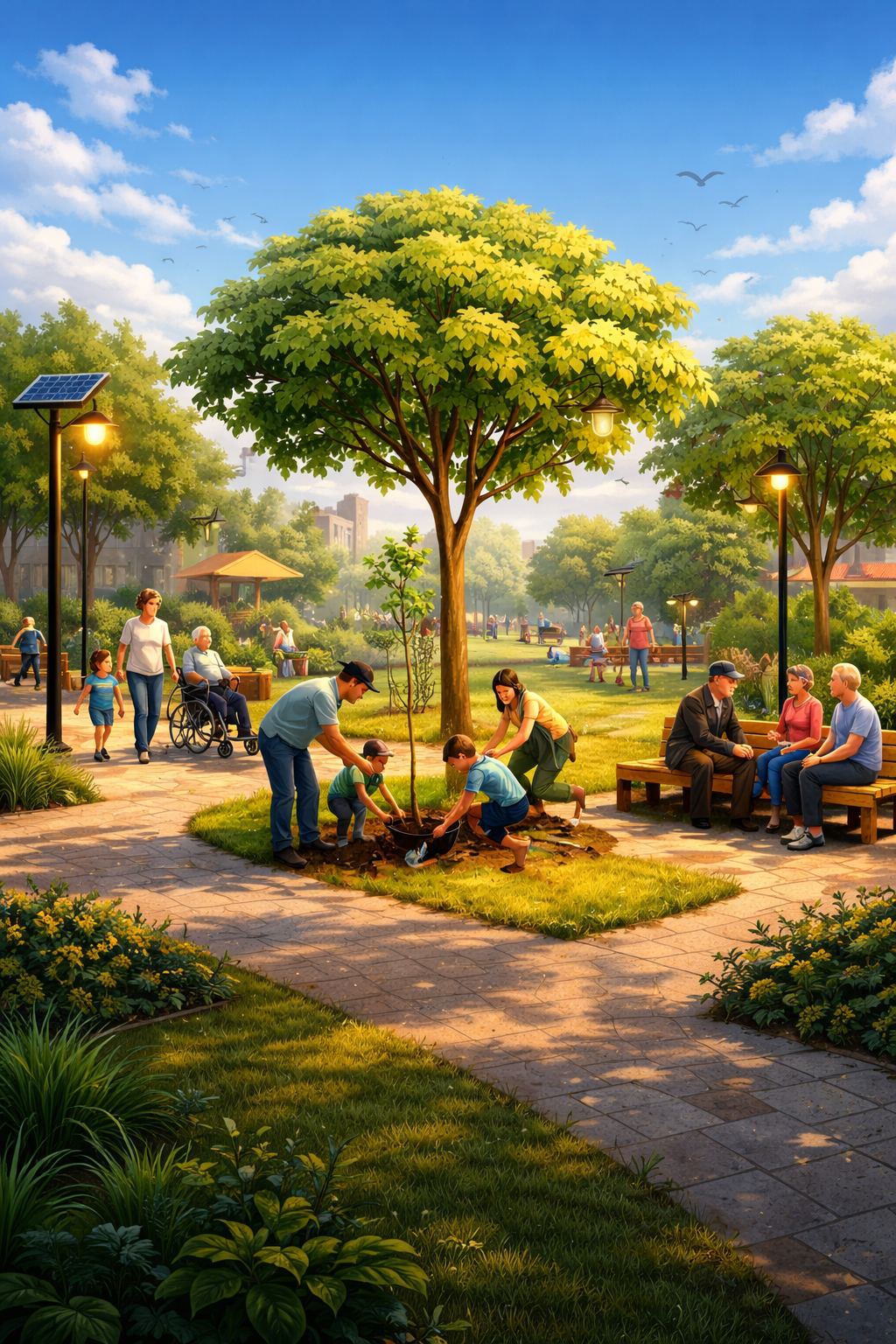
The project includes planting 30 catalpa trees to create natural shade and reduce heat in the area, helping to lower the temperature during summer peaks by an estimated 3–5°C. A smart drip irrigation system will optimise water use and ensure healthy growth of the trees while reducing water consumption. In addition, solar-powered lighting and a smart bench will provide safe and comfortable use of the space during evening hours without relying on the main electricity grid.
The space will be designed according to principles of universal design, ensuring accessibility for people with different mobility needs, including elderly residents, veterans, families with children, and internally displaced persons.
Expected results include improved microclimate, increased green coverage, enhanced safety through energy-independent lighting, and the creation of an attractive and inclusive public space that encourages community interaction. The concept demonstrates how small-scale, nature-based interventions can strengthen community resilience while improving the quality of everyday public spaces.
The idea for the “Green Island of Safety” emerged from discussions within the Dobroslav community about how public spaces could better respond to the realities of climate change and wartime challenges. In recent years, increasingly hot summers have made many outdoor areas uncomfortable for children and elderly residents, while periodic energy disruptions have reduced the safety of public spaces after dark.
At the same time, the community has seen a growing need for calm and welcoming places where residents, internally displaced persons and veterans can rest, communicate and recover from stress.
The concept was developed through informal consultations with residents, parents and young community members who regularly use the local public space. Their feedback highlighted several key priorities: natural shade, safe lighting in the evening, accessible infrastructure and a welcoming atmosphere for people of all ages.
Based on these discussions, the concept combines nature-based solutions, renewable energy and inclusive design principles. The strategy focuses on simple but effective interventions such as tree planting, smart irrigation and solar lighting, which together create a resilient and sustainable micro-environment.
The initiative demonstrates how small-scale community-driven solutions can improve everyday public spaces and strengthen social resilience at the local level.
Nature-based solutions
Climate resilience
Inclusive public space
Renewable energy
Community participation
The concept “Green Island of Safety” addresses several environmental and social challenges by introducing nature-based solutions and sustainable technologies into a local public space. The planting of 30 catalpa trees will create natural shade, improve air quality and help reduce the temperature in the area during summer heat peaks by an estimated 3–5°C. This contributes to climate adaptation and helps mitigate the urban heat island effect.
A smart drip irrigation system will ensure efficient water use by delivering water directly to the roots of the trees and adjusting irrigation according to soil moisture. This approach significantly reduces water consumption while supporting healthy plant growth.
The concept also integrates renewable energy solutions. Solar-powered lighting and a smart bench will allow the space to remain safe and functional even during electricity disruptions. This energy independence is particularly important for communities experiencing energy instability.
Social sustainability is ensured through the creation of an accessible and inclusive public space designed according to universal design principles. The area will provide a comfortable environment for children, families, elderly residents, veterans and internally displaced persons.
By combining ecological landscaping, efficient resource management and renewable energy, the concept demonstrates how small-scale interventions can support climate resilience and improve the sustainability of everyday public spaces in local communities.
The concept “Green Island of Safety” aims to transform an ordinary public space into an attractive, welcoming and human-centred environment that improves everyday life for residents. The aesthetic approach of the project is based on the integration of nature, comfortable public infrastructure and thoughtful design.
The planting of catalpa trees will create a distinctive green canopy that provides natural shade while visually transforming the space into a calm and pleasant environment. Over time, the trees will shape a recognizable green identity for the place, turning it into a small urban oasis where people can relax, meet and spend time outdoors.
Carefully selected elements such as wooden benches, discreet solar lighting and accessible pathways will create a harmonious and comfortable atmosphere. The lighting design will provide a soft and safe evening environment, allowing the space to remain welcoming after sunset.
The concept also emphasises the emotional connection between people and place. Community participation in planting trees and caring for the space will strengthen the sense of ownership and belonging among residents.
By combining greenery, simple design and community involvement, the project demonstrates how even a small transformation of public space can create beauty in everyday life and foster a long-term culture of care for the local environment.
The concept “Green Island of Safety” is designed as an inclusive public space that is accessible and welcoming for people of different ages, backgrounds and mobility levels. The project follows the principles of universal design, ensuring that the space can be comfortably used by children, elderly residents, families with strollers, people with disabilities and other groups with specific accessibility needs.
The layout of the area will avoid physical barriers and provide comfortable seating and clear pathways that allow easy movement for people with limited mobility. Informational elements will also consider accessibility needs, including the potential use of tactile or Braille elements.
The initiative also responds to the social context of Ukrainian communities, where many internally displaced persons and veterans are seeking safe and welcoming environments for social interaction and psychological recovery. The green public space will provide a calm and supportive environment that encourages communication and community life.
Inclusion is also reflected in the governance approach of the concept. Local residents, parents and young community members have been involved in discussions about the needs of the space and will participate in tree planting and community activities related to the project.
By combining accessible design, community participation and a focus on vulnerable groups, the concept demonstrates how public spaces can support social cohesion and ensure that everyone can benefit from a shared environment.
The concept “Green Island of Safety” has been shaped through dialogue with local residents and users of the public space. Informal discussions with parents, young people and community members helped identify the main needs of the area, including the lack of shade during summer heat, insufficient lighting in the evening hours and the need for a comfortable and welcoming place for social interaction.
These conversations played an important role in defining the priorities of the concept. Residents highlighted the importance of greenery, safe lighting and inclusive design that allows people of different ages and mobility levels to use the space comfortably.
The concept therefore integrates community suggestions by focusing on tree planting, accessible seating areas and energy-independent lighting that ensures safety even during power outages.
Community participation will continue during the implementation phase. Residents, young people and volunteers will be invited to take part in tree planting activities, community events and the care of the green space.
This participatory approach strengthens the sense of ownership and responsibility for the space, encouraging residents to actively contribute to the creation and long-term maintenance of a shared and welcoming environment.
The development and implementation of the concept “Green Island of Safety” involves cooperation between stakeholders at several governance levels.
At the local level, the initiative is supported by the Dobroslav community administration, local residents and community groups. Residents, parents and young people contribute their ideas and participate in discussions about the design and use of the space. Local volunteers are expected to participate in tree planting and community activities related to the maintenance of the green area.
At the regional level, the project can benefit from cooperation with environmental specialists, landscape designers and organisations working on sustainable urban development and climate adaptation.
At the national and European levels, the concept aligns with broader priorities related to climate resilience, sustainable public spaces and inclusive community development. Participation in initiatives such as the New European Bauhaus helps connect local projects with European knowledge networks and good practices.
The engagement of stakeholders at different levels adds significant value to the concept. Local participation ensures that the space responds to real community needs, while regional and European collaboration can bring additional expertise, knowledge exchange and innovative approaches. This multi-level cooperation helps strengthen the long-term sustainability and impact of the project.
The concept “Green Island of Safety” is based on a transdisciplinary approach that combines knowledge and practices from several fields in order to create a sustainable and people-centred public space.
Environmental science and landscape design play a key role through the use of nature-based solutions, particularly the planting of catalpa trees to improve the microclimate, increase biodiversity and reduce heat during summer periods.
Engineering and renewable energy technologies are integrated through the use of solar-powered lighting and smart irrigation systems. These solutions support efficient resource use and ensure that the space remains functional even during disruptions in electricity supply.
Urban design and architecture contribute to the spatial organisation of the area, focusing on accessibility, comfort and the principles of universal design to ensure that the space can be used by people with different mobility needs.
Social sciences and community development approaches are reflected in the participatory process used to shape the concept, involving residents and local stakeholders in discussions about the needs and priorities of the space.
By combining environmental knowledge, technological innovation and social engagement, the concept demonstrates how interdisciplinary collaboration can lead to resilient and inclusive public spaces that improve everyday life in local communities.
The concept “Green Island of Safety” is designed as a socially oriented public space initiative with a sustainable mixed-support model. The initial implementation is expected to rely on a combination of public funding, international support programmes and potential grant opportunities that promote climate adaptation, sustainable urban development and community wellbeing.
In the long term, the financial sustainability of the concept will be ensured through integration into the regular maintenance activities of the local municipality, which is responsible for the management of public spaces. The use of nature-based solutions and solar-powered infrastructure significantly reduces long-term operational costs by lowering energy consumption and minimising irrigation needs.
Additional support may be generated through community engagement initiatives, such as local fundraising, partnerships with local businesses and small sponsorships for maintaining elements of the space. Community participation in planting and care activities also reduces maintenance costs while strengthening local ownership.
The concept is intentionally designed as a low-cost and easily maintainable model of climate-resilient public space. This approach ensures that the project remains financially sustainable while continuing to deliver environmental and social benefits to the community over time.
The concept “Green Island of Safety” is designed as a simple, adaptable and easily replicable model for improving small public spaces through nature-based solutions and sustainable technologies.
Several elements of the concept can be transferred to other communities and contexts. The combination of tree planting to create natural shade, smart irrigation systems for efficient water use and solar-powered lighting for energy independence can be implemented in parks, playgrounds, school yards or other public areas.
The methodology used in developing the concept is also transferable. It includes community consultations to identify local needs, small-scale interventions that address climate challenges, and participatory activities such as community tree planting. This approach allows each location to adapt the concept to its own social and environmental context.
The project is intentionally designed as a low-cost and modular solution, making it accessible for small municipalities with limited resources. The key learning from the concept is that relatively small, well-designed interventions can significantly improve the comfort, safety and attractiveness of public spaces.
As a result, the concept has strong potential to be replicated in other communities facing similar challenges related to climate adaptation, public space quality and social resilience.
The concept “Green Island of Safety” is planned to move from the conceptual stage to practical implementation through several coordinated steps during the year following the application.
The first phase will focus on detailed planning and preparation. This includes refining the spatial design of the area, consulting with residents and local stakeholders, and preparing the technical specifications for landscaping and infrastructure elements.
The second phase will focus on mobilising resources and partnerships. This may include applying for funding opportunities, engaging local partners and businesses, and involving volunteers and community groups interested in supporting the initiative.
The implementation phase will include the planting of catalpa trees, installation of the smart irrigation system and the deployment of solar-powered lighting and public seating elements. Community participation will be encouraged through volunteer tree-planting activities and awareness events about sustainable public spaces.
In parallel, the concept will be promoted through local communication channels and community events in order to encourage engagement and support.
By the end of the first year, the goal is to create a visible and functional green public space that demonstrates the benefits of nature-based solutions, renewable energy and inclusive design for everyday community life.