Arts, Culture, and Heritage as Drivers of Change
The Climate Refuge at the CBA
The Climate Refuge: Cultural Institutions as Frontline Spaces for Climate Action and Community Care
The Climate Refuge is a free indoor plaza inside the Círculo de Bellas Artes (CBA), a historic cultural institution in Madrid committed to art, civic life, and social innovation. Each summer, since 2024, its iconic ballroom becomes a cool sanctuary open to all during the city's extreme heat, where culture, nature, and community meet to reimagine our relationship with the planet. It has welcomed over 100,000 visitors and proven that art and heritage are powerful engines of climate action.
Spain
Local
Madrid
Mainly urban
It involves other types of transformations (soft investment)
Yes
2025-09-07
No
No
No
Organisation
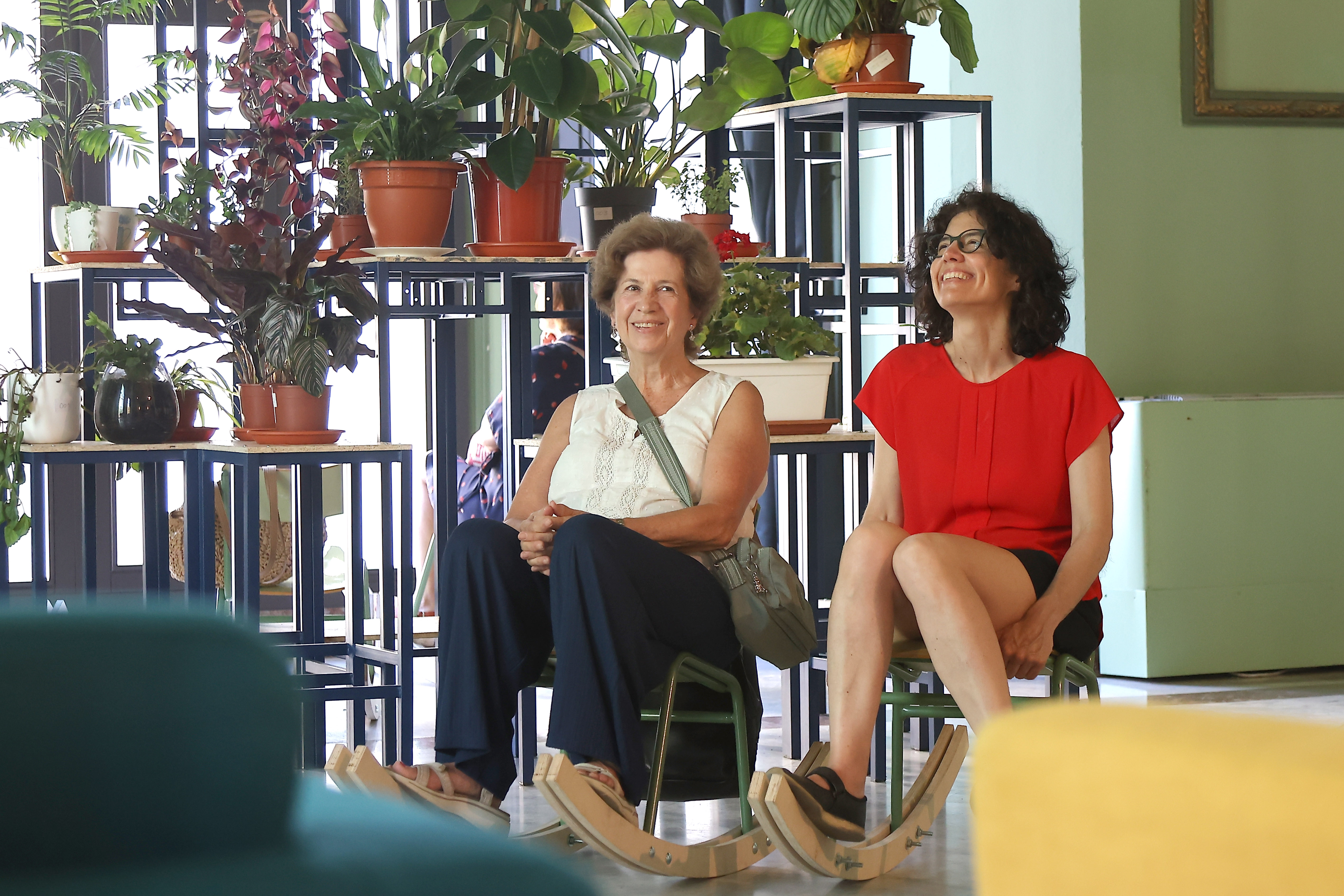
The Climate Refuge is an annual free public programme hosted in the historic ballroom of Madrid's Círculo de Bellas Artes. Each summer, this 800 m² space is transformed into a cool indoor plaza maintained at 26°C while outdoor temperatures exceed 40°C, offering vital shelter to heat-vulnerable citizens: the elderly, low-income residents, children, and outdoor workers. Designed as a living community hub, it is a place to rest, connect, work, and think collectively about the ecological crisis, free of charge and open to all.
Now in its third edition, the Refuge has welcomed over 100,000 visitors across 2024 and 2025, generating remarkable institutional resonance nationally and internationally. Each edition deepens its conceptual ambition: 2024 addressed climate action broadly; 2025 reclaimed slowness and rest as acts of ecological resistance; 2026 proposes play as a tool for imagining sustainable futures. These themes are not decorative, they are driven by artists, communities, and creative partners who co-design the space and activities each year.
The project has proven that cultural institutions are uniquely powerful agents of climate innovation. Its success has sparked a multiplier effect, with institutions across Europe seeking to replicate the model. The Refuge is not only a response to the climate emergency from the arts and cultural sector, but also a replicable, scalable model showing how art, heritage, and community can drive lasting systemic change.
The Climate Refuge began with a simple but urgent question: what can a cultural institution do, concretely and immediately, in response to the climate crisis? In the summer of 2024, as Madrid faced record-breaking heat, the Círculo de Bellas Artes opened its historic ballroom as a free refuge for the city’s most vulnerable residents. Rather than raising awareness, it embodied climate action, turning the institution into an open space where art, culture, and heritage became tools for response.
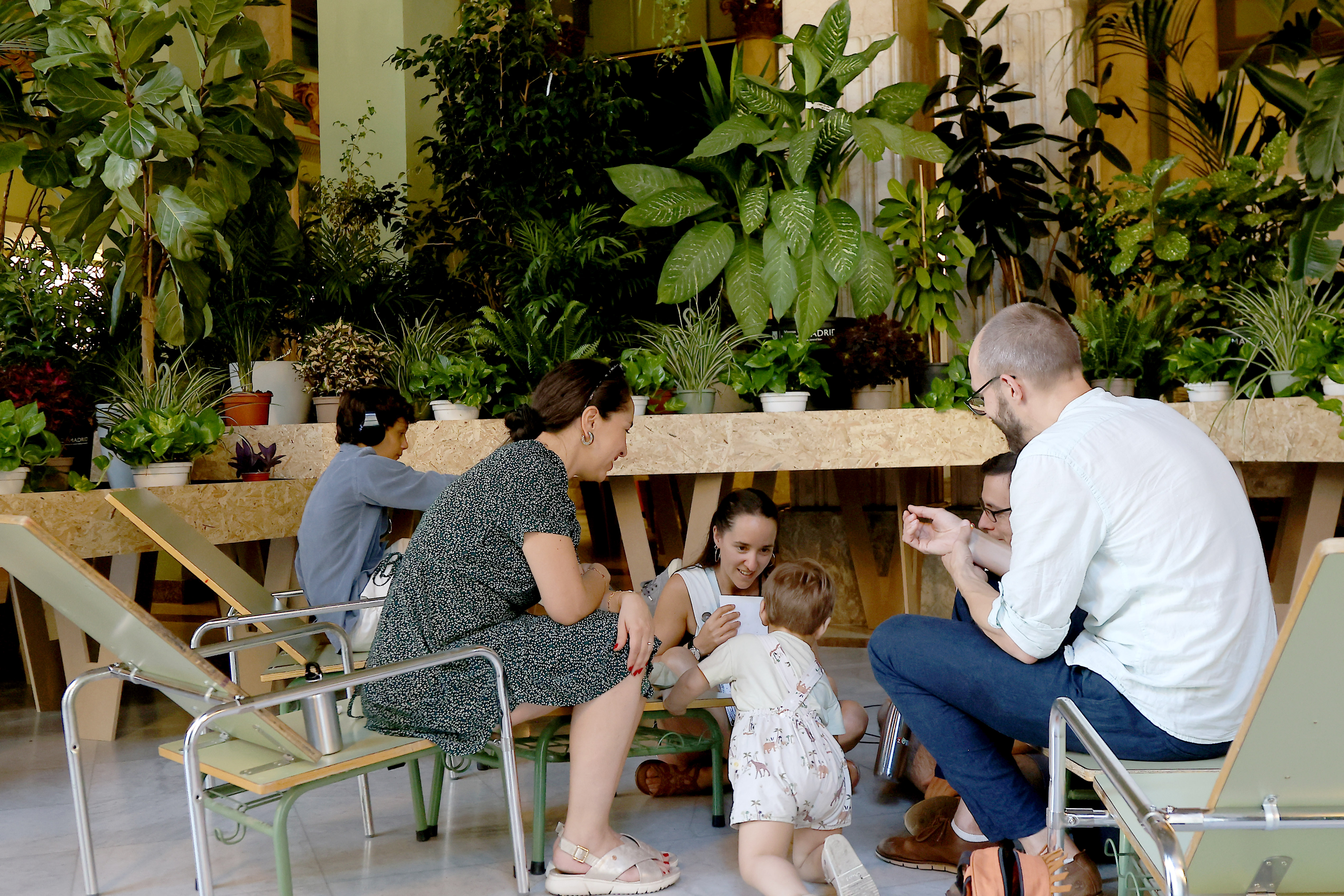
The Refuge emerged through genuine collaboration. Environmental collectives, artists, residents, and partners contributed expertise, creativity, and materials. Repurposed furniture, municipal vegetation, artistic interventions, and a community garden formed a space somewhere between a park, library, and town square: informal, welcoming, and alive. That first summer, 45,000 people visited.
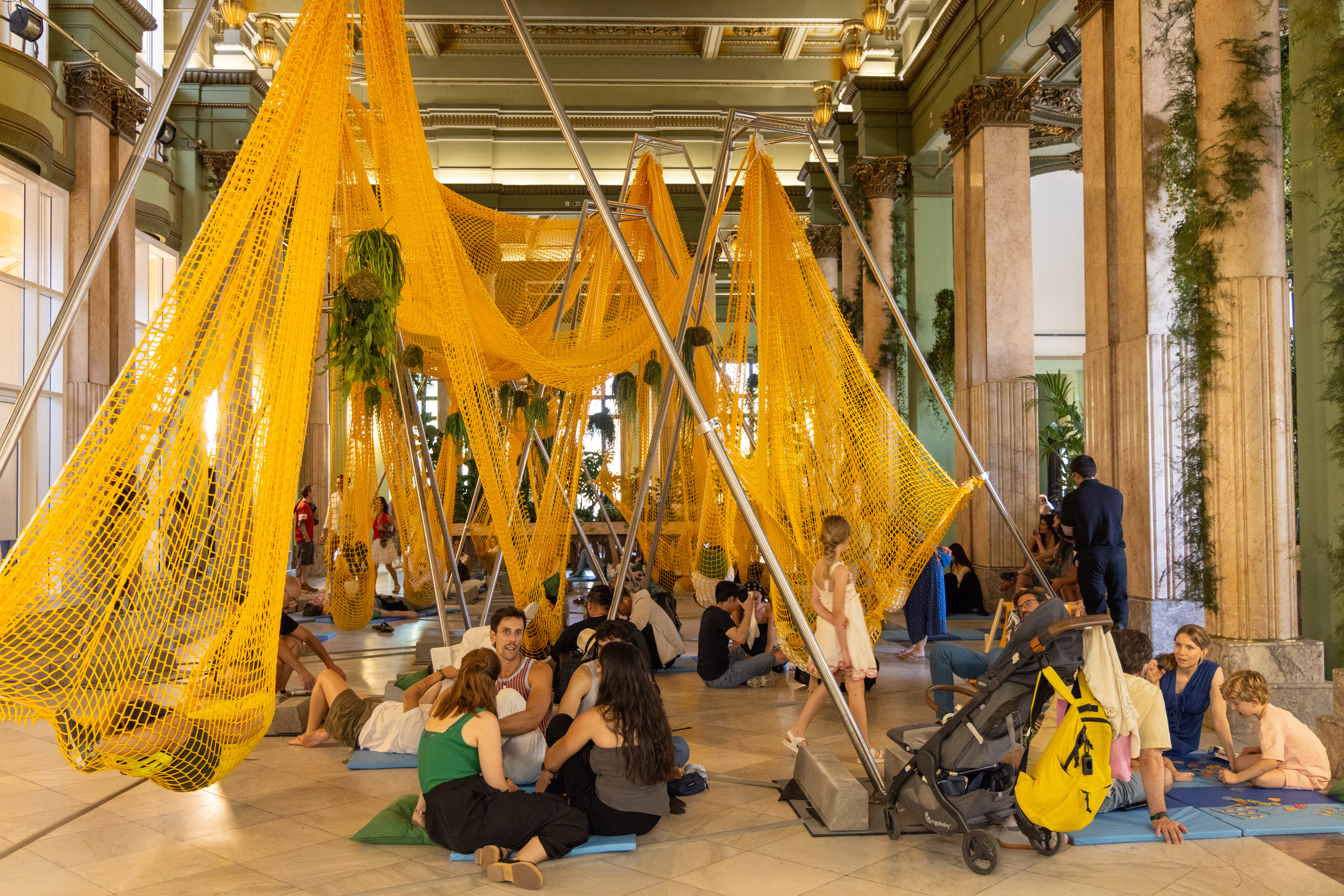
In 2025, the project returned with a bolder proposition: to reclaim rest and slowness as forms of resistance to the eco-social crisis. Once again, the space was co-created with artists, collectives, and community, this time joined by TYPSA, whose collaboration gave rise to the siestódromo, a resting installation that became the edition's defining symbol. 60,000 visitors followed.
Each edition is conceived as an artistic act rather than a service, shaped by real social and ecological tensions through creativity and community. This summer, the Refuge explores play as a tool for social innovation and collective imagination for sustainable futures. A new collaboration with RHECO (University of Valencia) brings together 13 research groups, connecting academic knowledge with civic life and reinforcing the Refuge as a space where science, culture, and community meet.
What began as a local response to urban heat has evolved into a recognised model, showing that art and cultural heritage are central to the climate conversation, not peripheral.
Urban heat adaptation
Cultural climate action
Art and heritage as civic infrastructure
Cultural refuges
Civic co-creation
The Climate Refuge directly confronts the urban heat emergency, one of the most immediate consequences of climate change on urban life, while embedding ecological principles into every aspect of its design and operation.
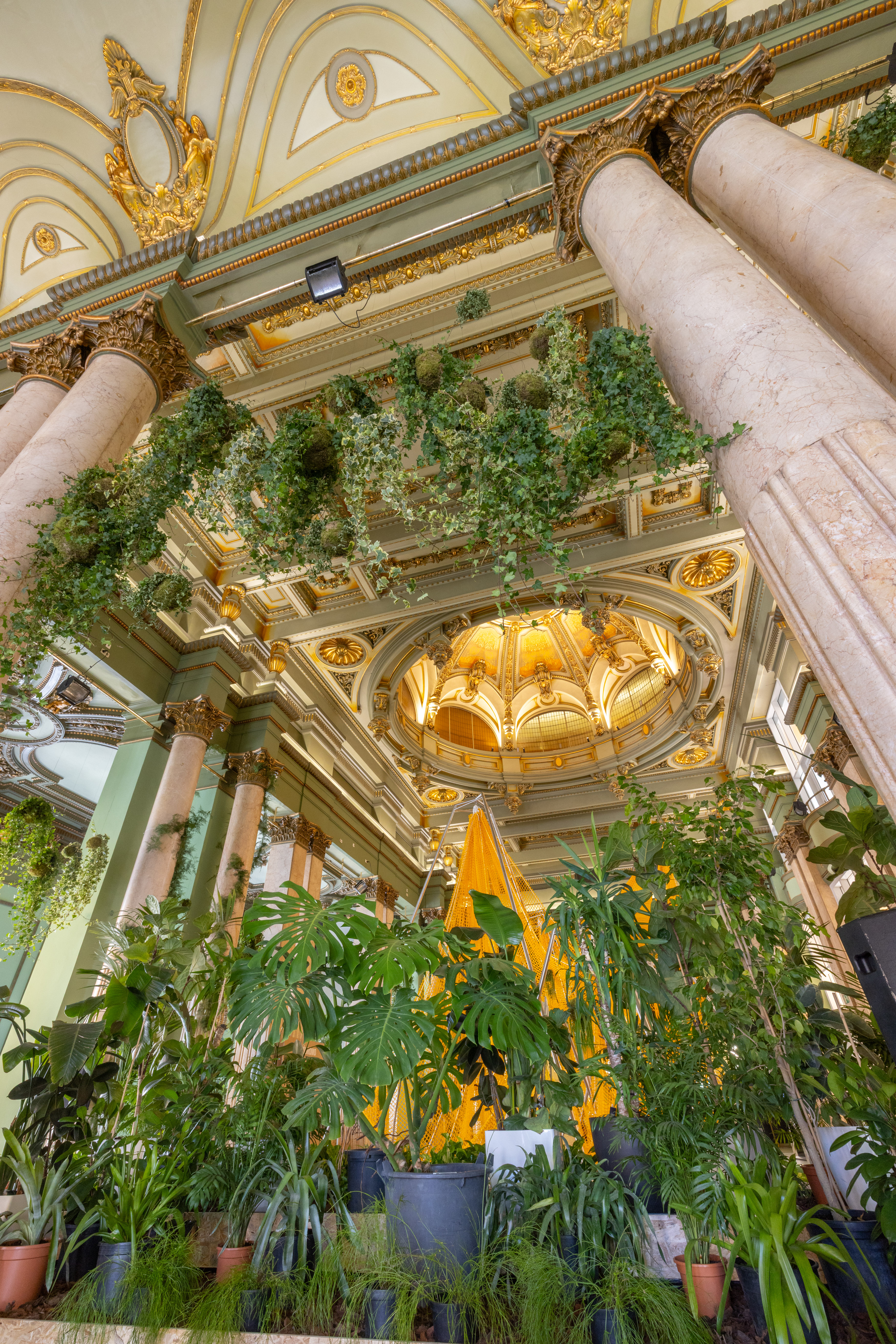
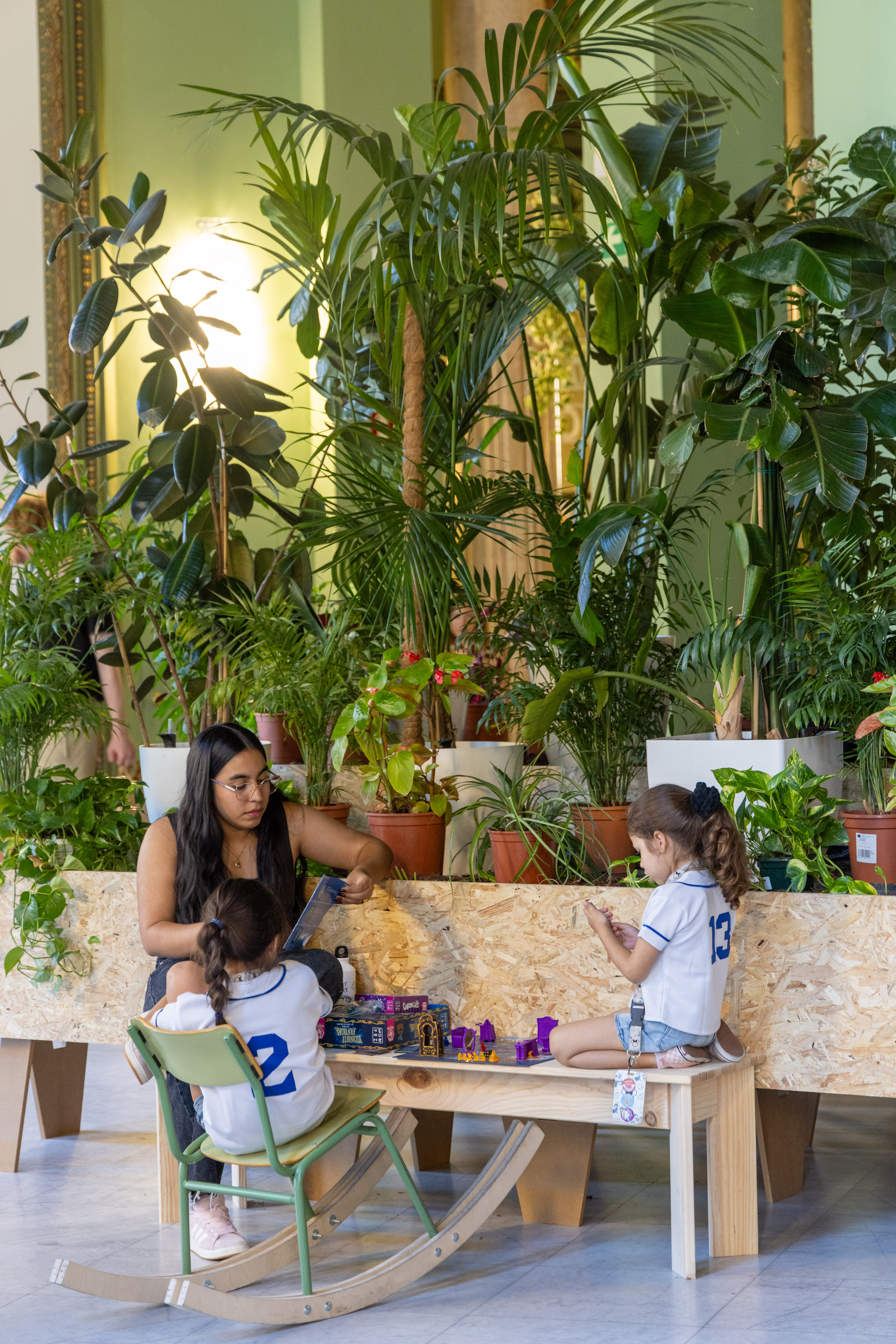
Environmentally, the project operates on strict circular economy principles. 450 plants, borrowed from the community and Madrid's municipal nurseries, provide natural cooling and biodiversity. All materials are repurposed: school furniture becomes seating, a disused bar becomes a community garden, seed paper replaces printed communications. At the end of each edition, nothing is wasted, plants return to nurseries, furniture moves to the CBA's art school, and installations are redistributed to other cultural centres.
Socially, the Refuge addresses the compounding vulnerability of urban heat on low-income residents, the elderly, children, and outdoor workers, people who cannot access private cooling or simply cannot afford to leave the city. By offering a free, dignified, consumption-free public space, it treats social inequality as an environmental justice issue.
Culturally, it demonstrates that art, culture, and heritage institutions are active agents of ecological transition. The project has generated lasting institutional shifts at the CBA, and the interest it has sparked beyond Madrid. In 2026, inspired by our Climate Refuge, other cultural institutions are joining a growing network of Climate Refuge forums: sustainable spaces where art, culture, and community come together to drive ecological transition.
Economically, it proves that high-impact climate action does not require large infrastructure investment. The model is low-cost, replicable, and scalable, already inspiring institutions across Spain and Europe to develop their own versions.
With 100,000 visitors across two editions and a growing network, The Climate Refuge offers an exemplary proof of concept: that sustainability, culture, and community care are the same project.
The Climate Refuge is, at its core, a work of art and environmental design: an immersive, living space that makes beauty central to climate action. The starting point was the CBA's historic ballroom: a century-old space of columns, vaulted ceilings, and architectural grandeur. Rather than overwriting this heritage, the intervention enters into dialogue with it, layering natural elements, contemporary art, and sensory experience into a space that feels both familiar and transformed.
Some 450 local plants (ficus, pothos, ferns) were selected for their cooling and air-purifying qualities but also for sensory richness: soft leaves against rough bark, deep greens against pale stone, the quiet presence of living things in an urban interior. Artist Sayaka Fujio's sound installation (2024) wove soundscapes and guided meditation to evoke the rhythms of plant growth, making nature's invisible processes audible and felt. Basurama's upcycled furniture gave new aesthetic life to discarded materials, while Germinando curated the plant ecosystem, bringing unexpected biodiversity into an architectural setting. In 2025, the siestódromo introduced a collective space for rest as a political act: hammocks for napping, reading, or simply being still, reclaiming pause as a public good in an overheated city.
The result is not an exhibition to observe but a place to inhabit with zones for reading, chess, quiet work, and unhurried conversation. Visitors are not audiences; they are participants in a shared atmosphere. Many returned throughout the summer, forming lasting relationships with the space and with one another.
As extreme heat empties the streets that once held crowds and conversation, the Refuge reclaims the idea of the public square as a place to stay. Not movement, but collective time. Not transaction, but togetherness. That is its most lasting aesthetic contribution: not an object, but a transformed quality of life.
Inclusion is not a feature of The Climate Refuge, it is its founding logic. The project was designed from the outset to dismantle the barriers that typically separate cultural institutions from the communities that need them most.
Free entry, open hours, and no requirement to consume or participate in any scheduled activity meant that the space welcomed everyone on their own terms. Flexible zones, quiet work areas, social corners, chess tables, books, a community garden, a fee water fountain, etc. ensured that visitors of every age, background, and need could find their place. Pets were also welcome.
Beyond universal access, the project specifically targeted heat-vulnerable populations: low-income families, elderly residents, children, and people experiencing social exclusion. Targeted outreach through trusted community partners (senior centres, social inclusion organisations, urban summer camps) brought in 400 children, 150 institutionalised elderly visitors, and 60 unaccompanied minors through tailored programming 2024 and 2025). These groups did not simply visit; they were co-designers of their own experience within the space.
The governance model was equally inclusive. Community organisations shaped the programme from the inside, not as consultees, but as partners. Groups such as Somos Acogida, Repair Café Madrid, and Ajedrez en el Parque became embedded collaborators, contributing expertise and relationships that the Círculo alone could not provide.
Most significantly, the project challenged the cultural institution's traditional role as a gated, time-bounded space for consumption. The Refuge operated as genuine public infrastructure, a no-consumption zone in a high-demand city-centre location, prioritising presence over transaction. In doing so, it modelled a new societal role for art and cultural institutions: hospitable and structurally committed to those most often left out.
Citizen participation was not a consultation layer added to The Climate Refuge, it was the mechanism through which the space came to life. The project is driven by the full team of the CBA working in close collaboration with the communities it aims to serve, rejecting a top-down institutional model in favour of genuine co-creation from the outset.
Environmental and creative collectives shaped the space physically and conceptually. Basurama led the interior design, transforming discarded materials into functional, beautiful furniture. Germinando advised on plant selection, bringing agroecological expertise into an architectural setting. FUHEM organised eco-social reading groups; Fábrica de Texturas ran workshops for children and elderly visitors; Ajedrez en el Parque established a chess corner that became one of the most loved daily features of the space. In 2025, TYPSA joined as a creative collaborator, co-designing the siestódromo.
A plant-lending programme invited citizens to bring plants from their own homes, creating a literal community garden and an act of shared ownership. The flexible, unscheduled space encouraged organic appropriation: strangers playing chess, neighbours working side by side, groups resting without obligation.
The lasting impact has been transformative. Collaborators became permanent partners. A vivid example: elderly workshop participants went on to lead intergenerational storytelling events during the CBA's winter programme, moving from recipients to authors of cultural programming, and bringing entirely new communities into the institution's life throughout the year.
This spirit is now scaling outward through the Network of Cultural Climate Refuges, a horizontal alliance of institutions across Spain sharing methodologies, resources, and community knowledge, co-creating a collective response rather than replicating a fixed blueprint.
The Climate Refuge was built on a deliberately multilevel architecture of partnerships, each contributing distinct resources, expertise, and legitimacy to the project.
At the local level, Madrid City Council was a foundational partner. The Vivero Estufas de El Retiro supplied the municipal plants that formed the heart of the indoor garden, embedding the project within the city's own ecological infrastructure. Public urban camps and senior centres served as community bridges, connecting the Refuge to populations it might not otherwise have reached and facilitating intergenerational programming.
Community organisations operated at the neighbourhood level, connecting the project to lived realities and ensuring that outreach was grounded in trust. Somos Acogida worked with socially excluded groups; Repair Café Madrid brought waste-reduction culture and peer knowledge-sharing; Ajedrez en el Parque created daily social ritual through chess. These partnerships were not symbolic, they shaped the programme in concrete, daily ways.
At the national level, Fundación Biodiversidad (Ministry for Ecological Transition) established a formal partnership with the CBA, creating a framework for future sustainability initiatives. Fundación Daniel y Nina Carasso provided essential support for the project's network ambitions. Private sector partners CaixaBank and Fundación Reale enabled the free-access model.
At the European level, the European Climate Foundation provided strategic advice and stakeholder connections, situating the project within broader continental conversations on climate adaptation. The CBA's role as an official New European Bauhaus partner has amplified the Refuge's reach.
This multilevel logic now extends into the project's next chapter. Launched in spring 2026 with the support of Fundación Daniel y Nina Carasso, the Network of Cultural Climate Refuges, connects cultural institutions across Spain committed to sustainability, social care, and cultural innovation
The Climate Refuge could not have existed within the boundaries of any single field. Its power lies in the productive friction between disciplines that rarely share the same room.
Architecture and heritage conservation shaped the foundational challenge: how to intervene in a century-old ballroom with reversibility and ambition. Environmental design provided the answer: organic materials, flexible furniture, and living plants working with, rather than against, the historic structure. Ecology and agroecology, brought by Germinando, treated the indoor garden as a functioning ecosystem. Environmental engineering ensured the space maintained 26°C within energy efficiency regulations. In 2025, TYPSA's structural expertise gave rise to the siestódromo, merging social intention with technical precision.
Contemporary art provided affective and philosophical depth. Sayaka Fujio's sound installation made nature's invisible rhythms perceptible. Basurama fused design and environmental activism, elevating upcycled furniture into a statement about waste and value. Social sciences shaped the participatory model, outreach strategies, and long-term engagement frameworks. Communication design extended the ecological logic into every material touchpoint through a zero-waste approach.
In 2026, the transdisciplinary scope expands with RHECO, the Ecological Humanities Network coordinated by the University of Valencia. 13 university research groups bridging academic knowledge and civic life, introducing ecological humanities and environmental ethics into the Refuge's creative framework.
The result is a space no single discipline could have produced: beautiful, functional, inclusive, and culturally resonant: a prototype for integrated climate action when art, science, and community genuinely think together.
The Climate Refuge is a free, open-access programme and that is a deliberate and proud choice. Removing economic barriers is not simply a feature of the project; it is its founding principle. The idea that the most heat-vulnerable citizens can walk in without a ticket, without a membership, without any condition, is what gives the Refuge its meaning and its warmth. Sustaining that promise across editions, however, calls for a thoughtful and diversified financial model.
The CBA carries the project as a genuine institutional commitment, absorbing space, infrastructure, and core staffing within its own budget. The historic ballroom, technical systems, and coordination capacity represent a substantial in-kind contribution that makes the model viable from the ground up. Yet the programming, the artists, collectives, installations, workshops, and community activities that give the Refuge its depth and ambition require dedicated external funding each year.
This is met through a deliberately mixed model: public funding and partnerships, including Fundación Biodiversidad and Madrid City Council's in-kind plant supply; private foundation support from Fundación Reale, CaixaBank, and Fundación Daniel y Nina Carasso; and collaborative in-kind contributions from partner collectives who bring expertise, design, and facilitation in exchange for shared mission and visibility.
A conscious circular design strategy including upcycled furniture, donated plants, zero-waste communications, and full end-of-life redistribution keeps production costs contained without compromising quality and makes the model genuinely replicable. Other institutions do not need exceptional resources to make it their own; they need commitment, community partnerships, and the willingness to open their doors unconditionally.
One of the most compelling aspects of The Climate Refuge is how naturally it lends itself to replication. Since its first edition, institutions across Spain have approached seeking to develop their own versions, because its core logic is clear, transferable, and adaptable to very different contexts. This multiplier effect gave rise to the Network of Cultural Climate Refuges, launched in spring 2026 with the support of Fundación Daniel y Nina Carasso. A horizontal alliance of cultural institutions across Spain, designed to grow to European scale, each operating as a local hub for shelter, learning, and citizen climate action.
Several elements are directly replicable. The fundamental model, transforming an existing institutional space into a free, climate-controlled public refuge during summer heat, requires no new infrastructure. Any cultural institution with an interior space, a civic vocation, and a community network has the essential ingredients. The circular design methodology is fully transferable: municipal and donated plants, upcycled furniture, local collectives as programmers, and a full end-of-life redistribution plan. Cost is controlled by design, not by compromise.
The participatory model, the flexible spatial zoning, and the thematic evolution framework, which keeps the project intellectually alive and community-relevant year on year, are all processes that can be adapted to different urban contexts and institutional cultures without building from scratch.
As heat emergencies intensify across European cities, this model offers a replicable, human, and culturally grounded response. Culture, here, is not a complement to climate action. It is the infrastructure.