Enhancing Circularity, Sustainability, and Innovation
Earthbound
{Empty}
The vision for reactivating Riez is embodied by the use of earth to regenerate local heritage for a circular economy and a sustainable future. Rammed earth (‘pisé’) has a rich building history in Provence-Alpes-Côte d’Azur. The region’s clayey soil is a local material well-suited to building with. Rebuilding Riez in a hyperlocal, sustainable, and contemporary way works sensibly to re-embed the village in its rich landscape, whilst supporting local trade and safeguarding vernacular heritage.
France
Local
Riez
It addresses urban-rural linkages
It involves a physical transformation of the built environment (hard investment)
Early concept
No
No
No
Organisation
Riez, once a thriving and bustling medieval village in the valleys of Provence-Alpes-Côte d'Azur, now suffers from diminished civic attractiveness and urban inactivity in its village centre. The proposal for revitalisation carefully threads the needle of Riez and celebrates its historic urban fabric by running a new element, earth, through the village and its hinterlands. This ribbon of earthen material, which is hyperlocal and contemporary, works to repair and reinforce the drama of the Provencal hills and valleys of which the village is the heart.
Through a series of consistent yet site-specific interventions, at scales both human and urban, a work of tracing edges both historic and imagined creates inhabitable spaces that sustain the heart of Riez, combatting the current observation of shop closures and squalid homes. This forms the basis for a new urban plan which promises to be closely informed and refined through local consultation. The village centre will be transformed from a static site into a dynamic social place as it was before, maintaining a vibrancy all year round.
Through a series of consistent yet site-specific interventions, at scales both human and urban, a work of tracing edges both historic and imagined creates inhabitable spaces that sustain the heart of Riez, combatting the current observation of shop closures and squalid homes. This forms the basis for a new urban plan which promises to be closely informed and refined through local consultation. The village centre will be transformed from a static site into a dynamic social place as it was before, maintaining a vibrancy all year round.
The issue of Riez’s urban and civic decline was outlined in a brief established in EUROPAN 18, with consultation from the village council and other local-regional stakeholders. Having studied the site and its context through mapping and historical research, it was evident that Riez has a wealth of historic heritage in its village centre that is worth preserving and up-keeping, and could benefit from better links to its natural surrounds of Provence-Alpes-Cote d’Azur to build a village that is truly activated and inhabited by its people.
At the urban scale, there is an impending need to safeguard Riez’s cultural and building heritage in its transformation.
In analysing the village’s medieval typology and morphology, a critical approach to restoring Riez’s disused and crumbling structures was taken. Desk-based research into archives and building documents made it possible to establish a framework for cataloguing the buildings in the village centre. This framework would form the basis and starting point for building a robust urban plan for Riez. Setting up an urban plan is looking forward into the future of Riez, forming a resilient set of guiding principles that can encourage future innovation and adaptations while protecting the rich history it possesses.
community co-design
circular economy
heritage reactivation
nature-based solutions
traditional craftsmanship
A return to form
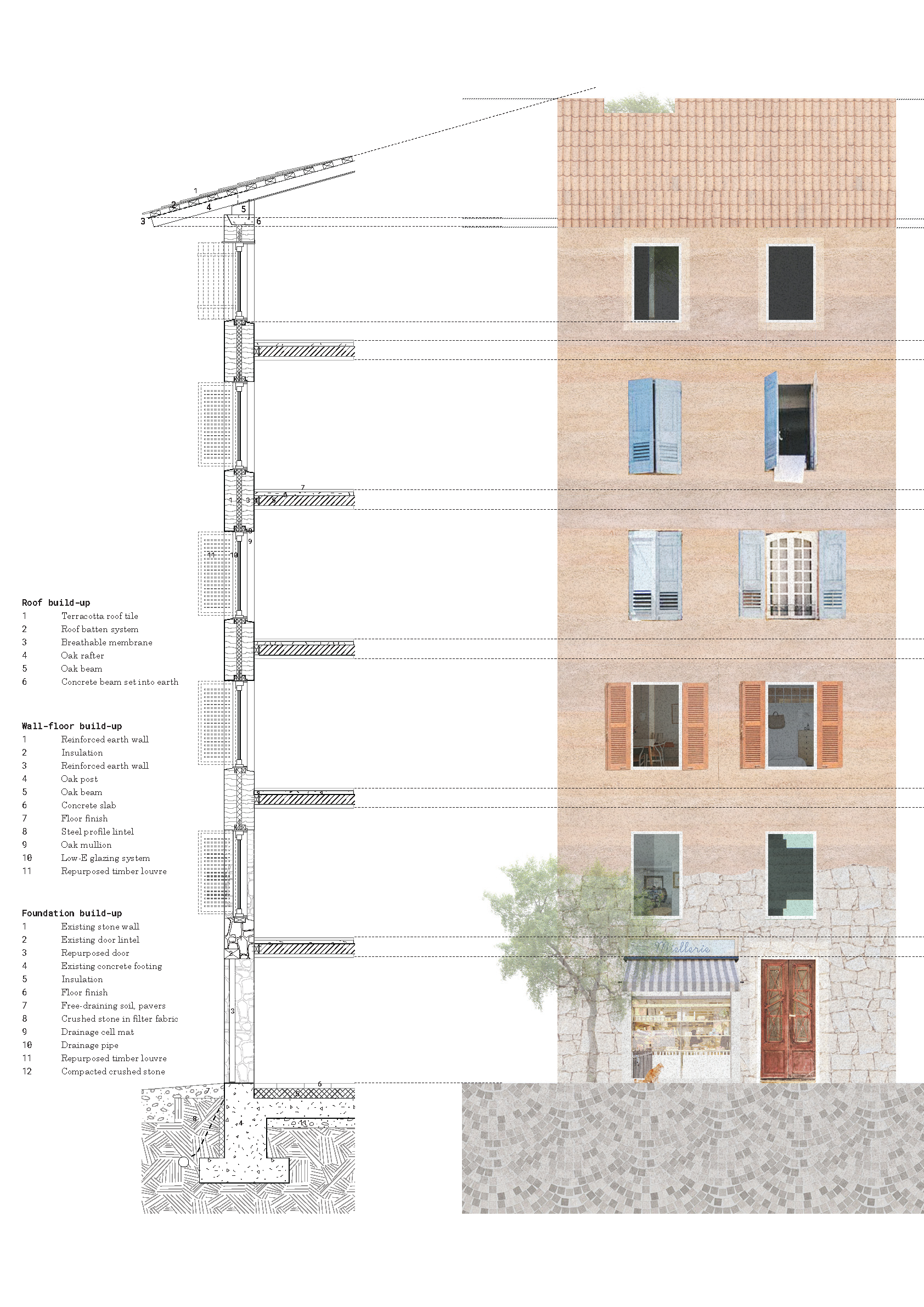
The vision for re-activating Riez is embodied by the use of earth, to regenerate local heritage for a circular economy and a sustainable future. Rammed earth (‘pisé’) has a rich building history in Provence-Alpes-Côte d’Azur. The region’s clayey soil is a local material asset well-suited to building with. In utilising earth from local and regional construction sites, the proposal to build is considerably low-impact and sustainable in method and form. Rebuilding Riez in a manner that is hyperlocal, sustainable, and contemporary works sensibly to re-embed the village in its rich landscape, whilst supporting local trade and safeguarding vernacular heritage.
Learning to build
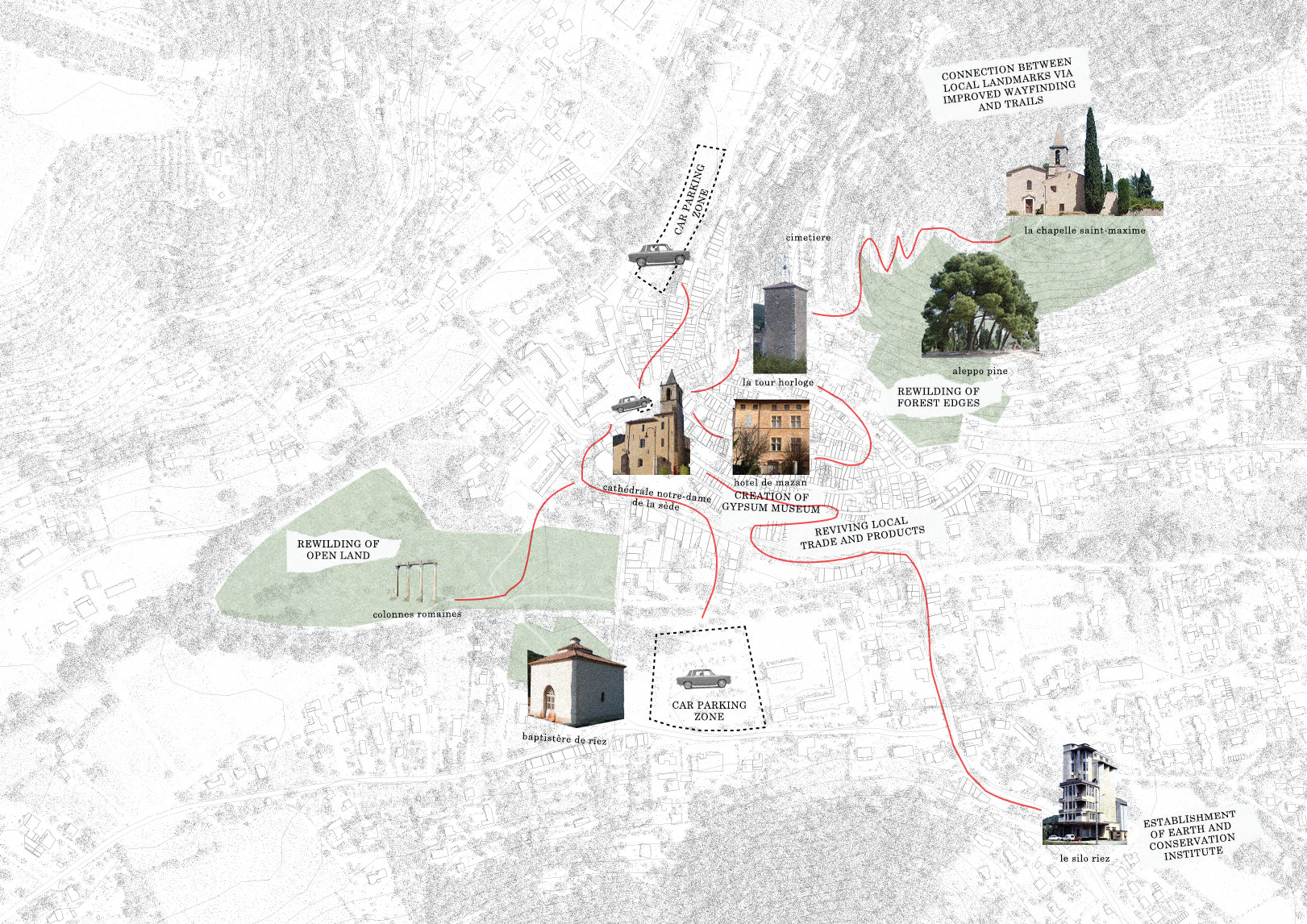
A strategy of care and education is imperative for setting a foundation of craftspeople and makers that support existing trade in Riez. A history in gypsum is evident in the village and the proposal to repurpose the historic Hotel de Mazan into a cultural centre for gypsum is an example of this. In re-establishing earth-based construction techniques in Riez, the building of an Earth and Building Conservation Institute is proposed. This will bring together artisans of different biases, and can be built upon the art and architecture platform that the Silo currently champions. Here artists and craftspeople can develop their skills in local materials and techniques.
Repair as a form of art
All existing buildings have irrevocable value and are viewed through the lens of repair. They will be strengthened, thermally improved, and where necessary reconstructed using a combination of earth, timber, steel, and other local materials; robust, primary materials that utilise construction waste, sourced locally and transported short distances. As rammed earth construction is a technique historic and local to the region, the proposal seeks the opportunity to engage local industry, and explores the feasibility of training up local specialists to champion new technologies in design.
Le Place
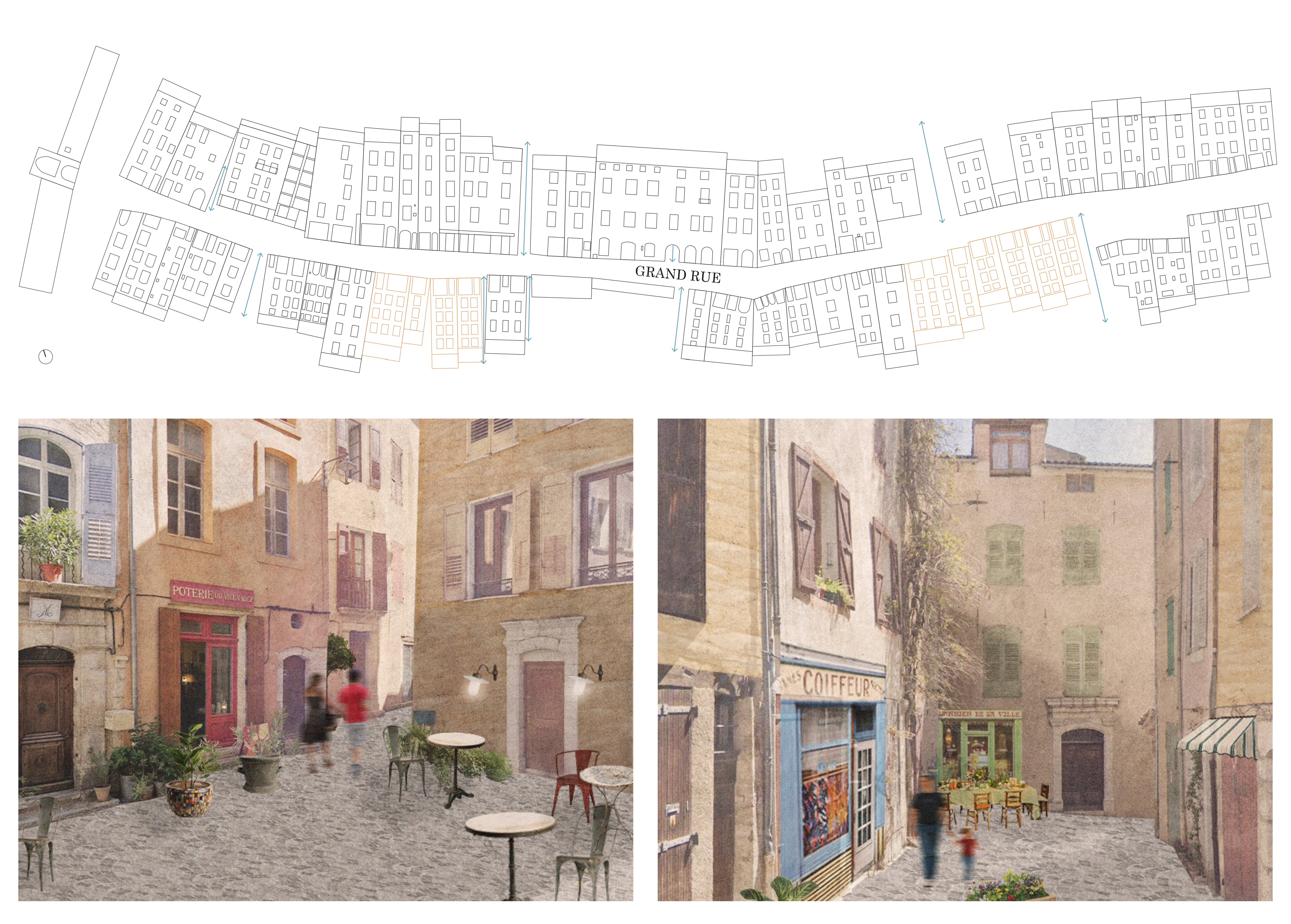
Establishing public squares ‘places’ at different scales is a key feature of the urban plan. The public squares of Riez are currently either underused or overrun by cars, yet they have unbridled potential to offer opportunities for gathering and for the visitor moments of surprise amidst Riez’s narrow alleyways. The proposal calls for all of Riez’s existing ‘places’ to be retained and paved over, maintaining safe connections with streets and buildings. New ‘places’ will be introduced to support the existing network of squares. To revitalise the village centre in a sustainable way, mixed-use developments incorporating retail, civic, and domestic spaces are proposed. Existing buildings will be retained and repurposed, and are well-suited to residents who intend to downsize, or people moving regionally to Riez for work, in conjunction with plans to revive local trade.
Outside in, inside out
A current disconnect between the village centre and Riez’s natural surrounds can be helped through urban intervention, to increase mobility across the different types of tourism endemic to Riez. Efforts to connect nature, historic landmarks, and the village centre will enable visitors to gain a multifaceted, rich understanding of the area. To this end an ‘outside in, inside out’ approach is proposed: a rewilding of the forest edges where it meets the village will be beneficial to local biodiversity, bridging the gap between the natural and the urban. At the same time, a concerted effort to enhance green spaces within the village will help strengthen this connection.
Pedestrianising the streets
The project proposes pedestrianising Riez for a safe, walkable, and functional village centre. Existing road widths will be retained to aid vehicular access for residents, but pedestrian circulation will be outwardly prioritised. Designated car parking is proposed within walking durations of five minutes to the village centre. The street network will be checked for accessibility, and updated in the case of disrepair or ill-function. A wayfinding system linked to the hiking trails and surrounding campsites will be beneficial for a varied recreational offer to visitors.
La maison modeste/La maison bourgeoise
Many of the buildings in the village centre are variations on the typologies of ‘la maison modeste’ or ‘la maison bourgeoise’, persisting from the 16th Century for the larger modest village population. These were largely townhouses characterised by a central staircase on a narrow plot. The intention is to preserve this historic typology. Having been largely altered and at times unsympathetically, the fabric of these houses will be surveyed and their thermal performances maximised using earth-based strategies and techniques that emerge from local testing. A possibility to extend a floor upwards or to add a dwelling-place at the end of the length-wise plot will be dependent on the house’s specific location, and will attract a broader local community to move downtown as opposed to spreading out into the landscape. Residents might be incentivised by an opportunity for additional income in the form of rentable tourist accommodation, or the ability to create live-work spaces for themselves.
The idea is not to reintroduce new models of living into the village, but to build upon a body of knowledge pre-existing to place.
Building an urban plan, from the ground up:
Riez’s decorated history would not have come to be without its engaged, skillful people. Investing in the local community is imperative to sustaining future regeneration efforts. A concerted effort to engage and invest in the community is key to the new urban plan for Riez.
Reviving local and regional industry:
In addition to involvement in the local plan, the proposal would provide jobs and upskilling for local and regional residents, attracting craftspeople and makers to develop and share their knowledge in the town. There will also be opportunities for residents to share their knowledge, for example through hosting visitors, material research, carrying out guided tours, or open studios and workshops. The collaboration between the town and its architecture will be central, one not without the other.
Learning from afar:
In the development of this concept, robust archival and field-based research has been conducted for the town of Riez. As we are not based in France, access to the site and locality is limited. However, we choose to see this as an opportunity rather than a delimiting factor. From this perspective, we have been able to learn with the town through its local bulletin, Le Riezois, and other ground-up initiatives by residents that together paint a picture of daily living in Riez. Studying and connecting with place through the eyes of its own people has been fulfilling and important for the development of our concept.
Participation is key!
This transdisciplinary, participatory approach to urban regeneration is key to good design. It acknowledges the complexities of a town with a medieval constitution and a modern outlook, and aims to celebrate and unravel these intricacies for social, cultural, and economic benefit. We are learning that this can only be achieved as fruit of a lively engagement between resident, town, and region.
It is proposed to involve stakeholders with varying local and regional interests. The regeneration of a town involves commitment to civic improvement at every level, and the heart of the concept is for Riez to be deeply embedded into its local context and natural setting.
It is expected to involve local and regional institutions championing earth-based building solutions and traditional building techniques, like Association AsTerre, CAPEB Confederation, Icomos France, and the Terra Incognita Conservatory of European Earthen Architecture. The involvement of these institutions through policy consultations, workshops, and other engagements will strengthen the strategy to enhance the built environment of Riez in a sensitive manner.
Regional and state-level actors such as the Direction Departementale des Alpes de Haute-Provence, Drac PACA, Unite Departmentale de l'Architecture et du Patrimoine, Region Sud, Departement des Alpes de Haute-Provence, PNR du Verdon, Fondation du Patrimoine PACA, Villages et Cites de Caractere du Departement des Alpes de Haute-Provence, and Conseil Municipal des Jeunes de Riez have all been involved in the establishment of this need for the civic regeneration of Riez. The agreed commitment of the councils and state-level institutions is crucial to the development and implementation of the proposal.
In the development of our concept, we have prioritised putting together a strategy that is inherently and irrevocably transdisciplinary in its makeup.
Establishment of a local urban plan via comprehensive consultation with policy, governmental stakeholders and the community will ensure the project meets local needs. A series of in-depth feasibility studies will be performed to this end, alongside a host of regulatory compliance checks.
To effectively manage construction, it is imperative to involve the community in the selection of contractors and skilled persons involved. It is the hope of the project that local people invested in the project will also contribute meaningfully in this endeavour. A diligent approach to accounting for timeline buffers and contingency budgets will be required.
Sustainable building practices will be incorporated into the project from the research and design stages, which will greatly alleviate future risks. Involvement with environmental sciences and detailed studies into local climate resilience will especially be needed to bolster these efforts.
Following the implementation of the urban plan, an actionable maintenance plan for the upkeep of the village will be developed. The spirit of repair and care is crucial to this project, and active involvement of the local community is considerably encouraged. A process for continuous feedback from the community and stakeholders will also be developed and tested to this end.
The concept is designed to be self-sustaining and considers the lifespan of a building. This is shown through the reliance on local-regional construction sites for raw building materials, coupled with the establishment of an earth-building institute in the village. By forming lasting connections across the region and positioning Riez as a centre for earth-based building solutions, a group of skilled professionals are trained up in Riez and can make longstanding contributions to the village and region, generating revenue and attracting a workforce around the village. The innovative adaptive reuse of Riez’s disused buildings also becomes an attractor for visitors and tourists, who may also venture into nearby natural parks due to increased linkages and accessibility. The increased vibrancy of Riez sustained over time would form a robust business plan for the village and region.
The formation of the urban plan for a village or town is an innovative concept that can be exercised in other places. A concerted engagement with residents and stakeholders would ground a keen understanding of the place. This forms the basis for an urban plan, that can flex and stretch with the place’s needs and external factors. The principle of the urban plan is to resist a reactionary response to urban or rural issues, and instead form a well-meant strategy that is sustainable and deeply rooted in a place.
The following is foreseen as further steps to develop and implement the concept:
- Engagement with village and local-regional councils in a series of visioning workshops
- Engagement with aforementioned heritage and earth-based building institutions, for knowledge sharing on implementing earth-based interventions in adaptive reuse
- Engagement with Parcs Nationaux in Provence Alpes de Cote-Azur (PACA) to establish developmental and protective initiatives for the national parks surrounding Riez
- Preparing a feasibility study for the urban plan, in collaboration with the above stakeholders