Strengthening Local Democracy and Inclusion
Reviving El Besòs i el Maresme
"Un viento que sigue soplando". Reclaiming Identity, Revitalizing Community
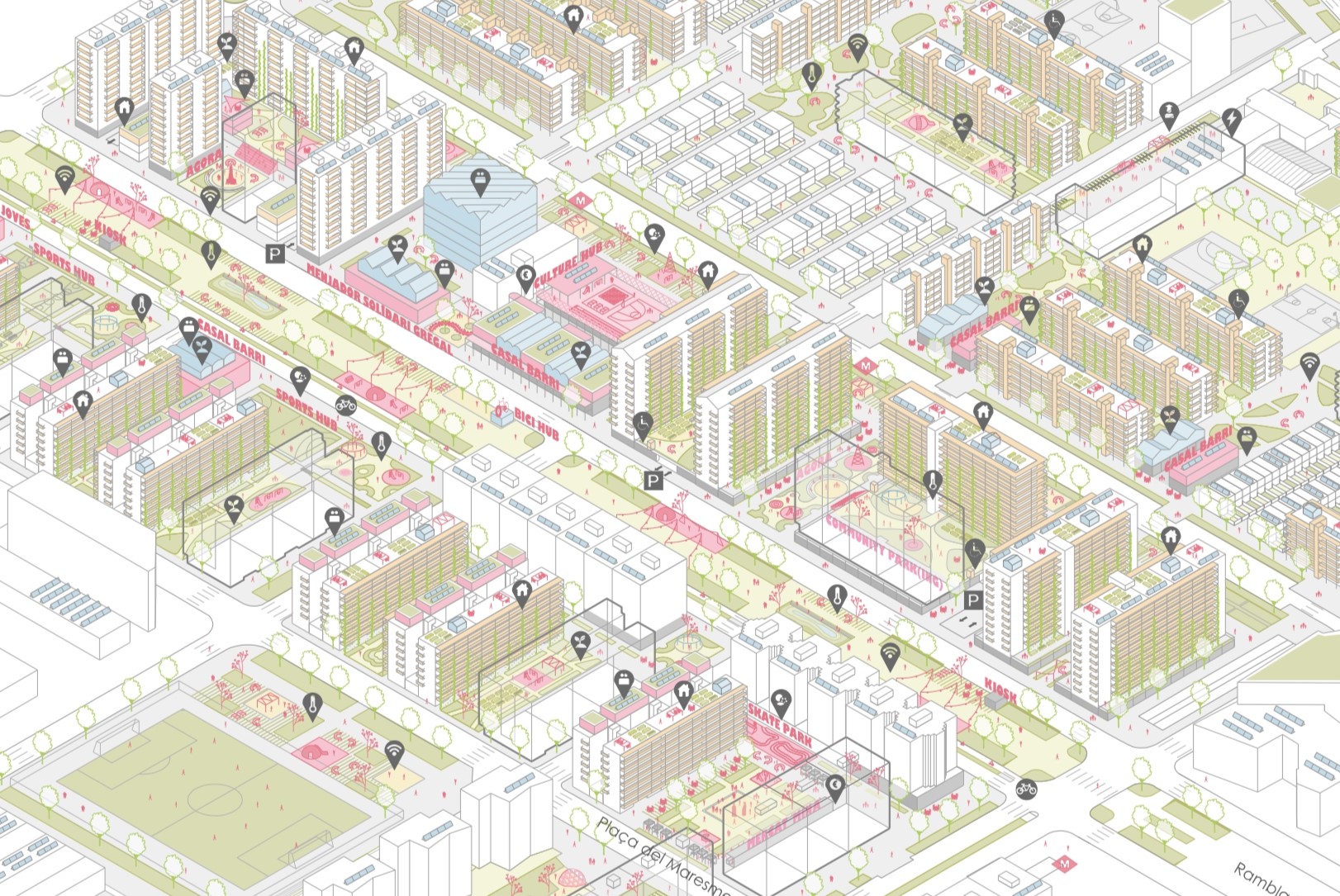
“Un viento que sigue soplando” reimagines El Besòs i el Maresme through a participatory, multi-scalar urban regeneration. The project reconnects urban voids, revitalizes public space, enhances social cohesion, supports vulnerable groups, and promotes local economy and ecological cycles. Through inclusive design, green interventions, and co-created community spaces, it fosters a resilient, walkable, and vibrant neighborhood, empowering residents as co-creators of their living environment.
Spain
Local
Barcelona
Mainly urban
It involves a physical transformation of the built environment (hard investment)
Early concept
No
Yes
Europan
No
Individual
“Un viento que sigue soplando” is a participatory urban regeneration concept for El Besòs i el Maresme, aiming to transform a fragmented, underused, and socially vulnerable neighborhood into a resilient, inclusive, and vibrant community. Building on social structures like Cooperativa Gregal, it addresses oversized streets, generic public spaces, aging housing, and a fragile local economy.
The concept integrates four interlinked urban milieus:
Green City: Reconnects urban voids and ecological networks with sustainable drainage, microclimatic shelters, permeable surfaces, and pedestrian-friendly streets.
Living City: Rehabilitates housing, adds facades and shared rooftop and ground-floor spaces, improves accessibility and energy efficiency, fostering inclusive and dignified living.
Social City: Strengthens the associative fabric, cultural and sports nodes, and communal public spaces, promoting intergenerational and intercultural interaction.
Productive-Economic City: Revitalizes local commerce, supports circular economy practices, creates mixed-use flexible spaces, and activates rooftops for urban gardens and energy co-generation.
The project follows a phased, multi-scalar approach, linking neighborhood interventions to city-wide ecological and mobility networks. Residents, associations, and authorities are engaged as co-creators, ensuring ownership, adaptability, and long-term impact.
Expected results: improved social inclusion, ecological and climatic resilience, revitalized public space, strengthened local economy, and a replicable model for other dense urban neighborhoods. By combining community-led governance, ecological design, and social and economic regeneration, the project transforms El Besòs i el Maresme into a walkable, vibrant, and sustainable neighborhood fostering pride, well-being, and belonging.
“Un viento que sigue soplando” was developed as part of a Europan competition proposal, where it received 2nd prize. The project addresses the challenges of El Besòs i el Maresme, a dense neighborhood with fragmented urban fabric, underused public spaces, social vulnerabilities, and fragile local commerce. Historical post-war housing programs and modernist planning created oversized streets and generic public spaces, producing a “dormitory” character disconnected from green and urban networks.
Although we were eager to implement it locally, no further actions followed after the competition. The concept was developed through a participatory, multi-scalar process:
Territorial Auscultation: Mapping ecological, social, and economic conditions, identifying vulnerabilities like energy poverty, social exclusion, and fragile commerce.
Participatory Diagnosis: Engaging local associations and residents, including Cooperativa Gregal, through workshops and interviews to understand needs and opportunities.
Conceptual Framework: Organizing interventions into four interlinked milieus—Green, Living, Social, and Productive-Economic City—to integrate ecological restoration, housing rehabilitation, social cohesion, and local economy.
Design Strategies: Proposing building, neighborhood, and territorial interventions, including shared rooftop spaces, ecological corridors, pedestrianized streets, and mixed-use public spaces.
Iterative Co-Creation: Involving residents in refining strategies, empowering them as co-creators of both spaces and social programs.
Implementation Roadmap: A phased approach starting with the most vulnerable areas, enabling gradual transformation while maintaining existing activities.
The project is a living framework for regeneration, combining participation, social inclusion, ecological resilience, and economic revitalization to transform a gray, underused neighborhood into a vibrant, walkable, and sustainable community.
Participatory regeneration
Social inclusion
Ecological resilience
Community-led design
Mixed-use urban revitalization
“Un viento que sigue soplando” promotes sustainability by combining ecological, social, cultural, and economic strategies to transform El Besòs i el Maresme into a resilient, inclusive, and vibrant neighborhood. Environmentally, it restores urban and natural connections, increases permeable surfaces, implements Sustainable Urban Drainage Systems, and activates rooftops and underused spaces for urban gardens, biodiversity, and local energy production, reducing flood and heat risks.
Socially, sustainability is achieved through participatory co-creation, engaging residents and associations in shaping public spaces, housing upgrades, and community facilities. This approach strengthens social cohesion, inclusivity, and long-term well-being.
Economically, the project supports local and circular economies by revitalizing commercial premises, creating flexible mixed-use spaces, and promoting local production and services, ensuring benefits circulate within the neighborhood.
Culturally, it builds on the neighborhood’s associative heritage and identity, combining urban regeneration with collective memory and pride. Low-impact, modular interventions ensure adaptability and replicability.
By addressing environmental, social, cultural, and economic dimensions together, the concept exemplifies sustainability as a holistic, long-term approach, turning a dense, underused area into a climate-conscious, socially cohesive, and economically active community.
“Un viento que sigue soplando” enhances the beauty of El Besòs i el Maresme by transforming underused, grey spaces into vibrant, accessible, and meaningful public areas. Through participatory design, residents co-create streets, pocket gardens, rooftops, and communal spaces, ensuring everyday urban life is enriched with social, cultural, and ecological experiences.
The project redefines oversized streets and rigid block patterns into a human-scaled, walkable neighborhood, integrating greenery, playful and social urban furniture, lighting, and flexible gathering areas. Facade extensions, shared thresholds, and rooftop interventions create soft, inclusive edges between private and public spaces, enhancing the sensory and visual quality of the environment.
By building on the neighborhood’s associative heritage, the design fosters pride, memory, and identity, strengthening residents’ sense of belonging and care for their environment. Artistic, cultural, and community-led interventions bring vibrancy and meaning to daily life while ensuring the neighborhood remains adaptable to future needs.
The concept is exemplary in aesthetics because it combines beauty with function, ecology, and social life, creating spaces that are not only visually appealing but also inclusive, interactive, and emotionally resonant, promoting well-being and a lasting attachment to place.
“Un viento que sigue soplando” places residents at the center of transformation, addressing accessibility, affordability, and social cohesion. Through participatory workshops and co-design processes, citizens, associations, and local authorities shape public spaces, housing upgrades, and community facilities, ensuring that interventions respond to diverse needs, including children, elderly, women, and vulnerable groups.
Design strategies promote inclusive, accessible, and flexible environments: pedestrianized streets, pocket gardens, microclimatic shelters, soft thresholds, and shared rooftops enable social interaction and community use for all. Housing improvements integrate accessibility upgrades, energy efficiency, and modular interventions, increasing living quality and affordability.
Economic and social measures, such as revitalizing local commerce, creating mixed-use spaces, and supporting circular economy initiatives, reinforce equitable opportunities for participation, work, and local enterprise. The neighborhood’s associative heritage is strengthened, fostering a culture of collective responsibility, pride, and belonging.
The project exemplifies inclusion by combining participatory governance, universal design principles, and equitable access to public, social, and economic resources. It demonstrates how collaborative, community-led approaches can create inclusive, resilient, and thriving neighborhoods where everyone feels empowered, visible, and connected.
“Un viento que sigue soplando” was developed through active participation of residents, local associations, and public authorities, with Cooperativa Gregal playing a central role. Participatory workshops, interviews, mapping exercises, and co-design sessions were used to identify neighborhood needs, aspirations, and opportunities. Citizens contributed directly to shaping proposals for public spaces, housing interventions, ecological improvements, and social and economic activities.
Their involvement ensured that design solutions reflect everyday life, local identity, and community priorities, creating spaces that are functional, inclusive, and socially meaningful. Feedback from residents guided the definition of pocket gardens, pedestrianized streets, shared rooftop spaces, and cultural and economic hubs, embedding ownership and collective responsibility into the project.
Participation also strengthened the social fabric, fostering collaboration between neighbors, associations, and authorities. By making residents co-creators rather than mere users, the project cultivated a sense of belonging, pride, and stewardship, ensuring that the concept is not only technically robust but socially resilient and culturally rooted.
The participatory approach demonstrates how inclusive governance and citizen engagement can drive sustainable, context-sensitive urban regeneration, making the neighborhood’s transformation co-designed, adaptive, and community-led.
“Un viento que sigue soplando” relies on collaboration across multiple governance levels. At the local level, residents, neighborhood associations, schools, and Cooperativa Gregal were engaged to co-create public spaces, housing improvements, and social programs, ensuring solutions respond directly to community needs. At the municipal level, urban planning and housing authorities were consulted to align interventions with regulations, zoning, and infrastructure strategies.
At the regional and Catalonia-wide level, environmental agencies and mobility authorities provided insights on ecological restoration, water management, and sustainable transport connections, helping integrate the neighborhood into broader urban and territorial systems. At the European level, the project benefited from the Europan competition framework, which allowed benchmarking against international best practices in participatory, inclusive, and sustainable urban regeneration.
This multilevel engagement ensures that interventions are coordinated, context-sensitive, and scalable, combining local knowledge with technical expertise and policy alignment. It strengthens legitimacy, fosters shared responsibility, and increases the potential for long-term impact, demonstrating how cross-level collaboration can enhance resilience, inclusivity, and sustainability in dense urban neighborhoods.
“Un viento que sigue soplando” is inherently transdisciplinary, combining knowledge from architecture, urban design, environmental sciences, social sciences, and community development. Architectural and urban design expertise guided the rehabilitation of housing, facade extensions, public spaces, and streetscapes, ensuring functional, accessible, and aesthetically engaging environments. Environmental sciences informed ecological restoration, Sustainable Urban Drainage Systems, climate adaptation strategies, and biodiversity interventions, integrating green infrastructure at multiple scales.
Social sciences and community development shaped participatory processes, co-design workshops, and governance strategies, ensuring interventions respond to local needs, promote inclusion, and strengthen the social fabric. Cultural knowledge and heritage practices guided identity-sensitive design, connecting past associative legacies to present urban life. Economic and circular economy perspectives informed the revitalization of local commerce, mixed-use spaces, and rooftop initiatives for urban gardening and energy production.
This integration of disciplines enables a holistic approach, addressing environmental, social, cultural, and economic dimensions simultaneously. The concept demonstrates how cross-sector collaboration produces inclusive, resilient, and adaptable urban solutions that are technically sound, socially meaningful, and ecologically sustainable.
The concept of “Un viento que sigue soplando” envisions a hybrid, community-driven business model combining public funding, cooperative management, and revenue-generating activities to ensure long-term financial sustainability. Local authorities and urban regeneration programs would provide initial funding for infrastructure, ecological restoration, and housing upgrades.
Community-led initiatives—such as shared rooftop gardens, local workshops, cultural and sports activities, and small-scale retail or service spaces—could generate modest revenues to maintain public spaces and fund social programs. Mixed-use and flexible ground-floor premises would support local commerce, start-ups, and circular economy activities, reinforcing neighborhood self-sufficiency.
Additional financing could come from blended instruments, including grants, impact investment, crowdfunding, and partnerships with social enterprises. Cost-effective design strategies—modular prefabrication, low-maintenance greenery, and phased implementation—reduce investment needs while maximizing adaptability and reuse.
By combining public support, cooperative management, local economic activation, and diversified funding, the model ensures both the maintenance of interventions and the empowerment of residents as active stakeholders, creating a financially resilient, socially inclusive, and ecologically sustainable neighborhood framework.
“Un viento que sigue soplando” is designed with high potential for transferability and replicability. Its participatory methodology—engaging residents, associations, and local authorities in co-design workshops and decision-making—can be adapted to other neighborhoods facing social, spatial, or ecological vulnerabilities.
Key interventions such as pocket gardens, micro-climatic shelters, shared rooftops, pedestrianized streets, and mixed-use ground-floor spaces are modular, flexible, and cost-effective, making them suitable for diverse urban contexts with similar challenges. Sustainable strategies like water management, biodiversity enhancement, green corridors, and energy-efficient retrofits can be scaled or adapted to different climates, densities, and infrastructures.
The project also offers transferable governance and cooperative models, combining public support, community-led management, and circular economic initiatives, which can guide other localities in fostering inclusion, social cohesion, and economic resilience.
By integrating social, ecological, economic, and design strategies into a cohesive framework, the concept demonstrates how participatory, phased, and adaptable approaches can be applied elsewhere to generate inclusive, sustainable, and resilient urban regeneration.
Although “Un viento que sigue soplando” originated as a Europan competition proposal and received 2nd prize, its implementation remains aspirational. In the year following the application, the focus would be on consolidating partnerships, securing funding, and initiating pilot actions in collaboration with residents, associations, and local authorities.
Key steps include: establishing a cooperative governance structure to coordinate stakeholders; conducting detailed site assessments and feasibility studies for ecological, social, and housing interventions; and prioritizing small-scale, high-impact pilot projects such as pocket gardens, shared rooftops, and pedestrianized streets to demonstrate tangible benefits.
Concurrently, participatory workshops and co-design sessions will continue to refine interventions and engage the community, fostering local ownership and long-term stewardship. Funding strategies, including public grants, impact investment, and cooperative revenue models, will be explored to ensure financial viability.
This phased and participatory approach aims to transform the neighborhood gradually, starting with the most vulnerable areas, while generating knowledge, replicable methodologies, and community trust—laying the foundation for larger-scale implementation and long-term sustainability.