Arts, Culture, and Heritage as Drivers of Change
Reweaving
Reweavings: A (Re)Approach to the History and Memory of the Community
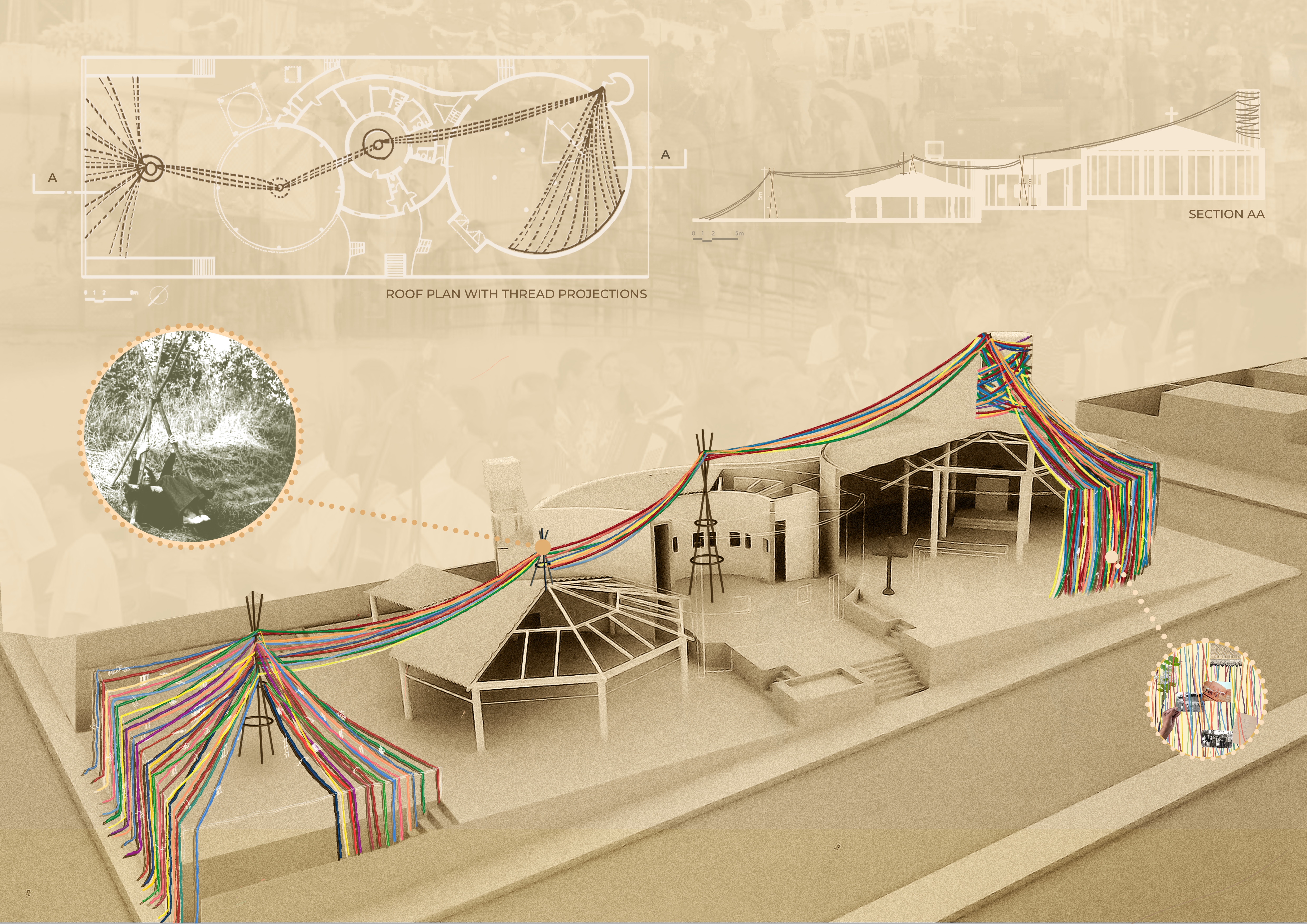
Reweaving is a temporary intervention that reconnects the community with the history of the Church of the Holy Spirit at Cerrado, in Minas Gerais, Brazil, designed by Lina Bo Bardi. Cotton threads emerge from the chapel walls carrying photos, letters, and objects that hold local memories. During a week-long cultural program inspired by the traditional Festival of the Holy Spirit, residents add their own stories, turning the church and its surroundings into a living tapestry of collective memory.
Brazil
Local
Uberlândia (Minas Gerais, Brazil)
It addresses urban-rural linkages
It refers to other types of transformations (soft investment)
Early concept
No
No
No
Individual
Reweaving is a participatory cultural intervention that reconnects a community with the history and memory of the Church of the Holy Spirit at Cerrado, designed by Lina Bo Bardi in Uberlândia, Brazil. Erected in 1976 through collective effort, built by ordinary people using donated materials in the Brazilian Cerrado, Lina described it as her "great work." Beyond its architectural significance, the church is a living cultural reference for the community of the Jaraguá neighborhood.
The title refers to the repasso mineiro, a centuries-old regional weaving technique that Lina first encountered in Uberlândia. Just as threads interlace to form fabric, the memories of individuals are woven together to form collective heritage. The intervention unfolds over one week. Workshops on the repasso technique open the program, followed by community conversations. Organic cotton threads, recycled from regional textile industries, are installed throughout the church's interior, carrying photographs, letters, drawings, and objects contributed by residents. The threads then climb to the bell tower and expand into the circular outdoor spaces, giving the installation urban scale.
The week culminates in two celebrations within existing community rituals: a "Memories" moment after the country mass, and a "Lived Experiences" gathering during the Festa do Divino, where residents tie personal fragments to the suspended threads in a collective, festive act. At the end of the week, the threads are removed, but the reweaving remain.
Conceived in 2021 and awarded First Prize at the 6th Award CURA, Reweaving demonstrates that heritage lives not in buildings alone, but in the stories communities continuously weave around them. As Lina herself once said: "perhaps the great work is that wretched little chapel in Uberlândia."
Reweaving was born at the intersection of architectural culture, intangible heritage, and the story of Lina Bo Bardi. In 2021, Lina was posthumously awarded the Golden Lion at the Venice Architecture Biennale, a milestone that triggered the creation of the 6th Award CURA in Brazil: a national competition inviting proposals for conceptual interventions within her built legacy.
The Church of the Holy Spirit at Cerrado (Igreja do Espírito Santo do Cerrado, 1976) was chosen as the site. While it lacks the metropolitan scale of Lina's MASP in São Paulo, it carries unique human magnitude: erected through collective community effort, with donated materials, by non-professional builders in a working-class neighborhood of the Brazilian interior. Lina considered it her most meaningful work precisely because of this.
The project's core question emerged from cultural heritage theory: assets do not hold value only in themselves, they are valued because people connect them to their own identity and lived experience. As Lina wrote, "architecture is created, invented anew, by every person who moves through the space." Who are the people who reinvent this small church? What does this place mean to them?
To answer this, the concept of cultural reference became the guiding framework. Rather than treating the church as a monument preserved from the outside, Reweaving proposes an intervention made by and for the community, positioning residents as both producers and interpreters of their own heritage.
The repasso mineiro weaving technique became the conceptual and material spine: it links Lina's biography (she first visited Uberlândia to research this very tradition), the region's craft heritage, and the metaphor of collective memory-making. The project was developed as a student-led conceptual proposal and awarded First Prize at the 6th Award CURA in 2021.
Cultural heritage
Participatory intervention
Memory and storytelling
Artistic and architectural reinterpretation
Community engagement
Reweaving engages with sustainability across social, cultural, environmental, and economic dimensions, always proportionate to its community-scale ambition.
Socially, the intervention activates existing bonds rather than imposing external structures. By embedding the program within rituals the community already practices (the country mass, the Festa do Divino) it requires no artificial mobilization. The participatory format builds social cohesion and intergenerational exchange, particularly between elderly residents who remember the church's construction and young people discovering it anew. Crucially, it also addresses the endangered repasso mineiro weaving tradition, a centuries-old artisanal practice threatened by the mass production of cheap fabrics and hyper consumption. By offering weaving workshops and presenting the technique as a potential source of income, the project contributes to the active preservation of a craft that Lina herself considered significant enough to travel to Uberlândia to research.
Environmentally, all materials are organic cotton threads sourced as recycled by-products from regional textile industries, otherwise discarded. The intervention leaves no permanent physical trace: when the threads are removed, the church remains unchanged. This light-touch principle honors the spirit of the original construction, built entirely from donated resources.
Economically, Reweaving is intentionally low-cost and high-impact. It requires no expensive technology or permanent infrastructure, and can be accomplished through modest cultural grants or community partnerships. This economy of means, a direct echo of Lina Bo Bardi's own approach to building, demonstrates that meaningful cultural interventions do not require significant financial resources.
Reweaving proposes an aesthetics of memory: a visual and sensory language in which the act of weaving becomes both the form and the content of the work. The cotton threads that traverse the chapel's interior, suspended between the rough concrete walls, catching the light that falls through Lina's characteristic circular openings, create an installation of profound visual beauty. Yet this beauty is never gratuitous: every thread carries meaning, weighed down by photographs, letters, objects, and fragments of personal history.
As the installation expands from the intimate scale of the chapel interior to the bell tower and the circular outdoor spaces, it acquires urban presence. The threads become visible from the street, transforming a quiet neighborhood church into a beacon of collective storytelling. The contrast between the geometric simplicity of Lina's three intersecting circles and the organic, human texture of the accumulated threads creates a powerful aesthetic tension, architecture and memory in dialogue.
The aesthetic experience is also deeply participatory. The moment when a community member approaches a suspended thread and ties to it an object, a photograph, or a handwritten note, accompanied by the applause of their neighbors, is an act of profound beauty in the everyday sense: it makes people feel seen, valued, and connected. This is beauty as dignity, as belonging, as care for place.
In the longer term, Reweaving creates an aesthetic legacy that outlasts its physical presence: a renewed way of looking at the church, at one's neighbors, and at the neighborhood itself. By making visible the invisible layers of meaning that inhabit the building, the project cultivates what might be called a heritage gaze, a lasting sense of wonder and attachment toward one's own cultural environment.
Inclusion is not merely a dimension of Reweaving, it is its structural principle. The intervention is designed from the outset to be accessible to and authored by the full diversity of the Jaraguá community: elderly residents and young children, practicing Catholics and secular neighbors, long-time inhabitants and recent arrivals, those with formal education and those without.
Accessibility is ensured at multiple levels. The programming is embedded within events that the community already attends (the Festa do Divino), eliminating barriers of invitation or unfamiliarity. The forms of participation are deliberately pluralistic: one can contribute a poem, a drawing, a photograph, a physical object, or simply a spoken story. No artistic skill, literacy, or technical knowledge is required. Children are specifically included through dedicated free drawing workshops, which serve both as creative expression and as tools for heritage education.
The project also challenges dominant narratives of architectural heritage, which too often center on expert knowledge and institutional recognition. By positioning community members as the primary interpreters and custodians of the church's significance, Reweaving enacts an inclusive model of heritage governance, one that recognizes the epistemic authority of lived experience alongside that of architectural history.
This model has direct relevance to the NEB's ambition to promote 'design for all' and 'new societal models.' Reweaving demonstrates that a cultural intervention can be simultaneously excellent in its conceptual and aesthetic ambition and radically inclusive in its authorship, that these two qualities are not in tension, but mutually reinforcing.
Participation is not a feature added to Reweaving: it is the beginning point. The intervention is structurally incomplete without the community, as the installation can only exist and acquire meaning through the active contribution of residents. This is a fundamental departure from the conventional model in which heritage interventions are designed by experts and consumed by the public.
The participatory process unfolds across the week-long program in carefully graduated stages. Early in the week, workshops and open conversations create a space for community members to reflect on their relationship with the church and to learn the repasso weaving technique, itself an act of cultural transmission. This preparatory phase builds trust and collective investment before the more vulnerable act of personal memory-sharing is invited.
The climactic participatory moments, the Memory gathering after the sertaneja mass and the Lived Experiences celebration during the Festa do Divino, are designed to be festive and emotionally generous. Each person who approaches the threads to add their contribution is applauded by the community: a simple but powerful gesture of collective recognition. The festive framing ensures that participation feels like a celebration rather than an obligation.
The impact is significant. Community members become co-authors of the installation and, by extension, co-authors of their own heritage narrative. The act of publicly sharing a memory and receiving the validation of one's neighbors strengthens social bonds and individual sense of belonging. The project also generates an informal archive of community memory that can serve as the basis for future heritage documentation and educational initiatives.
Reweaving engages a layered landscape of stakeholders at different scales, each bringing distinct added value to the project's development and implementation.
Local: The primary stakeholders are the residents of the Jaraguá neighborhood and the parish community of the Igreja do Espírito Santo do Cerrado. Their active participation is the condition of possibility for the intervention. Local cultural associations, neighborhood councils (conselhos de bairro), and informal community networks are key partners for mobilization and communication.
Municipal and Regional: The Municipality of Uberlândia and the state of Minas Gerais are key partners for funding, permitting, and cultural programming. Regional textile industries, who supply the recycled organic cotton threads, represent a material and economic connection to the regional landscape. IEPHA-MG is a critical partner for heritage recognition and institutional legitimacy.
National: IPHAN, Brazil's federal heritage authority, has a direct interest in the valorisation of Lina Bo Bardi's built legacy. The Prêmio CURA connects the project to a national network of architectural culture. Brazilian universities, notably USP and UFU, offer potential research and documentation partnerships.
International: Lina Bo Bardi's global recognition means Reweaving has genuine relevance for international audiences interested in the intersection of architecture, heritage, and community participation. The New European Bauhaus represents an extraordinary opportunity for cross-continental dialogue: Reweaving embodies NEB values from a Global South perspective, demonstrating that participatory, sustainable, and inclusive cultural interventions can emerge from contexts very different from Europe while sharing the same fundamental commitments.
Reweavings is inherently transdisciplinary and could not exist as a single-discipline project. Its conceptual and practical fabric weaves together knowledge, methods, and sensibilities from multiple fields.
Architecture and Spatial Design: The project is grounded in an architectural reading of Lina Bo Bardi's work, proposing a spatial transformation of the church and its surroundings with attention to the building's geometry, circulation, materiality, and urban relationship.
Heritage Studies and Cultural Anthropology: The framework of cultural reference, developed within Brazilian intangible heritage theory, guides the project's understanding of how communities attribute value to built space. Ethnographic sensibilities inform the participatory methods and the way community knowledge is honored.
Arts and Craft Practice: The repasso mineiro is both a material process and an act of cultural transmission. The workshops draw on traditional craft knowledge, and the installation itself is a work of textile art at architectural scale.
Education and Pedagogy: The programme draws on educação patrimonial, a well-developed field in Brazil, particularly through free drawing workshops for children and adolescents that engage young people in creative and critical relationship with their built environment.
Social Sciences and Community Engagement: The participatory design, the facilitation of public storytelling, and the attention to social dynamics draw on methods from community development and participatory action research.
Documentary and Communication: The screening of a heritage documentary and the public round of conversation draw on practices from documentary filmmaking and public discourse facilitation.
Reweaving is designed as a low-cost, high-impact cultural intervention with a diversified and realistic funding model appropriate to its conceptual nature and community scale.
Primary funding for the first full implementation is envisioned through a combination of public cultural heritage grants (such as those offered by IPHAN, IEPHA-MG, CAU-MG and municipal cultural funds in Uberlândia), architecture and design awards (potentially, the NEB Prize), and small-scale crowdfunding campaigns targeting the Brazilian diaspora in Europe and the international community interested in Lina Bo Bardi's legacy.
Material costs are intentionally minimal: the organic cotton threads are sourced as donated industrial by-products, the installation infrastructure is simple and reusable, and the program is facilitated largely by volunteer professionals (architects, educators, weavers) who engage out of cultural conviction. The budget structure is therefore dominated by coordination, facilitation, and documentation costs rather than materials.
Over time, the project's financial sustainability can be supported through: (1) licensing the methodology for replication in other Lina Bo Bardi sites or other cultural heritage contexts; (2) partnerships with universities for research and documentation activities that generate modest institutional income; and (3) positioning the project as an annual or periodic community event within Uberlândia's cultural calendar, which would attract ongoing municipal cultural funding.
The fundamental financial resilience of Reweaving lies in its economy of means: it was conceived as an intervention that achieves maximum cultural impact with minimum resource expenditure, a direct echo of Lina Bo Bardi's own approach to building with "coisas recebidas em esmola" (things received as alms).
While the specific intervention is inseparable from its particular site, the underlying approach of Reweaving constitutes a replicable model for community heritage re-appropriation applicable across a wide range of contexts.
Key transferable elements include: (1) The week-long program structure, which balances skill transmission through workshops, reflective dialogue through conversations and documentary screening, and collective celebration through community gatherings, and can be calibrated to different timescales and community rhythms; (2) The principle of embedding participation within existing community rituals rather than creating new events, which dramatically lowers barriers to engagement and ensures cultural resonance; (3) The light-touch material strategy, temporary, reversible, and made from recycled or donated materials, which makes the intervention affordable and environmentally responsible in any context.
Within Brazil, immediate candidates for replication include other significant Lina Bo Bardi buildings with active community relationships: the Casa de Vidro in São Paulo, the Solar do Unhão in Salvador, or the SESC Pompéia. Beyond Brazil, the approach is transferable to any context where a community holds a meaningful but under-recognised relationship with a heritage building, from post-industrial neighbourhoods in Central Europe to informal settlements in the Global South.
The NEB Prize itself would act as a powerful multiplier, connecting Reweaving to a European network of architects, urban designers, heritage practitioners, and community organizations for whom this methodology could offer direct practical inspiration.
The year following this application will be dedicated to transforming Reweaving from an award-winning conceptual proposal into a fully accomplished community intervention. Conceived by architecture students from the University of São Paulo (USP), the project has never been implemented due to funding constraints. Conversations have already taken place with the parish priest of the Igreja do Espírito Santo do Cerrado and with researchers and professors from the Federal University of Uberlândia (UFU), establishing early interest and goodwill as a foundation to build upon.
In the first quarter, the focus will be on converting these initial contacts into formal partnerships, and expanding engagement to neighborhood associations in Jaraguá and the Municipality of Uberlândia's Secretaria de Cultura. Grant applications will be submitted to relevant Brazilian and international cultural funds, including IPHAN and IEPHA-MG for heritage endorsement and co-funding.
In the second quarter, preliminary community engagement sessions in Jaraguá will allow residents to co-shape the program's content, timing, and forms of participation. Regional textile industry partners will be approached for the donated cotton thread material.
In the third quarter, the first full edition of Reweavings will be implemented, timed to coincide with the Festa do Divino. A documentation team will produce a photographic and video record for archive, dissemination, and educational use.
In the fourth quarter, a community evaluation session will gather feedback from participants. A short publication documenting the concept, process, and outcomes will be developed for distribution to architecture schools and heritage institutions in Brazil and Europe.