Enhancing Circularity, Sustainability, and Innovation
Designing with intention
Designing with intention: A trophy reflecting on space, memory, and inclusive design
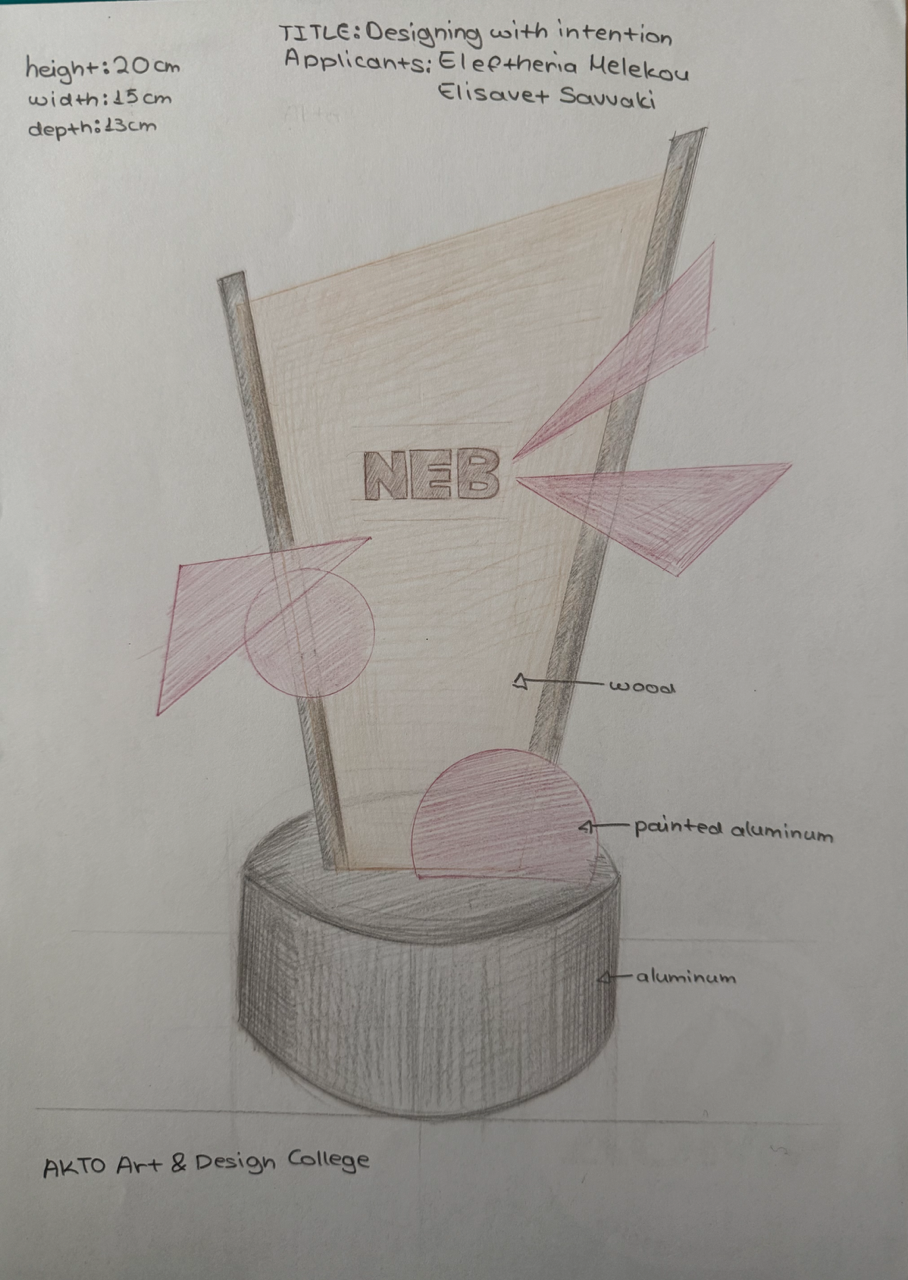
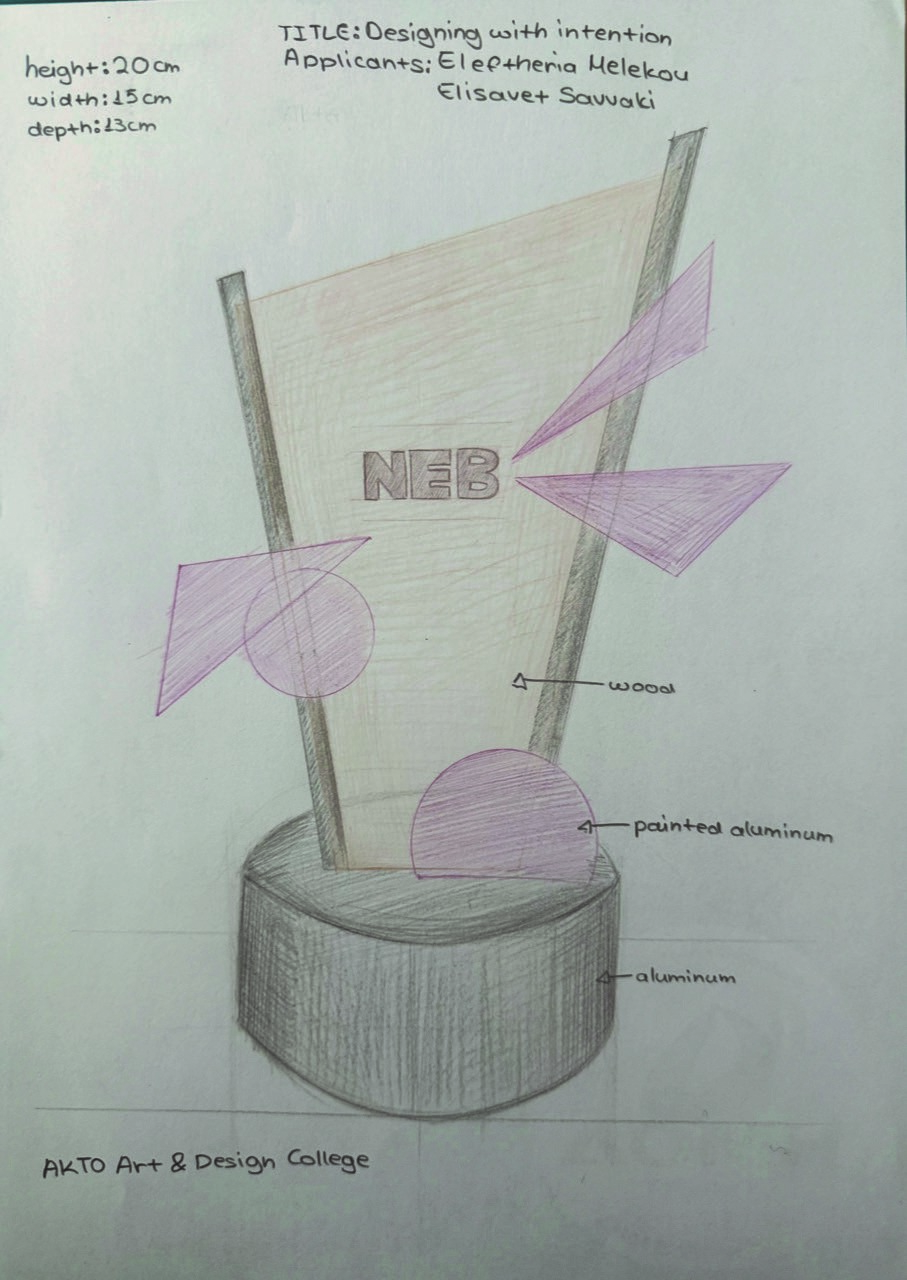
This trophy explores how thoughtful design can express values such as care, openness, and inclusion. It is inspired by memories of a schoolyard and uses simple geometric forms to show how the environments around us shape our everyday experiences. Through sustainable materials and a balanced composition, the design reflects the vision of the New European Bauhaus.
Greece
Local
Thessaloniki
Mainly urban
It refers to other types of transformations (soft investment)
Early concept
No
No
No
Individual
“Designing With Intention” is a trophy concept inspired by my personal experience is a restrictive and unwelcoming schoolyard in Thessaloniki. This project explores how spaces can shape human behavior and interaction. Through my graphic design studies, I learned that what appears absent in space such as color, shade, or invitation can become an opportunity to create environments that are inclusive, sustainable and engaging.
This trophy embodies these values through simple geometric forms such as circles and triangles arranged asymmetrically to nance solid elements with negative space. The design encourages engagement and interpretation, transforming lessons from my schoolyard into a meaningful, tactile form.
Through this project, the trophy embodies the values of care, inclusivity, and environmental responsibility. It demonstrates that even small objects can inspire reflection, foster connection and model sustainable design practices. This concept illustrates how international design can create spaces and experiences that are both beautiful and resilient, in harmony with the principles of the New European Bauhaus.
The idea behind “Designing with intention” was born from my own experience with an uninviting and restrictive school yard in Thessaloniki. As I walked daily on the worn concrete, I noticed the lack of color and invitation to stay. Although the negative spaces inspired thoughts about how environments influence the behavior and emotions of humans.
During my graphic design studies, I began to analyze the space with a designer’s perspective, seeing the possibility in what had previously been restrictive. I considered how design could change the space into an inviting, engaging, and sustainable experience with the minimum amount of intervention using color, form, and structure.
The concept evolved into a trophy design embodying these reflections. I began by sketching to test the possibilities of geometric forms and their relationships, specifically with circles and triangles. By studying positive and negative space, I discovered how voids could invite interaction while solid forms provide stability. Prototyping allowed me to refine balance, rhythm, and proportion, ensuring the trophy communicates care, openness and inclusivity.
Social inclusion
Sustainability
Human-centered design
Intentional design
Care and well-being
The main body of the trophy is conceived using recycled or responsibly sourced materials such as recycled aluminum and sustainably sourced wood. These materials reduce the demand for new raw resources while maintaining high aesthetic and structural quality. The production process is designed to minimize waste through digital fabrication techniques and modular components.
The form of the trophy allows for efficient material use, avoiding unnecessary mass while preserving strength and visual presence. Its modular base can be produced separately and assembled easily, facilitating transport and reducing packaging volume and carbon emissions.
Beyond its physical materials, the concept reflects sustainability as a cultural value. The design communicates balance between technology, nature and human creativity principles that align with the New European Bauhaus vision of a greener future.
The trophy is intended to last over time as an object of meaning and memory, encouraging emotional durability rather than disposability. By combining responsible materials, efficient production methods and symbolic storytelling, the concept demonstrates how even ceremonial objects can embody sustainable thinking and inspire environmentally conscious design practices.
“Designing with Intention” contributes to making life more beautiful for people, communities, and neighbourhoods by translating reflections on everyday spaces into a thoughtfully crafted design. The composition emphasizes proportion, balance, and visual lightness. Transparent and reflective materials interact with light, giving the trophy a dynamic quality that changes depending on its surroundings. This engagement with space reinforces the idea that design should be experienced and interacted with, rather than remain static.
The visual language is minimal yet expressive. By reducing the form to essential elements, the design communicates elegance and timelessness, avoiding unnecessary decoration while remaining rooted in the historic Bauhaus tradition. The trophy functions not only as an award but as a symbolic object representing creativity, collaboration, and cultural transformation. Its sculptural quality allows it to act as a small architectural object, celebrating the intersection of design, society, and innovation.
Through its clear geometry, refined materiality, and symbolic meaning, the trophy inspires reflection, engagement, and a sense of care for the places we inhabit. By making design visible and approachable, it demonstrates how aesthetics can enhance everyday life, foster belonging, and create lasting impact, embodying the core vision of the New European Bauhaus.
“Designing with intention” promotes inclusion by translating personal reflections on restrictive spaces into a design that is accessible to everyone. The trophy embodies the principles of “design for all” by using simple geometric forms and clear visual language that is easily perceived and interpreted by people of all ages and backgrounds. Its open forms and thoughtfully placed negative spaces encourage interaction and interpretation, allowing each person to engage with the object in their own way.
Accessibility and affordability are ensured through a modular, lightweight design that can be efficiently produced using recycled aluminum and sustainably sourced wood. This approach makes the trophy both environmentally responsible and widely reproducible, allowing equitable access to a design object that carries cultural and educational significance.
The project reflects inclusive governance by building on shared experiences, turning everyday spaces into objects that express care, oneness, and belonging. By transforming insights from a typical schoolyard into a physical trophy, the concept shows how intentional design can encourage engagement, reflection, and mutual understanding across diverse audiences.
“Designing with intention” was shaped by listening to the experiences and insights of classmates and community members. While inspired by my personal reflections on a restrictive schoolyard, involving others revealed how different people perceive and interact with spaces, highlighting opportunities to make design more inclusive, engaging, and meaningful.
Sketches and prototypes were shared with participants to collect feedback on form, scale, materials, and usability. Their suggestions guided adjustments to the balance of positive and negative space, the modular structure, and the tactile qualities, making the trophy more accessible, engaging, and meaningful for people of all ages and abilities.
This collaborative approach transformed a personal reflection into a design that speaks to a wider audience. By involving users, the project became more inclusive, empathetic, and socially aware, showing how participatory design can produce thoughtful, human-centered outcomes that align with the values of the New European Bauhaus.
The development of “Designing with intention” was shaped through dialogue with peers and members of the local community, whose perspectives helped refine the concept and highlight how everyday environments influence human experiences.
At a broader level, the concept can engage designers, educators, and cultural organizations interested in inclusive and sustainable design practices. Their engagement can help expand the project’s visibility through exhibitions, dialogue, and collaborative activities.
At the European level, the project aligns with the values of the New European Bauhaus by encouraging exchange between designers, communities, and institutions. This multilevel engagement connects local experiences with wider cultural and design networks, strengthening the relevance and potential impact of the concept.
“Designing with Intention” is developed through a transdisciplinary perspective that combines graphic design, spatial thinking, art, and environmental awareness. The project explores how visual communication and geometric composition can shape the way people perceive objects and relate to their surroundings.
The design process integrates principles from sustainable design and material studies through the use of recycled aluminum and sustainably sourced wood, connecting aesthetic choices with environmental responsibility. At the same time, the concept reflects insights from social and human-centered perspectives by examining how everyday environments influence emotions, behavior, and a sense of belonging.
By bringing together creative practice, environmental awareness, and reflections on spatial experience, the project demonstrates how different disciplines can interact to produce design solutions that are both meaningful and responsible. This transdisciplinary approach reflects the values of the New European Bauhaus by linking creativity, sustainability, and human experience in a single design outcome.
The concept of “Designing with Intention” can be supported through a combination of small-scale production, cultural partnerships, and design dissemination activities. The modular structure of the trophy allows efficient manufacturing using recycled aluminum and sustainably sourced wood, enabling limited series production while maintaining environmental responsibility.
Revenue could be generated through collaborations with cultural institutions, design festivals, and organizations that host competitions or events aligned with sustainability and innovation. The trophy could serve as an award object for such initiatives, connecting design with cultural and social recognition.
Additional financial sustainability could come from public funding programs, design grants, and initiatives supporting sustainable and creative projects. Exhibitions, design showcases, and educational presentations could further expand the project’s visibility while creating opportunities for partnerships and commissions.
By combining production, collaborations, and cultural dissemination, the concept can remain financially viable while continuing to promote the values of thoughtful, inclusive, and sustainable design.
Several elements of “Designing with Intention” can be replicated and adapted in different contexts. The design methodology, starting from personal observation of everyday environments and translating these reflections into meaningful designcan be applied to many spaces, communities, and cultural settings.
The trophy’s geometric structure and modular design allow it to be reproduced efficiently using accessible production techniques such as casting and laser cutting. This makes it possible to adapt the design for different events, institutions, or cultural initiatives while maintaining its core principles.
The concept can also be transferred as a design approach that encourages reflection on how spaces influence human experience. Designers, educators, and cultural organizations could adopt this methodology in workshops, educational projects, or design initiatives that promote inclusive and sustainable thinking.
Through its adaptable form, reproducible materials, and transferable design process, the project demonstrates how a small design object can communicate universal values of care, inclusivity, and sustainability across different contexts and communities.
In the year following the application, “Designing with Intention” will move from concept to tangible impact. The first step will be producing a refined prototype that preserves modularity, balance, and sustainability, incorporating any feedback received during the submission process.
The project will then be showcased through exhibitions, design events, and workshops to engage designers, students, and cultural communities, fostering reflection on how everyday spaces influence behavior and inclusion. These activities will also serve as a platform for dialogue on sustainable and human-centered design principles.
Partnerships with cultural and educational organizations will help share and adapt the concept, while grants, sponsorships, or public funding will support its production, exhibitions, and educational activities.
Finally, thorough documentation and digital presentation of the design, methodology, and lessons learned will enable replication and inspire similar projects elsewhere. By combining production, collaboration, and knowledge sharing, the project demonstrates a clear path toward real-world implementation and lasting impact aligned with the values of the New European Bauhaus.