Arts, Culture, and Heritage as Drivers of Change
Triskáč: Mobile Theatre for Communities
A tricycle-powered theatre bringing culture directly into neighbourhood public spaces.
Triskáč is an electric cargo tricycle converted into a mobile puppet theatre. It carries its own stage, sound system, and performer - everything needed to stage a full production in residential neighbourhoods, with no external power and no ticket price. In September 2025, it toured 7 districts of Trnava, Slovakia, performing an original play to an estimated 1600 people who otherwise have little access to live culture.The project is a replicable model for neighbourhood-based cultural programming.
Slovakia
Local
City of Trnava, 65000 inhabitants
Mainly urban
It involves other types of transformations (soft investment)
Yes
2025-10-18
No
No
No
Organisation
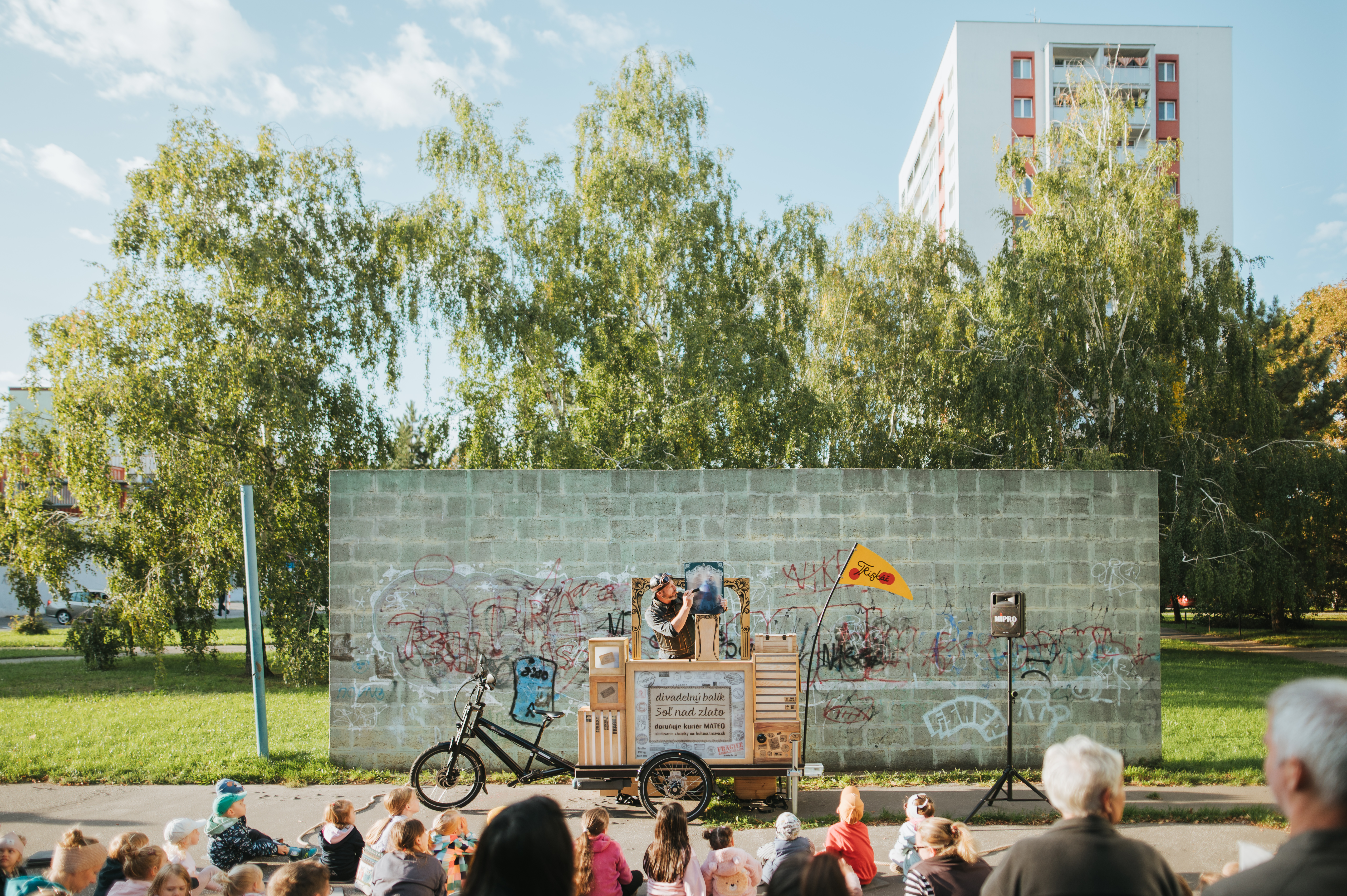
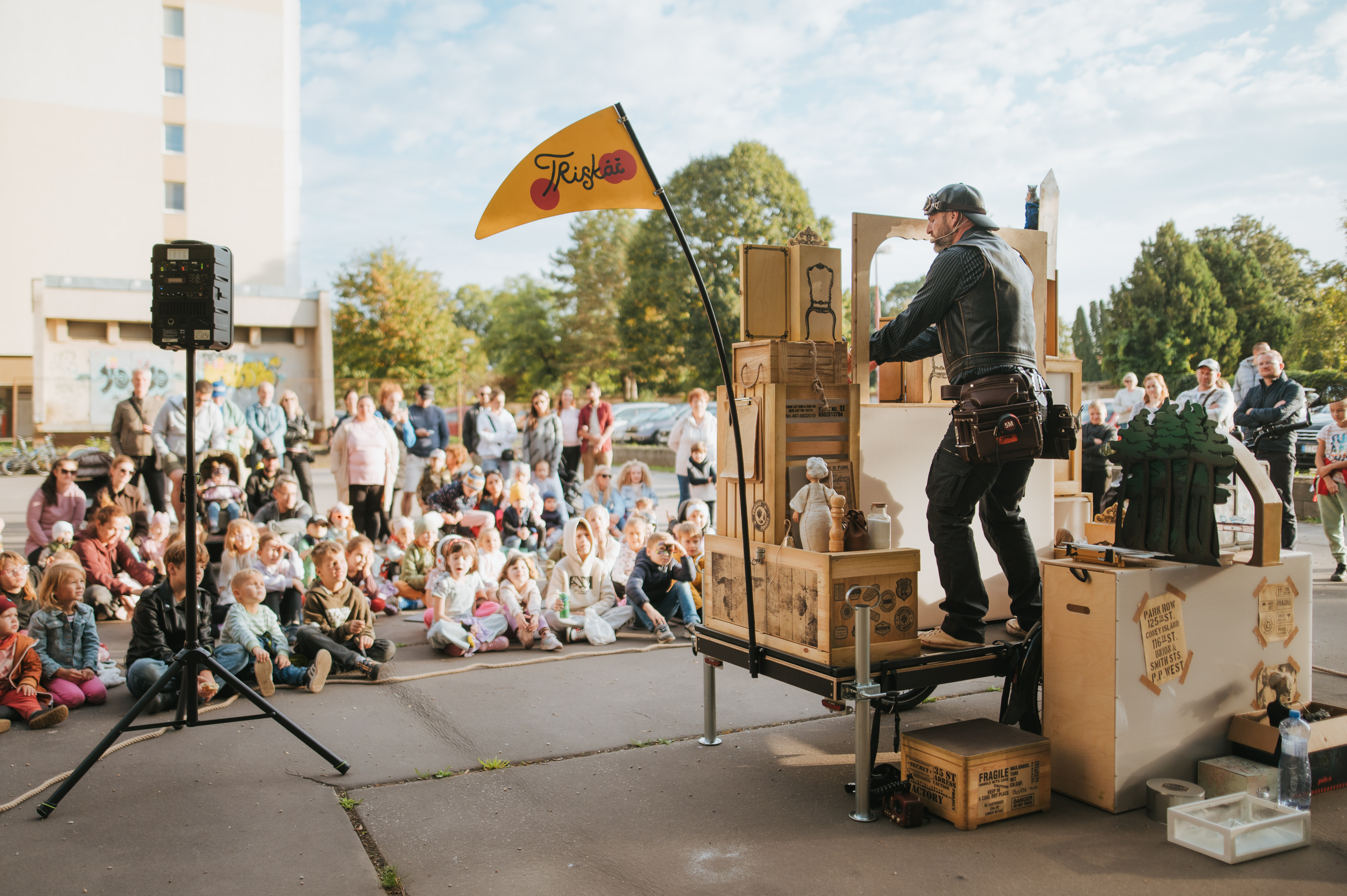
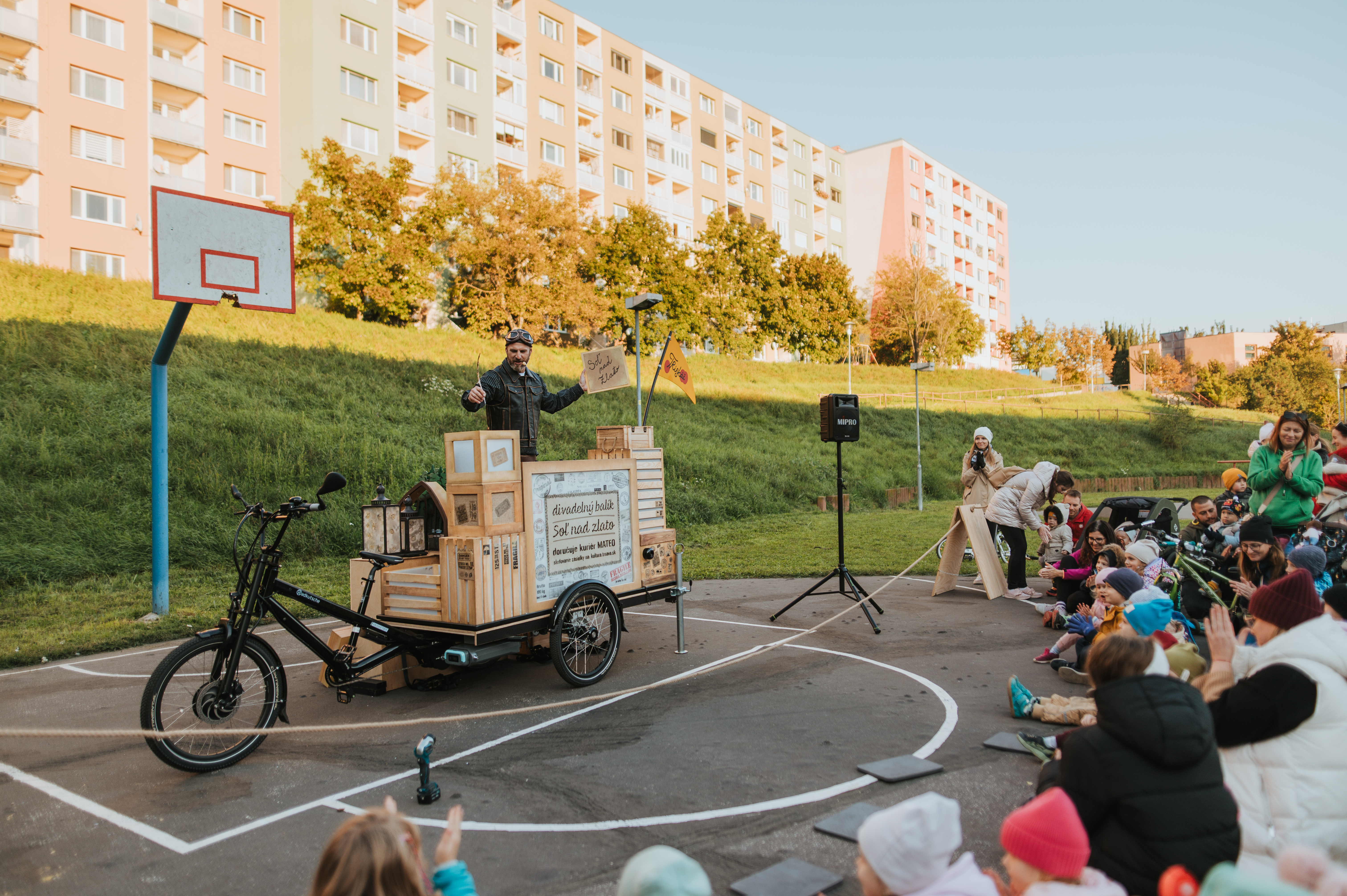
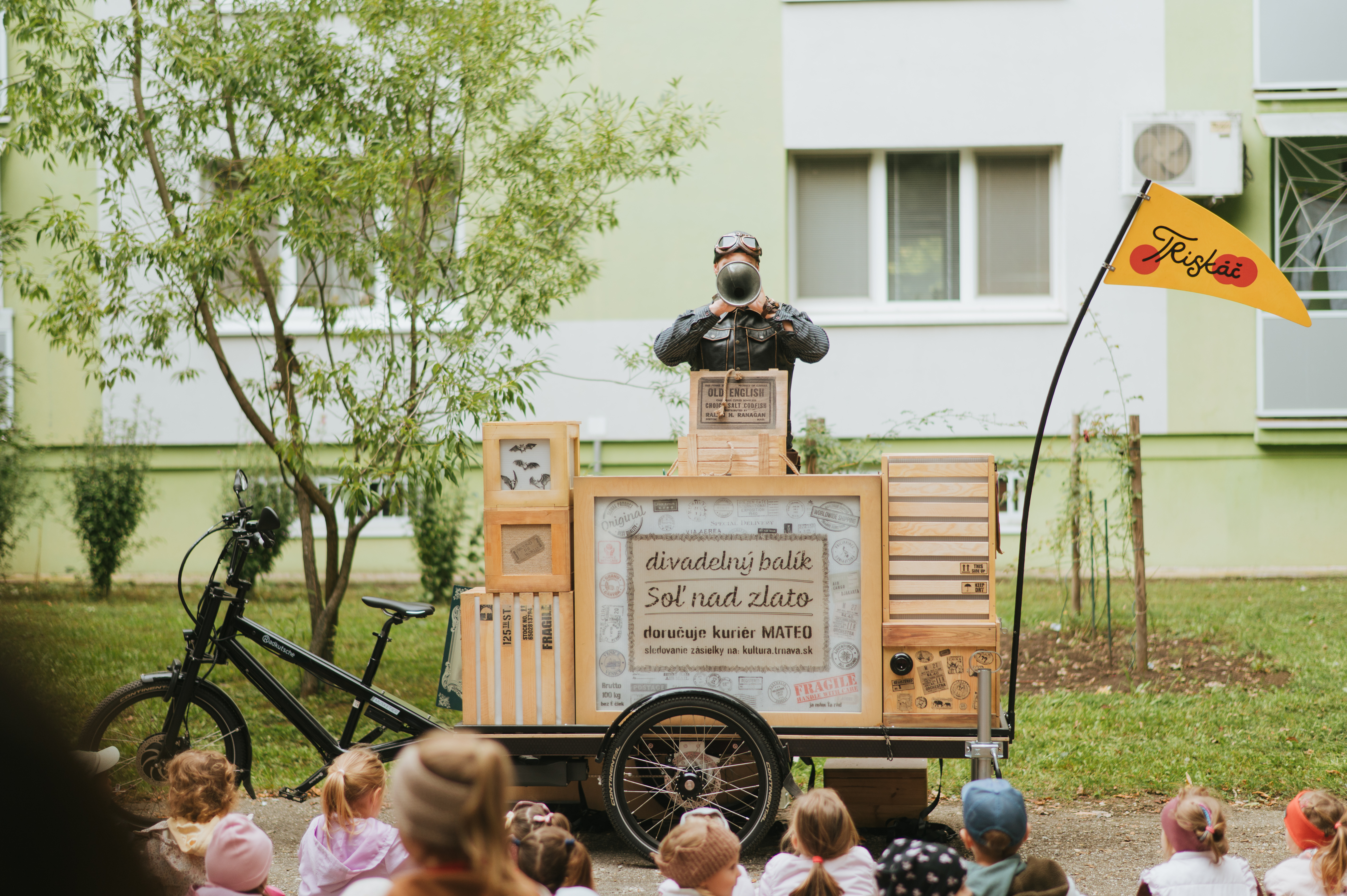
Triskáč is an electric cargo tricycle that operates as a mobile theatre stage, built, owned, and programmed by Zaži v Trnave, the city's cultural centre. It carries a folding puppet stage, battery-powered sound system, wireless microphone, and a single actor. No external power, no infrastructure, no advance setup. The tricycle rides into a courtyard, the stage unfolds, and the show begins.
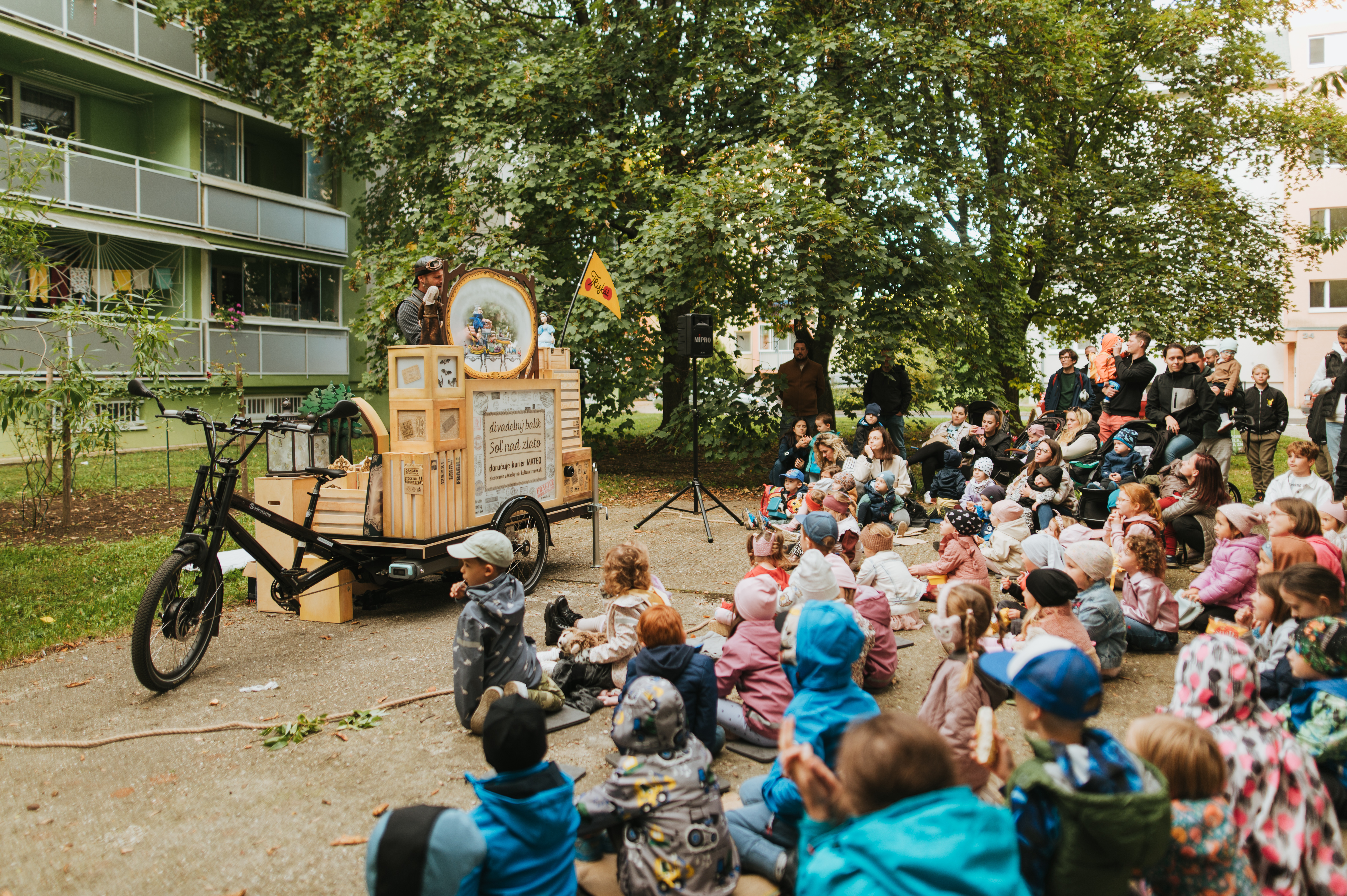
In September 2025, Triskáč completed its first tour: 7 performances of "Salt Above Gold," an original puppet play, across 7 housing estate districts in Trnava (Prednádražie, Modranka, Hliny, Linčianska, Družba, Pod Agátkou, Merkúr). The premiere at Prednádražie drew roughly 400 people - in a residential courtyard, with no advance ticket sales and no paid promotion. Subsequent performances averaged around 200. Total estimated audience: 1600.
The project exists because cultural opportunities in Trnava are heavily concentrated in the centre. Housing estates on the periphery see a fraction of the cultural programming, and residents, faced with the extra distance and effort, tend not to seek it out downtown either. Triskáč reverses the logic: instead of expecting people to travel to culture, it brings a complete production to their doorstep.
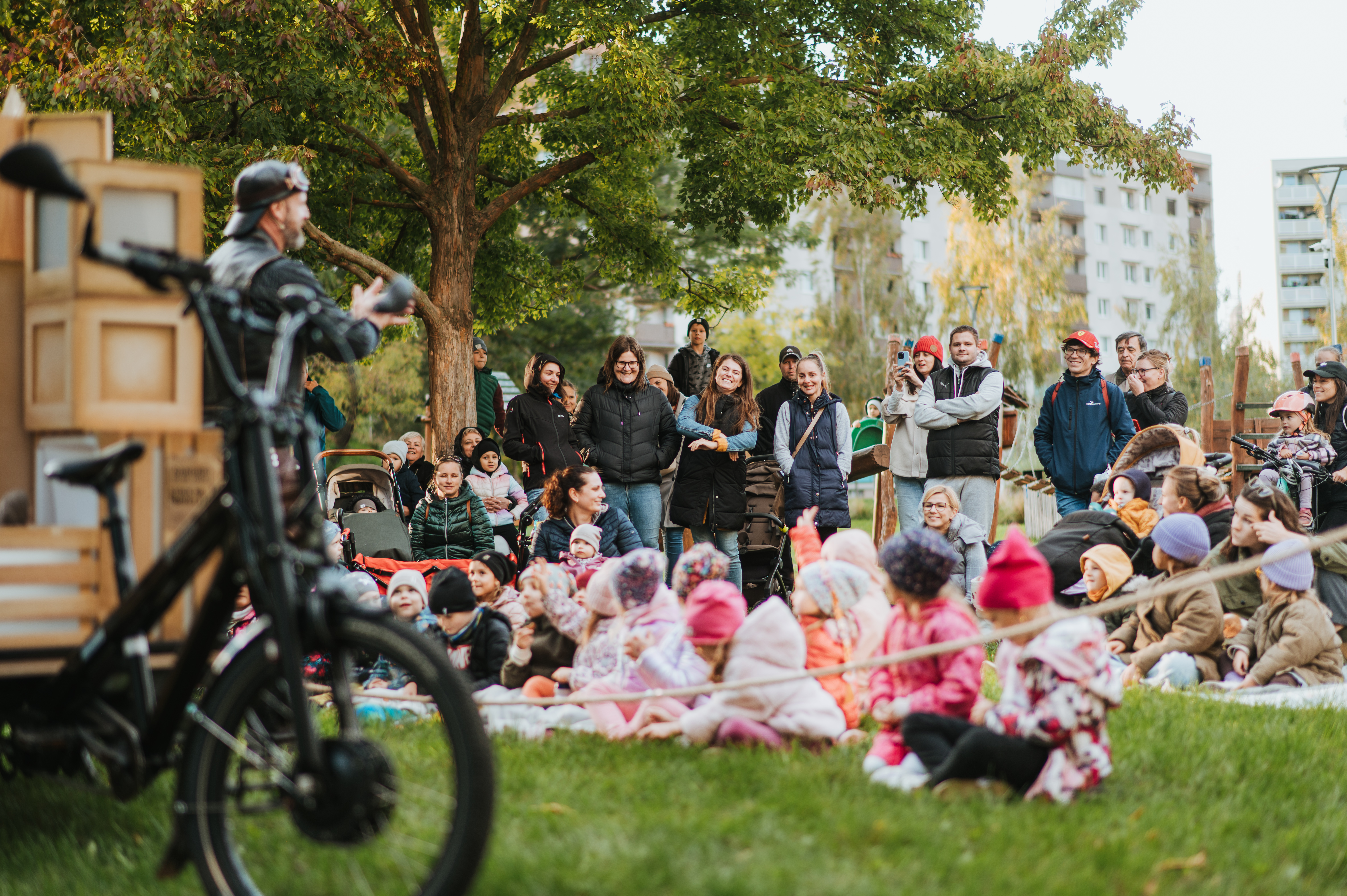
What we did not anticipate, after each performance, people stayed. Parents sat on benches while kids kept playing. Neighbours who shared a staircase but had never spoken ended up in conversation. A courtyard that normally serves as a shortcut briefly became a commons.
In 2026, a second production is in development - fairytale "The Golden Fish" (co-produced with O.Z. Divadlo Agapé), and we plan to extend the programme beyond theatre to include live music and poetry readings.
The idea started in a barn. Peter Cagala, the director of Zaži v Trnave, was visiting actor Martin Žák and noticed a dusty adult tricycle in the corner, something Martin Žák had long imagined turning into a mobile theatre. That conversation set the project in motion.
Over the following months, we assembled a team and worked through the concept in stages. We sourced a Radkutsche Musketier electric cargo tricycle from Germany. Scénographer Barbora Rajčanová and builder Miloš Rajčan designed and constructed a modular puppet stage that fits entirely in the cargo box (foldable, durable, weather-resistant, operable by one person). Director Kamil Žiška wrote an original script adapted for a single actor performing outdoors. Martin Žák developed the character of Mateo, a courier who has cycled across continents and arrived in Trnava to deliver not parcels but stories.
Nothing about this was off the shelf. The stage, the props, the special effects devices, the sound rig, each component had to be small enough to fit on a bike, tough enough for wind and rain, and striking enough to hold attention in an open courtyard competing with traffic and dogs and kids on scooters. We tested, rehearsed, rebuilt, tested again.
The first performance took place on 22 September 2025 at Prednádražie. We expected maybe fifty people. Around 400 showed up, drawn by the music and Mateo's voice carrying across the courtyard through a wireless headset mic. Over the following weeks Triskáč visited six more districts. Each time the same pattern: the tricycle arrives, a crowd forms, an hour later the show ends and people stay.
That last part, the staying, was not something we planned for. Parents on benches, kids still running around, neighbours talking. It kept happening at every location.
mobile sustainable cultural inclusion
community activation
simple and replicable solution beyond borders
cultural decentralisation
high-quality cultural programming directly into residential neighbourhoods
A conventional mobile theatre setup in the same city would require a van for transport, a portable generator for sound, and temporary staging to assemble and dismantle at each site. Triskáč eliminates all of these. The tricycle is the transport, the stage, and the power source in one. Direct emissions per performance are zero.
Compared to a standard touring theatre using vans, generators and staging trucks, the Triskáč model reduces emissions by an estimated 90–95%. We are operating with:
• reusable scenography
• repairable vehicle
• long life cycle of infrastructure.
• performances are free
• events take place in residential courtyards (no fee for venue)
The vehicle weighs approximately 75 kg including motor and battery. The full stage setup (a wooden puppet theatre with a metal subframe for durability) adds roughly 70 kg. Everything is packed up and ridden home the same way it arrived.
The platform is designed around modularity, adaptability and long-term reuse. The cargo bicycle, stage frame and sound system form a modular platform that can host different performances without requiring new equipment or materials. Future productions will reuse the same structure, extending the lifespan of the investment and reducing material consumption. In this way, the project applies principles of circular design to cultural programming.This demonstrates how cultural production can be redesigned to align with the goals of the European Green Deal while maintaining artistic quality and accessibility.
Triskáč does not wait for an audience to arrive. As the tricycle moves through a housing estate, it plays the atmospheric soundtrack of the upcoming performance. The actor calls out to residents from the saddle through a wireless headset mic – improvised rhymes and invitations to come downstairs. One recurring line: “Don’t hang your laundry out just yet, come watch the theatre – no regrets.” By the time the tricycle stops and the stage unfolds, the show has already been going on for minutes.
The stage itself is the size of a kitchen table. It was designed to fold out of the cargo box in a sequence that one person can complete in under five minutes. Puppets emerge from hidden compartments. Scenery panels hinge open. The whole thing has a handmade quality (carved wood, painted backdrops and cloth elements) that reads completely differently from a printed banner or a projector screen. You are watching something that someone built by hand, and you can tell.
A courtyard that was empty fifteen minutes earlier now has 200 people sitting on cushions. Children up front, parents behind, a few people watching from a balcony. The sound carries just far enough, voice and a soundtrack are at a volume that feels like it belongs in the space rather than dominating it.
Spaces that normally function only as transit areas or playgrounds become places of shared cultural encounter. Even for a short time, the presence of theatre changes how residents perceive and use their neighbourhood.
By temporarily transforming ordinary housing estate courtyards into spaces of imagination and storytelling, the project reintroduces beauty, playfulness and artistic expression into everyday public environments. We offer the audience an intimate theatre format and a spatial transformation of courtyards. They can admire handcrafted puppets and handmade stage design and, hopefully, develop a new appreciation for handcrafted art.
Trnava has roughly 65000 inhabitants, but its cultural life is almost entirely centralized. For residents of peripheral housing estates, attending a performance means a 30-minute commute and buying a ticket. Therefore, many stay home. Not out of disinterest, but because the offer is not tailored for them.
Triskáč flips this logic. The performance comes directly to the courtyard. During our pilot tour, we reached 1600 residents across seven districts, largely because the threshold for participation is zero. There are no tickets and no time slots to book. People do not have to plan a night out. They just hear the music from their kitchen window and walk downstairs. A mother with a stroller or a group of teenagers don’t need to decide if theatre is "for them." The format meets people where they physically and psychologically already are.
The spatial setup reinforces this "design for all" approach. The actor performs from the tricycle at ground level, at eye height with the children sitting closest on scattered cushions. There is no formal entrance or seating plan. People drift in during the show and leave if they need to. The boundary between the stage and the public space remains soft.
In terms of new societal models, Triskáč actively decentralizes municipal cultural funds, shifting resources from the historic centre to often-overlooked neighborhoods. We also applied a street-level approach to governance. We did not select locations from a desk. Instead, we scouted the estates on foot, talked informally with residents spending time outside, polled local Facebook groups, and relied on our own knowledge of pedestrian flows. This ensured we placed the stage exactly where community life naturally happens.
Before the pilot tour, we scouted all seven housing estates on foot and bicycles to observe evening routines and find suitable open spaces. We consulted the locations directly with people on the street, local city councilors, and active contributors in district-specific Facebook groups. The final performance spots were chosen based on these interactions.
The performance format requires active participation. Children made up roughly 60-70% of the estimated 1600 attendees. During the play, they help produce sound effects, call back to the actor, and react physically to the plot. As a closing ritual, children "sign for the delivery" brought by courier Mateo, creating a direct personal interaction with the performer.
After each show, we stayed to talk with the audience. We did not run formal demographic surveys during the pilot, relying instead on immediate qualitative feedback. Residents actively suggested specific new courtyards for future shows and asked for the upcoming schedule. The project also received extensive organic coverage across regional media, including trnava-live.sk, Trnavský hlas, Trnavské rádio, and the city's municipal television.
For the 2026 season, we are formalizing community involvement. We are partnering with Trnavské klubovne (local community clubs) to coordinate locations and outreach. We will also introduce a simple on-site feedback mechanism after each performance to feed audience responses directly into our programming decisions.
Triskáč was initiated and fully funded by the City of Trnava through its municipal cultural budget. The decision to invest in a mobile cultural platform was approved by the Mayor and implemented by the director of Zaži v Trnave, the city's cultural centre. The project directly implements Measure 1.1 (Community Cultural Programme) of the Strategy for Culture and the Creative Industry of Trnava to 2030, the city's first strategic document for cultural policy. That strategy explicitly identifies peripheral housing estates, including Prednádražie, Družba, Linčianska, and Modranka, as priority locations for community-level cultural events.
The strategy itself was developed through a participatory process involving 1000 residents surveyed across city districts, 58 participants in facilitated workshops with cultural professionals, and a dedicated community needs survey of 536 residents on the Družba estate and 315 in Modranka. Triskáč is one practical outcome of that process.
At the regional level, the Trnava Self-Governing Region (TTSK) operates five major cultural institutions within the city, spending approximately €4.4 million annually on their operation. While TTSK was not directly involved in the Triskáč pilot, the city and regional cultural ecosystems are closely interlinked. The city's cultural strategy was partly shaped by Trnava's 2020 bid for European Capital of Culture 2026, which was prepared in cooperation with TTSK and international consultants.
The project has already attracted interest from other municipalities. The Petržalka district of Bratislava, Slovakia's largest housing estate area, has been in contact with us about the model. Regional media covered the pilot extensively, including Trnavský hlas, Trnavské rádio, and the city's municipal television. These signals suggest the concept has relevance beyond Trnava. We were also already invited to a cultural creative exchange of the best practices by regional Europe Direct that takes place in May.
Triskáč forced everyone involved into unfamiliar territory. A scénographer had to think like a structural engineer, builder had to care about sight lines and actor had to become a sound technician, a municipal cultural manager had to procure a cargo bike from Germany and figure out how to classify it in the city's asset register.
Barbora Rajčanová designed the puppet stage, the puppets, the costumes, and the scenic world of the production. Her husband Miloš Rajčan built the physical structure: a metal subframe with wooden folding panels that locks into the cargo box and can be assembled by one person in minutes. They worked side by side, but their problems were different. She needed visual coherence and theatrical scale. He needed load-bearing joints and weather resistance. They cooperated and tested multiple versions to find an easily operated one. Threfore, the stage works seamlessly.
The sound system posed a similar overlap. The actor performs with a wireless headset mic connected to a battery-powered speaker, and triggers atmospheric music cues from a mobile device while performing. This is not a standard theatre setup. Martin Žák had to rehearse the technical operation alongside the artistic performance until both became one routine.
Cube, a graphic design studio, developed the visual identity. Their task was to make Triskáč recognisable at street level, on the body of the tricycle itself, on A3 posters stapled to wooden signs and on social media. The result is a design system that holds together across all of them.
Zaži v Trnave was the coordinator, managing procurement, permits, and communication. We work with these creative professionals regularly, but nothing in our portfolio had prepared us for procuring a cargo tricycle from Germany and building a theatrical production around it.
The project is funded entirely by the City of Trnava through the budget of its cultural centre, Zaži v Trnave. It does not generate revenue and is not designed to. Charging admission would exclude the people the project exists to reach.
The cost structure is simple. The capital investment was approximately €15,700 for the tricycle, sound system, and stage construction. This is a one-time expense. The asset is now owned by the city and has a functional lifespan of many years. Operating cost per performance is €250, which covers the actor's fee. He is an independent professional contracted per show. Other running costs are negligible: batteries, minor bicycle maintenance, promotional materials.
Seven performances in 2025 cost the city €1,750 in total operating expenses. For that, roughly 1600 residents saw a professional theatre production in their own neighbourhood. Per audience member, the cost was just over one euro.
The financial model scales well. Each new production requires investment in creative development (script, puppets, set adaptation), but the vehicle, sound system, and structural frame remain the same. Adding a second or third show to a tour week costs €250 per performance, nothing more. The marginal cost of reaching another 200 people is fixed and low.
In the longer term, the platform could also function as shared infrastructure. An independent theatre company or musician could use the tricycle and stage for their own programme, bringing their own creative and financial resources. The city would provide the vehicle. The offer still stands for the interested - the technical setup makes it possible without modification.
Cultural participation in mid-sized European cities drops sharply outside historic centres. Triskáč addresses this by acting as a new model for neighbourhood-based cultural infrastructure. We combine lightweight mobility, local artistic production, and public space activation to distribute culture evenly.
The technical setup is simple and highly transferable. It requires an electric cargo tricycle, an outdoor performer, and a coordinating cultural organization. Our custom-built stage is fully documented, meaning another city avoids reverse-engineering. The financial barrier is low. The Trnava pilot cost €24,600 (vehicle, sound, stage, creative development, materials) as a one-time investment. The recurring cost is €250 per performance.
While the physical infrastructure remains identical, creative content must adapt locally. Replication works best by pairing a stable municipal institution with an independent theatre maker. Interest already exists; Bratislava's Petržalka district is consulting with us to apply the concept to Slovakia's largest housing estate.
Cultural innovation does not require major investments. A bicycle, a story, and a courtyard can reconnect a community. The pilot's most striking outcome was spontaneous social interaction. Residents who usually pass each other anonymously stayed together after shows, transforming courtyards into active community hubs.
In the long term, Triskáč can serve as a shared infrastructure for local artists, turning courtyards into a network of small stages. It embodies core New European Bauhaus values: sustainability (low-carbon mobility), inclusion (free access), and aesthetics (high-quality art in everyday spaces).