Enablers for New European Bauhaus Transformation
Energy Shift Vouchers
Energy Vouchers: Citizen-Financed Acceleration of the Clean Energy Transition
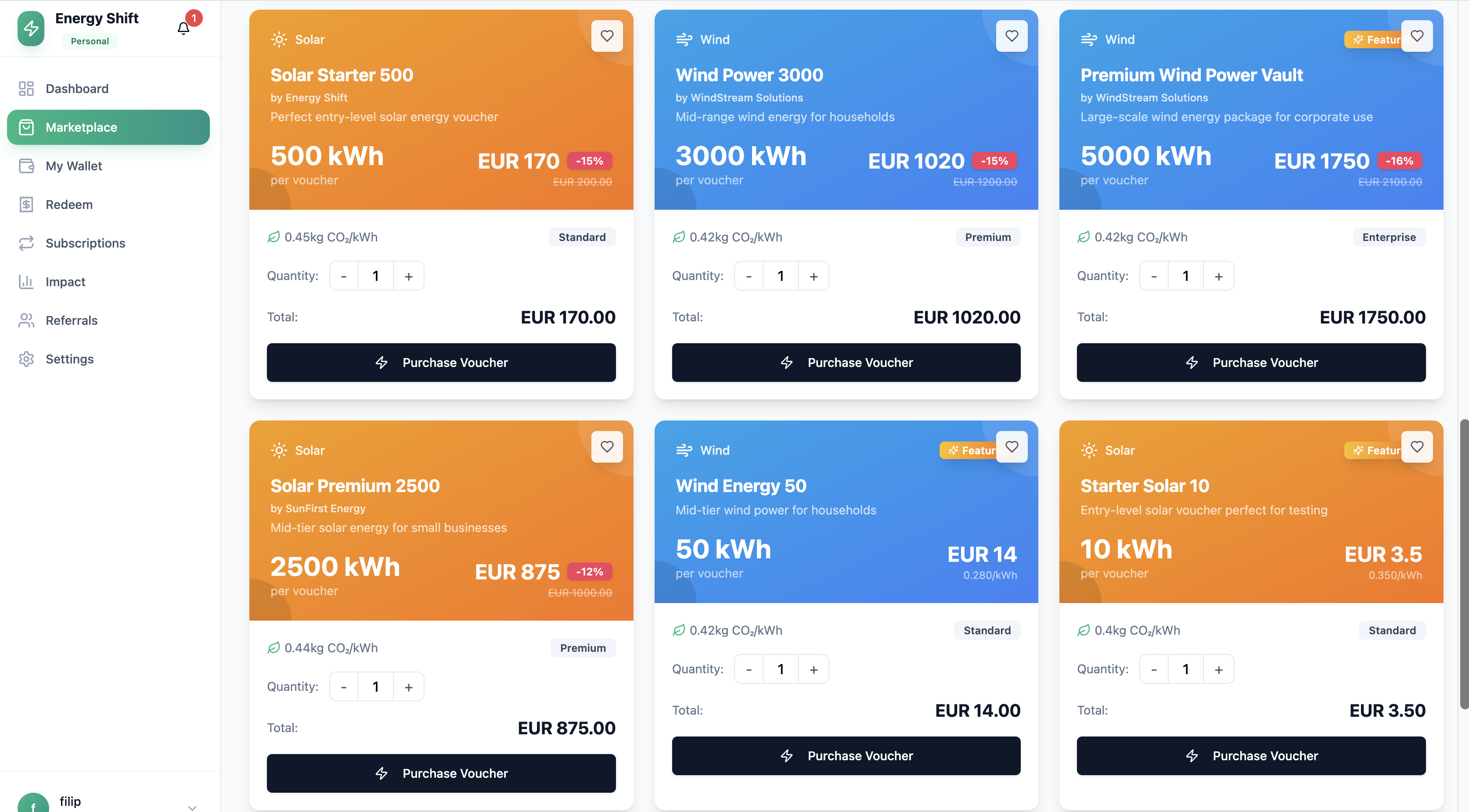
Energy Shift introduces energy vouchers — a new way for citizens and businesses to pre-purchase future energy at a discount, turning everyday payments into upfront capital for clean energy. By enabling utilities to access predictable funds early, this model accelerates renewable deployment, strengthens energy resilience, and empowers communities to actively participate in Europe’s sustainable energy future.
Croatia
National
It addresses urban-rural linkages
It involves a physical transformation of the built environment (hard investment)
Prototype level
Yes
New European Bauhaus
Yes
EU Sustainable Energy Award in the Young Energy Trailblazer category.
No
Organisation
Energy Shift introduces energy vouchers — a new citizen-centered financing mechanism designed to accelerate Europe’s clean energy transition.
The core challenge is not the availability of renewable technologies, but the speed of capital deployment. Utilities must invest heavily in renewable generation, storage, and grid modernization, yet they recover capital slowly through monthly energy bills. Energy Shift transforms this model by allowing households and businesses to voluntarily pre-purchase future energy (e.g., €1,000 of annual electricity value). In return, customers receive price stability or discounts, while utilities gain immediate capital to reinvest in clean infrastructure.
The concept strengthens three key European priorities: sustainability, affordability, and participation. Environmentally, it accelerates renewable deployment and reduces dependence on fossil fuels. Socially, it empowers citizens to actively participate in shaping local energy systems rather than remaining passive consumers. Economically, it improves utility cash flow without increasing public debt.
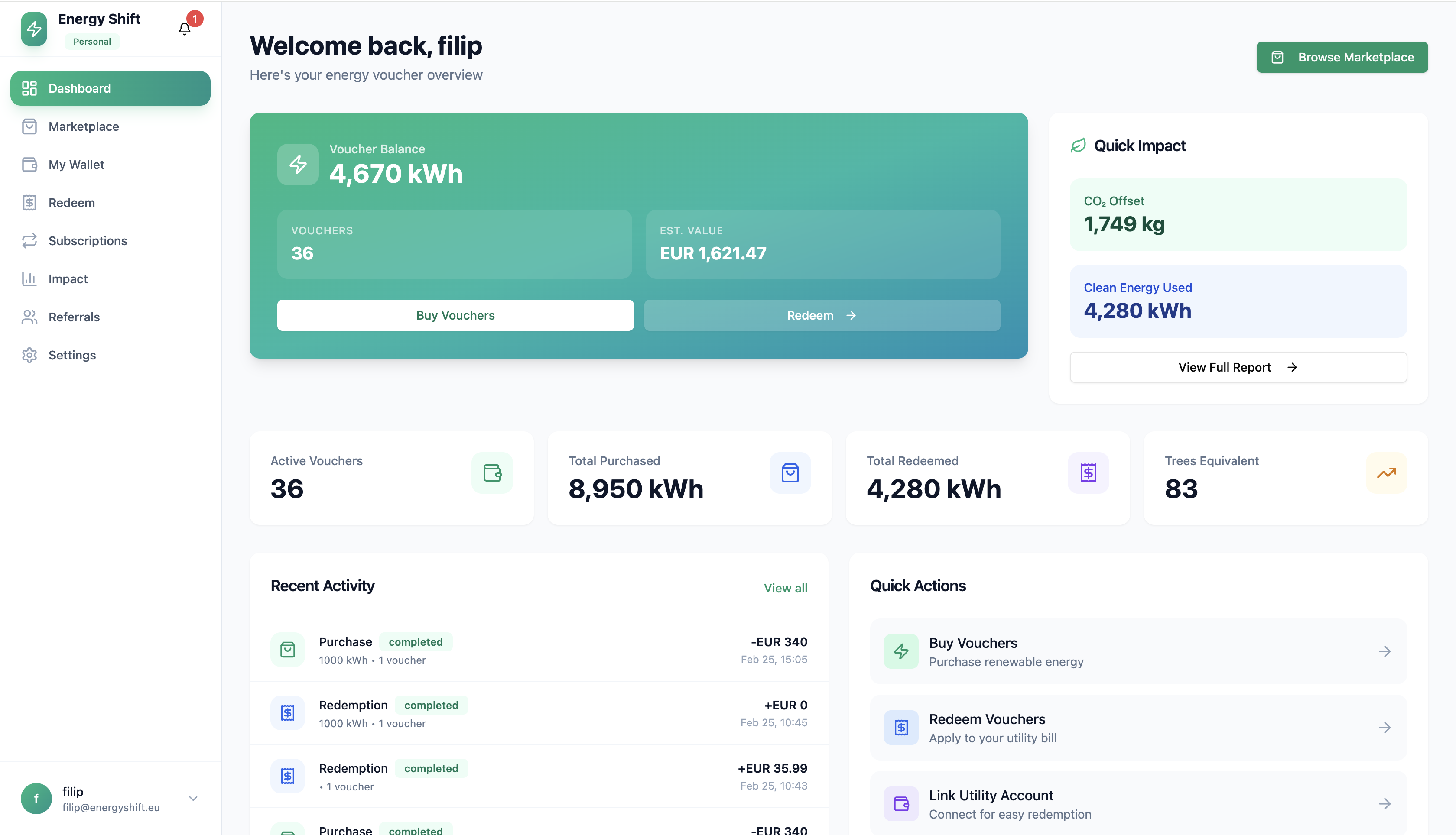
To date, Energy Shift has developed a pilot-ready digital platform, validated early demand through a community of over 2,000 registered supporters, and initiated discussions with European utilities regarding pilot implementation. The concept has evolved into a B2B utility model aligned with European regulatory frameworks.
Expected results include measurable renewable capacity enabled through prepaid commitments, improved energy price stability for participants, and a scalable financing tool that can be replicated across EU Member States.
Energy Shift reimagines energy systems as participatory, resilient, and community-backed infrastructure.
Energy Shift emerged from a simple but urgent observation: Europe has the technology to decarbonize, yet infrastructure deployment remains too slow due to financing constraints.
The idea developed at the intersection of energy policy, industry advisory experience, and firsthand exposure to energy insecurity in Europe. Recognizing that citizens regularly pay for energy over time, we asked: what if those predictable payments could be voluntarily shifted forward to accelerate infrastructure today?
The concept began as a consumer-facing participation model and evolved through research, stakeholder interviews, and engagement with utilities. We conducted market validation with early adopters and analyzed regulatory structures to ensure prepaid energy would comply with existing energy market rules.
The main development steps included:
-Mapping financing bottlenecks in renewable deployment
-Designing a digital voucher architecture integrated with utility billing systems
-Validating consumer interest through community-building campaigns
-Pivoting toward a B2B model to ensure scalability and systemic impact
-Engaging utilities and innovation ecosystems for pilot discussions
The process combined systems thinking, financial structuring, digital platform design, and strategic stakeholder engagement.
Energy Shift reflects the belief that the energy transition must not only be green and efficient, but also democratic and participatory — aligning economic incentives with environmental goals while strengthening community resilience.
Citizen participation
Clean energy financing
Energy resilience
Affordability
Sustainable infrastructure
Energy Shift addresses sustainability at the systemic level by redesigning how clean energy infrastructure is financed and socially anchored.
Environmentally, the concept accelerates renewable energy deployment by unlocking upfront capital for solar, wind, storage, and grid modernization. By converting future energy demand into immediate investment capacity, utilities can deploy clean infrastructure faster, reducing greenhouse gas emissions and fossil fuel dependence. Earlier renewable deployment directly contributes to EU climate neutrality targets and long-term environmental resilience.
Economically, Energy Shift strengthens financial sustainability. It reduces reliance on public subsidies and debt-heavy financing structures by mobilizing voluntary citizen capital. Utilities gain predictable working capital, while households benefit from price stability and protection from energy volatility — reinforcing economic resilience in times of crisis.
Socially, the model promotes long-term stewardship of energy systems. When citizens directly contribute to financing infrastructure, they develop a sense of shared responsibility and engagement in the transition. This shifts sustainability from a top-down policy objective to a participatory societal process.
Energy Shift is exemplary in sustainability because it integrates environmental impact, economic resilience, and civic participation into one coherent model. It moves beyond incremental efficiency improvements and instead proposes structural change in how energy systems are funded and governed — aligning climate goals with community empowerment.
Energy Shift contributes to aesthetics not through physical architecture, but through the design of invisible infrastructure that shapes everyday life.
Energy systems deeply influence how neighbourhoods function — from lighting and heating to mobility and public space. By enabling faster deployment of renewables and resilient grids, Energy Shift supports cleaner air, quieter cities, and more liveable urban and rural environments. The transition to decentralized, renewable energy contributes to healthier public spaces and a more harmonious relationship between communities and their surroundings.
At a deeper level, the concept redesigns the “architecture” of energy participation. It transforms the experience of paying an energy bill from a passive obligation into an act of contribution and care. This shift creates a new emotional and civic connection between people and the systems that power their homes and communities.
By making energy infrastructure participatory and transparent, Energy Shift fosters a sense of belonging and shared ownership. Communities are no longer distant recipients of large-scale infrastructure decisions; they become co-financiers and stakeholders.
The project is exemplary in aesthetics because it reimagines the design of energy systems as democratic, empowering, and community-centered — aligning technical infrastructure with human dignity, agency, and long-term care for place.
First, the system is designed to be voluntary and accessible. Energy vouchers can be offered in flexible amounts, allowing participation across income levels. By providing price stability or discounts in exchange for prepayment, the model can reduce vulnerability to energy price volatility — a key factor in energy poverty.
Second, the concept promotes inclusive governance by shifting citizens from passive consumers to active participants in financing infrastructure. This supports new societal models where communities are engaged stakeholders in energy systems rather than external observers.
Third, the model strengthens territorial inclusion. It can be applied in regions facing energy insecurity, rural areas requiring grid upgrades, or communities rebuilding after crisis. By mobilizing domestic participation, it reduces dependency on distant capital sources and increases local resilience.
Energy Shift also supports “design for all” principles through digital accessibility and integration with existing billing systems, avoiding exclusion through complexity.
The concept is exemplary in inclusion because it democratizes energy finance. It lowers the barrier to participation in climate action, distributes opportunity more widely, and fosters shared responsibility across generations and income groups. It reframes the energy transition as a collective societal project rather than a purely institutional one.
Participation is at the core of Energy Shift — both in the development of the concept and in its implementation.
From the earliest stage, the idea was tested through direct engagement with citizens, energy consumers, and energy professionals. Through community-building initiatives, over 2,000 individuals registered interest in participating financially in renewable energy infrastructure, representing significant potential capital commitment. This early validation shaped the model from a purely conceptual financing idea into a citizen-centered mechanism grounded in real demand.
We also conducted discussions with utilities, policy stakeholders, and energy market experts to ensure regulatory feasibility and practical implementation. Feedback from these actors led to a pivot toward a B2B utility-integrated model, making participation scalable and system-compatible.
The impact of citizen involvement has been transformative. It demonstrated that people are not only concerned about climate change but willing to act when given accessible tools. Their engagement shifted the concept from “energy financing innovation” to “democratic energy participation.”
Energy Shift therefore does not treat participation as consultation alone — it embeds participation structurally into the financing mechanism itself. Citizens are not only heard; they become co-financiers of infrastructure. This deep form of participation strengthens trust, legitimacy, and long-term resilience of energy systems.
Energy Shift operates across multiple governance levels, recognizing that the energy transition requires coordination beyond a single institutional scale.
At the local level, the model can be implemented through municipal utilities or community energy providers, allowing residents to directly support infrastructure in their own region.
At the regional and national levels, the concept aligns with renewable energy targets, energy affordability policies, and resilience strategies. Engagement with national regulatory frameworks has informed the prepaid structure to ensure compliance with consumer protection and energy market rules.
At the European level, Energy Shift supports EU climate neutrality goals, energy security priorities, and financial innovation initiatives aimed at mobilizing private capital for the Green Deal.
Stakeholders involved or expected to be involved include:
-Local utilities and municipalities
-National energy regulators
-Renewable developers
-Innovation ecosystems
-European climate and energy networks
The added value of multilevel engagement lies in alignment. By integrating citizens, utilities, and policy frameworks, Energy Shift avoids fragmentation and creates a coherent financing pathway that can scale across Member States while remaining locally adaptable.
Energy Shift is inherently transdisciplinary, combining knowledge fields that rarely intersect in traditional energy projects.
The concept integrates:
-Energy engineering and infrastructure planning, ensuring capital supports renewable and grid deployment.
-Finance and fintech design, structuring prepaid energy as a viable financial instrument.
-Public policy and regulatory expertise, aligning the model with energy market rules.
-Social sciences, understanding consumer behavior, trust, and participation dynamics.
-Digital technologies, developing the platform architecture for secure voucher issuance and integration with billing systems.
-Sustainability science, evaluating environmental impact and decarbonization outcomes.
This transdisciplinary approach enables systemic innovation rather than incremental improvement. Instead of designing a new technology component, Energy Shift redesigns the relationship between finance, infrastructure, and society.
By bridging technical, economic, and social domains, the concept demonstrates how climate innovation must move beyond siloed expertise. The result is a holistic model that aligns environmental goals with economic viability and democratic participation — embodying the integrative spirit of the New European Bauhaus.
Energy Shift is designed as a financially sustainable B2B platform serving utilities and integrated energy companies.
The core model is a SaaS + transaction-based structure:
• Utilities license the Energy Shift digital voucher platform (annual SaaS fee).
• A small transaction fee is applied to each energy voucher issued.
• Optional integration/setup fees are charged for billing system integration and regulatory structuring.
• Performance-based components may apply depending on capital unlocked.
End customers voluntarily pre-purchase future energy (e.g., €500–€2,000 annually) in exchange for price stability or loyalty benefits. Utilities receive immediate working capital, which is reinvested into renewable generation, storage, grid upgrades, or distributed infrastructure.
The model strengthens EU competitiveness by:
-Reducing reliance on external capital markets
-Mobilizing domestic citizen capital
-Improving liquidity for infrastructure deployment
-Supporting energy affordability and resilience
Financial sustainability comes from recurring enterprise revenues tied to voucher volume. As utilities scale prepaid offerings, platform revenues scale proportionally.
The concept can also be complemented by public innovation grants during early pilots, but long-term viability relies on commercial enterprise partnerships.
Energy Shift aligns climate goals with a market-driven mechanism, ensuring economic durability without permanent subsidy dependence.
Energy Shift is highly transferable because it is a structural financing model rather than a location-specific technology.
Replicable elements include:
• The digital voucher architecture
• Utility billing integration framework
• Regulatory-compliant prepaid energy structuring
• Citizen participation model
• Impact measurement methodology (capital unlocked, renewable capacity enabled)
Geographically, the model can scale across EU Member States, particularly in markets with liberalized retail energy sectors. It can also expand to MENA and other regions where utilities seek alternative capital formation mechanisms.
Sectoral transferability includes:
-Electricity retail
-District heating
-Renewable project pre-financing
-EV charging networks
-Sustainable fuels
-Water and other infrastructure sectors
Because the system integrates into existing utility frameworks, it avoids heavy physical infrastructure dependency, making cross-border replication faster and cost-efficient.
The concept’s key learning — converting predictable future consumption into present investment capacity — can be applied beyond energy to other essential infrastructure sectors.
Energy Shift therefore represents not just a product, but a replicable methodology for participatory infrastructure finance.
Energy Shift has progressed from concept development to pilot-ready platform architecture and early-stage utility engagement.
Over the next 12 months, we aim to:
-Secure the first formal pilot agreement with a European utility.
-Implement a 3–6 month demonstration with 500–1,000 customers.
-Measure key metrics: voucher uptake, capital unlocked, renewable investment allocation.
-Conduct regulatory validation in at least one additional EU Member State.
-Refine product-market fit and prepare for multi-utility rollout.
Parallel activities include:
-Expanding enterprise outreach across EU markets
-Strengthening technical integrations
-Enhancing impact measurement transparency
-Building strategic partnerships within EU innovation ecosystems
The focus for the year following application is real-world validation. The objective is to move from pilot deployment to scalable enterprise contracts.
Energy Shift is committed to demonstrating that citizen-financed infrastructure can become a viable, competitive European financing model — strengthening both climate ambition and economic sovereignty.