Enhancing Circularity, Sustainability, and Innovation
KostNixWagen a Mobile Sharing Incubator
Kost-Nix-Wagen – A Mobile Sharing Incubator for Rural-Urban Linkages
What happens when a give-away shop loses its roof? It grows wheels! The Kost-Nix-Wagen is a mobile treasure chest. People bring items they no longer need—like a coat or a toaster—and others take them for free. Built by youth, its wooden facade reveals the word 'NIX' when scanned. By recirculating goods, it avoids the massive water footprint of new production. With three permanent shops already inspired, it proves that mobile sharing connects people, revitalizes regions and protects our planet.
Austria
Regional
Mühlviertler Kernland / District of Freistadt, Upper Austria
It addresses urban-rural linkages
It involves other types of transformations (soft investment)
Yes
2021-11-28
Yes
EAFRD : European Agricultural Fund for Rural Development
No
Yes
Organisation
The "Kost-Nix-Wagen" is a mobile circular economy incubator addressing the systemic crisis of overproduction. In our "throw-away" society, massive amounts of high-quality resources lie dormant in private basements, contributing to staggering CO2 emissions and "virtual water" footprints of new production. Our project reactivates these resources: the wagon serves as a mobile laboratory to test and spark sharing cultures across rural-urban boundaries.
Target Groups & Objectives:
Beneficiaries are twofold: First, local residents (including low-income households) who use the 24/7 sharing space to exchange goods based on radical trust. Second, municipalities and civic groups seeking to establish their own sharing infrastructures. By "borrowing" the wagon for free, they can test local demand without financial risk. Our goal is to provide a low-barrier sharing space that operates on near-zero running costs (Zero-OPEX) and empowers communities to launch their own resource cycles.
Achieved Outcomes & Evidence:
Since November 2021, the project has delivered measurable results:
Ecological: By recirculating goods, it avoids the massive energy and water consumption of new manufacturing—saving millions of liters of water and tonnes of CO2 annually.
Social: At its home base, 14 "care-holders" manage operations digitally, while in transit, local host-initiatives take over. Remarkably, it is sustained by "silent volunteers"—anonymous citizens who spontaneously tidy up the space.
Institutional: It acted as a "mobile seed," leading three municipalities to establish their own permanent sharing infrastructures after hosting the wagon.
Transformative Potential:
Our approach decouples "sharing" from a fixed location. The zero-running-cost model removes the financial barrier for public authorities, allowing them to experiment with sustainable governance. It proves that a mobile, open-source intervention can spark a regional movement of resource resilience.
The Idea: Born from a crisis in 2021 when our stationary free shop in Freistadt lost its location. Realizing that fixed real estate creates vulnerability, we chose "wheels instead of walls" to create a mobile, 24/7 accessible circular economy hub operating on radical trust.
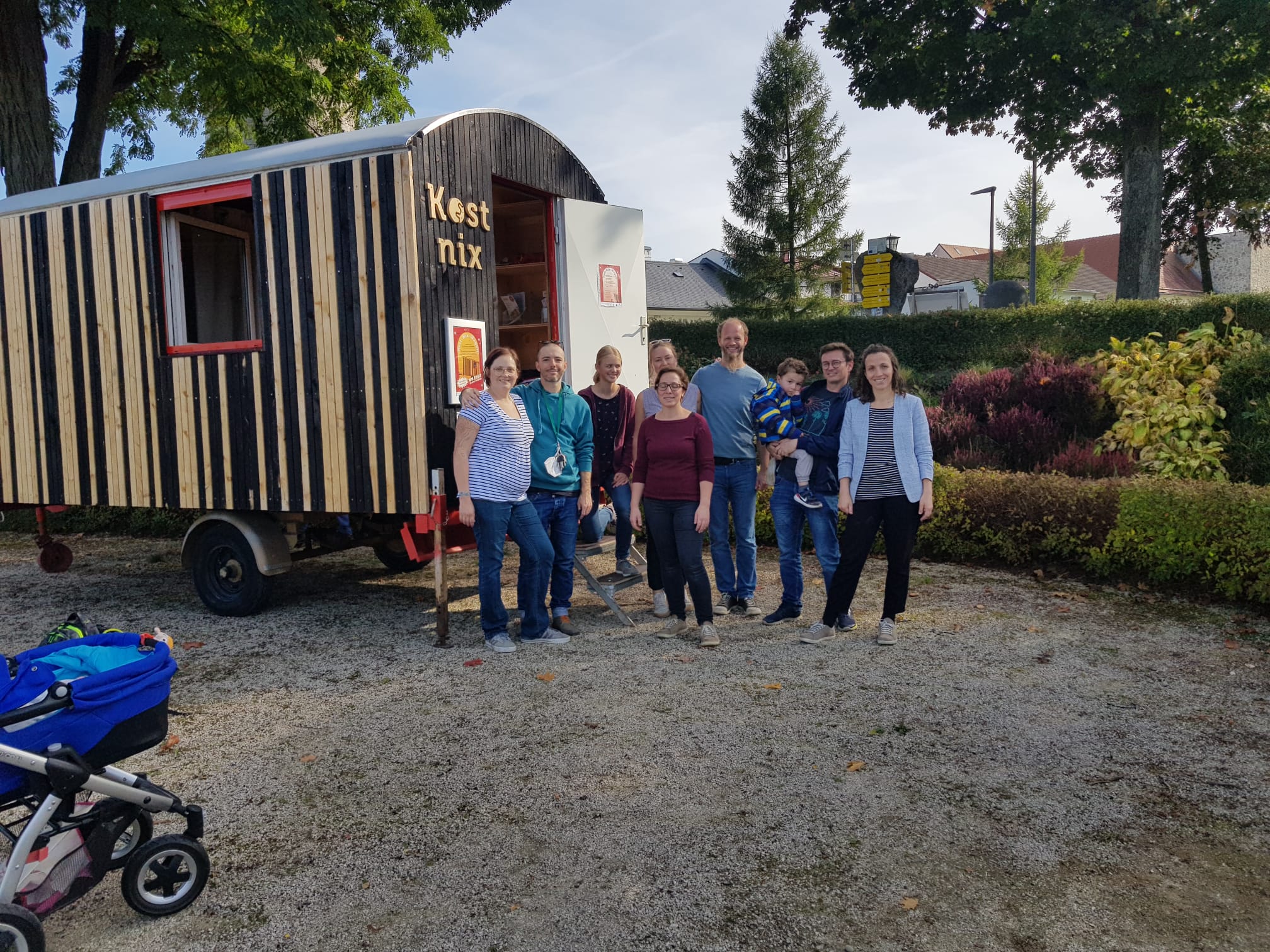
Participation & Governance: Decisions were made collectively by the OTELO Freistadt core team in collaboration with the municipality of Freistadt (providing the stand-place/logistics) and the youth project "Ausbildungsfit NextLevel."
Main Phases:
Research & Concept: Following the loss of our shop, we developed the initial concept and secured a LEADER grant to fund the acquisition of a 30-year-old construction trailer.
Strategy Evolution: As implementation became concrete, we realized the wagon’s true potential was not just as a local replacement, but as a "mobile seed." This insight transformed the project from a stationary idea into a regional lending model before the first nail was driven.
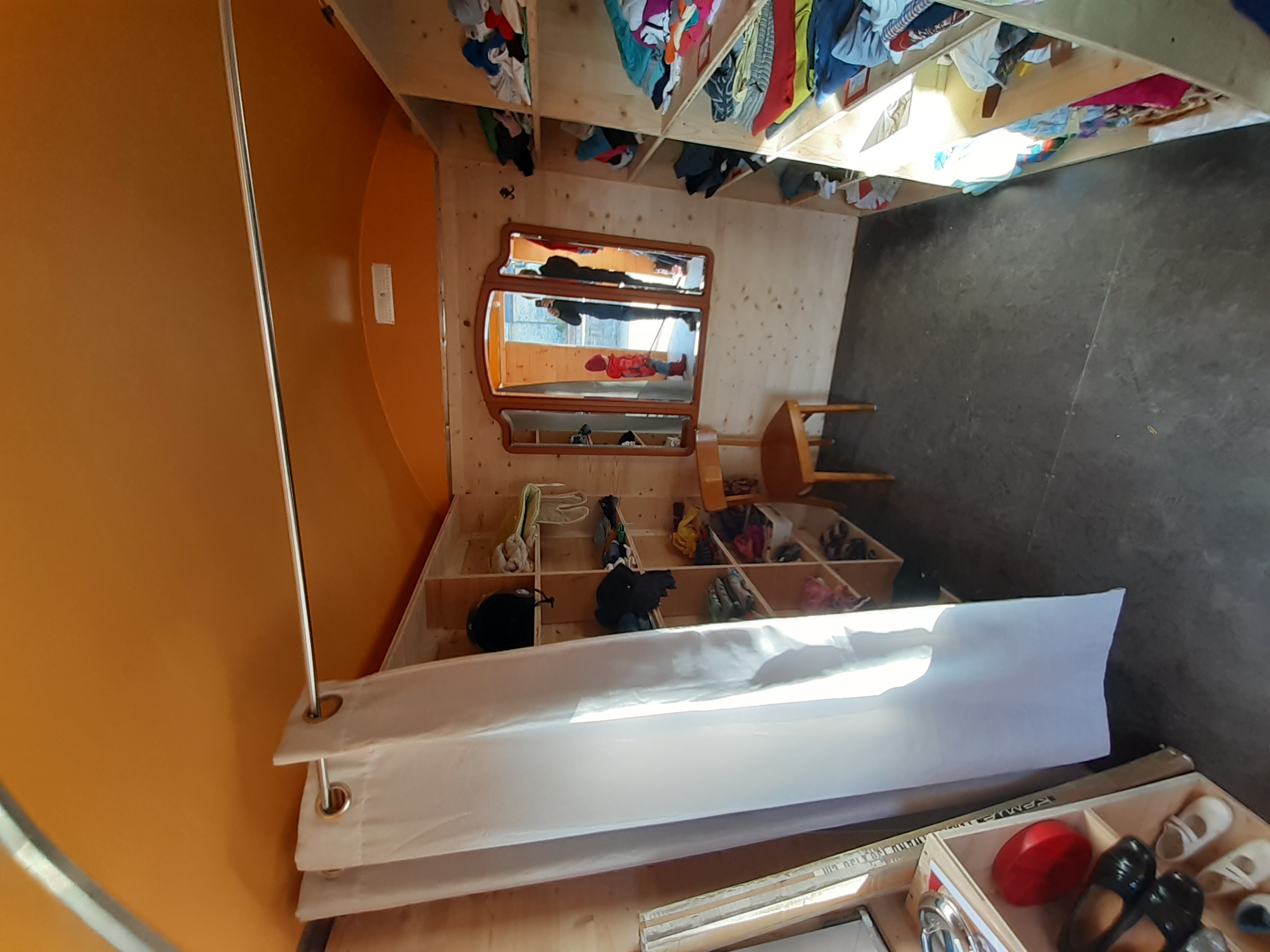
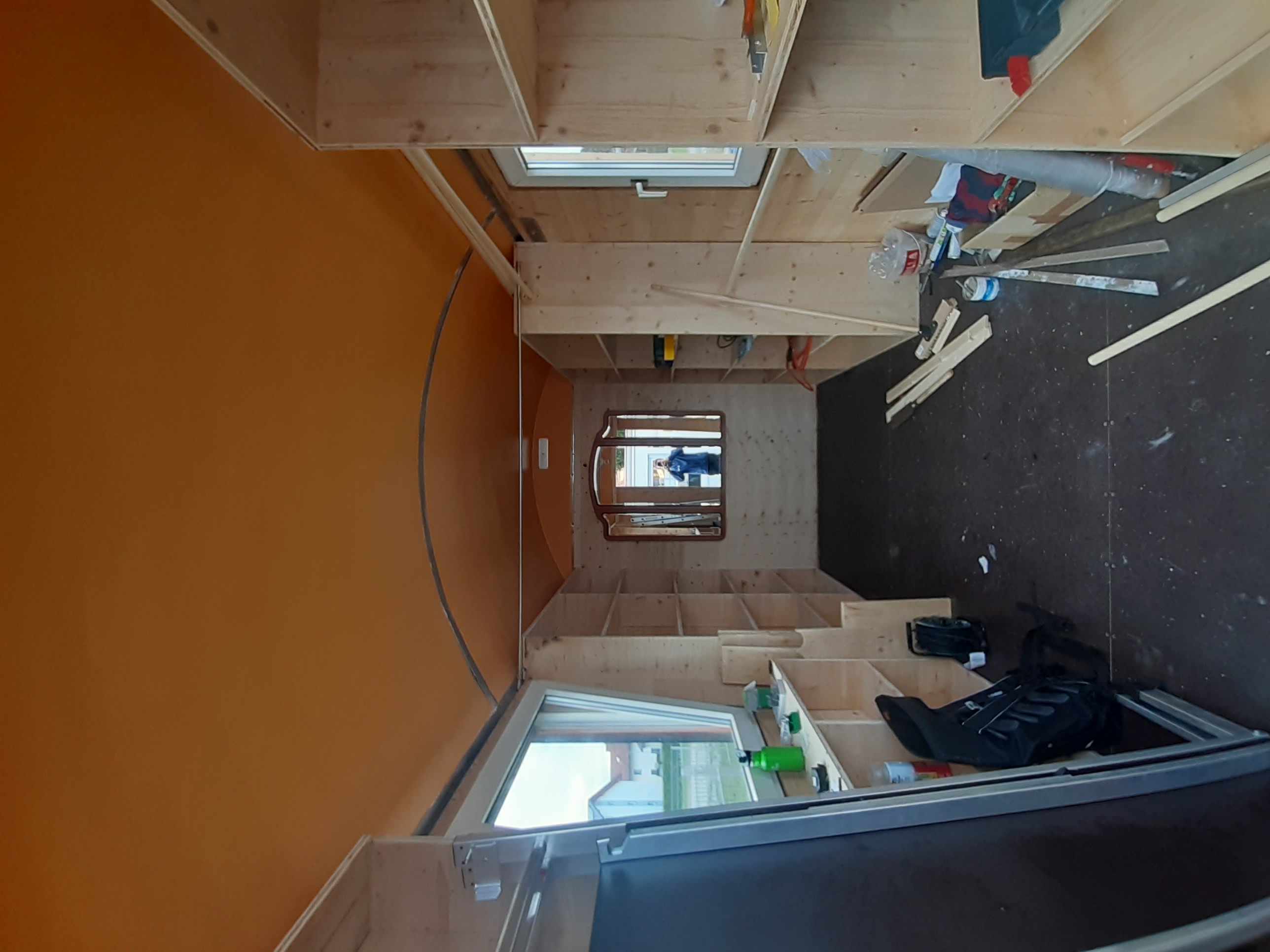
Co-Design: A key phase where teenagers from NextLevel and our team developed the interior furniture and layout, optimizing the space for a 24/7 autonomous flow of goods.
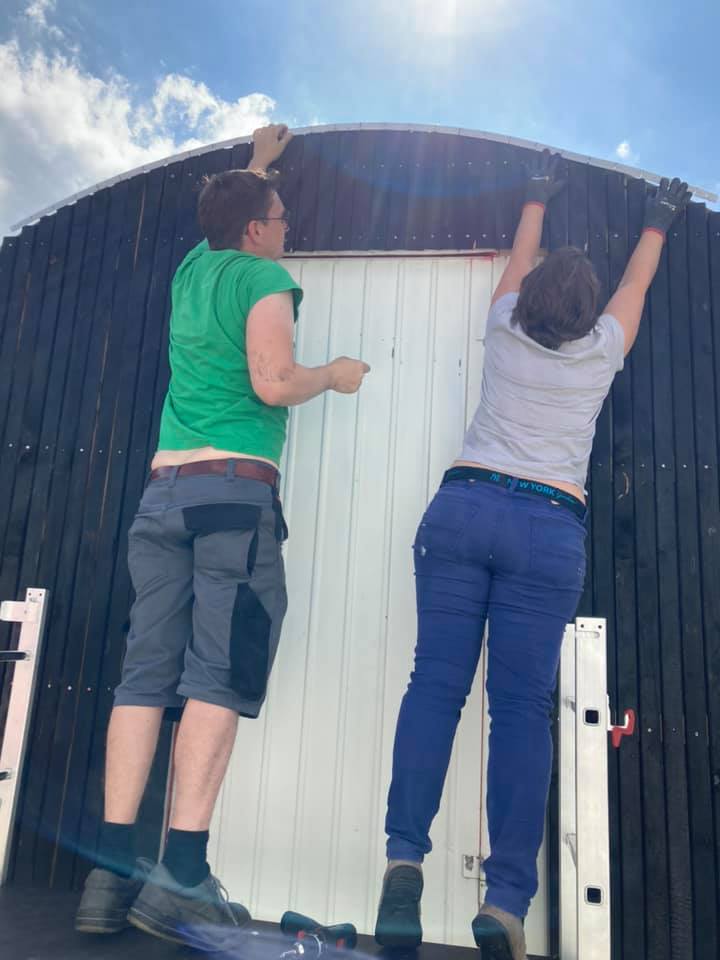
Implementation: The youth transformed the trailer into a visible landmark using traditional methods like Shou Sugi Ban (charred wood).
Testing & Evaluation: We launched at the historic Stadtgraben. Following this pilot, we began offering the wagon to neighboring municipalities to test sharing cultures locally without financial risk.
Tools & Methods: We combined traditional craftsmanship with digital management (a WhatsApp group of 14 care-holders). The "Lending Method" became our primary tool for scaling the project’s impact.
Objectives achieved: This approach transformed an emergency into a movement. Stationed as a 24/7 living commons, the wagon proved that beauty and trust ensure sustainability. It has already sparked three permanent initiatives, significantly saving water, CO2, and strengthening social ties.
Responsible Consumption
Circular Economy
Water Resilience
Radical Trust
Mobile Seed Sharing
Objectives: We establish a regional circular economy to reduce the ecological footprint of consumer goods. By extending the lifecycle of everyday items, we target "hidden" resources—specifically virtual water and CO2. Our goal is to transform linear consumption into a community-based sufficiency model that is both socially and ecologically resilient.
Implementation:
Radical Trust: 24/7 access without fees or supervision maximizes the "turnover rate" of goods.
Repurposing: Instead of a new build, we upcycled a 30-year-old construction trailer as a mobile laboratory for urbanism.
Logistical Synergy: Using municipal infrastructure for transport minimizes the project’s own carbon footprint and integrates it into public services.
Results:
As automated tracking is not possible in a low-threshold project, we rely on qualified estimates based on a 2026 survey among our care-holders. Using conservative daily minimums (10 garments, 3 books, 5 misc. items), the wagon recirculates >6,500 items annually:
Water Resilience: Producing one textile item uses ~2,500L virtual water. By recirculating ~3,650 garments, we save 9.1 million liters, reaching a total of 10 million liters of virtual water per year when including other goods.
CO2 Mitigation: 1kg of textiles emits ~15-25kg CO2. By recirculating an estimated 1,000kg of textiles, we save approx. 20 tons of CO2 annually by avoiding new production and global transport.
Catalytic Effect: This model has already sparked three permanent regional sharing initiatives, multiplying these resource savings.
Exemplary Character:
The "Kost-Nix-Wagen" proves that systemic sustainability is achieved through social innovation. While many projects rely on high-tech efficiency, we focus on Sufficiency. Its "Tactical Mobility" makes it a risk-free tool for municipalities to shift regional behavior. By making second-hand more attractive than buying new, we protect global water resources and climate at the source.
Aesthetic Objectives: The Beauty of the Gesture
Giving and sharing possess an inherent beauty that requires a dignified environment. We move away from a "shabby charity look" toward an aesthetics of appreciation. Design is our tool to restore the dignity of used goods, ensuring they are perceived as valued gifts, not waste.
Implementation: The Barcode of Solidarity
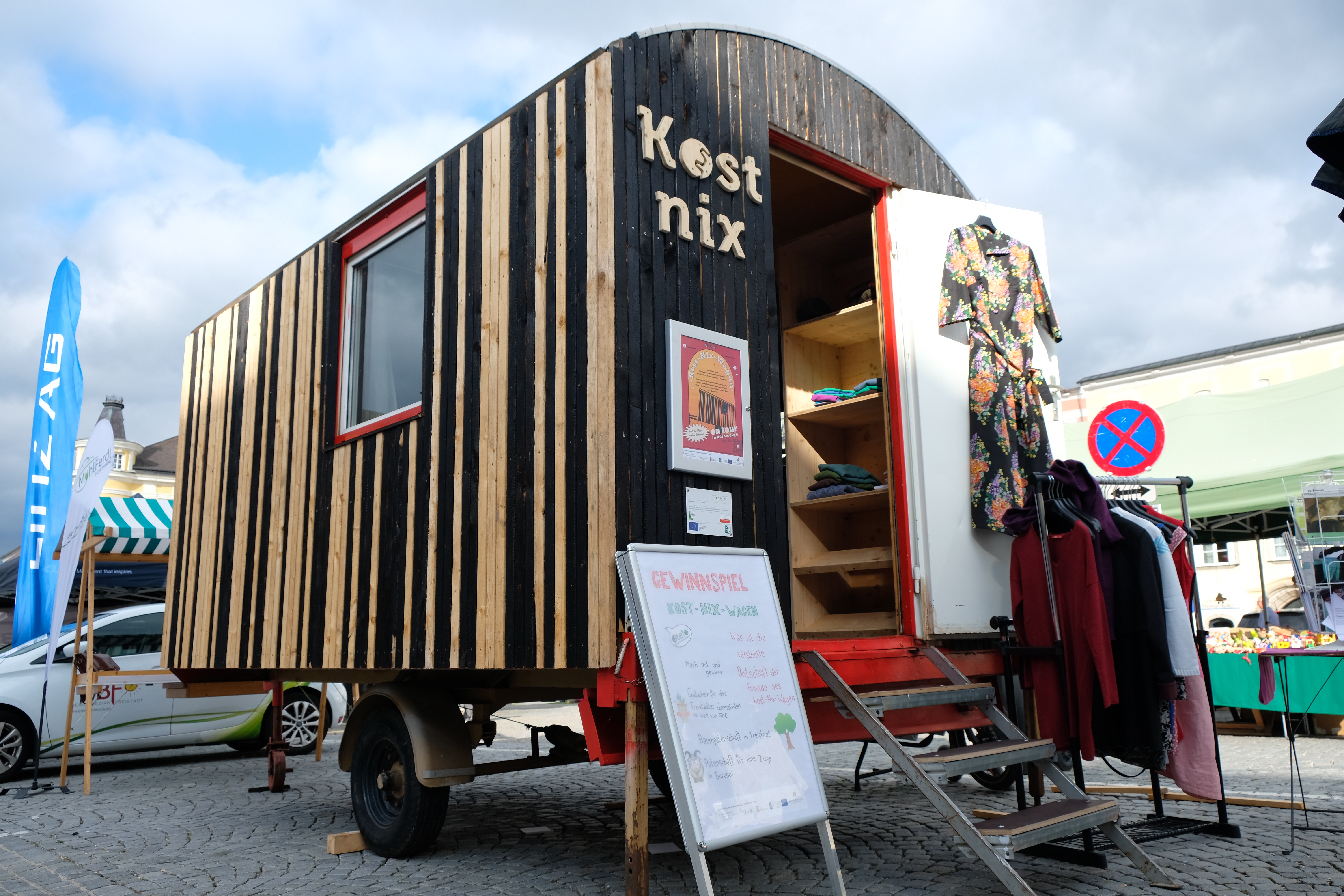
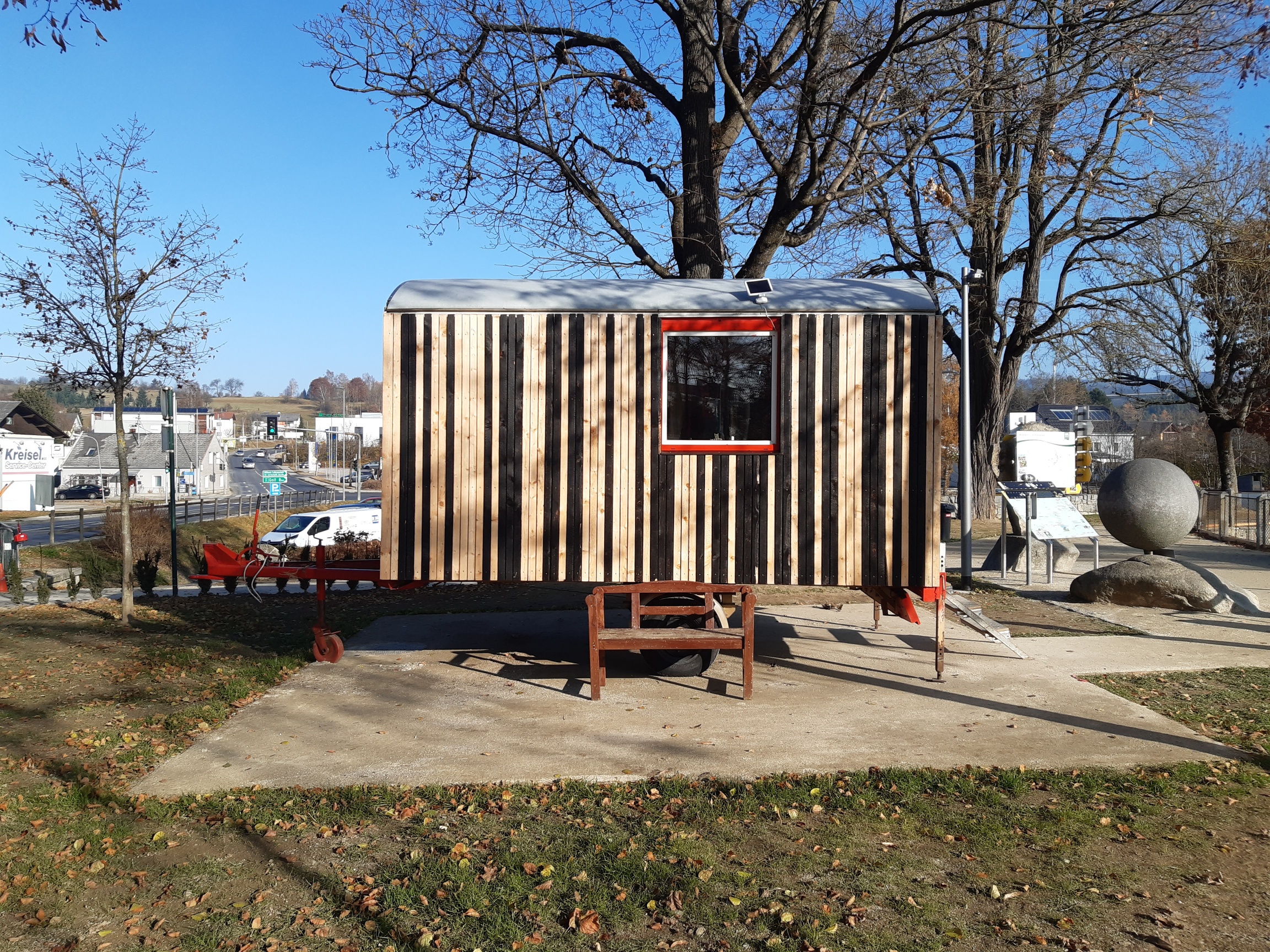
The exterior is a powerful visual metaphor. We used Shou Sugi Ban (wood charring) to create a rhythmic, vertical texture of deep black wood. This facade acts as a Barcode of Solidarity: it adopts the visual language of global commerce but hacks it. If passersby attempt to scan these vertical lines like a commercial product, the digital result simply displays: "NIX" (Nothing). This playful subversion of commercial logic reflects our spirit: by removing the price, we make room for human value. Inside, a bright Co-Design interior continues this clarity.
Quality of Experience: A Landmark for Curiosity
The wagon serves as a striking landmark in the city moat. Its dark aesthetic creates a bold contrast to the historic stone walls, making it recognizable from a distance. This visibility is strategic: it sparks instant curiosity and acts as a low-threshold invitation. The professional atmosphere replaces the stigma of need with a sense of joy and discovery. The beauty of the space signals to every visitor: "You are worth this effort."
Cultural Benefits: The Aesthetics of Transformation
The Shou Sugi Ban process, where wood is carbonized to become more resilient and beautiful, symbolizes the inner change we trigger. Just as the material is transformed, visitors undergo a transformation regarding their relationship with consumption. By stripping away the veneer of commercial value, we reveal a durable, social core. The high-quality environment ensures that participants feel part of a beautiful movement rather than a charity case. We prove that social justice must be beautiful to be effective.
Inclusion Objectives: Dignity over Charity
We aim to dissolve the "invisible barriers" of social shame. Instead of traditional charity hierarchies, we create radical social inclusion where sharing is not a sign of poverty, but a proud participation in a sustainable movement. Everyone meets on eye level.
Implementation: Discretion and Solidarity
The Shield of Anonymity: Due to the constant flow of goods, it is not visible from the outside whether someone brings or takes an item. This discretion removes the fear of judgment or stigma.
Normalizing "Taking": We communicate that taking is a positive act that keeps resources in the cycle. This prevents negative bias.
Physical Adaptation: We chose to repurpose a historical wagon despite its three steps to prioritize reuse. To mitigate this barrier, we retrofitted a custom handrail. For those unable to climb, we rely on active solidarity: our team and visitors assist by engaging at ground level in the barrier-free city moat.
Results: From Consumption to Contribution
The diverse mix of visitors proves our success. The key result is the "Aha-moment": people grasp the moneyless logic and shift from passive users to active participants who take responsibility for the space. We democratize sustainability by making a high-quality, ecological lifestyle accessible to those with zero budget.
Exemplary Character: Regional Social Commons
We replace the "charity model" with a "societal model" of mutual respect. The project is exemplary as it extends sharing to the infrastructure itself: the wagon is lent for free to other initiatives across the entire region. This allows different communities to test social models without financial risk. As a "Social Commons," the wagon lowers psychological and economic thresholds and fosters regional solidarity.
Participation Objectives: Building a Social Commons
Our goal was to transform a passive service into a community-led "Social Commons" where users are creators and managers. Instead of top-down planning, we focused on deep involvement during implementation and operation to ensure the project is rooted in actual citizen needs.
Stages and Roles of Involvement
Involvement occurred in two main phases. During implementation, the interior was a collaboration with the youth group "NextLevel". Young people co-designed and built the furniture, gaining direct influence over the shop’s functionality. The second, crucial phase is the ongoing operation. Since completion, the project has been maintained through civil society participation. There is no central staff; the community manages the daily flow of goods and negotiates the social rules of sharing.
Methods of Participation and Influence
We use an open governance model where user feedback directly influences the project's form. A key example: after the launch, community feedback showed that hanging options for textiles were more effective than shelving. In a second participatory step, we adapted the interior based on this experience. Replacing shelves with hangers addressed the challenge of maintaining order, making it significantly easier for users to keep the space organized. This proves the community acts as a co-designer even after the building phase.
Impact and Quality Improvement
This approach ensures resilience and continuous improvement. The evolution to textile hangers increased usability and ensured a tidy appearance through "design for maintenance." The impact of this daily participation is profound: it transformed the wagon into a living social organism. This ongoing involvement makes the project self-regulating and deeply embedded in the local fabric, proving that true design happens through continuous adaptation by the people.
Multilevel Governance: From Grassroots to European Goals
The project demonstrates how a small-scale initiative creates regional impact through cooperation across different governance levels. At the Local Level, the Municipality of Freistadt provides the essential home base. Beyond official approval, municipal employees assist with the logistics and transport of the wagon. This close collaboration ensures visibility and legitimacy in public spaces. Simultaneously, direct civil society ownership is maintained through a self-organized community of citizens who manage daily operations as a bottom-up movement.
Regional and National Synergies:
A key added value is our Regional Level engagement. By offering the wagon to other municipalities for free, we created a regional testing laboratory. These partner towns host the wagon for several months, acting as stakeholders who test the sharing concept locally. This has already sparked two permanent free shops in the district, proving the project acts as a catalyst for regional circular economy structures. On the National Level, our collaboration with "Ausbildungsfit nextlevel" (overseen by the national Social Ministry Service) connects the project to national goals of youth empowerment. This partnership ensured the construction phase was a professional pedagogical intervention rather than just a DIY project.
European Framework and Added Value:
On the European Level, the project is embedded in the LEADER rural development framework. LEADER provided the necessary financial start-up and institutional trust, while the project fulfills EU goals of sustainable, decentralized, and community-led development. The added value of this engagement is a resilient network where local trust, regional scaling, and European funding work together. It transformed a single trailer into a regional movement, providing scalability and alignment with overarching European sustainability policies.
Transdisciplinary Objectives: The Wagon as Social Sculpture
The "Kost-Nix-Wagen" is a "social sculpture" at the intersection of fine arts, social sciences, and circular economy. The collaboration integrated perspectives from culture, politics, and administration into a single project. This cross-sectoral approach ensures the wagon functions as both a utilitarian object and a regional catalyst for waste reduction.
Interaction of Arts, Design and Material Science
The design process combined conceptual art with architectural craftsmanship. The facade acts as a graphic interface: wooden slats form a barcode revealing the word "NIX" when scanned. We applied the Japanese technique of Shou Sugi Ban (charred wood) for natural durability, requiring shared decision-making between artists and master craftsmen to balance aesthetics with structural longevity. French Ochre pigments further bridge the gap between historical heritage and contemporary design.
Social Pedagogy and Knowledge Transfer
The implementation was rooted in social pedagogy through "nextlevel", where social scientists and craftsmen worked with marginalized youth to foster self-efficacy. Beyond construction, the project’s transdisciplinary nature inspired other sectors: dialogues with waste management centers (ASZ) led to the implementation of local exchange platforms (e.g., swapping tables), proving the project’s role as a regional knowledge hub.
Digital Integration and Regional Impact
The project bridges physical and digital worlds via analog-digital governance. Using WhatsApp, a diverse community coordinates logistics and the regional lending process between cultural and political initiatives. This synergy of ancient craft, social pedagogy, and cross-sectoral governance ensures stability. It proves that a resilient movement emerges through the interaction of creative intelligence, institutional cooperation, and practical waste-prevention expertise.
Business Model: Social Value over Monetary Profit
The financial sustainability of the "Kost-Nix-Wagen" relies on radical cost-reduction and replacing financial capital with civic engagement. The initial implementation was financed through a LEADER small-scale grant for materials, supplemented by Otelo’s own funds and massive 'sweat equity' from volunteers. By repurposing a 30-year-old trailer, we created a high-value asset with minimal capital.
Operating Expenses and Revenue Structure
The project generates social and ecological dividends rather than monetary profit. Operating costs are near zero due to three factors:
1. No Personnel Costs: The wagon operates 24/7 without paid staff. Daily maintenance is handled by a self-organized volunteer community via digital governance.
2. Municipal Support: The municipality provides the location and logistics free of charge, recognizing the project as a public good.
3. Low Maintenance: Durable materials like Shou Sugi Ban ensure that long-term maintenance costs remain negligible for the Otelo association.
Scalability and Regional Innovation
Our model scales through "Social Franchising." By lending the infrastructure to other small municipalities, we act as an incubator. This allows towns to test the concept without financial risk, already resulting in two permanent, locally funded structures. This proves the model's potential to create municipal savings in waste management.
Disruptive Potential for Small Towns
The project offers disruptive innovation by proving that small towns do not need expensive real estate or large budgets to provide vital social services. It shifts the paradigm from "fixed-cost infrastructure" to "flexible, community-animated assets." This makes it a highly replicable blueprint for small European municipalities facing budget constraints, ensuring social services remain viable in rural areas.
Scalability: The Wagon as a Scaling Tool
The "Kost-Nix-Wagen" is a self-contained scaling tool for the circular economy. It acts as a "Trojan Horse" for the "Kost-Nix" philosophy: by serving as a mobile "Test-Drive" infrastructure, it allows municipalities to adopt the sharing economy without financial risk. This methodology is proven; it has already catalyzed two permanent free shops in our region.
Universal Blueprint
The model is a "Copy & Paste" solution for Europe. The repurposed 8 m² trailer is a universal format that bypasses expensive real estate and permits. It is a "plug-and-play" infrastructure for any small town or urban district. Our digital-analog governance via WhatsApp is a "governance-lite" tool that is easily transferable, shifting responsibility from paid staff to a decentralized citizen network.
Transferable Principles & Adaptation
Replication only requires a partnership between civil society and local authorities. While we used regional aesthetics, others can use any local materials or recycled resources. The universal principle is the "aesthetic nudge": using high-quality design to ensure that the space and goods are treated with respect.
Flexible Impact
The blueprint is inherently flexible. The visual identity should reflect the local culture, and the interior can be quickly reconfigured for textiles, food-sharing, or tool-libraries. This makes the "Kost-Nix-Wagen" a low-cost, high-impact tool for small European municipalities to foster social cohesion and waste reduction immediately.