Enablers for New European Bauhaus Transformation
Migration and Identity
Migration and Identity theme is an analytical approach, of thinking, between two extremes.
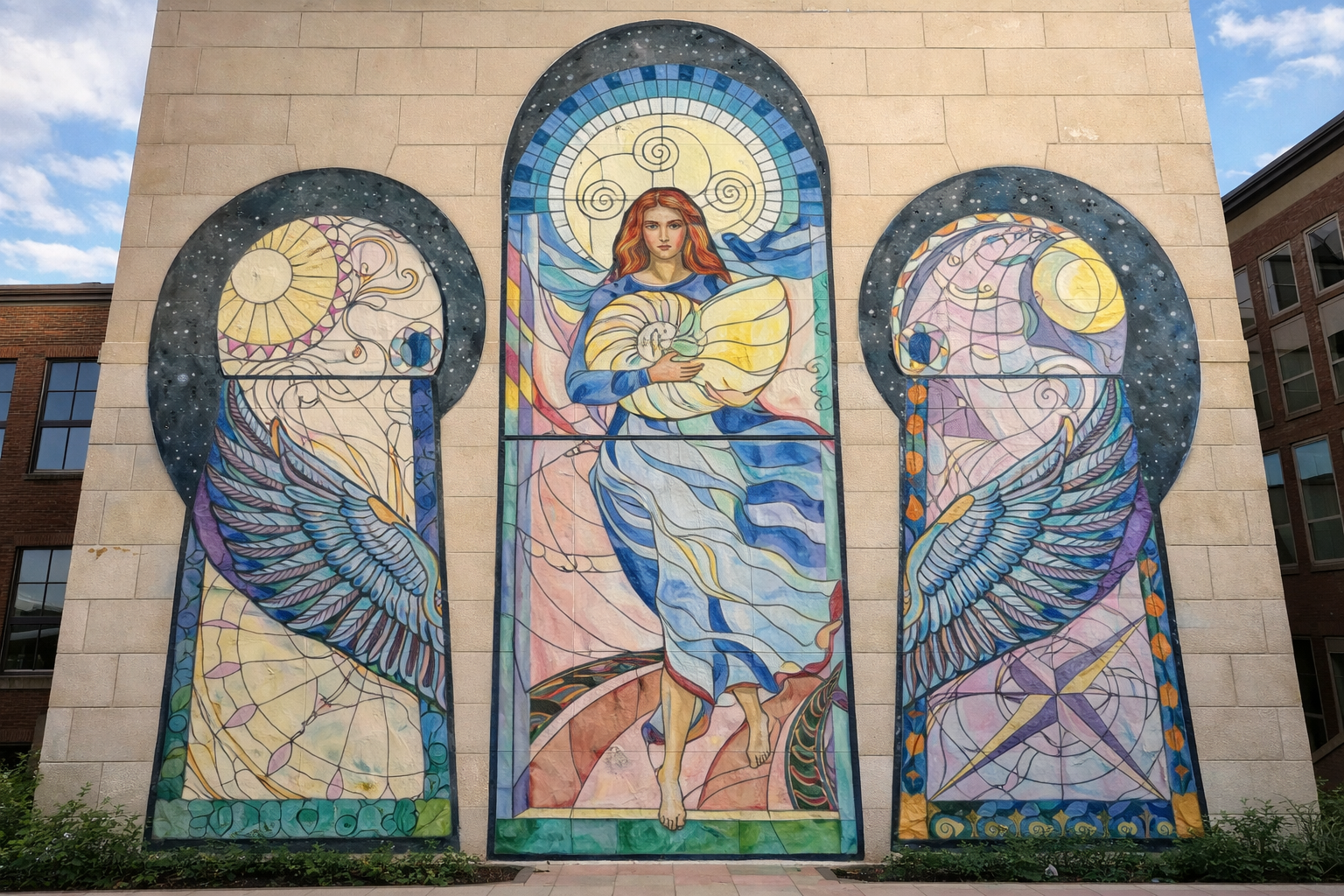
The image of the Migration and Identity theme is an analytical approach, of thinking, between two extremes, the physical and the spiritual, the outside with the inside, the terrestrial with the cosmic.The actuality of the theme of migration is both current and endless throughout universal history. Migration is a phenomenon with a global character, which makes a pronounced mark in the present time.The importance of the work lies of the relationship between art, artist and society.
Moldova
National
It addresses urban-rural linkages
It involves other types of transformations (soft investment)
Yes
2024-07-09
No
No
No
Individual
The actuality of the theme of migration is both current and endless throughout universal history. Migration is a phenomenon with a global character, which makes a pronounced mark in the present time.
he purpose of the work is to highlight the concept through monumental art. The common features between the types of migrations, the importance of preserving or discovering identity. How artists perform these themes through the prism of artworks.
The realization requires the following general objectives:
- Review of the history of the appearance and development of the false stained-glass technique;
- Analysis of definitions and concepts in the field of false stained glass and stained glass in general;
- Researching the topic from an artistic point of view and in the context of the history and theory of arts, namely from the perspective of visual art;
- Researching the theoretical problem of colors in the work;
- Interpreting the values of art through the lens of research on the formation of aesthetic thinking;
- Based on the research carried out, let's compare the approaches of the artists in the artistic activity with the coloristic component from their theoretical point of view and formulate appropriate conclusions;
- The proposal of recommendations for the use of the work in the interiors and architecture of different types of buildings;
- Researching the topic of migration and identity on a global level.
Man has many kinds of identities. We can talk about species identity, ethnic, national, cultural, gender identity, etc.
In the modern era, Gottlob Frege (1848 – 1925) noted that identity cannot be defined: “because every definition is an identity, identity itself cannot be defined”, “the identity of the individual is cultural coded.
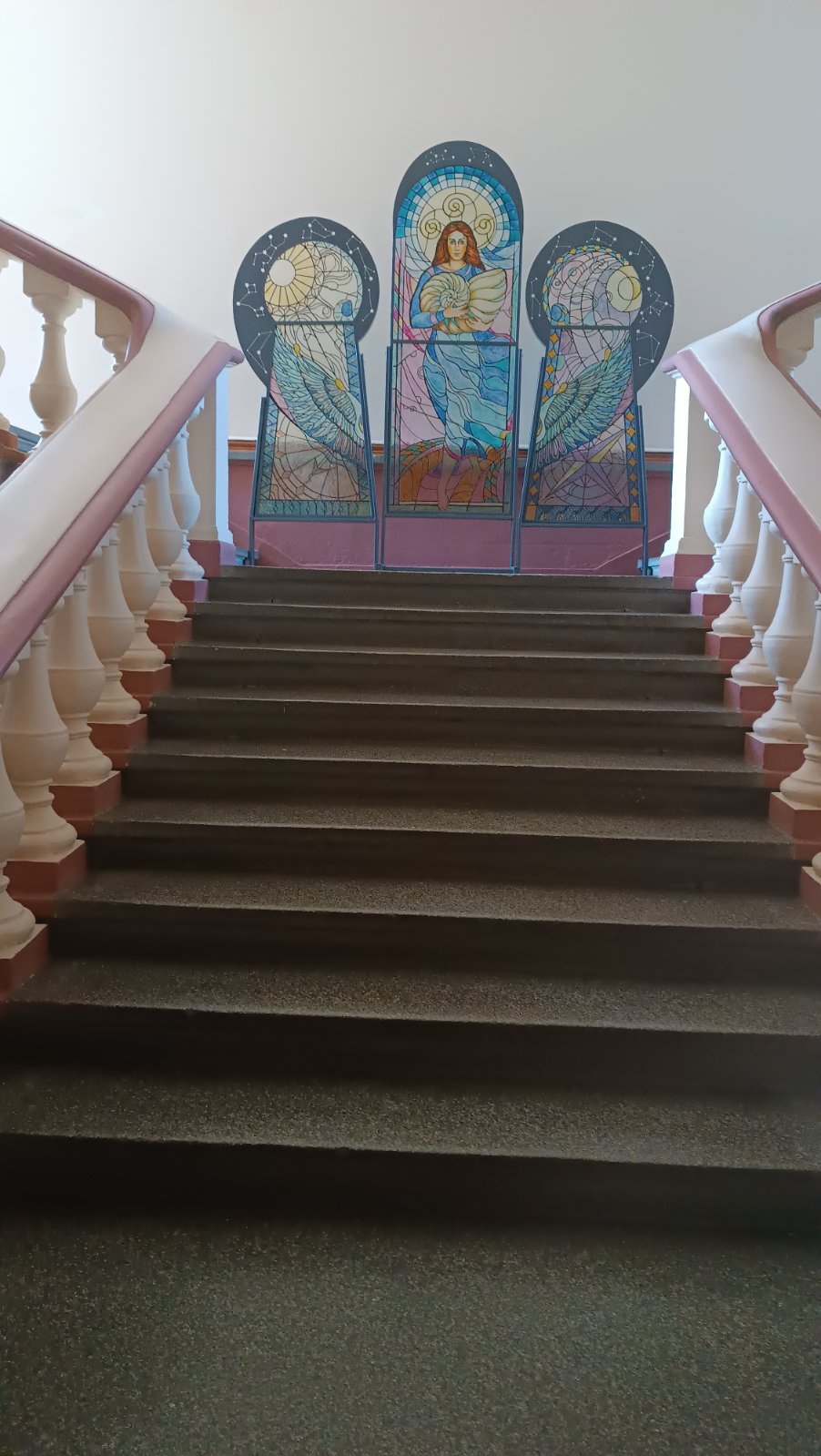
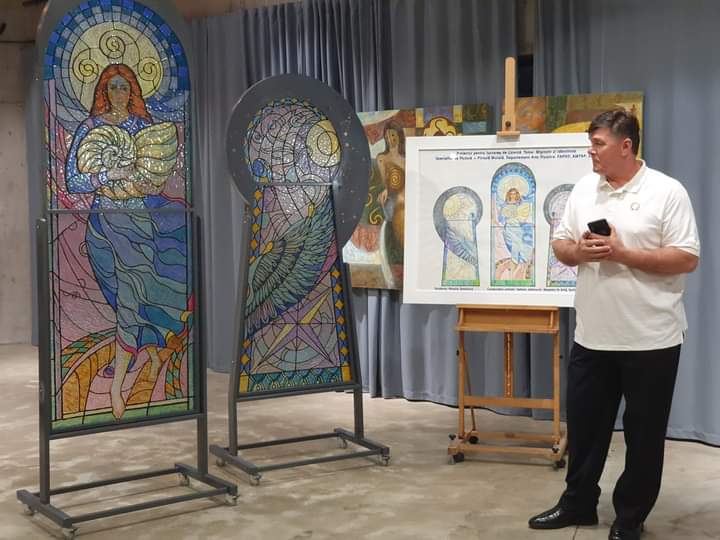
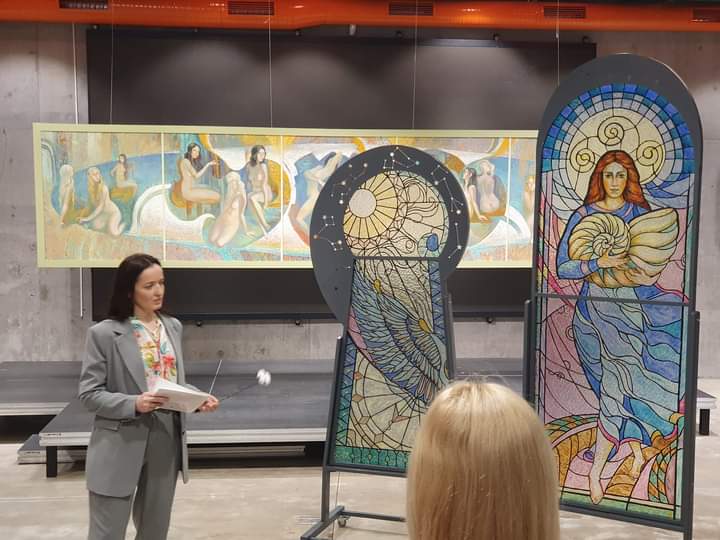
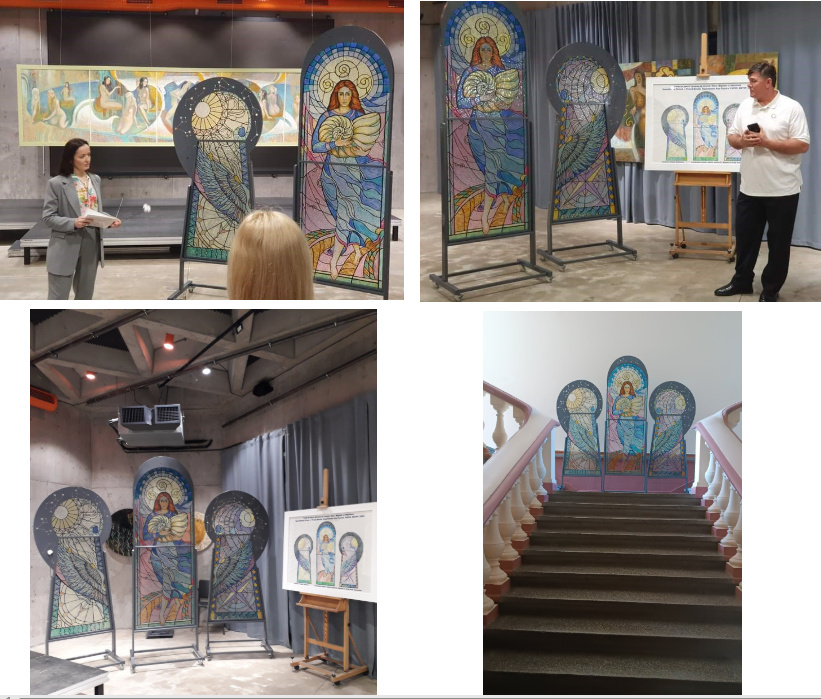
The work was executed in 2024 and has remained until now as a mobile decoration in the buildings of the Academy of Music, Theater and Fine Arts.
The importance of the work lies in the rigorous study of the given subject, of the relationship between art, artist and society.
On the territory of the Republic of Moldova, glass art, Bauhaus, contemporary art is not in high demand, but I executed this work as a stagnation movement.
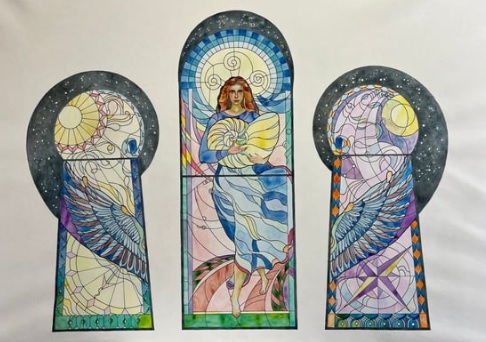
This triptych was executed in 2024, it is my bachelor's work that was marked with the maximum grade with Mention.
The concept of inspiration Migration and Identity comes from the perspective of personal bibliography. Born in a multinational family with a mixed culture, came to the Republic of Moldova in 1991.
The triptych Migration and Identity uses multiple symbols: The compositional center is the human figure; The snail held/carried in arms - life, the sacred moral-social work, our identity; cosmic elements; different types of movements; three colors;
The technique is painting on glass, fake stained glass.
The materials, sketches, information searches and the execution of the work itself took about 6 months. I own the copyright.
Migration
Identity
Migration and cultuture
Society and art
Artist
The project “Migration and Identity” addresses key environmental, social, cultural, and economic challenges by exploring how mobility shapes personal and collective identities in contemporary Europe. Through artistic research and visual expression, the project highlights migration as a complex phenomenon influenced not only by political and economic factors but increasingly by environmental changes such as climate pressures and resource scarcity.
Socially, the project contributes to greater inclusion and understanding by giving visibility to migrant experiences and diverse cultural backgrounds. Through exhibitions it creates spaces for dialogue where audiences can reflect on belonging, diversity, and shared European values. By encouraging empathy and challenging stereotypes, the project supports social cohesion and intercultural understanding.
Culturally, “Migration and Identity” explores how movement across borders transforms traditions, memories, and identities. It reflects the hybrid cultural landscapes that emerge when people carry languages, symbols, and narratives between places.
Economically, the project contributes to the creative and cultural sector by generating artistic value, fostering collaborations with cultural institutions or communities, and strengthening the role of art in sustainable local cultural ecosystems.
In the context of the New European Bauhaus, the project can be considered exemplary because it integrates the initiative’s core principles: sustainability, inclusion, and aesthetics. It addresses sustainability by connecting migration to environmental awareness and responsible artistic practices; inclusion by amplifying diverse voices and perspectives; and aesthetics by translating complex social realities into meaningful artistic forms that engage audiences emotionally and intellectually. In this way, the project demonstrates how art can contribute to a more sustainable, inclusive, and culturally rich European future.
The project “Migration and Identity” contributes to the value of aesthetics promoted by the New European Bauhaus by transforming complex experiences of migration into meaningful artistic expressions that make shared spaces more beautiful, reflective, and emotionally engaging. Through visual storytelling, symbolic imagery, and carefully considered artistic form, the project invites viewers to experience migration not only as a political or social issue, but as a deeply human narrative of memory, movement, and belonging.
In everyday life, the project can enhance the aesthetic quality of cultural and public spaces by introducing artworks that encourage reflection and dialogue. By integrating elements such as personal narratives, cultural symbols, and visual metaphors, the project creates an atmosphere where audiences feel invited to pause, connect, and reflect on the diversity of identities that shape contemporary communities. This aesthetic experience enriches the cultural life of neighbourhoods and institutions where the work is exhibited.
By presenting migration as a shared and evolving experience, the project fosters empathy between different communities and encourages viewers to see their surroundings as spaces of cultural exchange rather than division. This perspective can strengthen community bonds and promote a more inclusive understanding of place.
The project can be considered exemplary in terms of aesthetics because it combines artistic quality with social meaning. Its visual language transforms complex realities into accessible and emotionally resonant forms, demonstrating how art can connect beauty with social awareness. By linking creativity, cultural diversity, and human stories, “Migration and Identity” embodies the New European Bauhaus vision of aesthetics that enrich everyday life while inspiring more inclusive and thoughtful communities.
The project “Migration and Identity” promotes the value of inclusion highlighted by the New European Bauhaus by creating artistic spaces where diverse experiences—especially those of migrants and underrepresented communities—are visible and valued. By presenting migration through visual narratives that are understandable and emotionally engaging for a broad audience, regardless of cultural background, language, or educational level.
In terms of accessibility and affordability, the project can be presented in open cultural venues, public spaces, or community institutions, allowing free or low-cost access for visitors. Its visual approach ensures that the message can be understood without specialized knowledge, enabling people from different social groups to connect with the work. By encouraging dialogue through exhibitions, talks, or participatory activities, the project lowers barriers between artists, migrants, and local communities.
The project also supports inclusive governance and collaborative cultural processes by valuing lived experiences and diverse perspectives. By integrating personal stories, memories, and cultural symbols related to migration, it reflects a participatory approach where different voices contribute to shaping the narrative. This aligns with design for all principles, recognizing diversity as a source of creativity and shared knowledge.
Furthermore, “Migration and Identity” promotes new societal models based on coexistence, empathy, and cultural exchange. It presents identity as dynamic and interconnected, encouraging audiences to see diversity as an enrichment of communities rather than a division.
The project can be considered exemplary in terms of inclusion because it combines artistic quality with social engagement. By amplifying marginalized perspectives and fostering intercultural dialogue, it demonstrates how art can help build more open, accessible, and inclusive communities.
The project recognizes that migration and identity are lived experiences, and therefore meaningful representation requires the participation of people whose lives are shaped by these realities.
Community members, including migrants and people with diverse cultural backgrounds, contribute to the project through the sharing of personal stories, memories, and cultural references that inform the artistic narrative. Their experiences help shape the conceptual direction and visual language of the work. In this way, participants are not only subjects of the project but active contributors whose perspectives influence the themes and messages communicated.
Community members, including migrants and people with diverse cultural backgrounds, contribute to the project through the sharing of personal stories, memories, and cultural references that inform the artistic narrative. Their experiences help shape the conceptual direction and visual language of the work. In this way, participants are not only subjects of the project but active contributors whose perspectives influence the themes and messages communicated.
At the local level, the project engages with community members, migrants, cultural workers, and local cultural spaces that provide opportunities for exhibitions, discussions, and community interaction.
At the regional and national levels, cultural institutions, artistic networks, and civil society organizations can support the project through collaboration, promotion, and the exchange of knowledge.
At the European level, the project aligns with broader cultural and social values.By addressing themes of migration, diversity, and belonging that resonate across Europe, the project contributes to transnational dialogue about shared challenges and opportunities. European cultural programs and networks provide a framework for connecting the project with other artists, institutions, and communities working on similar themes.
At its core, the project is grounded in visual arts, which provide the primary medium for expressing personal and collective experiences of migration through imagery, symbolism, and artistic narrative. The artistic process transforms abstract concepts such as belonging, memory, and displacement into visual forms that audiences can emotionally and intellectually engage with.
The project also draws on social sciences, particularly sociology and cultural studies. Cultural studies and anthropology also inform the project by exploring how traditions, memories, languages, and cultural symbols travel with people and shape hybrid identities across different places. Education and community engagement practices and digital and communication practices may support the documentation, dissemination, and accessibility of the project through online platforms or multimedia presentation.
The project also draws on social sciences, particularly sociology and cultural studies. Cultural studies and anthropology also inform the project by exploring how traditions, memories, languages, and cultural symbols travel with people and shape hybrid identities across different places. Education and community engagement practices and digital and communication practices may support the documentation, dissemination, and accessibility of the project through online platforms or multimedia presentation.
The artwork “Migration and Identity” is already completed and can be mobilized in different venues and spaces, making it adaptable and scalable for various contexts. The project can also be reproduced using the same technique, executed as a mural in public spaces, or transformed into internationally distributed items such as postcards, leveraging its rich symbolic imagery. This flexibility allows the project to reach broader audiences while creating multiple avenues for engagement and visibility.
Financial sustainability is supported through exhibitions, artistic collaborations, and cultural events, which generate revenue while fostering social and cultural impact. The project can also benefit from art sales, limited edition prints, or related publications, enabling it to maintain ongoing financial support. Additional funding streams may include crowdfunding campaigns, donations, or sponsorship from supporters and institutions who value the project’s social and cultural message.
By combining mobilization, reproducibility, and multiple forms of artistic and cultural dissemination with revenue-generating activities, the project establishes a diversified business model. This structure ensures that “Migration and Identity” can continue to operate sustainably over time, reach new audiences, and maintain both its artistic and social impact. The combination of adaptability, multiple formats, and diversified funding channels makes the project resilient, scalable, and capable of generating lasting cultural and financial value.
The project “Migration and Identity” is highly scalable due to its flexible format, reproducible techniques, and transferable methodology. The artwork can be mobilized across different venues and spaces, allowing exhibitions in galleries, cultural institutions, or public areas. It can also be reproduced as a copy using the same artistic technique, or adapted into murals in public spaces, ensuring accessibility to a wider audience.
The project’s symbolic visual language makes it suitable for transformation into other formats, such as postcards, publications, or digital reproductions, allowing the work to reach international audiences and diverse communities. These formats also provide opportunities for educational use, workshops, or cultural programs, extending the project’s impact.
Beyond the product itself, the participatory methodology—engaging communities, migrants, and civil society organizations in storytelling, co-creation, and dialogue—can be transferred to other contexts. Local stakeholders in different regions can adopt the same approach to co-design artworks that reflect their own community experiences, ensuring cultural relevance while maintaining inclusivity.
The key learnings of the project, including the integration of artistic expression with social dialogue, intercultural exchange, and community participation, are fully transferable to other cultural, social, or educational projects. This combination of adaptable formats, participatory processes, and symbolic content ensures that “Migration and Identity” can be successfully replicated and scaled across diverse contexts and audiences.