Arts, Culture, and Heritage as Drivers of Change
Starodruk: Ukrainian Printed Heritage
Starodruk: An Open Digital Infrastructure for Early Modern Ukrainian Printed Heritage
Starodruk is an open digital infrastructure that transforms access to early modern Ukrainian printed heritage. Since January 2024, the platform has made over 500 digitised editions freely available to researchers, students, and the public across 73 countries. By combining high-quality digitisation, scholarly metadata, and an IIIF-compliant viewer, Starodruk repositions early modern Ukrainian book culture as a living reference point within European research and public knowledge.
Ukraine
National
It addresses urban-rural linkages
It involves other types of transformations (soft investment)
Yes
2024-01-16
No
No
No
Organisation
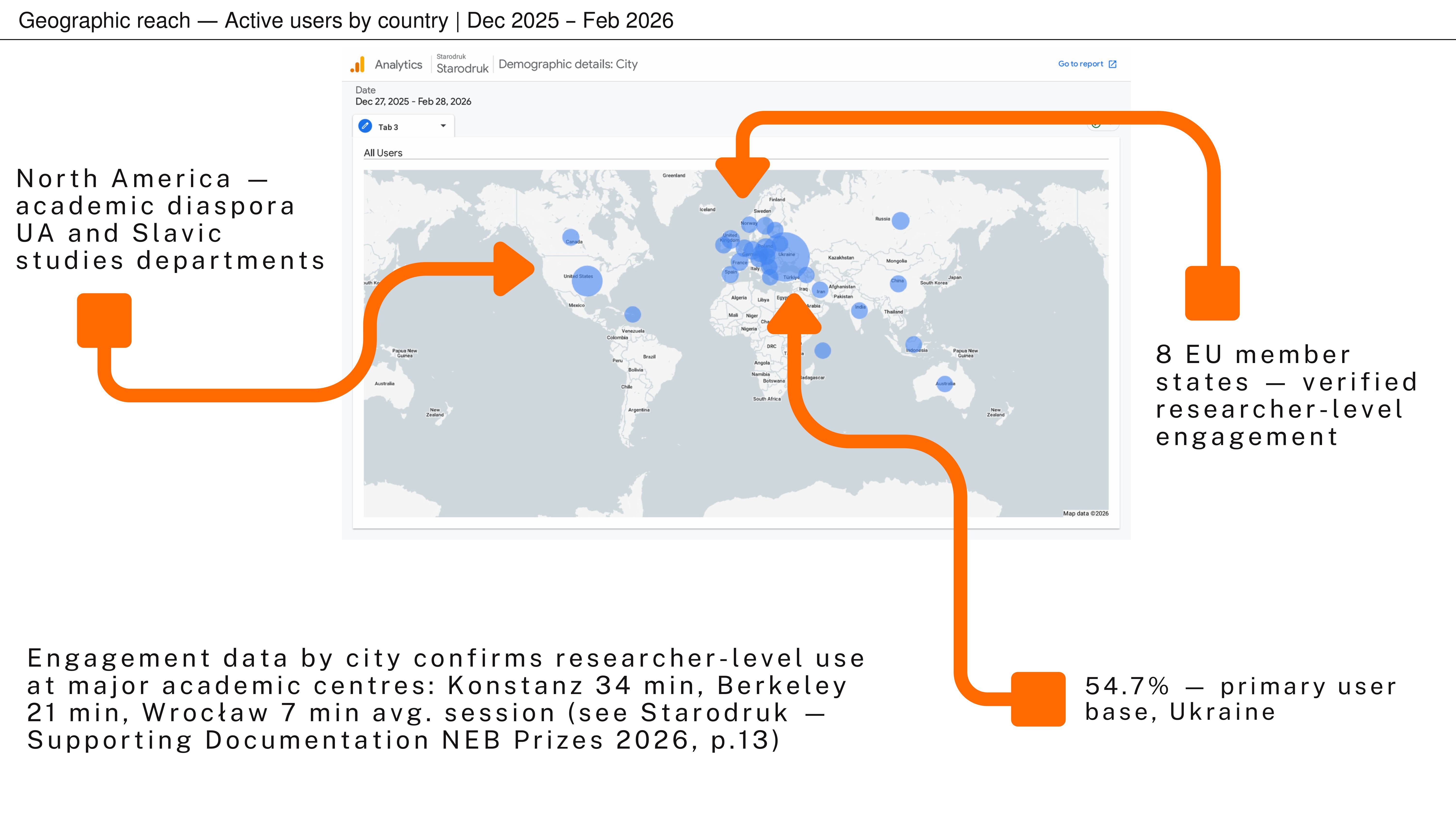
Starodruk is an open digital infrastructure dedicated to early modern printed heritage from the Ukrainian lands of the Polish-Lithuanian Commonwealth — books printed in Kyiv, Lviv, Ostroh, and Chernihiv between the 16th and 18th centuries. This corpus shaped the intellectual, religious, and literary life of Central and Eastern Europe across multiple languages, confessions, and political boundaries. Starodruk makes these materials freely accessible online, enabling their discovery, citation, and reuse in research, education, and public knowledge across Europe and beyond. Since its public launch in January 2024, the platform has grown into an actively used scholarly resource with over 500 digitised editions, each presented with high-resolution images and structured scholarly metadata. Between January 2024 and February 2026, it attracted more than 7,000 active users from 73 countries. Over 20 cities outside Ukraine — including Konstanz, Leuven, Jena, Berkeley, and Prague — show single-researcher sessions exceeding 8 minutes, a behavioural signature of active academic work with primary sources, reached organically without any paid promotion.
Researchers at the University of Lodz, the Polish Academy of Sciences, the University of Padova, and Justus Liebig University Giessen actively use the platform — confirming that Starodruk functions as a shared European research infrastructure, not a nationally bounded archive. Materials are cited in academic publications, integrated into university teaching, and referenced across multiple Wikipedia language editions.
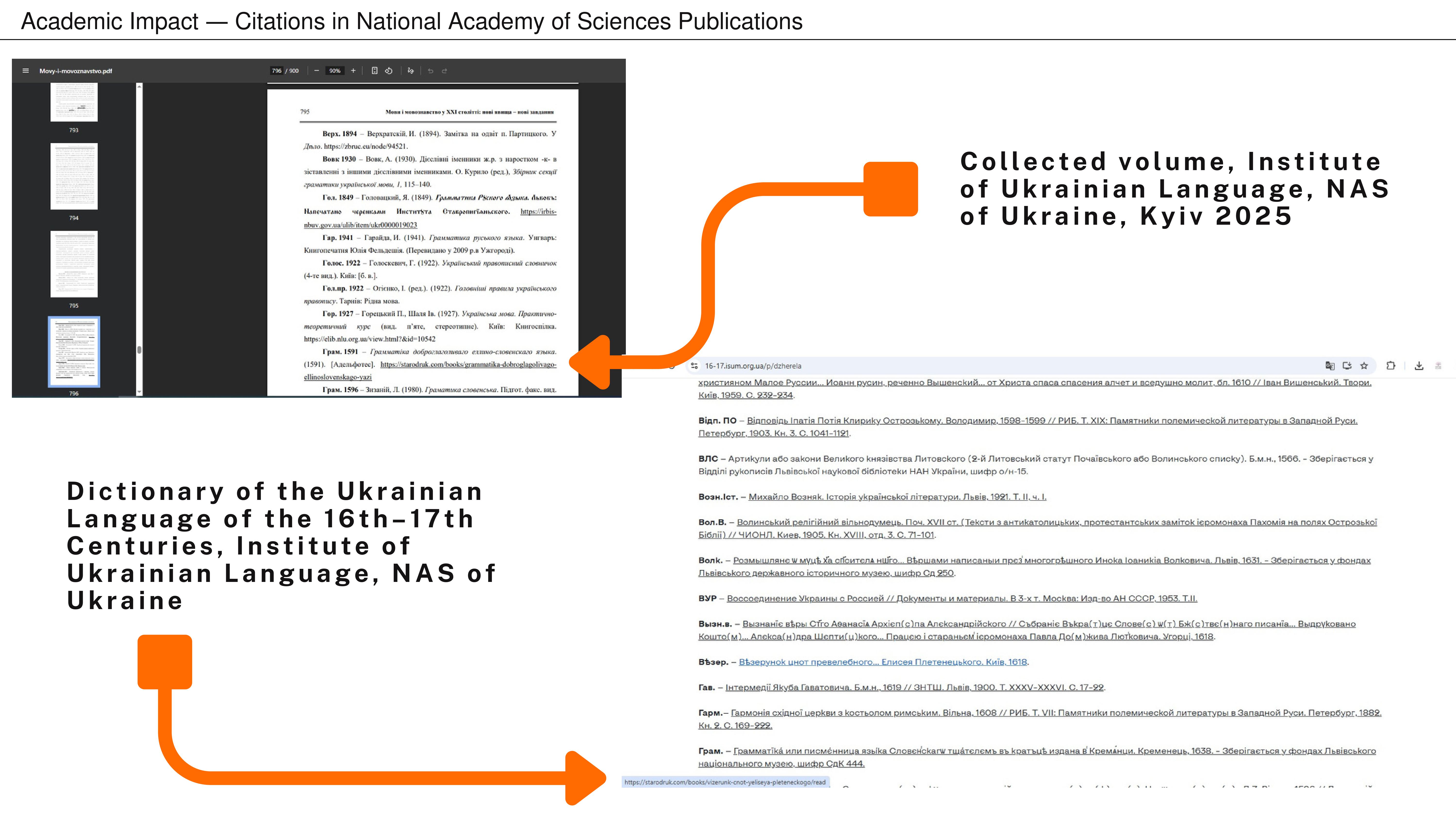
The clearest evidence of systemic impact: the Dictionary of the Ukrainian Language of the 16th–17th Centuries (SUM 16–17), a major project of the National Academy of Sciences of Ukraine, cites Starodruk across multiple entries as the source for primary texts. These are not incidental references — they document a national academic infrastructure built on Starodruk's open access materials.
Starodruk emerged from direct, long-term engagement with early modern printed sources from the Ukrainian lands of the Polish-Lithuanian Commonwealth. While working with these materials academically, the project's initiators, Iryna and Vladyslav Zakharova, encountered the same structural problem repeatedly: books printed in Kyiv, Lviv, and Ostroh in the 16th–18th centuries are physically scattered across archives in Ukraine, Poland, Lithuania, Germany, and Austria. Many are fragile, some are unique, and access has historically depended on institutional affiliation and geographic proximity — conditions that exclude the majority of researchers who would benefit from working with these sources.
The response was not to build another digitisation project, but to create an open digital infrastructure: a stable, publicly accessible platform where early modern printed books could be presented consistently, described in scholarly depth, and made permanently citable and reusable. From the outset, the design principles were clarity, openness, and interoperability — ensuring that materials could travel beyond the platform into research, teaching, and public knowledge ecosystems.
The platform launched publicly in January 2024. Development was incremental and practice-driven: content was added step by step with consistent quality control, and functionality evolved in direct response to how researchers, students, and educators actually used the materials. The IIIF-compliant viewer, exportable metadata, and mobile accessibility were each shaped by real use cases rather than assumed needs.
The project's European dimension became visible quickly. Scholars at the University of Padova, the Polish Academy of Sciences, and Justus Liebig University Giessen began using Starodruk independently — without formal invitation, simply because the resource worked.
Cultural heritage
Open access
Digital research infrastructure
Knowledge accessibility
Knowledge accessibility
Starodruk addresses sustainability across environmental, social, cultural, and economic dimensions — grounded in the project's actual design rather than aspirational claims.
Environmental sustainability is built into the infrastructure model. Before Starodruk, a researcher in Canada or Italy studying Ukrainian book culture had no realistic alternative to international travel or incomplete microfilm reproductions. Each remote access session represents a research interaction that required no physical travel to a Ukrainian, Polish, or Lithuanian archive — a direct consequence of making geographically dispersed heritage digitally accessible at scale.
Social sustainability is addressed by removing institutional and financial barriers. Starodruk provides free, open access without registration or subscription fees. The same primary sources are available to a postgraduate student in Kharkiv, a professor in Padova, and an independent researcher in Toronto on identical terms — documented by an active user base of over 7,000 people across 73 countries.
Cultural sustainability is central to the mission. Starodruk treats early modern Ukrainian printed heritage as a living resource. Visibility in open knowledge ecosystems — including Wikipedia and AI-generated search overviews — prevents cultural heritage from becoming digitally obsolete. In the context of active military conflict, materials preserved on global servers are resilient against physical destruction in ways no single archive can be.
Economic sustainability rests on a lean, reuse-based model. Open standards and machine-readable metadata allow the same digitised materials to support multiple uses simultaneously — research, teaching, Wikipedia editing, and public knowledge production — without additional costs per use. This multiplier effect demonstrates a sustainable model that does not depend on monetisation or continuous external funding.
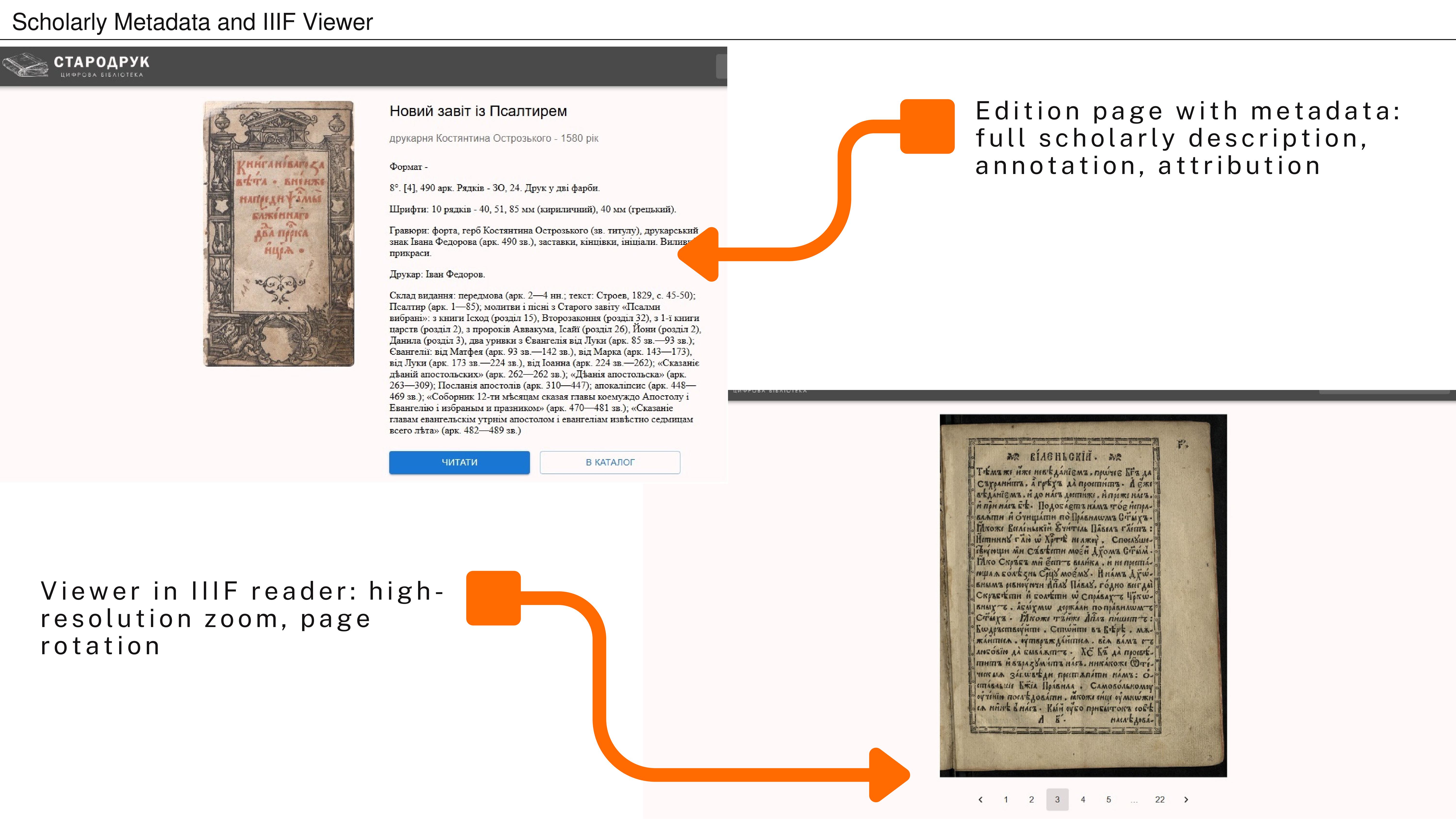
Starodruk contributes to aesthetics by enabling a meaningful encounter with the visual culture of early modern Europe. The books it presents — printed in Kyiv, Lviv, and Ostroh between the 16th and 18th centuries — are material artefacts: objects of sophisticated typographic design, woodcut illustration, and ornamental decoration produced by some of the most skilled craftspeople of their era. Through a clean interface and a full IIIF-compliant viewer with high-resolution zoom and page rotation, Starodruk makes these visual qualities directly accessible — not as scanned images behind a login, but as explorable objects that reward close looking.
The aesthetic dimension is embedded in specific design decisions. Each edition page presents the book as a visual and scholarly object simultaneously, combining high-quality images with structured metadata in a layout that avoids distraction. The IIIF viewer allows users to zoom into typefaces, decorative borders, and marginalia — details invisible in low-resolution reproductions. This transforms the encounter with heritage from an archival transaction into an aesthetic experience.
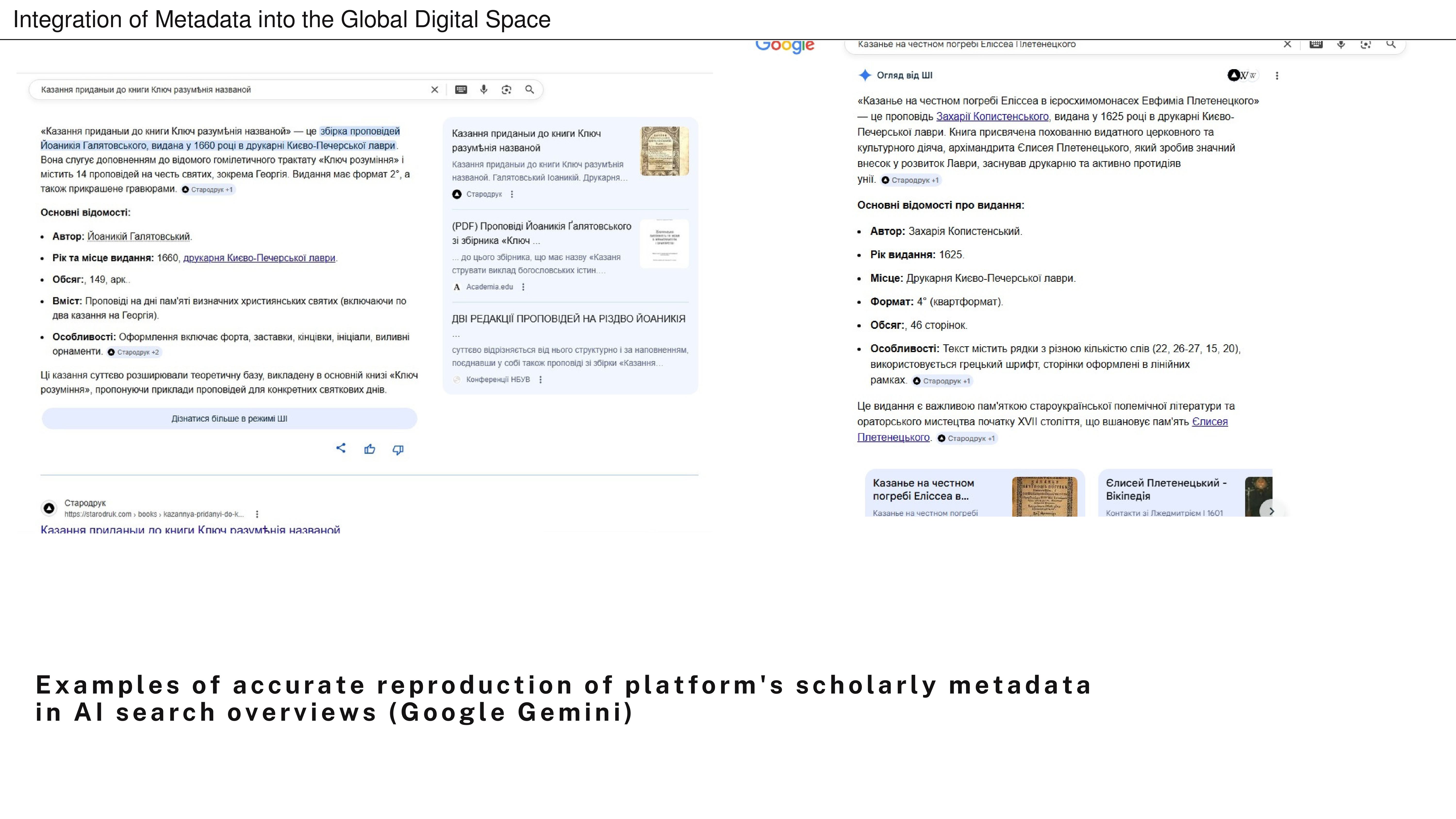
Starodruk's scholarly metadata has been reproduced accurately in AI-generated search overviews, integrated into Wikipedia across multiple language editions, and referenced in academic publications — meaning the aesthetic standards Starodruk applies travel beyond the platform, shaping how early modern Ukrainian heritage is perceived in the wider digital landscape.
The visual culture accessible through Starodruk is not merely decorative. The engravings of Oleksandr Tarasevych — a Kyiv-based artist whose work appears in ecclesiastical books printed across the 17th-century Commonwealth — exemplify a distinctly European Baroque graphic tradition.A single artist, a single visual language, multiple cities now scattered across different national collections: Starodruk makes this shared visual heritage navigable as a whole for the first time.
Starodruk addresses inclusion by removing structural barriers that have traditionally limited access to cultural heritage. The project provides free and open access to rare early modern printed materials, eliminating financial, institutional, and geographic constraints that often restrict their use to a small number of specialists. Researchers, students, educators, and the wider public can engage with the same primary sources on equal terms.
This is documented in individual scholarly practice. As confirmed by Prof. Viviana Nosilia (University of Padova), Starodruk has become a regular research tool enabling scholars to work with dispersed and fragile sources remotely — not as a substitute for archives, but as a necessary scholarly infrastructure. For a researcher working outside Ukraine, this access would otherwise require institutional affiliation, travel, and dependence on individual holding institutions.
Accessibility is embedded in the project's design. Materials are presented through a stable, user-friendly interface with structured metadata that supports search, discovery, and reuse across different levels of expertise. The platform enables both academic and non-academic users to navigate complex historical content without specialised tools or institutional affiliation.
Starodruk promotes inclusive knowledge governance by enabling integration of cultural heritage into open knowledge ecosystems such as Wikipedia and educational resources — allowing heritage materials to reach diverse audiences and support collective knowledge production.
The project exemplifies inclusion not as a parallel activity, but as a core principle of how cultural heritage is organised, accessed, and reused — demonstrating a model that supports equal participation, shared ownership of knowledge, and long-term social value.
Starodruk is participatory in practice, not only in principle. The project is shaped through continuous interaction with its user communities, and the evidence is documented and verifiable.
Academic users across Europe and North America actively engage with the platform as a primary research tool. Letters of support from scholars at the University of Lodz, the Polish Academy of Sciences, the University of Padova, and Justus Liebig University Giessen confirm that Starodruk materials are used in ongoing research on the cultural history of Central and Eastern Europe, and that the platform's metadata quality directly shapes scholarly practice. These are not endorsements: they are accounts of actual use.
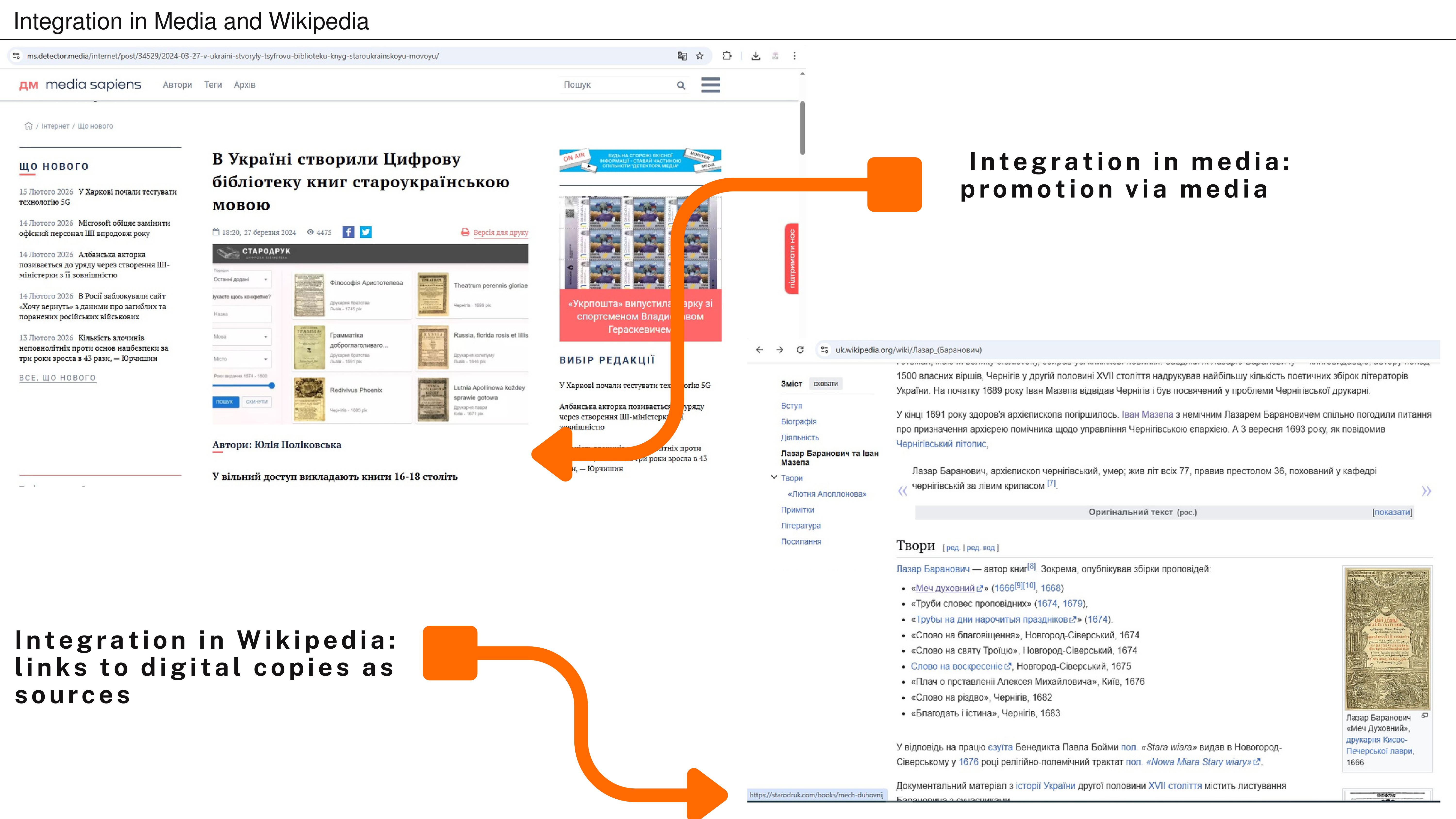
Starodruk is also integrated into open knowledge production. It is cited as a source in Wikipedia articles across multiple language editions, meaning digitised materials are actively reused by volunteer editors to improve public knowledge on topics ranging from early modern Ukrainian printing to the broader history of the Reformation in Eastern Europe. Users do not merely consume content — they contextualise, verify, and redistribute it within one of the world's most widely read reference platforms.
Between January 2024 and February 2026, Starodruk registered over 6,500 new users from 73 countries. Over 20 cities outside Ukraine — including Konstanz, Leuven, Jena, and Berkeley — show single-researcher sessions exceeding 8 minutes with hundreds of recorded events. This correlates directly with the locations of known Slavic and Eastern European studies departments across Europe and North America.
The project maintains open communication channels through which feedback and suggestions are shared. This dialogue informs incremental development: changes to metadata structure, search functionality, and content presentation respond to real-world use cases. Participation is embedded in the operational model, not limited to formal consultation processes.
Starodruk operates through a multi-level governance model that reflects how cultural heritage is produced, accessed, and used across different scales. While the project is implemented at the national level in Ukraine, its design and development are informed by interactions with stakeholders operating at local, national, and European levels.
At the local and institutional level, the project engages with researchers, educators, and students who work directly with early modern sources in archives, libraries, and academic settings. Their practical needs—such as reliable access, clear metadata, and citation-ready materials—have shaped the platform’s functionality and standards.
At the national level, Starodruk addresses the fragmentation of heritage collections by providing a unified digital infrastructure that brings together materials originating from different regions and institutions. This contributes to a shared national framework for access to printed heritage while remaining independent of individual institutional constraints.
At the European level, the project is embedded in academic and open knowledge networks. Researchers affiliated with European universities and research institutions use and reference Starodruk materials, while digitised sources are integrated into transnational knowledge platforms such as Wikipedia. This engagement ensures that Ukrainian printed heritage is contextualised within broader European research and educational landscapes.
The added value of this multi-level engagement lies in aligning local expertise, national cultural responsibility, and European knowledge exchange. By connecting these levels through a single, open infrastructure, Starodruk demonstrates how cultural heritage projects can function coherently across governance scales, enhancing relevance, trust, and long-term impact.
Starodruk sits at the intersection of multiple disciplines, and this transdisciplinary foundation is not incidental — it is what makes the platform function as a genuine research infrastructure rather than a single-purpose archive.
Book history and cultural history form the scholarly core. The platform's metadata standards, bibliographic descriptions, and editorial decisions reflect deep engagement with the conventions of early modern studies, textual criticism, and the history of the Polish-Lithuanian Commonwealth. This disciplinary grounding ensures that digitised materials are not merely accessible but intellectually usable.
Digital humanities and library science shape the infrastructure. The adoption of IIIF-compliant image delivery, structured machine-readable metadata, and open access principles reflects established best practices in digital preservation and interoperability — ensuring that Starodruk's materials can travel beyond the platform into broader research ecosystems, including Wikipedia and AI-generated knowledge overviews.
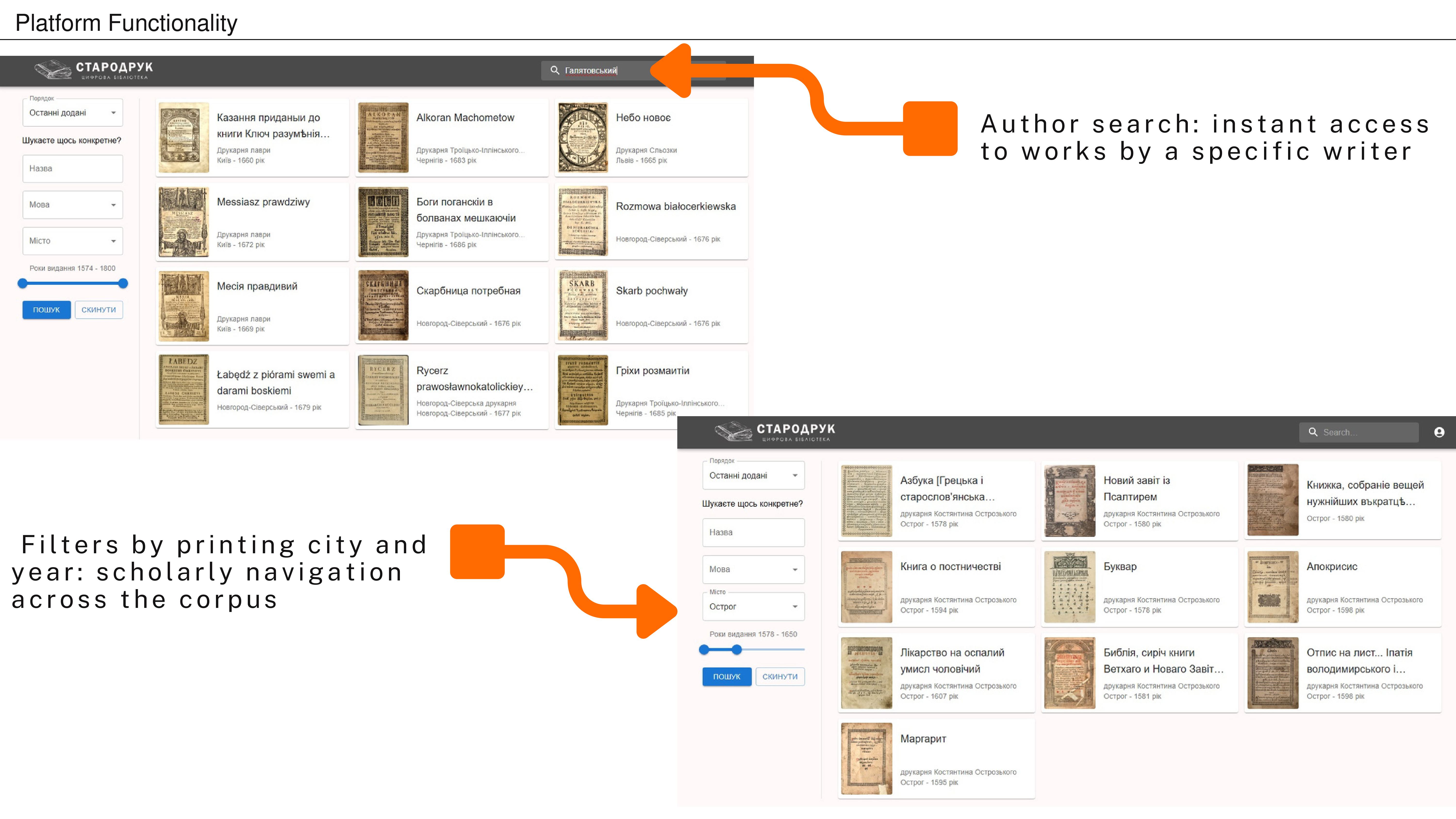
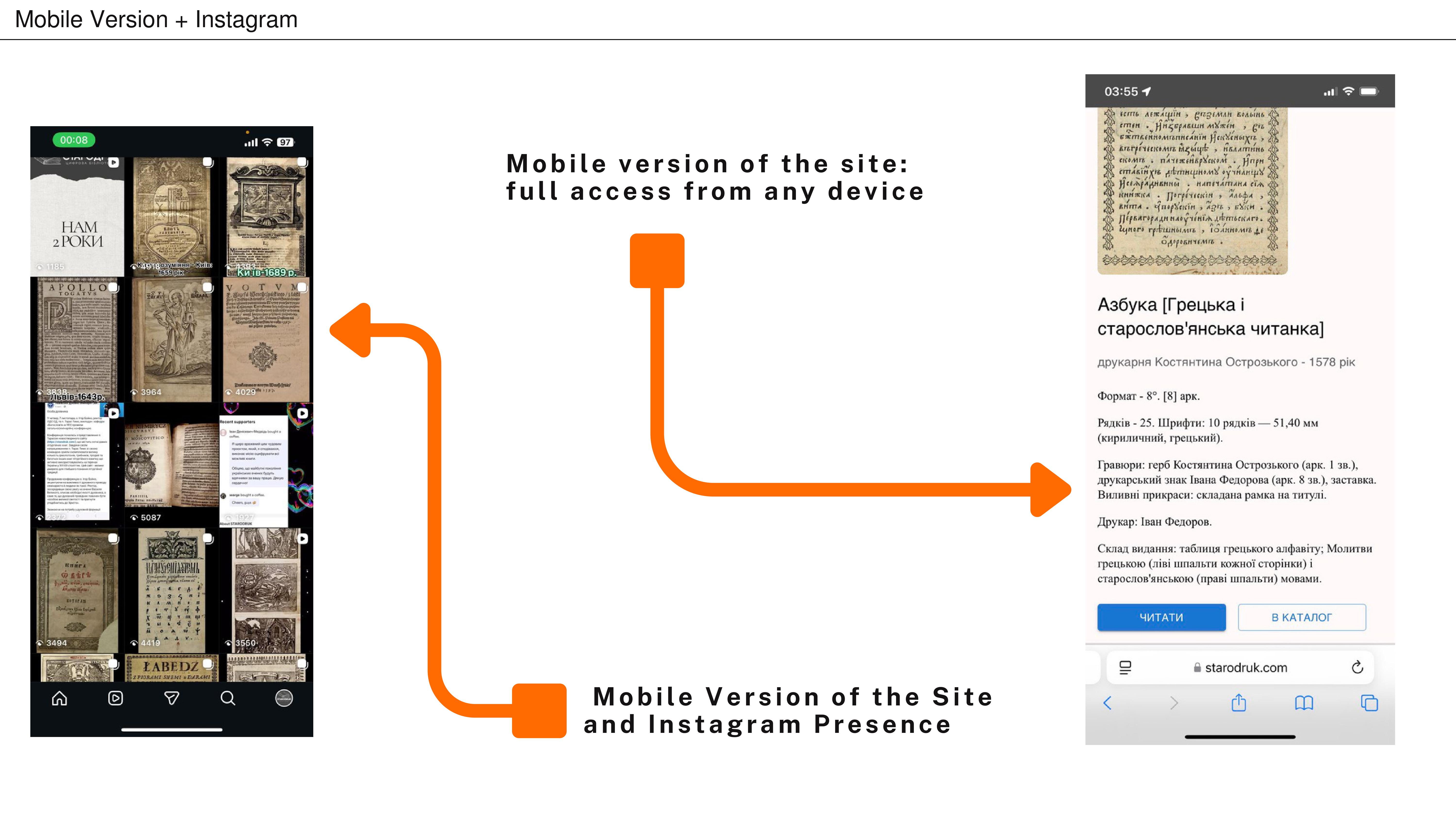
Software engineering and UX design are embedded in the platform's development model. Functionality evolved in direct response to how researchers, students, and educators actually used the materials — mobile accessibility, search filters by city and date, and the image viewer were each shaped by real use cases rather than assumed needs.
Art history contributes a dimension that extends beyond text. Early modern books are visual artefacts — their woodcut illustrations, engraved frontispieces, and typographic ornaments constitute a significant corpus of Baroque graphic culture. The platform's image-focused interface makes these visual elements accessible for art historical research alongside textual analysis.
Finally, heritage preservation and conflict studies inform the project's urgency. In the context of active military conflict, digitisation of unique materials serves as distributed cultural preservation against physical loss.
Comparable territorial bibliographic infrastructures exist for German-speaking countries (VD16/17/18), Britain (EEBO), Switzerland (e-rara), and the Netherlands (STCN). Until Starodruk, no equivalent open digital infrastructure existed for the early modern printed heritage of the Ukrainian lands. Starodruk fills this gap as a non-commercial infrastructure sustained primarily through direct financial commitment from its founding team — keeping the platform independent and free from the constraints of grant cycles or institutional dependencies.
Operational costs are kept lean by design. The platform runs on AWS cloud infrastructure scaling with actual usage rather than requiring fixed server investment. Open-source technologies and in-house development minimise third-party costs, delivering researcher-grade infrastructure at a fraction of the cost of institutionally managed equivalents.
When infrastructure costs require additional coverage — typically once or twice per year — the project runs community crowdfunding campaigns among its user base, supported by direct donations from researchers, educators, and members of the public who use the platform. This reflects the trust Starodruk has earned within its communities.
Looking ahead, Starodruk is expanding its funding base to include targeted grant support for the next development phase — expanding the corpus to 1,000 editions and launching a full English-language interface. The financial model will remain diversified: founder investment, community donations, crowdfunding, and project-based public funding that respects open-access principles. The goal is not to monetise the resource, but to ensure it remains permanently accessible as a shared European cultural infrastructure.
Starodruk is built on a methodology that is explicitly transferable. Its core elements — open access principles, item-level scholarly metadata, IIIF-compliant image delivery, and lightweight cloud infrastructure — are a replicable framework for any community working with dispersed, underdigitised early modern printed heritage. To contextualise the scale: the entire known corpus of early modern printed heritage from the Ukrainian lands between 1574 and 1800 amounts to approximately 4,300 editions. Starodruk has already digitised over 500 of these — more than 11% of the total corpus within two years of public launch. The next development phase will bring coverage to 1,000 editions, representing nearly a quarter of the entire known heritage. This is not incremental progress: it is the construction of a primary source infrastructure for an entire field.
The most immediate domain for replication is Central and Eastern European studies. The Polish-Lithuanian Commonwealth produced printed books across multiple territories simultaneously — the same printers, typefaces, and publishing networks operated across what are now separate national collections in Poland, Lithuania, Latvia, and the Czech Republic. A methodology that works for Ukrainian early modern editions works, without fundamental modification, for the broader corpus of Commonwealth printing.
The project's relevance also extends into art history. Early modern books are significant visual artefacts: their woodcut illustrations, engraved frontispieces, and typographic ornaments constitute a largely uncatalogued corpus of graphic art history. Starodruk's IIIF-compliant viewer and image-focused metadata make these visual elements directly accessible for art historical research — opening the platform's model to replication within digital art history infrastructure across the region. The key transferable asset is scholarly rigour, open standards, and infrastructure thinking — proven deliverable by a focused team.