ROOM TO GROW
Basic information
Project Title
Category
Project Description
Current stage development
Geographical Scope
Project Region
Urban or rural issues
Physical or other transformations
EU Programme or fund
Description of the project
Summary
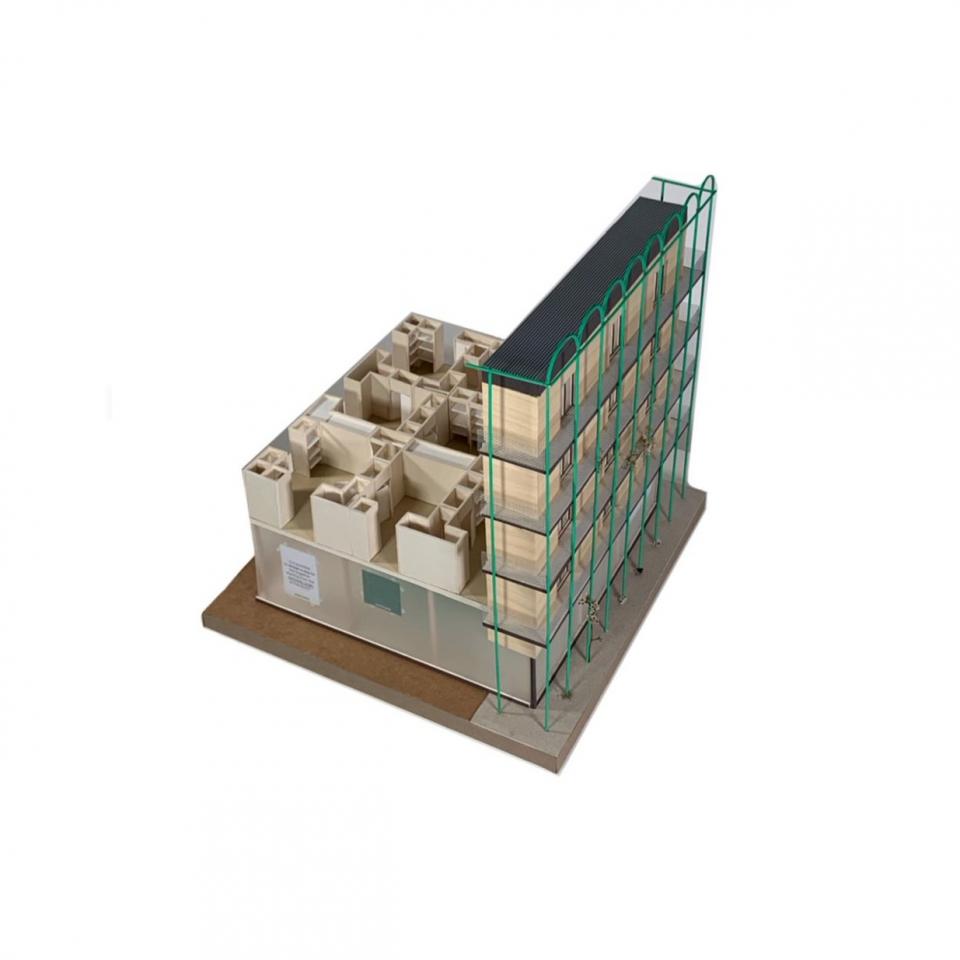
This context insipred a broader reflection on the possibility through alternative design ideas, for those forgotten places to become centre for the debate on the housing crisis. By rethinking the living solutions starting from the smallest scale of living, that of the room, the aim is the redefinition of what may be the standards to suit today's society. Starting from an idea of space that can host many different functions, the concept grows defining progressively housing units and buildings, until the design of an entire neighbourhood. The aim is, through modular systems, to create flexible solutions that allow versatility in use to help inhabitants to gain back possession of those urban spaces, feeling part of the city again.
The morphology of the concept privileges the creation of relationships, between people, between natural and built environment, between the area and the city, and between the present and the history, envisioning the growth of a community, and the reconstruction of an identity.
Key objectives for sustainability
Low impact: using a dry construction technique such as a cross laminated timber structure ensures a faster and easier construction process, a more sustainable lifecycle with the reduction of carbon emissions, and the possibilities of future adaptions of the function and dismantling of the structure. The permeable paving and the green surfaces ensure the filtration of rainwater and respect the natural ecosystem.
Circular economy: with a cooperative approach, the community could host activities and events at the urban level, and through the rent of accommodations and common/commercial spaces could sustain the maintenance costs of the intervention.
Key objectives for aesthetics and quality
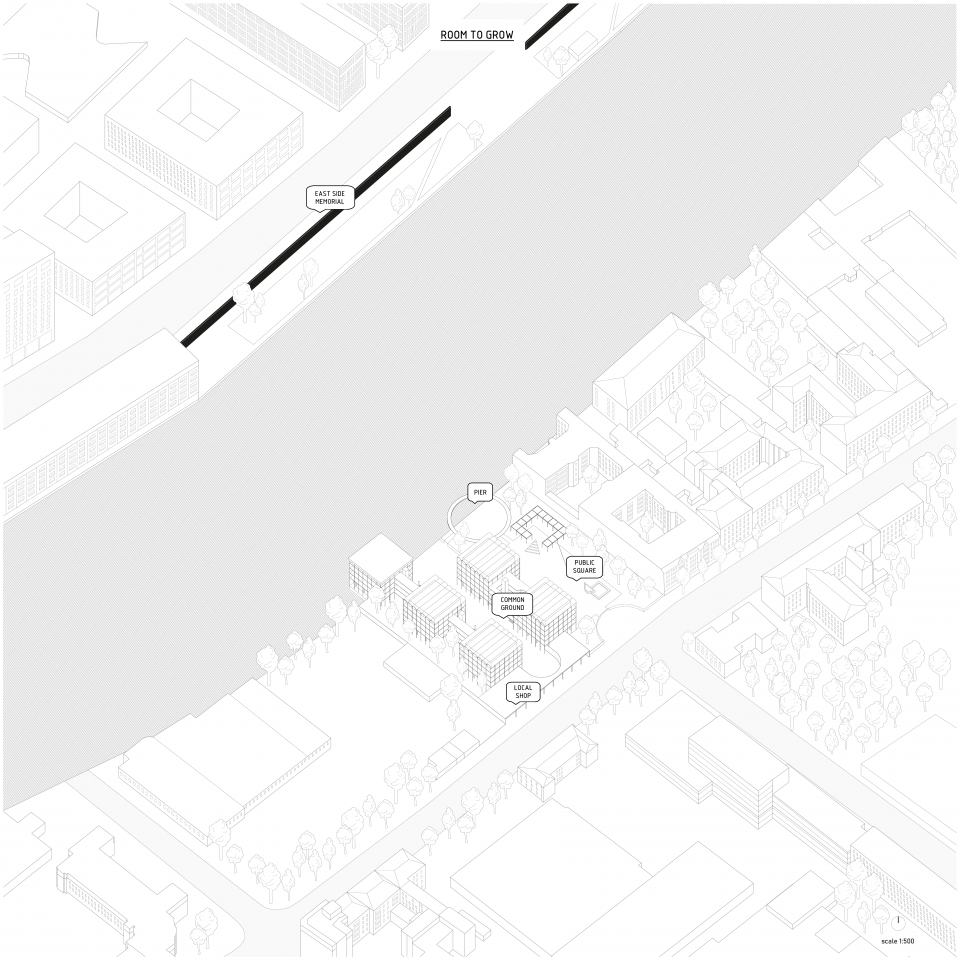
Relationship with the river: The creation of a visual axis between the main street and the river through a green connection area would create a connection for the citizens; in addition, the access to the water would be possible through a little public pier.
Point of reference: A new public area, centre of the exchange between the people living and working in the area and the citizens, together with the functions introduced at the ground floor could become a reference point in the neighbourhood for the promotion of interaction.
Key objectives for inclusion
Adaptability of the space: through the flexibility and adaptability of the housing units and its spaces, all the different needs of a diverse range of users could be satisfied, not only for living purposes but also professional and leisure related, leaving no one behind.
A place for the city: Becoming a reference point for the neighbourhood, the project area could open to the dialogue with all the citizens, welcoming and engaging new interactions and ways of living together and working together for the common good.
How Citizens benefit
Feeling involved through space: the adaptability of the units allows people to shape their space depending on their needs and wishes, helping them to build their identity and making their relationship with it even stronger.
Feeling responsible for improvement: being directly involved in the management, maintenance and improvement of the common space, the citizens can benefit from an enhanced sense of responsibility and connection with the environment.
Physical or other transformations
Innovative character
Fighting gentrification: the concept has been developed around a main goal, that of to provide accommodations in a situation of crisis where citizens are forced to move out of the city, in a central location, through a shared way of living and taking care of the space as a community.
Openness towards the city: the ground level of the project includes facilities and public spaces and functions, both indoor and outdoor, while at the same time it enhances and makes accessible the relationship with nature and the river as a common heritage to share with the city.
Identification through community and space: the establishment of a collective of people sharing the same space, and their engagement for its enhancement could help to create a sense of belonging and the redefinition of an identity, with the space as mean of expression.
Disciplines/knowledge reflected
Sociology: developing spatial solutions based on the needs of a specific target needs an analytical process to define profiles of the users and adapt the concept consequently.
Urban design: through the study of a specific area, the context and the relationship with the city, its evolution through the history and the characteristics of previous interventions or development plans, the study of the concept becomes able to respond to different needs, with a look for inclusion.
Structural design: the modular design approach starts from the study of a structure that can be flexible enough to guarantee the creation of different spaces through variations in the composition of the same basic elements with a unified assembly process. The cross laminated timber construction technique, using elements that combine function and load bearing capacity, allows simplified building and reconfigration processes.
Methodology used
After the identification of the housing issue as main topic and the area of interest, the research was conducted on the specific context and history of the city and the neighbourhood, and the causes and reasons that progressively generated to the current situation. The analysis of the area, of some interventions and activities of collectives and associations that shared the same vision was necessary to give a direction to the initial idea, together with the study of concepts that dealt in the past with urban and social related themes, as the reconstruction strategies.
The research process conducted to the development of the concept considering different challenges: finding a housing model that could respect the context and the idea of building a community, creating accommodations but also aggregative spaces and functions in contact with the nature and in continuity with the urban environment; helping people to congregate into communities and to build their identity also through the space; developing a modular approach that could be adapted to accommodate the needs of many different households, from singles to families and professionals.
How stakeholders are engaged
Associations: groups of people sharing the interest to care about the space, develop it and raise awareness on the different ways and habits that could help to improve everyone’s life for the common good.
Citizens: inhabitants willing to feel involved and welcomed inside a community through the participation to events and to the activities that fuel the little circular economy process.
Event organisers: with a large public space both indoor and outdoor, events, meetings and activities can be hosted, involving both the community and the citizens.
Little business owners: some public functions such as the library, a cafeteria and a free space with commercial purpose facing the street can be rented to business owners that will develop their activities in the context of the community developing a circular process.
Global challenges
SDG 10 - Reducing Inequalities: the effort put in the development of an accessible and flexible concept for the housing units aims to reduce inequalities through the adaption to the needs of the individuals, that can configure their accommodations and feel welcomed.
SDG 11 - Sustainable Cities and Communities: rethinking an underdeveloped lot in the context of a central neighbourhood with a specific history can be a benefit for the creation of new local communities based on sharing and team up for the common good.
SDG 15 - Life On Land: trying to rediscover the connection with the natural ground, nature and the water inside the built environment can be the starting point to learn how to live and grow together, promoting respect and coexistence and leaving space for new unexpected interactions.
Learning transferred to other parties
Next steps
Since the concept is still on a preliminary state of advancement, to define a more structured proposal, further discussion with experts in the technical and social aspects will be necessary, as well as the opinion of the involved characters; in this way the research will be developed more in depth.<br />
<br />
For the development of a project that involves both the role of designers and the active participation of a community, it will be necessary to set up an exchange between the two parts, illustrating the potential and leaving space to the dialogue, to have feedback and eventually to set up a long-term collaboration through constant interactions. An exhibition can be a successful mean to share the vision and encounter the point of view of associations and institutions, to engage the debate and explore the potential and concrete implications of the project, also in other contexts.<br />