REcollect
Basic information
Project Title
Full project title
Category
Project Description
Current stage development
Geographical Scope
Project Region
Urban or rural issues
Physical or other transformations
EU Programme or fund
Description of the project
Summary
The project primarily addresses individuals with Alzheimer’s and their caregivers but also benefits people with physical or cognitive disabilities, neurodiverse individuals, and the general public. By transforming museum spaces without altering existing infrastructure, the project seeks to create modular, customizable devices that enhance accessibility and engagement. It integrates museum therapy practices, such as Alzheimer Cafés, to promote socialization and emotional well-being while extending inclusivity beyond museums into urban environments.
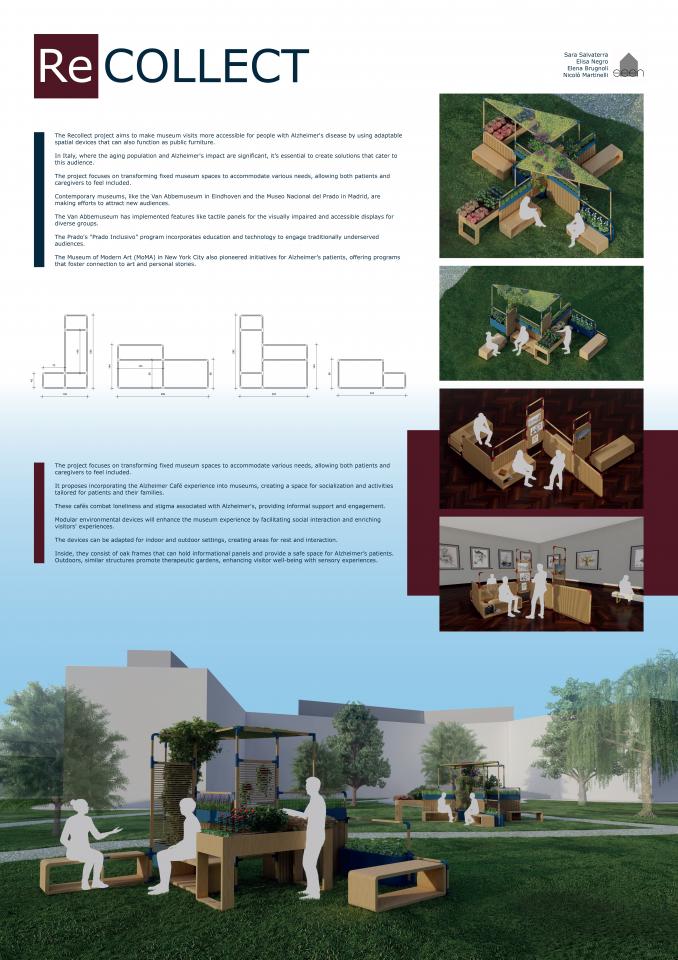
The project has led to the development of spatial devices made of sustainable materials like oak wood and bioplastic, designed for both indoor and outdoor settings. These structures incorporate sensory-enhancing elements, including tactile and olfactory features, to foster engagement and create a welcoming environment. The initiative strengthens museum accessibility by establishing structured pathways and designated resting areas, making cultural spaces more navigable and inclusive.
With its integration into real-world settings Recollect will support ongoing inclusive initiatives and contribute to a broader cultural shift towards universal design. By rethinking museum spaces as flexible, adaptable environments, the project not only enhances cultural participation for people with Alzheimer’s but also fosters a more inclusive experience for all visitors.
Key objectives for sustainability
The structures are designed to be modular and customizable, allowing them to be reconfigured for different museum layouts, cafés, and public spaces. This adaptability extends their lifespan and reduces waste from single-use installations. In addition to material sustainability, the project fosters social and cultural sustainability by ensuring that people with Alzheimer’s, neurodivergent individuals, and other visitors with diverse needs can navigate and experience museums independently. This contributes to a long-term transformation of cultural spaces, reinforcing their role as accessible and community-driven institutions.
Beyond museums, the project integrates healing gardens and sensory paths with therapeutic plants, creating stress-relieving environments in urban areas. The inclusion of Alzheimer Cafés strengthens social sustainability by fostering community interaction and mental well-being.
By combining renewable materials, modular flexibility, and social inclusivity, the Recollect project exemplifies how design and accessibility can intersect to create sustainable and inclusive museum experiences. Its scalable approach serves as a model for other institutions seeking to integrate sustainability into their cultural spaces while ensuring that these remain open and welcoming to all.
Key objectives for aesthetics and quality
Beyond aesthetics, Recollect enriches the visitor experience through multisensory design. Tactile materials, customizable seating, and sensory gardens enhance engagement, offering aromatic plants, wooden textures, and soft acoustic barriers that foster comfort and reduce cognitive fatigue. These elements create inclusive spaces where visitors, including those with Alzheimer’s, can navigate at their own pace.
Culturally, the project redefines accessibility as an essential design principle, ensuring museum spaces cater to diverse physical and cognitive needs. The integration of Alzheimer Cafés within museums strengthens the link between cultural participation and social connection, transforming museums into dynamic spaces of shared experience.
Through its combination of refined aesthetics, functional inclusivity, and cultural sensitivity, Recollect tries to create a new benchmark for museum design. It demonstrates how thoughtful spatial interventions can enhance engagement, accessibility, and emotional resonance, making cultural institutions more inclusive, and meaningful for all visitors.
Key objectives for inclusion
Affordability is a key aspect, as the modular design allows for cost-effective production and reconfiguration, reducing the financial burden on institutions while maximizing accessibility. The devices are crafted from sustainable, durable materials to ensure longevity and minimize maintenance costs, making them a feasible solution for museums of all sizes.
Beyond physical accessibility, Recollect promotes inclusive governance by challenging the idea of museums as static institutions and reimagining them as community-driven spaces. The inclusion of Alzheimer Cafés within museum environments fosters intergenerational and cross-community dialogue, turning cultural spaces into hubs for social interaction and well-being.
This model serves as an exemplar of how museums can evolve from exclusive institutions into participatory and inclusive spaces, prioritizing the active involvement of diverse audiences. By integrating universal design principles with social engagement, Recollect demonstrates how thoughtful interventions can transform museums into environments where all individuals—regardless of age, ability, or background—can experience art in a meaningful way.
How Citizens benefit
Workshops and focus groups will be organized with care organizations, accessibility advocates, and museum professionals, allowing for continuous feedback on the project’s inclusivity, usability, and integration within different museum spaces. These sessions will provide crucial insights into the sensory, cognitive, and mobility challenges that visitors face, directly influencing the modularity, tactile elements, and multisensory features of the devices.
The involvement of Alzheimer’s associations and social care organizations will become essential in integrating the Alzheimer Café model into the project, ensuring that museum visits not only provided cultural enrichment but also became a space for social interaction, emotional support, and community engagement. Museum staff and educators will also be included in the process to align the project with existing accessibility programs and promote a long-term shift toward more inclusive practices.
This participatory approach wants to male sure that Recollect will not be just designed for inclusion but will be co-created by those it seeks to serve.
Physical or other transformations
Innovative character
One of the project’s key innovations is its modular environmental devices, which function both as spatial elements within museums and as public furniture in urban spaces. Unlike conventional museum adaptations that modify permanent infrastructure, these customizable structures are lightweight, reconfigurable, and sustainable, allowing for dynamic spatial organization that meets diverse needs. Made from oak wood and bioplastic, they incorporate tactile and olfactory elements, creating a multi-sensory experience that enhances engagement for individuals with Alzheimer’s and other cognitive conditions.
Recollect also differentiates itself by merging museum accessibility with the Alzheimer Café model, transforming museum visits into holistic social and therapeutic experiences. While many museums have introduced programs for people with Alzheimer’s, these are often limited to scheduled sessions. Recollect, by contrast, integrates these experiences into the everyday museum setting, fostering continuous inclusion rather than temporary accommodation.
Furthermore, the project extends beyond museum walls, incorporating adaptable elements into urban environments to create inclusive public spaces. The integration of "healing gardens" and sensory features in museum courtyards and city spaces makes cultural participation more immersive and accessible. This approach challenges the traditional boundaries of museum accessibility, demonstrating that inclusive design can be flexible, mobile, and beneficial to all visitors.
Disciplines/knowledge reflected
Design and Architecture played a crucial role in shaping the spatial devices, ensuring they were modular, sustainable, and adaptable to different museum environments.
Museology and Curatorial Studies contributed by aligning the project with contemporary debates on inclusive exhibition design. Museum professionals and curators provided insights into how the devices could be seamlessly integrated into existing museum layouts, balancing accessibility with the integrity of the exhibition experience.
Healthcare and Social Sciences experts, including Alzheimer’s specialists, psychologists, and caregivers, will ensure that the project will respon to the cognitive and emotional needs of visitors with dementia. Their input will be crucial in developing multisensory elements, tactile engagement strategies, and Alzheimer Cafés, transforming museum visits into opportunities for stimulation, memory retrieval, and social interaction.
Methodology used
The methodology begins with an in-depth analysis of existing accessibility challenges in museums, particularly for individuals with cognitive impairments. Research includes consultations with medical experts, caregivers, museum professionals, and individuals with Alzheimer’s to understand their specific spatial and sensory needs. Insights from these discussions inform the design of modular environmental devices that enhance accessibility without altering existing museum infrastructure.
A key aspect of the approach is modularity and adaptability. The spatial devices are developed using sustainable materials and feature a flexible, interlocking frame system that allows for different configurations depending on the space and purpose. These structures serve both functional and experiential roles, offering tactile, visual, and olfactory elements to support memory recall and engagement. The methodology will also incorporates testing phases in real museum environments, where prototypes are evaluated by users and adjusted based on feedback.
Recollect integrates museum therapy principles by incorporating the Alzheimer Café model within museum spaces. This approach ensures that museum visits are not only cognitively stimulating but also socially enriching.
The final stage involves expanding the application of these adaptable devices beyond museums, integrating them into public spaces to enhance urban inclusivity. Through a participatory design process, involving continuous collaboration with stakeholders, Recollect ensures
How stakeholders are engaged
At the local level, we want to collaborate with Alzheimer’s associations, museum professionals, and community organizations to understand the specific needs of individuals with cognitive and sensory impairments. Their insights will directly influence the design and functionality of the spatial devices, ensuring they were user-friendly, adaptable, and responsive to real-life accessibility challenges.
At the regional and national levels, partnerships with museums, universities, and cultural policymakers will help shape the project within a broader accessibility and inclusion framework. We want to collaborate with institutions such as Gallerie d’Italia and Fondazione Manuli Onlus to facilitate the integration of Alzheimer-friendly museum programs, ensuring the project aligned with existing initiatives and reached a wider audience. Academic institutions contributed through research on inclusive museum practices, strengthening the theoretical foundation of the project.
At the European level we want to collaborate with instututions such as the Van Abbemuseum in Eindhoven and the Museo del Prado in Madrid, provided valuable insights into inclusive design strategies, enhancing the scalability of the project beyond its initial local context.
The added value of this multi-stakeholder engagement will be the creation of a flexible, replicable model that integrates universal accessibility principles with cultural participation.
Global challenges
One of the key global challenges the project tackles is the exclusion of people with cognitive disabilities from cultural and social life. Many museums remain inaccessible, offering only occasional specialized programs rather than permanent inclusive infrastructure. Recollect bridges this gap by embedding accessibility into museum layouts through modular spatial devices, ensuring continuous, rather than temporary, inclusivity.
The project also addresses urban inclusivity and well-being by extending its design principles beyond museums into public spaces. With cities worldwide striving to become more age-friendly, Recollect’s adaptable structures can be implemented in parks, community centers, and urban areas, creating environments that support cognitive stimulation and social interaction.
Another challenge Recollect addresses is the stigma and isolation experienced by people with Alzheimer’s and their caregivers. By incorporating the Alzheimer Café model into museum visits, the project fosters meaningful social engagement, reducing loneliness and promoting intergenerational and community interactions.
Learning transferred to other parties
The methodology, based on inclusive and participatory design, can be adopted by other museums seeking to enhance accessibility. The process of co-designing with individuals with Alzheimer’s, caregivers, and accessibility experts ensures that solutions are tailored to real needs. This collaborative approach can be replicated in different cultural settings, allowing institutions to create adaptable spaces without requiring major infrastructural changes.
The modular spatial devices can be transferred to other environments such as libraries, community centers, and hospitals. Their lightweight and reconfigurable nature allows for flexibility in adapting them to different spaces and functions, from structured museum tours to informal social gatherings. Additionally, their use in urban spaces, including healing gardens and sensory installations, makes them applicable to city planning initiatives focused on inclusivity and well-being.
The Alzheimer Café model within museums is another transferable aspect. While many institutions offer separate therapeutic programs, integrating social and cognitive activities directly into museum visits fosters a more inclusive cultural experience. This approach can be applied to other vulnerable groups, such as neurodiverse individuals, elderly communities, and people with disabilities.
Next steps
In the year following the application, the Recollect Project will focus on further developing, promoting, and implementing its concept through research, prototyping, partnerships, and public engagement.<br />
<br />
The first step will involve refining the design of the modular environmental devices through additional testing in collaboration with museums, caregivers, and individuals with Alzheimer’s. This phase will include evaluating user feedback and making adjustments to enhance functionality, safety, and adaptability. Prototyping will continue with a focus on sustainable material optimization and durability testing, ensuring that both indoor and outdoor versions meet long-term accessibility needs.<br />
<br />
Parallel to product development, Recollect will establish formal partnerships with museums, cultural institutions, and urban planners to implement pilot programs. The Gallerie d’Italia in Milan will ideallyserve as the initial test site, with plans to extend the project to other institutions interested in integrating inclusive museum experiences.<br />
<br />
By the end of the first year, Recollect aims to have successfully implemented its first full-scale installation, gathered comprehensive user insights, and expanded its network of stakeholders. These efforts will lay the groundwork for scaling the project to new locations, ensuring its long-term sustainability and impact.