Reboiler: Art & Community Space
Basic information
Project Title
Full project title
Category
Project Description
Current stage development
Geographical Scope
Project Region
Urban or rural issues
Physical or other transformations
EU Programme or fund
Description of the project
Summary
After the start of the full-scale war in Ukraine, many businesses moved to my city, which led to widespread construction. At that time, I was 20 years old, studying architecture, and I began to worry that such a massive building with great spatial potential might be demolished and replaced with residential complexes.
I couldn't ignore it. So, I decided to take action and led the revitalization process through cultural events, community building, and architectural interventions.
This process is still ongoing. I believe that one day this building will become a catalyst for the transformation of the community, turning the city into a space of sustainable development, equal opportunities, and circular economy. A place where talents are unlocked and everyone feels valued, where all generations — from the youth to the elderly — have the chance to realize themselves and feel dignified.
This building could become a symbol that not only changes the city's face but also inspires the entire community for transformation and recovery after the war, becoming a scientific-artistic observatory.
Key objectives for sustainability
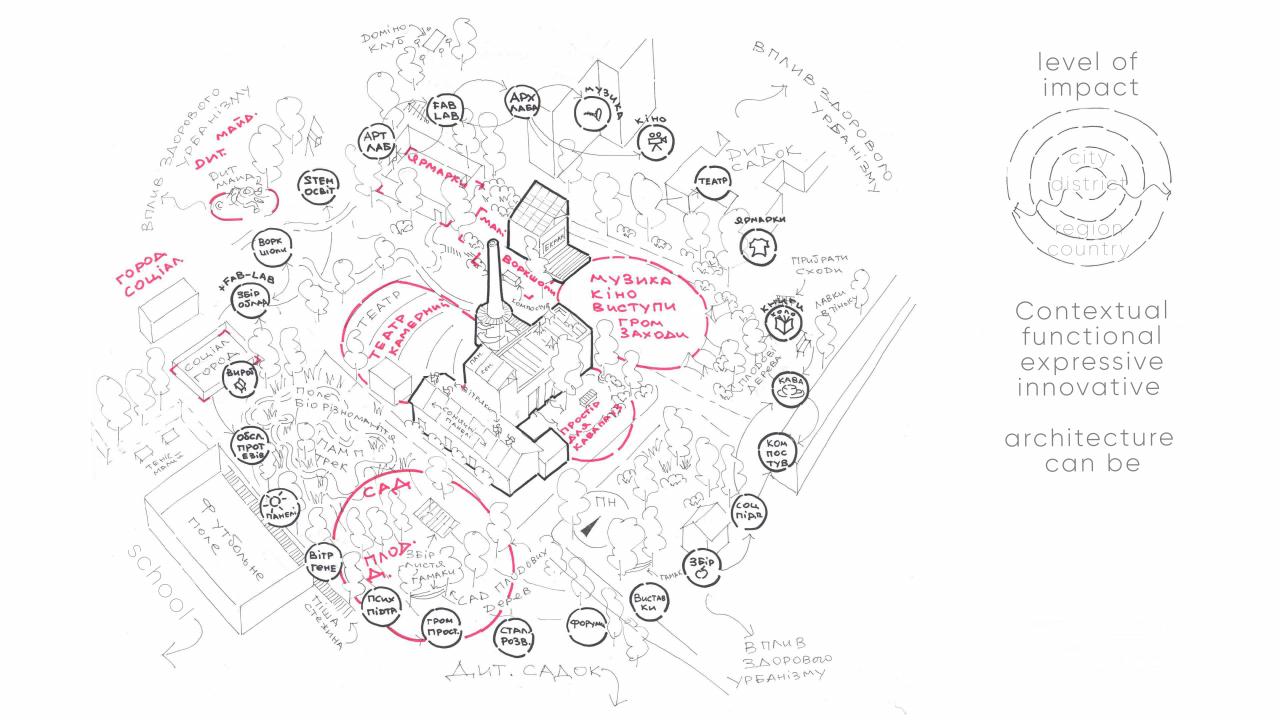
The project will feature open workshops for robotics, woodworking, model-making, and new fab-lab formats, fostering a culture of making, invention, and creativity with a strong emphasis on STEM approaches.
5. Gender Equality
We aim to create an inclusive environment where everyone, regardless of gender, age, or physical abilities, can find their place and thrive. Regular seminars and events will help form a community that actively promotes tolerance and mutual respect.
7. Affordable and Clean Energy
Solar panels and wind turbines will power part of the space, while the building's ventilation system will use solar energy and natural convection through the old boiler’s chimney.
8. Decent Work and Economic Growth
The workshops will create job opportunities in robotics, 3D printing, and architecture, offering hands-on training for young specialists.
9. Industry, Innovation, and Infrastructure
A cultural and scientific center will host artistic residencies and scientific forums, symposiums, and exhibitions, fostering innovation and cultural development.
11. Sustainable Cities and Communities
The project will establish a green public space, enhancing environmental quality and fostering social integration, strong community connections, and local economic development.
12. Responsible Consumption and Production
Workshops will support recycling and restoration of items, including plastic recycling, composting, and refurbishing old furniture, promoting sustainable resource use.
13. Climate Action
We will promote healthy urbanism through educational workshops and the creation of a biodiversity-rich environment, contributing to the city's future green network
16. Peace, Justice, and Strong Institutions;
17. Partnerships for the Goals
The project will create a space for cultural and scientific communities to collaborate, strengthening social connections and fostering a proactive, engaged population ready for growth and change
Key objectives for aesthetics and quality
The first is the location. It’s a huge building with a large green area and a complex topography at the center of the district. Even for me, it's just a 2-minute walk from home, and for 80% of the community, it's within a 15-minute walk. This is something special. The topography allows for the creation of amphitheaters, complex landscape architecture, etc., which is an exciting and unique opportunity for the country.
The second feature is the building itself. It is a large structure with high ceilings and spacious areas, which can change their configuration through pulley systems and partitions to accommodate different exhibits and artistic events. Large windows can open the space to the street, allowing for concerts in the summer or the entry of large sculptures for exhibitions.
The third feature is the use of the boiler stack as an observation tower. It could serve as a children's slide and also function as natural ventilation through convection from solar energy. An important aspect is that the STEM workshops inside the building can produce technologies and solutions both for the boiler itself and for the city. They should become a sort of Petri dish for startups and creativity, where innovative ideas and technologies interact with the urban environment.
This project creates a unique place for the development of youth culture and creative ideas, fostering both personal and societal growth.
Key objectives for inclusion
How Citizens benefit
The project develops **step by step**. The first stage was the revitalization hypothesis, which I published in the media. It received strong support from the community and participants of the urban forum. This enabled us to approach the municipality with a request for the first investment – grass mowing and organizing movie nights at the location.
This minimal project test showed:
**Legitimization** of cultural events in the space;
**Engagement of a large number of people and positive feedback**;
**Team formation** – the creation of a youth council in the community.
**The next step was scaling.** Over the course of a year, together with like-minded individuals, we organized a **series of summer cinemas**. Now, within the youth council, we regularly hold **board game nights, movie screenings, and team meetings**, which helps our community grow both quantitatively and qualitatively.
Simultaneously, we are preparing **educational events** on architecture and urbanism, workshops for exploring the boiler house area, and preparing it for transformation. We are also in communication with neighboring institutions – kindergartens, schools, sports communities, and the third-age institute – to integrate them into the process.
Next is the realization of a **small prototype** with key spatial meanings. This will allow us to test ideas, attract new participants, and create a wider community.
The cyclical participatory development also involves working with **neighboring courtyards and streets**, improving the areas surrounding buildings. This will foster greater social interaction, acquaintances, and strengthening horizontal connections in the city.
Physical or other transformations
Innovative character
Disciplines/knowledge reflected
In the long term, the project includes the establishment of workshops for artistic projects, as well as a café-bookstore with a creative hub that will become an important business and cultural center for local artists and musicians. This will be a space for selling artworks, hosting musical evenings and performances, which will also generate additional cultural initiatives.
Plans include the installation of solar panels, wind generators, and the implementation of energy-efficient solutions, combining technology with art.
This business model will create a sustainable and self-sufficient project that will foster the development of local culture, create jobs, and attract investment. The city will gain a new cultural hub that will stimulate cultural tourism and support the community.
Methodology used
Here is the structure:
1. Catalyst — "activation of space."
2. Formation/development of the team.
3. Soft development component (events, activities, etc.) — community development.
The cycle is closed, and after each stage, it repeats with new challenges and tasks:
1. Catalyst — infrastructure modernization, architectural intervention in the space.
This methodology will shape the boiler house space as a mirror, reflecting the needs of the community that has gathered around this project.
How stakeholders are engaged
Later, the city administration initiated the creation of the youth council and facilitated its formation. They also provide institutional support for architectural interventions and public events.
At the strategic level, the city authorities share our vision of transforming the project area into a youth center and support its development. They are eager to support the revitalization of the entire building and see the realization of this project in future programs.
Global challenges
Another challenge is ensuring access to cultural and educational resources, especially in smaller communities. Since boiler houses are often located in the heart of residential areas, they can serve as ideal places to create community centers with educational and cultural functions. This also supports the concept of a 15-minute city, where all essential resources are within walking distance.
The typology of boiler houses located in large residential complexes, and their proximity to educational institutions, provides an opportunity to create centers for youth development and social initiatives. This approach not only solves the problem of reusing old industrial buildings but also fosters infrastructure development for cultural and social events, which is crucial for local sustainable development.
Learning transferred to other parties
The typology of boiler houses in Ukrainian cities originally placed them in the center of residential areas, particularly near schools and kindergartens. This was done to ensure easy access to heating for the residents, but it also created challenges in separating residential zones from industrial ones. Sanitary distances between residential buildings and boiler houses were significant, leading to a separation of living and industrial areas. However, with new approaches to urbanism and sustainable development, these former engineering limitations can now serve as a foundation for creating new social hubs that rethink the functions of these spaces.
The idea is not just to preserve these objects but to adapt them for modern needs by creating cultural, educational, and community spaces based on such typologies, which provide direct access to these sites for local residents. This approach to utilizing infrastructure that already exists within cities allows cultural initiatives to be integrated in a convenient location—right in the heart of residential neighborhoods.
Next steps
This project is very complex and ambitious for my community, with a significant multiplicative impact.<br />
<br />
In 2025, I plan to implement the project based on a proven algorithm with an already-formed team from the youth council, a professional community of like-minded architects, urbanists, and other sectors.<br />
<br />
The projects will evolve cyclically in a spiral, with each year bringing new levels of complexity.<br />
<br />
May-June:<br />
<br />
I plan to organize a series of lectures, open panels, and seminars on architecture, urbanism, ecology, and sustainable development, together with the professional community, in the school where the youth council has its headquarters. These events will be held in the assembly hall, introducing students to these concepts and the idea of tactical urbanism.<br />
<br />
Next stage:<br />
<br />
June-July (two weeks)<br />
<br />
An architectural workshop with students and the community, using tactical urbanism methods to develop solutions for the boiler house area in the district center. This could potentially lead to creating an exhibition on the site.<br />
<br />
Third stage:<br />
<br />
(July-August) One month<br />
<br />
Design, procurement, and a construction workshop with the community, local activists, the municipality, and volunteers. The goal is to build an open stage in the area near the boiler house and create a permanent public space.<br />
<br />
Fourth stage:<br />
<br />
Forum-Concert, an open panel with seminars, and the grand opening of the space. Activation of the location, in collaboration with local activists and music bands, will help the community recognize this space as one for significant cultural events.