PERK
Basic information
Project Title
Full project title
Category
Project Description
Current stage development
Geographical Scope
Project Region
Urban or rural issues
Physical or other transformations
EU Programme or fund
Description of the project
Summary
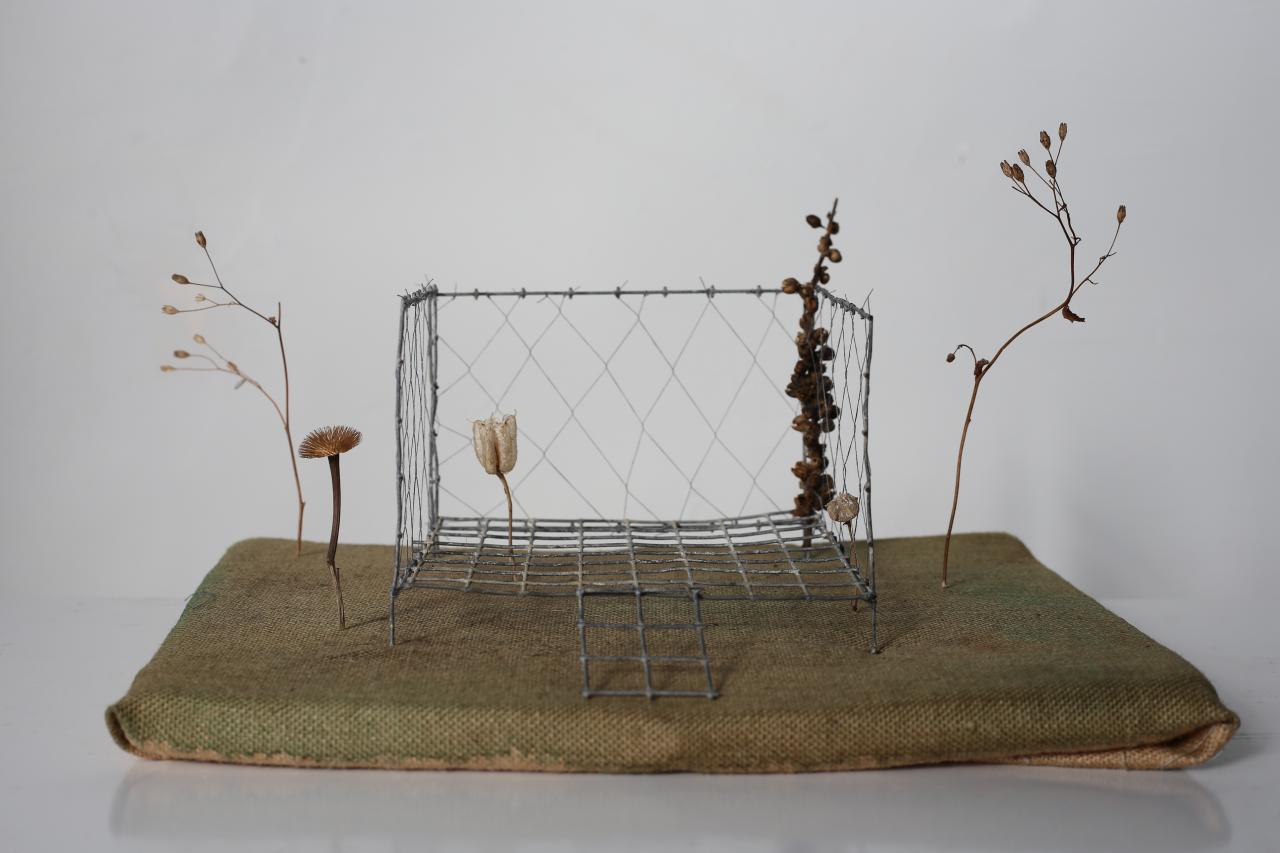
Reclaiming the enclosed garden as a site of resistance and imagination, PERK invites artistic interventions that reinterpret the hortus conclusus, creating new, polyphonic narratives. The first intervention—an enclosing metal structure by visual artist Margo Veeckman with support from architect Aurike Quintelier—will serve as both a setting and exhibition platform. Within its boundaries, the project sparks a dialogue between openness and seclusion, control and wildness, the human and the more-than-human.
Challenging the cultural divide between nature and culture, mind and body, and the feminine and the public sphere, PERK rethinks the garden as a living exhibition space. Rather than static relics, artworks will be invited to grow, evolve, decay, and return to the earth. Moving beyond the individualistic white-cube model, the garden fosters interactions between diverse contributors, creating a microcosm where cultural hierarchies are dismantled. By embracing the agency of more-than-human contributors, PERK envisions a more sustainable, symbiotic approach to art-making and exhibiting.
Located on the Ter Beken castle grounds on the outskirts of Ghent, the project will be embedded in a vibrant site managed by LUCA School of Arts, home to biological farmers, researchers, and a cherished local community. PERK welcomes nearby residents and city dwellers seeking refuge from urban enclosure, offering a space for alternative imagination and ecological engagement.
Key objectives for sustainability
The making of the structure will be done with respect towards and in symbioses with the close environment. The structure will be made of three fence-like-walls forming an open space. The covering of the ground will be part permeable metal structure, part concrete tiles. These tiles will be made out of recycled stones from the castle of Ter Beken that is currently under construction due to renovation works. Due to the renovation a lot of original material will have to be thrown out and can be recycled and repurposed as new building blocks for PERK.
Key objectives for aesthetics and quality
Histories and aesthetics of exclusion and binary thinking are imbedded in the architecture and landscaping of the site, which makes it an interesting spot to oppose and open up these boundaries. The hortus conclusus is also an exclusionary image that was developed to seclude women. Making the analogy of women with walled gardens says that both nature and women have to be tamed, controlled, kept under surveillance, because otherwise they will proliferate. PERK will start from the principles and aesthetics of the hortus conclusus but through artistic integration of rewilding and ecofeminist voices the archetype will be reclaimed as a space for new, polyphonic narratives.
Key objectives for inclusion
There will be a ramp incorporated in the design of the space for wheelchair users. The ramp will have a direct visual link to the tradition of the hortus conclusus, which was always portrayed with a closed fence in the middle. The ramp will replace the closed gate.
The site of Ter Beken is open for everyone and there is no access fee involved which makes it financially inclusive.
Mariakerke is the sub-municipality from Ghent with the least amount of young adults (age 20-29) living there. The project aims to work with a lot of young and mid-career artists that will result in an intergenerational exchange. With every new addition to the garden, the neighborhood will be invited for an introduction. The integration of this artistic platform will hopefully also attract more young people and artistic initiatives to the neighborhood.
The artists will also be invited based on their experience and/or engagement within intersectional ecofeminist praxis, working with ecological and nature-based materials. In the selection there will be a lot of attention going towards the inclusion of people from diverse backgrounds bringing different perspectives on art and the themes at hand.
How Citizens benefit
For the welding of the structure we will work together with volunteers living in the surrounding neighborhood, appealing to the knowledge that is present there.
Once the structure is placed there will be guided tours provided for people of the neighborhood and people coming from further. Those tours will be done by the initiator of the project in the beginning. Gradually we will work towards a network of neighbors who are enthusiastic about the project and who would like to give guided tours as well.
Neighbors will also be invited to take up the role of gardener. All that lives needs to be cared for, so we will need a group of people who would like to take care of the garden in one way or another. Eventually, if people get invested, there is room for co-curation. This co-curation does not have to be based on naming possible artists, but can depart from needs of the garden.
Physical or other transformations
Innovative character
The highly sensorial and immersive experience of the space is also an innovative aspect. Generally there is the tendency to present art in the most “neutral” way, eliminating the spatial context and depriving the visitor of an extra layer of embodied experience. In the setting of PERK there is not one subject, but many different actors/organisms contributing to a whole-body-experience.
The ephemeral approach of art is also very little explored in visual arts today. Even in art movements like Arte Povera there is a usage of natural materials but as soon as something becomes an ‘artobject’, the market value becomes more important and with the help of preservation the object stops living. In PERK, an artwork continues living when it is placed in the exhibition space.
Disciplines/knowledge reflected
In the future there will be, ofcourse, a lot more transdisciplinary exchange. Artists will bring their own expertise and set of skills. They will also bring questions and needs for specific knowledge for the translation of their artistic ideas into ecological elaborations. For each case, the right expert (by experience) will be consulted.
Methodology used
In terms of exhibition making the project draws inspiration from the principles of the Endless Exhibition (a curatorial-manifesto-as-artwork by Prem Krishnamurthy and implemented by Kunsthal Ghent as curatorial principle). Artists are invited to contribute with an intervention to the garden, accepting the artwork being a living (and dying) organism. Artworks will always be added in a duo.
Overarching, ‘rewilding’ is used as an artistic methodology. Thinkers like Jack Halberstam (Wild Things, 2020) consider rewilding a form of (queer) resistance to the orderly impulses of modernity. Rewilding can be a tool to regenerate our perspective and reconstruct more fluid and multiperspectival narratives.
How stakeholders are engaged
An architect working at LUCA, Aurike Quintelier, is supporting in the development and implementation of the structure. Together we will guide a class of 2nd bachelor students Visual Arts in the development of the repurposed tiles. Together with the students we will think about how natural elements have been incorporated in indoor spaces as ornamental patterns (as for instance in the Art Nouveau architecture style). Students will develop patterns based on the elements present on the site as a reference to this history.
Global challenges
Learning transferred to other parties
Museums often have parks or greenery around it, which could be interesting spots to duplicate the structure. PERK could also work well in a highly urban context as a public artwork/artspace.
Next steps
March-April: Finishing technical plans and preparing for the start of the construction. Applying for other grants and financial support for the programming of the artistic interventions. In the meantime I will be looking at an appropriate (inclusive) social media platform to communicate about PERK and its development. <br />
<br />
May-August: Building of the structure. In may the concrete tiles will be developed with students of LUCA. The rest of the period will be used for the placing of the screw pile foundations, the welding of the structure, and the weaving of the trellis (fence-walls). In the meantime, the first artists will be approached and invited to explore the site. There will be a first exchange of ideas and the planning of the first interventions. <br />
<br />
September-December: The space will be inaugurated on a small scale. Neighbors and LUCA staff and students will be invited to hear about future plans and to look at the first artistic intervention: the space. Meanwhile the production process of the first interventions will be executed and the space will be prepared for its official activation. There will be more effort to reach out to neighbors to start a network of caregivers.<br />
<br />
January: Hibernation<br />
<br />
February: first opening of the exhibition space with artistic interventions. This will be communicated and promoted on a broader level. In the meantime two new artists will be contacted to think about the following interventions. <br />