The Magličgrad Centre
Basic information
Project Title
Full project title
Category
Project Description
The aim of our project is to bring new ideas into a site of cultural significance, working with the community to create a more beautiful and enlivened place to live.
Current stage development
Geographical Scope
Project Region
Urban or rural issues
Physical or other transformations
EU Programme or fund
Description of the project
Summary
Until we began in 2021, the fortress, located across a small river, had no safe and consistent access. The absence of government initiative meant that the site was largely inaccessible.
We saw this as an opportunity to create something special on the site, as well as keeping the fortress in a good state and making it accessible to visitors. The Centre has now established a river ferry, enabling a safe and consistent connection. This intervention respects the site’s heritage as well as providing inclusive access.
The increase in tourism has benefitted local businesses. Not only have neighbouring restaurants and craft vendors benefitted from higher traffic, but also we also created a platform in our cafe for the sale of local, handmade products such as jam, pickles and honey. By supporting sustainable locally-produced goods, we are fostering a thriving rural economy where traditional, creative businesses can flourish.
In addition, we organise events for young people that stimulate cultural, social, and artistic engagement. We run art residences and festivals that bring together emerging local artists with international artists from scenes as far flung as London, New York and Melbourne. This provides the opportunity for interesting, innovative collaborations and growing networks.
Above all, we are committed to creating a vibrant rural lifestyle. By promoting sustainable design, creativity, and a deeper connection to both cultural heritage and the environment, the Magličgrad Centre embodies NEB values: beauty, sustainability and inclusivity for all.
Key objectives for sustainability
Firstly, we address the pressing issue of trash pollution through organising community clean-up initiatives with our volunteers the local community. The group sessions not only remove the rubbish, but reveal the stunning natural beauty of the Balkan landscape. An unprecedented number of people come and volunteer on these initiates, and they have reported that it creates a sense of well-being both to be able to enjoy the landscape, and know that they have done something to greatly improve their local area.
Secondly, the Magličgrad Centre is located within a national park, meaning that building new, permanent structures is not an option. In the Bauhaus spirit of innovative and adaptable design, we have repurposed the existing farmhouses and barn (six small buildings in total). By using sustainable materials, such as locally-sourced sheep wool for insulating the barn, we minimise environmental impact and preserve long-lasting traditional building techniques. Looking ahead, we plan to work with architects to design sustainable, mobile structures, embodying modernist design. These would balance the traditional buildings, in line with our aesthetic of weaving past traditions with future possibilities.
Lastly, our garden is central to our ethos of connection to the land and sustainable practice. We grow many of our vegetables, and also forage for wild herbs, which are in abundance around the site. We also purchase from neighbouring homesteads and regional supplies, which fosters connections and promotes a sustainable local economy.
Key objectives for aesthetics and quality
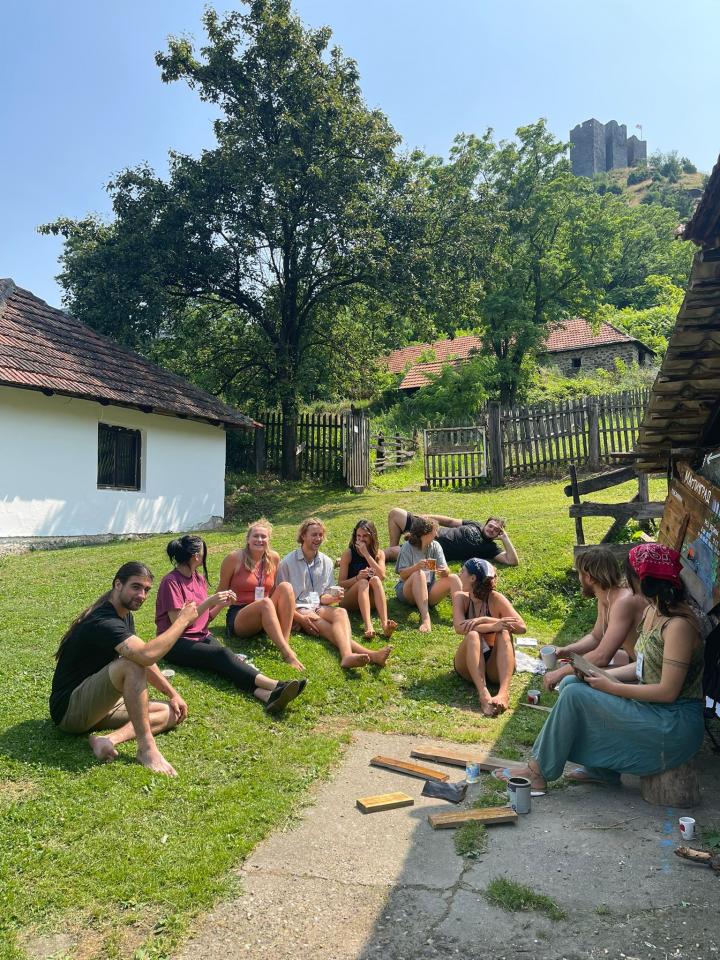
For tourists, this looks like having the educational experience that they would expect from a historical excursion, with a bonus of new ideas and innovation. Guests are greeted with expert local guidance, offering a deep understanding of the fortress’s history and its surroundings. After their visit to the fortress, they have the option of visiting the cafe and chatting with the international volunteers. The cafe facilitates relaxed connection between people, and draws on the Bauhaus principle of communal engagement in everyday life.
Further, our guest houses embody our aesthetic vision by combining traditional craftsmanship and convenient modern design. The walls are built from clay, a natural insulator, and the interior is adorned with kilims (patterned textiles), and sheep wool. The beds are handcrafted from driftwood, with charging stations integrated into the design for convenience. The guesthouses blend tradition, sustainable materials and functionality to create a space with interest and comfort.
Finally, in the latest iteration of our art residency series, we delved deeper into the aesthetics of Maglič. Participants were invited to think about Maglič in relation to the word ‘layers’, paying homage to Picasso’s quote “under each city is another city”. Over centuries, the site has been shaped by many different groups: Serb defenders, Turkish defenders, market traders, German military, and local farmers, railroad workers. They have all left traces and help to define it as the intersection of cultures, both travellers and locals, that it is today. The fruits of the art residency, a rich collection of paintings, sculptures and performance art are now on display in the cafe, showing how art can enrich a social space.
Key objectives for inclusion
Given that the fortress is located atop a large hill, we have made provision to ensure that access remains as inclusive as possible. Along the ascent, we have renovated existing resting places and added new ones to provide opportunities to rest for visitors with varying physical capabilities. Additionally, our cafe serves as a welcoming space to rest and a gathering point for visitors to relax and engage with the natural environment and each other.
As well as inclusivity and affordability, we aim to foster a sustainable local economy by sourcing food from nearby homesteads, showcasing local crafts, and providing platforms for local artisans. This economic model supports small businesses, reduces environmental impact, and keeps money within the community.
How Citizens benefit
Further, the Centre provides an alternative space to gather and unwind, away from the city. Our guests, especially those with families, enjoy being outdoors together, interacting with our animals and engaging with nature. The Centre is a source of well-being for many people who wish to take a break from city life.
As well as catering to families, the Centre provides an outlet for young people to express themselves. When they come to our festivals, they dance and meet one another. The space fosters freedom and togetherness, which can be very beautiful. The presence of international volunteers offers an opportunity to meet young people from other cultures in a relaxed, joyful environment.
We have welcomed local school excursions to visit the fortress and learn about their history, making the fortress an accessible educational space. We provided an educational tour, lunch, and relaxed time with the animals. Visiting this part of their history embeds a sense of pride and curiosity in young people. Without the river ferry, it would have been impossible for school groups to visit the fortress that is a stone’s throw from their city.
The project has attracted more people for more reasons that we could have expected. For example, Rotary Club members posed an initiative to plant lilac flowers around the fortress in order to reproduce the ‘Valley of the Lilacs’. This is a historical tradition, where lilacs were originally planted to there to make a French princess feel at home. Our team helped transport and plant the lilacs, and cared for them once they had been planted. The Centre can provide the logistics and energy for diverse community initiatives.
Physical or other transformations
Innovative character
Further, the aim of the project is not solely economic, but rather to give the site and surrounding area a new lease of life - to benefit the community and environment in a meaningful way. Economic stability is a natural consequence to creating a place where people want to spend their time and energy. We listen to what local people want in their area and adjust in line with our own ethos. For example, we offer historical tours, festivals and workshops to accommodate a wide range of people and to promote interest in culture and the environment. In essence, we rely on those around us and work together to create a more prosperous place in which people can reconnect with nature and encounter new ideas.
Also unlike mainstream projects, a significant portion of the work at the Magličgrad Centre is carried out by international volunteers. Through Worldpackers, we offer the opportunity for volunteers to contribute their time, energy and skills in exchange for accommodation and food. This creates a dynamic environment in which new friendships, skills and perspectives can refresh and enrich the project. To date, we have hosted upwards of two hundred volunteers. This steers away from the stagnancy that can encumber mainstream employment, and embodies the Bauhaus principle of collaborative creation, where diverse individuals come together to shape a shared vision.
Disciplines/knowledge reflected
Further, we have a trained archeologist on site who can identify sites of historical significance, who works with construction managers and designers to integrate new developments without disturbing the fortress’s cultural heritage.
Designers find inspiration from international projects and social spaces where they have been involved. These include volunteer centres in Columbia, grassroots community cafes in London, and sustainable music residencies in Norway. We replicate ideas that function well, and work with construction managers to bring the design to life.
We welcome many volunteers who are talented in creative arts such as painting. We give them the opportunity to express themselves through functional elements such as signs and festival decor. Recently, Russian and American volunteers got together to create a beautiful wood etching of the site that is used to direct tourists.
Finally, we facilitate a skills exchange between our professional chef and our volunteers. For everyday team meals, the chef offers a wealth of practical and technical skills, while volunteers share their local cuisine and home-cooking skills.
Methodology used
Collaboration is at the core of our creative processes. We hold weekly meetings with the core team to engage in discussion and debates, listening to what people with the knowledge and experience have to contribute. We cultivate a culture of trust and do not shy away from disagreements, knowing that this can create the necessary energy for solutions to naturally emerge. We are aware that we cannot do anything alone, and step up to help each other out, fostering meaningful friendships. For instance, everybody will help in transporting materials needed for construction, even if they are not participating in that particular project. This means that responsibility is shared and the team feels supported.
Further, our approach is inherently grassroots. As we had minimal early investment, we began by applying our knowledge in small ways, and building experience step by step. For example, our first festival was a small affair with minimal infrastructure, hosting one hundred and fifty guests. Our latest festival was equipped with two stages, two large commercial bars, three food stands, two workshops and hosted nine hundred people. We mirror the Bauhaus belief that design and innovation grow from experimentation and iterative processes, gradually evolving into something more impactful over time.
Lastly, as in many places, Serbia’s political challenges present both obstacles and opportunities (such as the possibility of a grassroots cultural heritage site). We put our heads together to make the best of our resources and potential. The world is changes quickly, and being adaptable is key to making our project sustainable and meeting challenges of the future.
How stakeholders are engaged
Other relevant stakeholders include the Touristic agency and local council, who we liaise and advertise with, and who regularly inspect the site to ensure everything is in line with regulations.
Global challenges
The Magličgrad Centre also addresses the growing global issue of polarisation. The site has a unique position that allows a relaxed mix of many different people. The site attracts a wide variety of people. It acts as a microcosm, where people who may not interact with each other in daily life can meet and share ideas. Volunteers and long-term visitors frequently comment on how their perspectives have expanded by being part of a community that actively encourages conversation and collaboration across cultural and ideological boundaries. Further, Serbia exists at the crossroads of East and West, and is uniquely positioned to bridge divides in society, leading to greater understanding and social harmony.
Lastly, a central pillar of our work is reconnecting with the natural world, something we have become distanced from in busy, metropolitan modern life. At the Centre, we have a variety of animals, as well as a rich ecosystem of natural wildlife. Visitors, especially younger ones, relish the rare opportunity to interact with the animals. Further, living alongside animals provides a relief from the anthropocentric principles that can damage the environment. The wildlife also provide therapeutic benefits by regulating the nervous system and improving mental health. They are invited to bath in the waterfall, where the rich mineral content is said to have healing properties.
Learning transferred to other parties
Firstly, a key aspect that can be replicated is our focus on community-driven economic development. By providing a platform for local artisans to sell handcrafted goods such as textiles and food products, we support local businesses and stimulate local economies. This model can be applied to other rural areas, creating sustainable marketplaces that benefit local communities.
Further, our cultural events demonstrate how life can be brought into rural areas. Our camping festivals, which foster social connection and appreciation of nature can be replicated in other rural areas. Our artists residencies show how dialogue can be sparked by art, and can be replicated to grow professional networks and spread ideas.
Finally, our commitment to sustainable tourism offers a roadmap for meeting the needs of the local community as well as visitors. The environmentally conscious model promotes economic development without compromising the natural environment.
Next steps
Kitchen: <br />
This year, we plan to build a brand new kitchen, serving primarily as a Napoli pizzeria. We will renovate the existing farm buildings that join onto the cafe to create a fully functional adjoining kitchen. The main components will be a wood-fired pizza oven, and space to prepare more traditional meals to cater for touristic excursions. <br />
Garden:<br />
We will create a new, larger garden that is closer to the living spaces. This will make it more accessible and allow it to meet our growing needs. It will produce the majority of fruit, vegetables and herbs that we use onsite, as well as serving as a model of sustainable, community-driven agriculture. <br />
Art Residency:<br />
At the end of August, we will host another iteration in our series of art residencies. The word that they will focus on this time will be ‘passage’, drawing attention the history of travellers, the word ‘passage’ in relation to time, and the many small paths that link the entire site together and make it up as a whole. <br />
Culture: <br />
We will continue to grow our culture programme by organising a new series of talks, workshops and events such as our annual first of May festival, regular DJ events, and a summer film festival.<br />
Infrastructure:<br />
We will improve general infrastructure by (1) building two new toilets for tourists for more convenient access, (2) further developing the cafe for more efficient service and comfortable seating areas, (3) making improvements to the tourist path and adding resting places so that it is more accessible to all. <br />
Sustainable Guest Houses:<br />
Looking further ahead, we plan to work with architects to create sustainable, mobile structures that we will have around the site. This will give architects a chance to play with cutting-edge ideas in sustainable design, and further our commitment to environmental consciousness and future thinking.