Life4PLANota
Basic information
Project Title
Full project title
Category
Project Description
Current stage development
Geographical Scope
Project Region
villages: Ponikve, Pečine, Prapetno Brdo and Šentviška Gorda, Slovenia
Urban or rural issues
Physical or other transformations
EU Programme or fund
Description of the project
Summary
Key objectives for sustainability
- sustainable use of natural resources,
- preservation of the natural environment,
- diversification of the economy and sustainable technologies.
The plan focuses on sustainable tourism because it is one of the few industries that can increase material and non-material well-being of local inhabitants while preserving the natural environment, encouraging efficient and effective use of environmental resources that ensures a resilient economy that is able to respond to disturbances without major and long-lasting negative consequences.
There are many different areas and places which, if included in the tourism offer, would increase tourist arrivals, provide additional accommodation, and strengthen the catering offer: archaeological sites, profane and sacred buildings as well as 28 natural attractions on the Šentviška Plateau, 22 of which are caves.
Key objectives for aesthetics and quality
- improvement of the standard of living;
- vital countryside.
As part of the research work, two questionnaires were prepared and distributed among the local people as well as those who visited the area in the past. The first questionnaire was prepared in Slovenian and English, as it was aimed at local and foreign tourists visiting the Šentviška Plateau. A second questionnaire was prepared for locals.
Results of the first survey reveal the following:
- Visitors have little choice when it comes to accommodation,
- There is a strong interest in visiting natural attractions;
- The majority of respondents visited neighbouring places during their stay,
- A large proportion arrives by car.
- 4/5 of respondents are satisfied with the range of recreational activities.
Results of the second survey reveal:
- ¾ of locals are in favour of tourism development,
- locals are aware that inadequate tourism planning could have negative impacts on the natural environment;
- people are aware that without basic tourism infrastructure, the development of a tourist destination will not be possible
Key objectives for inclusion
- accessible and infrastructurally equipped countryside,
- high quality, attractive, competitive, and varied tourist offer.
The previously mentioned tourist attractions are rarely visited as the current tourism infrastructure does not support tourism development: there are no catering services, shops with basic living conditions, access to health care, or public transport – everything a tourist needs for a comfortable and pleasant stay. These Inadequate conditions have had a significant impact on the number of tourists who choose to visit these places as well as the local people.
This could be reversed if the plan was implemented, as it would create jobs, strengthen the local economy, contribute to local infrastructure development, and help conserve the natural and cultural assets as well as preserve local traditions while reducing poverty, inequality ,and emigration.
How Citizens benefit
Results of the first survey reveal the following:
- Visitors have little choice when it comes to accommodation,
- There is a strong interest in visiting natural attractions;
- The majority of respondents visited neighbouring places during their stay,
- A large proportion arrives by car.
- 4/5 of respondents are satisfied with the range of recreational activities.
Results of the second survey reveal:
- ¾ of locals are in favour of tourism development,
- locals are aware that inadequate tourism planning could have negative impacts on the natural environment;
- people are aware that without basic tourism infrastructure, the development of a tourist destination will not be possible
Physical or other transformations
Innovative character
- respect the specificities of the area and adapt the development of tourism in accordance with them;
- renew and supplement the tourist and recreational offer and infrastructure in accordance with the
expected volume of tourist visits;
- develop untapped potential in the field of tourism;
- develop an integrated tourist offer;
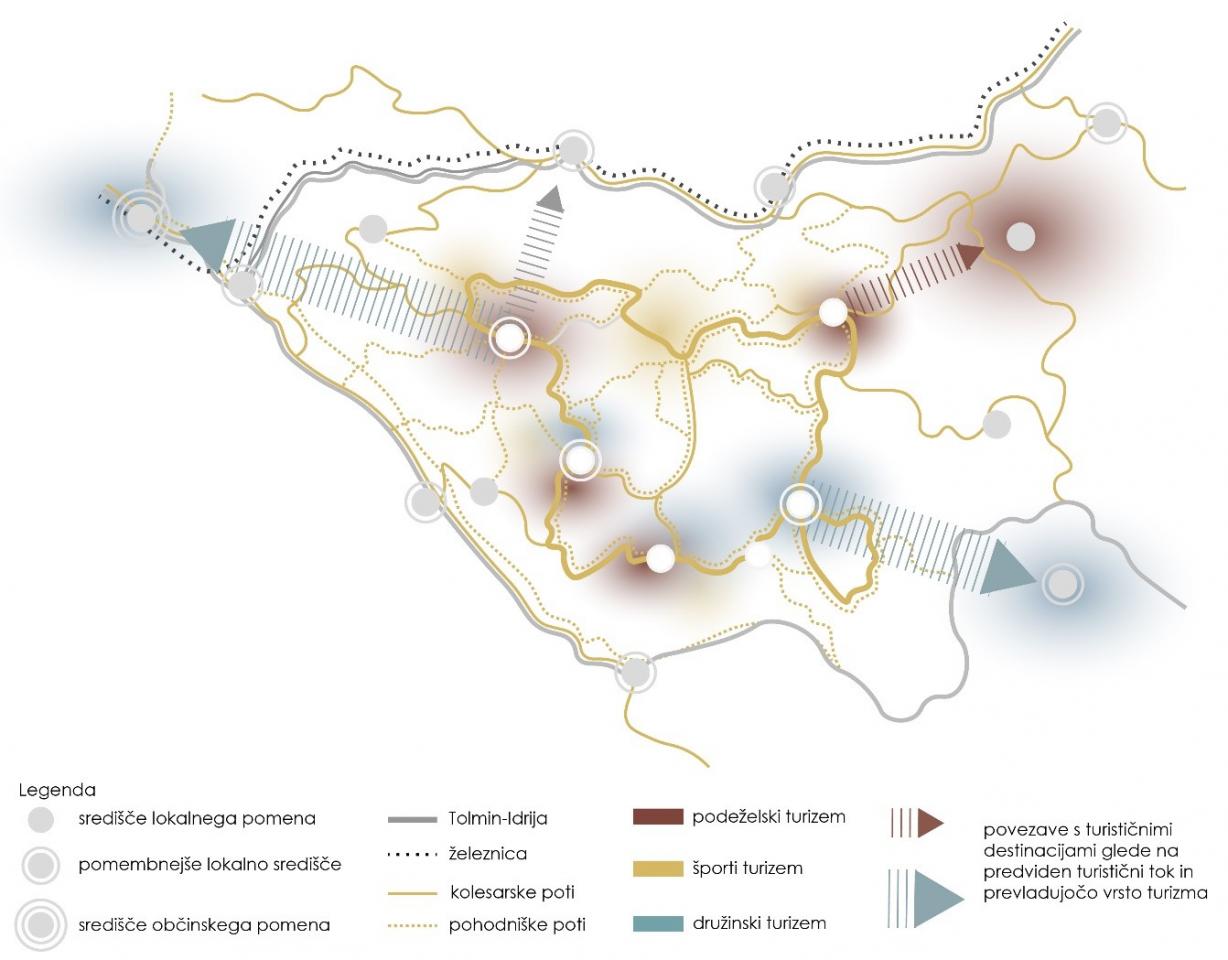
- develop rural, sports and family tourism;
- establish links with neighboring tourist destinations;
- draw up a financial plan and a plan for the promotion and marketing of the tourist destination.
The existing tourist facilities shall therefore be preserved, renovated where necessary, and landscaped to ensure safe access or use. To avoid excessive damage to the natural environment, it is necessary to ensure that tourist arrivals are spread evenly throughout the area, and therefore new facilities shall not be concentrated, but rather a network of point arrangements shall be established. The principles of nature conservation, biodiversity conservation and cultural heritage conservation, as well as the expected number of visitors, shall be taken into account in the planning of new facilities and the location of activities. In areas that are vulnerable, only facilities or activities such as sightseeing, nature exploration, animal watching or visiting cultural heritage sites, shall be developed. Existing and new rural, sport and family tourism activities shall be linked thematically and tourism products shall be developed. A package for tourists who want to experience an authentic rural way of life (Culinary Route), a package for sports and nature lovers (Scenic Route and Geological Route), and a package for cultural explorers (Archaeological Route) are being developed.
Disciplines/knowledge reflected
- the humanities (adds value in the field of: well-being),
- social sciences (communication),
- natural sciences (natural processes),
- engineering (infrastructure).
In the proposal of the plan, all disciplines that are key to spatial planning were equally considered: urban planning, geography, economics, law, sociology, landscape planning with environmental protection.
How different disciplines would interact will remain a mystery until a plan for realization is needed.
Methodology used
- global and local trends and social,
- economic and environmental factors
- the inventory of existing tourism and recreational infrastructure,
- findings obtained during spatial analyses,
- SWOT analysis results,
- findings obtained through questionnaires conducted among tourists and locals,
- as well as informal conversations with locals, presidents and members of local communities and other associations.
All of this is gathered in the vision for the development of tourism and recreation on the Šentviška Planota was established, by which development goals were subsequently formed. The goals outline programs and measures that, when implemented, will ensure the sustainable development of the Planota. In more detail, the proposal highlights those programs and measures that promote the sustainable development of tourism and recreation.
How stakeholders are engaged
- global and local trends and social,
- economic and environmental factors
- the inventory of existing tourism and recreational infrastructure,
- findings obtained during spatial analyses,
- SWOT analysis results,
- findings obtained through questionnaires conducted among tourists and locals,
- as well as informal conversations with locals, presidents, and members of local communities and other associations.
Global challenges
- Goal 6: Clean water and sanitation,
- Goal 12: Responsible consumption and production,
- Goal 13: Climate action,
- Goal 15: Living off the land,
- Goal 7: Affordable and clean energy.
- Goal 8: Decent work and economic growth, and
- Goal 11: Sustainable cities and communities.
Learning transferred to other parties
- vision, strategy, goals
- interdisciplinary teams
Next steps
The proposal represents the answer to lack of strategic documents and professional bases that would specifically regulate the field of spatial development on the Šentviška plateau. <br />
The content of the can represents a rough basis for further development activities in the field of tourism, as it contains framework guidelines for creating tourist offers and guidelines for spatial placement of recreation and states possible measures to realize the proposed vision tourist destinations Šentviška plateau. It is primarily intended for spatial planners and local communities, but would also inform future visitors, tourists and direct potential investors. The proposal offers:<br />
- decision-makers responsible for spatial development in the municipality of Tolmin a basis for long-term direction of the spatial development of tourism and recreation Šentviški plateau<br />
- the local communities a set of proposals for expanding the tourist area offers and recreational activities<br />
- visitors and potential investors a source of information about the tourist offer and recreational content on the Šentviška plateau, its history as well as physical-geographical and socio-demographic characteristics.<br />