INCLUDO SPORTIQUE
Basic information
Project Title
Category
Project Description
Current stage development
Geographical Scope
Project Region
Urban or rural issues
Physical or other transformations
EU Programme or fund
Description of the project
Summary
It's a fun, educational tool to help teachers run inclusive sports activities.
The games can be used with basketball, football and handball, and the aim is to break down performance barriers, build cohesion and encourage children to play team sports, whatever their level, gender or disability.
With its many game variations, this kit adapts to the dynamics of the group, its level and its age. It puts performance back into perspective so that it can be collective and benevolent, which doesn't prevent people from pushing themselves physically.
The addition of this playful, supportive dimension develops psychosocial skills (empathy, tolerance, etc.) and other abilities (memory, spatial awareness, balance) so that everyone can flourish in sport on an equal footing.
This kit is based on four principles:
Forming teams without a hierarchy: changing teams in the middle of the game, playing with three teams, without knowing who your team-mates are.
Put everyone on the same level: a game of balance that requires you to slow down.
Create more solidarity: field and movement rules
Giving everyone a place: a role-playing game with individual actions.
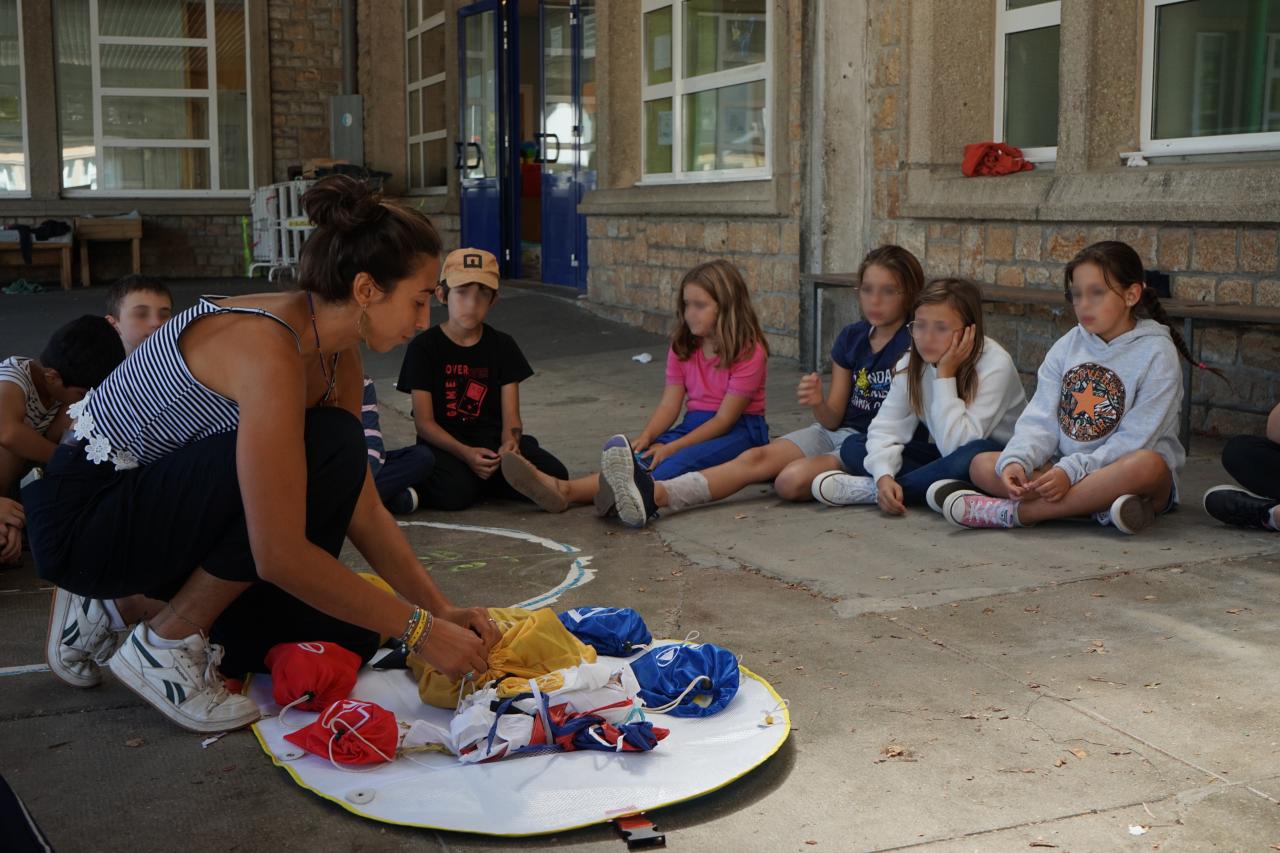
Many workshops took place with people of all ages and backgrounds: art school students, a class of 6e and a Maison de Quartier (10 to 19 year olds). For my part, I was the designer, facilitator and player in the project, which enabled me to assimilate the different mechanisms of each proposal and to test them in situ.
Key objectives for sustainability
The sustainability of this project is also reflected in its production, which is carried out on a local scale by ESATs. A quotation is currently being drawn up with the Papillon Blanc ESAT in Wattrelo in northern France.
It advocates social and sporting sustainability, a way of living together where everyone feels valued and legitimately involved in sport, regardless of their skills, gender, morphology, age or disability. INCLUDO SPORTIQUE goes beyond valuing individuals through sport by developing psychosocial skills that have a positive impact on individuals in their daily lives and social interactions, with the aim of building a more ethical and inclusive society.
Key objectives for aesthetics and quality
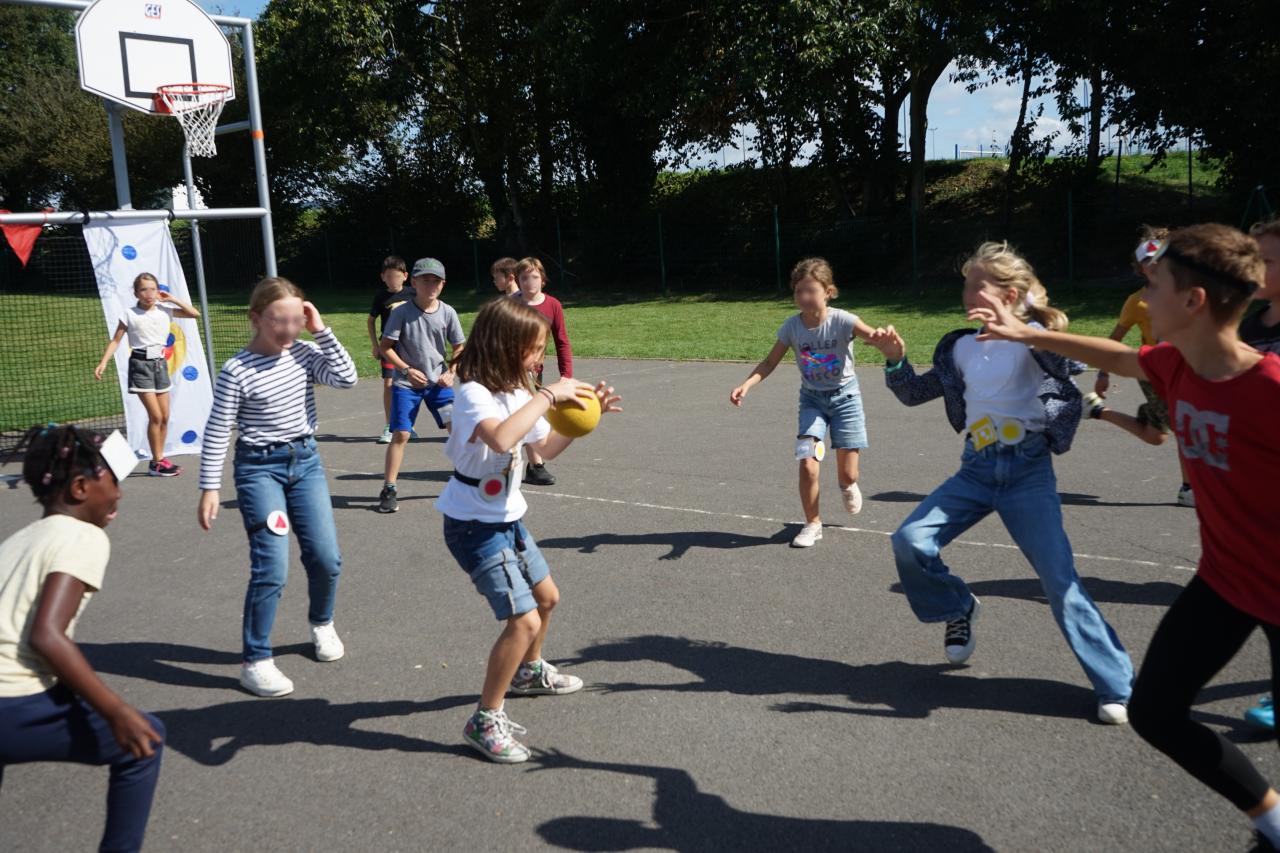
The devices have a sensory aspect with the textile, shapes and colours, they can be scratched, the tabs on which the devices are scratched to hang them are elastic to adapt to all morphologies, they can be put on the head, stomach, arm or leg and even on wheelchairs for people with disabilities.
The container for the devices is a bag that can be opened with the various Velcro pockets for easy transport and match launch.
INCLUDO SPORTIQUE is part of the transition towards a fairer, more caring society by creating inclusiveness in sport and solidarity between participants. It fights against gender stereotypes by legitimising every individual, whatever their socio-cultural background and physical abilities, including people with disabilities. The game-based interaction systems proposed in the kit share new ways of interacting and creating links, helping to break down the isolation of isolated young people by fostering self-confidence and trust in others to create a new way of living together. It also gives everyone a taste for effort and team spirit. By being at ease in sport, young people become aware of their bodies as they move through space, developing a sense of belonging to a group, respecting others in the game and in everyday life.
Key objectives for inclusion
This project enables all types of public to play team sports and to adapt to them in terms of age, morphology, disability, gender and dynamics. Whether in the principle of the game or the rules can be combined to make the game more complex and activate different psychosocial skills and abilities.
This kit was created as a co-creation process during workshops with different audiences. This enabled them to be tested and adjusted to suit the game, both in terms of rules and form. After that, I ran a number of workshops with different audiences, including primary school children, teenagers, students, adults, elderly people in care homes and people with disabilities.
It democratises team sports and makes them accessible so that everyone can benefit from their positive impact, whether on an individual or collective scale, by putting everyone on an equal footing without positive discrimination, for all types of audience, whatever their level, gender, disability or socio-cultural background.This learning through play and sport helps to build self-confidence and confidence in others by developing psychosocial skills that will serve them throughout their lives.
How Citizens benefit
This approach to social design, which involves working with and for the public, and pedagogy is an integral part of my creative process. Teaching through play is a way of stimulating and integrating different skills while having fun. It reshuffles the deck with regard to gender norms by developing the psychosocial skills needed to interact with and take account of others in an inclusive way. These two approaches are reflected in my L'INCLUDO SPORTIQUE project. Through my work, I sought to combine the skills of teachers and activity leaders to become fully aware of their pedagogical and sporting challenges and needs in relation to their audience.
The core of the project was to promote girls and anyone who did not fit in with the hegemonic masculinity of sport, without any positive discrimination. To do this, I came up with a fun, educational tool to help teachers run inclusive sports activities.
This cross-fertilisation of skills took place on sports pitches through sports workshops where I tested inclusive games in team sports with different age groups, dynamics and motor skills. Feedback from the teaching staff and the players enabled me to refine the systems and propose new ones, until I came up with a functional project that fitted in perfectly with the way the game was played and how the systems were used by the players.
I continue to run workshops with L'INCLUDO SPORTIQUE, notably in EPAD, in companies and in nursery schools, giving people with motor and mental disabilities, schoolchildren, students and adults the opportunity to play.
Physical or other transformations
Innovative character
It's a fun way to support teachers and give them the keys to dealing with unequal, stereotyped, individualistic, discriminatory and hierarchical group dynamics.
The innovative aspect of this project lies in its creation process, which is the fruit of co-creation and the cross-fertilisation of skills and know-how. At the same time, it develops a collective and individual approach to thinking about and experiencing team sports differently.
Disciplines/knowledge reflected
The social design methodology permeated the whole project, from the way it was set up, to the involvement of the participants, the creation of workshops, joint reflection and collective sports practice.
The involvement of education and sports professionals meant that skills could be pooled to produce a kit suitable for sports teachers.
Just as the use of the kit on the pitch by male and female players meant that the equipment could be adapted to suit all body types, ages and dynamics.
Education and fun were my watchwords when approaching this subject in terms of both theory and practice. This is the very essence of the L'INCLUDO SPORTIQUE playing experience.
Methodology used
Social design, which involves building a project with and for the public by including them in the thinking process and putting it into practice through workshops. It allows the different skills and know-how to be shared in order to open up the field of possibilities and create a joint project. This co-creation enables us to propose coherent systems that correspond to the reality of use.
That of education, which uses games to stimulate and integrate different skills while having fun.
This project required me to take a multi-disciplinary approach in terms of skills to adapt to the audience and bring the project to a successful conclusion in terms of both its ideation and design. This involved leadership, coordination, analysis and adaptability.
How stakeholders are engaged
This collective involvement has resulted in a rich range of game suggestions, highlighting the different abilities and skills involved in team sports.
The collection of materials made it possible to create partnerships with local players to recycle materials and use their technical expertise in the design of the kit.
Global challenges
Learning transferred to other parties
Next steps
It is planned to develop a digital version of the kit with videos and tutorials. This is a transmission challenge that would allow the kit to be shared more widely, making it easier for educational and sports staff to adopt it.<br />
<br />
An enhancement of the role-playing game is being considered to develop more characters and actions within a match.<br />
<br />
Initially, to launch this project and make it exist in schools, the production of about twenty kits will be started. I am currently in contact with the ESAT Papillons Blancs of Wattrelos in the north of France to explore how development can be integrated into their structure. This first distribution of kits in schools will help raise awareness and generate demand for further production.<br />
<br />
An industrial production is not planned in order to maintain an ethical approach. However, various alternatives can be explored to share this project more broadly: a downloadable version of the kit, developing a rental system for physical kits, and intervening with the kit for a targeted audience.