Humanizing and renaturalizing cities
Basic information
Project Title
Full project title
Category
Project Description
This approach can also be applied to various contexts, as the need for local spaces that foster community and nature is essential in any urban setting.
Current stage development
Geographical Scope
Project Region
Urban or rural issues
Physical or other transformations
EU Programme or fund
Description of the project
Summary
The transformation particularly benefits marginalized demographic groups in the city, such as children and the elderly, who need accessible, nearby spaces for the proper development of their lives. By humanizing and renaturalizing the patios, the project creates environments that encourage local interaction, intergenerational engagement, and a stronger sense of community, while also reintroducing nature into the urban environment. This boosts biodiversity, improves climate comfort, and enhances the city’s resilience to climate change.
By identifying block patios as opportunity spaces, the project provides a scalable model for revitalizing other underused spaces in various contexts, wherever urban morphology allows. The outcomes include increased greenery and biodiversity, stronger social cohesion, improved climate resilience, and a model for sustainable urban regeneration. Ultimately, the project envisions a more sustainable, livable, and socially connected city by revitalizing these neglected spaces and restoring their essential role in urban life.
Key objectives for sustainability
Beyond the climatic benefits, reconnecting residents with nature has significant psychological impacts. Green spaces create environments of calm, offering an escape from noise, traffic, and danger. Observing local flora and fauna fosters empathy toward nature, encouraging a deeper awareness of how daily actions impact the environment.
On a larger scale, if this transformation is implemented in a significant number of patios across the Ensanche district, it could lead to a 47% increase in the total green space in the district. This would enormously reduce the urban heat island effect, improve air quality, and enhance water management, benefiting both the environment and residents. The transformation would also increase biodiversity, contributing to a more sustainable and resilient urban ecosystem.
This project sets an exemplary model for sustainable urban regeneration by revitalizing neglected urban spaces. It demonstrates how local interventions can improve the quality of life for residents, foster social cohesion, and create a more environmentally resilient city, offering a replicable approach to other urban areas facing similar challenges.
Key objectives for aesthetics and quality
The existence of these spaces would also contribute to revitalizing the neighborhood. Activities that have never been possible due to a lack of proper spaces and conditions will begin to take place, fostering greater movement within communities. Residents will be motivated by the presence of the space and the possibility of engaging in various activities, while the spaces themselves will benefit from the initiation of these processes, which will in turn bring about new forms of social activation and environmental improvement.
These activities could be linked to the care and enhancement of the space. A space that is not used tends to deteriorate over time, but by activating and maintaining it, the conditions required to ensure it remains a functional and improved gathering space will be guaranteed.
Key objectives for inclusion
The project promotes communal forms of management and organization of the space, ensuring inclusive governance. It is a participatory project that actively involves residents in the decision-making process. Furthermore, the space has the potential to evolve over time through community management, allowing for ongoing adaptability to meet the needs of its users.
This approach exemplifies how urban spaces can be designed with inclusivity at their core, creating spaces that not only serve the immediate needs of diverse populations but also empower the community to play an active role in the management and transformation of their environment.
How Citizens benefit
In addition to the interventions within the courtyards themselves, the proposal includes joint actions on the surrounding buildings. This would involve modifications and improvements, such as adding balconies to the façades, to strengthen the connection between interior and exterior spaces. As a result, the interior spaces would benefit from improvements like better climate control due to vegetation, as well as a closer connection to the activities happening outside, fostering a sense of community. Similarly, the courtyards themselves would benefit from increased interaction with neighboring buildings, making them safer, more monitored spaces naturally overseen by the community.
This dialogue and connection between the people in the buildings and the courtyards evoke communal relationships typical of rural areas or past times, encouraging a sense of shared living and belonging.
Physical or other transformations
Innovative character
Yet, it requires imagination and a long-term vision to recognize the potential of these spaces as local spaces where nature and community can coexist harmoniously. The idea behind this project is not only to reimagine these forgotten areas, but also to conduct an in-depth analysis to assess the feasibility and quantify the vast benefits of such a proposal.
What makes this project innovative is its ability to reframe the role of these neglected courtyards in the urban landscape. Unlike traditional urbanization efforts that prioritize economic growth and short-term profitability, this approach advocates for a sustainable, long-term solution that focuses on environmental regeneration and community well-being. It emphasizes the integration of nature into the urban environment while fostering a strong sense of local community.
This project calls for interdisciplinary collaboration between urban planners, architects, ecologists, and local stakeholders, generating creative solutions that balance urban growth with the preservation and revitalization of public spaces. In contrast to mainstream urban interventions, which often overlook the value of communal spaces, this initiative seeks to bring about a transformation that benefits both the environment and society in a meaningful and sustainable way.
Disciplines/knowledge reflected
The goal is to act sustainably within the urban environment in a way that impacts not only specific sites but also the local, metropolitan, and even global level. Each project involves architectural design changes to both the courtyards and the surrounding buildings, aiming for improvements and enhanced interaction between these two spaces.
For the project to function as a system that can be applied in various contexts, an urban study is essential. This study analyzes and identifies all potential areas for intervention to ensure the maximum impact and benefit for the surrounding environment and the city. Furthermore, both the overall conception of the project and the design of specific components require knowledge of the natural environment. This includes understanding how to adapt spaces to the laws of the land and nature, how to integrate biodiversity, and how to increase resilience to climate change for the benefit of cities and their inhabitants.
Since the intervention is aimed at improving people's lives, it is essential to analyze, study, share, and debate ideas with social experts, as well as engage with the local community. This ensures the best development of key concepts and the design of interventions.
Methodology used
Analysis of inner block patios in Madrid:
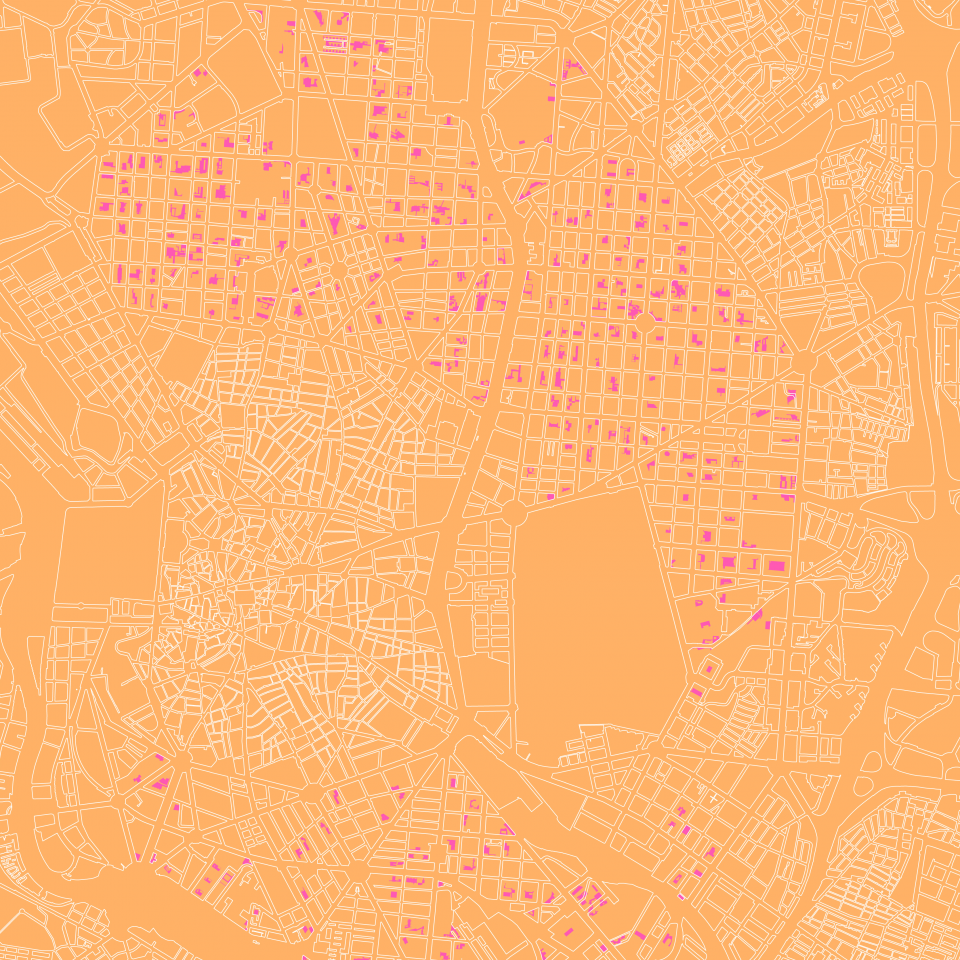
All inner block courtyards in Madrid have been mapped and analyzed. Based on their dimensions and density, a series of areas of interest for the project have been identified. The Ensanche district, with its abundant and favorable courtyards, was selected as the main study area.
Viability parameters:
A set of parameters was applied to the courtyards to assess the feasibility of the project. These parameters include:
Minimum dimension
Solar exposure
Type of ownership
Existing buildings in the courtyard
Relationship between courtyard and interior spaces
Access from the public street
Relationship between courtyard and street
These parameters help evaluate the suitability of each courtyard for intervention.
Case studies:
Three case studies in the Ensanche district were selected for more detailed analysis and to exemplify the project. The proposed transformations follow principles of renaturalization and humanization, contributing to global objectives such as climate change, sustainability, health, social inclusion, and innovation.
Guideline for potential actions:
A set of guidelines has been created to provide general solutions for the transformation of inner block courtyards. These include strategies for integrating vegetation, water management systems, and improving accessibility and social interaction.
The result is a catalog of intervention guidelines, enabling the expansion of the project to other courtyards across the city. The strategy is designed to be adaptable to other neighborhoods and cities.
How stakeholders are engaged
I have also consulted with institutions such as the City of Madrid's local government to gather more information about the feasibility of the project, as well as the current urban situation and management of inner block courtyards.
In summary, this work has been carried out by me with external assistance. However, for future phases of implementation, collaboration with the City of Madrid and local community organizations will be essential. Through initiatives like the New European Bauhaus, I hope to raise awareness and pave the way for making this project a reality.
Global challenges
Transforming underused patios into green spaces enhances Madrid’s resilience to climate change, mitigates the urban heat island effect, and improves groundwater recharge. The project promotes walkable neighborhoods, passive climate strategies, and reduces carbon emissions. Solar power and water recycling systems support sustainability, while native plants and wildlife refuges restore biodiversity.
Health and well-being
Green spaces reduce pollution, noise, and urban stress, enhancing both physical and mental health. These patios provide safe, sheltered environments away from traffic, naturally monitored by residents, fostering a sense of security. They offer spaces for physical activity, exercise areas, and sports facilities, encouraging an active and healthy lifestyle.
Social inclusion and equity
The project ensures local access to green spaces, of especial importance for children and the elderly, fostering social interaction and community engagement. Promoting diversity and intergenerational exchange, patios become shared spaces where people from different backgrounds connect, strengthening social ties.
Cultural identity and aesthetic quality
Patios, a key element of Madrid’s architecture, have historically fostered community life. Restoring them preserves their historical significance while reinventing them as vibrant spaces for artistic expression, cultural events, and social interaction, enriching the city’s communal identity.
Resource efficiency and circular economy
Urban mining and repurposing materials minimize waste and promote sustainable construction. The patios are designed for long-term adaptability, reducing environmental impact while ensuring lasting, functional spaces.
Digital and technological innovation
Smart technologies optimize energy use and water management. Digital platforms encourage community engagement, while patios serve as testing grounds for innovative urban solutions.
Learning transferred to other parties
More specifically, the creation of these spaces within city blocks is possible in any urban environment with a morphology that includes inner courtyards. The concept of interior courtyards within urban blocks is common in many cities worldwide, especially in Europe and Latin America. Cities such as Madrid, Barcelona, Paris, Rome, and Buenos Aires, among others, share this characteristic. In many cases, as in Madrid, these courtyards have been progressively privatized or altered by urban development, making it necessary to reconsider their role in the contemporary urban context, as proposed in this project.
Next steps
This project, currently in its conceptual stage, has been developed with the aim of shaping and refining a viable approach to improving urban conditions in my city, where the creation of green community spaces is essential.<br />
<br />
To move forward, I seek to increase the project's visibility and facilitate connections with institutions and organizations that have the authority to implement measures that can make this initiative a reality. Establishing these foundations is crucial for ensuring the project's feasibility. Additionally, financial support through grants or aid programs for neighborhood communities could help make the initiative more accessible and achievable.<br />
<br />
It is also essential to raise awareness among the city's residents, allowing them to advocate for the project's implementation. By engaging the community, citizens can apply pressure on decision-makers to prioritize this initiative, ultimately contributing to an improved urban environment and a better quality of life.<br />
<br />
That is why I see the New European Bauhaus Prizes as a crucial opportunity for this project to gain visibility and access the necessary resources to transition from a conceptual framework to real-life implementation.