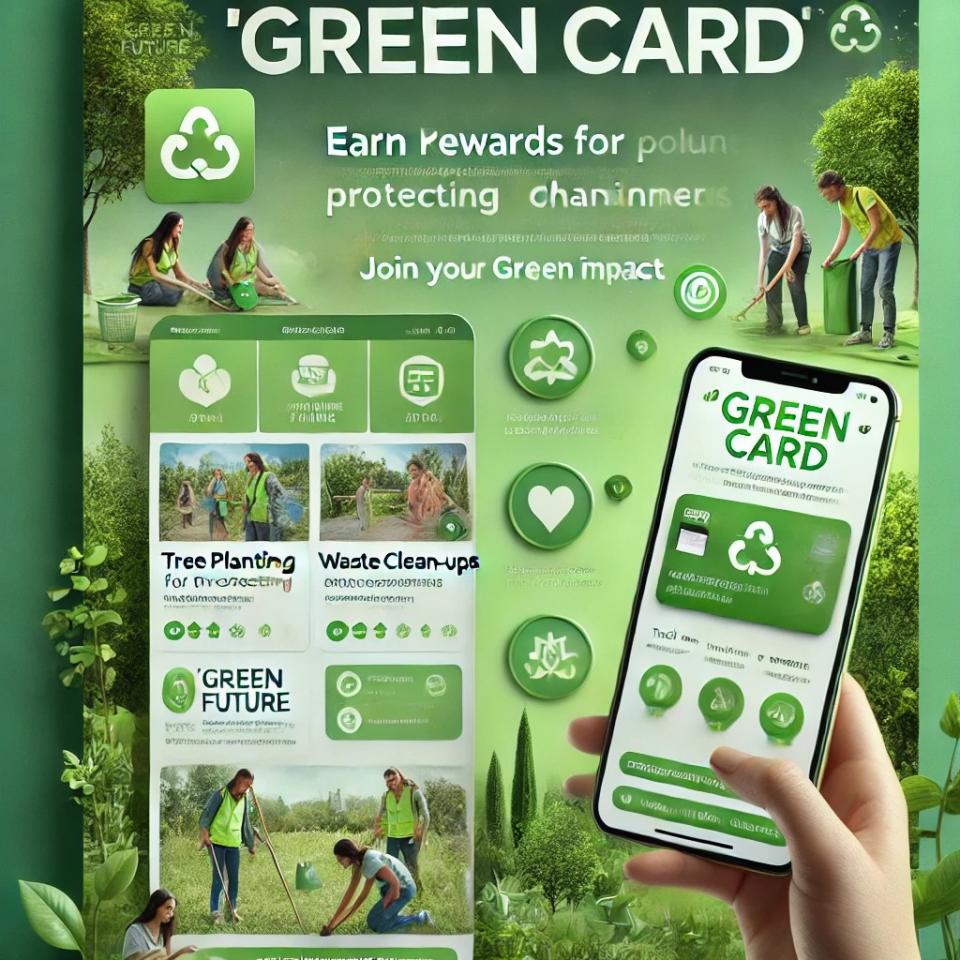
The "Green Card"
Basic information
Project Title
Full project title
Category
Project Description
Current stage development
Geographical Scope
Project Region
Urban or rural issues
Physical or other transformations
EU Programme or fund
Description of the project
Summary
Who We Target
1.High school and university students
2.Young professionals interested in sustainability
3.Eco-clubs and NGOs focused on environmental action
4.Businesses supporting green initiatives
Key Objectives
1.Increase accessibility to environmental volunteer opportunities through the Green Future app.
2.Motivate participation with the Green Card—a reward system for volunteers completing 30+ hours of eco-work.
3.Foster collaboration by building partnerships with businesses, institutions, and municipalities.
4.Promote a culture of sustainability by encouraging long-term youth engagement in environmental action.
Impact & Achievements
1.Higher youth participation in sustainability initiatives.
2.A structured digital platform to track and showcase volunteer contributions.
3.Active partnerships with local businesses and institutions to provide incentives.
4.Tangible environmental benefits through clean-ups, tree planting, and waste reduction projects.
Alignment with New European Bauhaus (NEB) Values
This project embodies NEB's core values of sustainability, inclusion, and aesthetics by:
1.Offering an engaging, user-friendly digital solution to encourage eco-action.
2.Integrating technology with sustainability to make environmental efforts more accessible.
3.Rewarding participation to motivate and sustain long-term involvement.
Addressing Local Challenges
Kosovo faces declining youth participation in volunteerism, alongside critical environmental concerns like pollution and deforestation.
The Green Card Project tackles these challenges by:
1.Simplifying access to volunteer opportunities through a structured digital platform.
2.Providing incentives that make sustainability more appealing and rewarding.
Key objectives for sustainability
Encouraging long-term commitment through the Green Card system.
Partnering with businesses to offer eco-friendly rewards (e.g., discounts for cultural events).
Fostering a sense of responsibility in youth through hands-on participation.
Reducing waste and promoting reforestation through structured volunteer programs.
This approach is replicable in other regions and adaptable for various environmental challenges.
Key objectives for aesthetics and quality
Moreover, the integration with social media allows volunteers to showcase their efforts, share accomplishments, and inspire peers to take part. By making sustainability efforts public and rewarding, the project builds a sense of collective action, reinforcing the idea that environmental responsibility is both fulfilling and socially valued. Beyond digital engagement, partnerships with cultural institutions and community spaces ensure that environmental work is recognised as a meaningful part of daily life. Through this blend of technology, design, and social influence, the project transforms volunteerism into an appealing and immersive experience.
Key objectives for inclusion
A key aspect of inclusion is partnerships with businesses, institutions, and local governments, which expand the reach and benefits of participation. The Green Card not only rewards environmental contributions but also integrates sustainability with cultural and social incentives. By providing discounts at cinemas, libraries, and recreational venues, the project connects environmental action with leisure, making sustainability an attractive and rewarding pursuit for all.
The initiative also focuses on engaging underrepresented youth, including those in rural areas where access to volunteer opportunities may be limited. By linking volunteers to projects in different regions, the project bridges urban-rural divides and ensures equal opportunities for all participants. This holistic approach makes sustainability more inclusive, accessible, and rewarding, fostering long-term commitment among diverse youth communities.
How Citizens benefit
Beyond individual engagement, the initiative relies on strong partnerships with local governments, businesses, and NGOs, which play a crucial role in supporting and expanding the project. Local authorities help facilitate environmental initiatives, while businesses provide incentives and promotional support. NGOs and educational institutions integrate the project into extracurricular activities, further increasing its reach and impact.
Schools and universities are key partners, incorporating the Green Future app into student-led initiatives and sustainability programs. By embedding environmental activism into academic and community settings, the project reinforces long-term engagement and institutional support. This multi-stakeholder involvement creates a sustainable ecosystem for environmental volunteerism, ensuring that the project continues to grow and evolve based on the needs of its users and partners.
Physical or other transformations
Innovative character
Gamification makes volunteerism engaging: By incorporating badges, leaderboards, and milestones, the project motivates sustained participation rather than one-off involvement.
The digital platform removes barriers: Many environmental initiatives struggle with low accessibility and engagement. The Green Future app makes opportunities easy to find and track, simplifying participation.
The reward system builds long-term commitment: Unlike programs that rely on intrinsic motivation alone, the Green Card ensures that volunteers are recognized and rewarded, making sustainability efforts feel valuable and impactful.
By blending technology, community involvement, and behavioural incentives, the project rethinks and modernises traditional environmental activism, making it more dynamic, accessible, and rewarding.
Disciplines/knowledge reflected
Technology & Digital Innovation: The Green Future app was designed by developers and UX/UI experts to provide an intuitive platform for volunteers to track activities, earn rewards, and engage with the community.
Environmental Science & Sustainability: Experts in ecology and waste management guided the project’s environmental initiatives, ensuring activities like tree planting and waste reduction align with best practices.
Education & Youth Engagement: Teachers and youth organisations helped integrate the project into school curricula and extracurricular programs, promoting environmental awareness among students.
Business & Economic Incentives: Collaboration with local businesses ensured the Green Card reward system was attractive and financially sustainable, encouraging long-term engagement.
Policy & Governance: Municipalities and national agencies supported the initiative, offering regulatory insight and expanding its impact.
Methodology used
Recruitment & Engagement:
Outreach through schools, universities, social media, and NGOs.
Volunteers register and track activities via the Green Future app.
Implementation:
Environmental actions such as tree planting, waste management, and sustainability workshops are listed on the platform.
Volunteers participate, log their hours, and work towards earning the Green Card.
Businesses and cultural institutions provide incentives to reward participation.
Monitoring & Impact Assessment
Data collection through app analytics and user feedback.
Surveys assess engagement levels and overall impact.
Stakeholder reports ensure transparency and continuous improvement.
How stakeholders are engaged
At the local level, municipalities, schools, NGOs, and businesses collaborate to provide volunteer opportunities, incentives, and logistical support. Schools and universities integrate the project into extracurricular activities, while businesses offer discounts to volunteers, making sustainability socially and economically rewarding.
At the regional level, municipalities coordinate environmental efforts, while media and NGOs promote participation. Cross-municipality partnerships expand the initiative, increasing youth engagement across different areas.
At the national level, ministries support policy integration, funding opportunities, and business engagement, ensuring long-term recognition and growth. National NGOs and corporate sponsors help sustain the reward system, strengthening financial backing.
At the European level, partnerships with EU programs, networks, and environmental initiatives enhance scalability and knowledge-sharing, fostering cross-border collaboration.
This multi-level approach creates a sustainable, scalable model for youth-led environmental action, bridging communities, institutions, and businesses in a shared mission for long-term impact.
Global challenges
Climate Action: Encourages long-term sustainable behaviour through active participation.
Youth Unemployment & Skill Building: Provides structured volunteer experience that enhances job prospects.
Community Engagement: Strengthens social ties by linking volunteers to meaningful activities that improve their surroundings.
By making environmental activism rewarding, accessible, and engaging, the Green Card Project bridges the gap between awareness and action, creating a sustainable movement for lasting impact.
Learning transferred to other parties
Expanding the digital platform to support multiple languages and regional environmental initiatives.
Partnering with local governments and businesses in different countries to create customised reward systems.
Broadening the scope beyond environmental work to include social impact projects, such as humanitarian aid or civic engagement initiatives.
This flexible framework allows the project to be scaled internationally, making volunteerism accessible and engaging for a wide range of communities.
Next steps
Over the next year, the Green Card Project will focus on expanding, enhancing, and sustaining its impact through the following steps:<br />
<br />
Pilot Expansion: Increase outreach in Kosovo’s cities and rural areas by partnering with more schools, municipalities, and NGOs to engage a wider volunteer base.<br />
Digital Platform Enhancement: Improve the Green Future app by introducing advanced gamification features, a user-friendly interface, and real-time impact tracking.<br />
Business & Government Partnerships: Secure additional partnerships with businesses and cultural institutions to expand the Green Card rewards system, ensuring long-term sustainability.<br />
Awareness & Engagement Campaigns: Launch targeted social media and community-driven campaigns to attract new volunteers and increase participation.<br />
Impact Measurement & Reporting: Conduct data analysis and stakeholder feedback sessions to refine the project, ensuring continuous improvement.<br />
Regional & EU Collaboration: Establish connections with similar initiatives in the Western Balkans and EU, fostering knowledge exchange and potential scalability.<br />
These steps will ensure that the Green Card Project becomes a sustainable, scalable, and widely adopted model for youth-led environmental action.