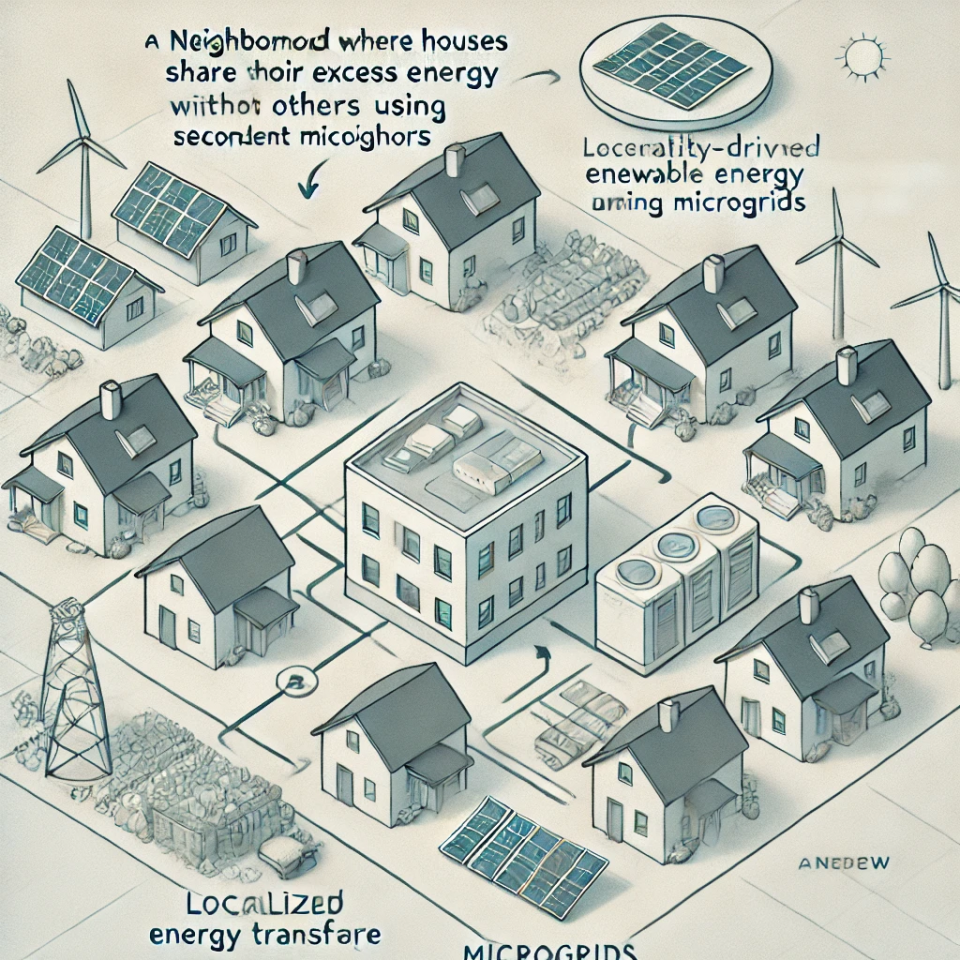
Decentralized energy-sharing model
Basic information
Project Title
Category
Project Description
Current stage development
Geographical Scope
Project Region
Urban or rural issues
Physical or other transformations
EU Programme or fund
Description of the project
Summary
The model promotes energy justice by making clean electricity more affordable, sustainable, and accessible to all, while reducing reliance on fluctuating market prices. By decentralizing energy production and distribution, we empower local communities to take control of their own energy needs, fostering fairness and affordability. Furthermore, it strengthens community bonds as participants become both producers and consumers of energy, working collaboratively to manage and benefit from their shared energy resources.
This approach prioritizes autonomy, fairness, and resilience, creating a more cooperative and self-sustaining energy ecosystem. By fostering local energy independence, we can help build stronger, more sustainable communities that are less vulnerable to external energy disruptions.
This model goes beyond traditional self-sufficiency, promoting a more interconnected and efficient energy distribution system.
Key objectives for sustainability
Participants can not only reduce their carbon footprint by consuming local solar energy, but also maximizing efficiency and minimizing waste through this shift from individual self-sufficiency toward a collective, interconnected energy model.
Key objectives for aesthetics and quality
This model fosters a stronger sense of connection and collaboration among neighbors and local businesses by creating a shared energy network. By collectively generating, distributing, and consuming clean electricity, participants become the sole stakeholders in managing their energy resources. This self-sufficient system not only empowers the community with greater control over its energy costs and sustainability efforts but also reinforces social bonds. Neighbors are no longer just consumers but active contributors to a local energy ecosystem, encouraging trust, cooperation, and a shared commitment to a cleaner, more affordable future.
Key objectives for inclusion
How Citizens benefit
However, we strongly believe that citizens should be actively involved in more advanced stages of the product design, and various engagement strategies must be followed to ensure its accessibility and acceptance.
Community consultations and workshops would need to be conducted with neighbors and building owners to understand their energy needs, concerns, and expectations regarding implementation. Pilot testing and user feedback would play a crucial role, allowing small-scale trials to assess feasibility and social acceptance, leading to system refinements. Additionally, collaboration with neighborhood associations and local organizations is helpful to promote adoption and ensure the model benefits as many people as possible.
Finally, transparency and continuous communication are key through informational materials, meetings, online platforms, and brochures, keeping the community informed and engaged throughout the project’s development.
Physical or other transformations
Innovative character
Disciplines/knowledge reflected
Renewable Energy Engineering: Mar's expertise in renewable energy engineering and technologies is central to the design of our decentralized microgrids. As we develop the prototype, her insights will guide the integration of wind and solar energy, ensuring that the system is both efficient and adaptable to local conditions, with the goal of reducing reliance on traditional power grids.
Data Science and Software Development: Guillermo's role in developing the software systems for the prototype is crucial. By designing tools to track energy production, consumption, and sharing, his work will enable real-time data analytics, allowing the system to optimize energy use locally. His contribution ensures that the prototype will be flexible, transparent, and capable of adapting as data is gathered.
Strategy and Community Integration: Fernando’s strategic input is key in shaping the business model and community governance framework for the prototype. As the project progresses, his expertise will ensure the model is economically viable, with a focus on empowering local communities to take ownership of the energy-sharing system. He’ll help align the prototype’s development with long-term sustainability goals, fostering inclusivity and economic benefits for all stakeholders.
The added value of this interdisciplinary collaboration in the prototype phase is that it enables us to create a holistic and scalable solution. By combining engineering, data science, and strategic planning, we can develop a system that is technically sound, socially inclusive, and economically sustainable, ready to be tested and refined in real-world scenarios.
Methodology used
Next, the project moves into the pilot testing phase, where small-scale trials are conducted in selected neighborhoods to evaluate the system's functionality, efficiency, and social acceptance. Real-time data analytics will be integrated into the software to optimize energy production, consumption, and sharing during this phase. Feedback from participants will guide refinements to both the technical infrastructure and governance model.
The scaling phase involves collaboration with local technical experts for infrastructure adjustments, such as installing additional cables and meters, while fostering partnerships with regional energy cooperatives to promote knowledge-sharing and adoption in other communities.
Finally, the project transitions into a sustained operation phase, where the decentralized energy-sharing system is fully implemented, monitored, and maintained by empowered local communities. Continuous improvements will be made based on performance data and user feedback, ensuring long-term sustainability and replicability in other contexts.
How stakeholders are engaged
At the local level, building owners, residents, and neighborhood associations will be the primary stakeholders, as they will participate in the adoption and management of the system through private agreements and minor infrastructure adjustments. On another hand, local technical experts and electricians will play a key role in implementing the necessary modifications, such as installing additional cables and meters, ensuring safe and efficient energy sharing. This would imply a boost in employment for local communities.
At the regional level, energy cooperatives and local sustainability initiatives may provide support by facilitating knowledge-sharing and promoting the model to interested communities. Since the project does not require changes to national energy regulations, utility companies and regulatory bodies will have limited involvement, mainly ensuring that the system operates within permitted self-consumption and peer-to-peer sharing guidelines. This streamlined approach reduces complexity while allowing for a scalable and community-driven implementation of decentralised energy sharing.
Global challenges
> Climate Change: By promoting renewable energy and reducing reliance on fossil fuels, the project directly contributes to decarbonisation and aligns with global net-zero targets.
> Energy Justice: It tackles energy poverty by providing affordable and accessible clean energy to underserved communities, fostering inclusivity and equity.
> Utilities Oligopoly: The decentralised model challenges the dominance of utility incumbents by empowering communities to produce and share their own energy, reducing dependency on monopolistic grids.
> Grid Resilience: Localised microgrids enhance energy resilience by minimising reliance on vulnerable national grids, ensuring stability during disruptions.
> Economic Barriers: The project lowers costs for participants through peer-to-peer sharing and avoids the high infrastructure investments required for centralised grid upgrades.
Learning transferred to other parties
> Peer-to-Peer Energy Sharing Model: The governance framework and software enabling direct energy exchanges between participants can be implemented in various contexts, fostering community-driven energy ecosystems globally.
> Community Engagement Processes: The methodology of involving stakeholders through consultations, workshops, and pilot testing can be replicated to ensure social acceptance and tailored solutions in diverse communities.
> Sustainability Practices: The focus on maximizing local renewable energy use and reducing reliance on traditional grids can be applied to other regions aiming to enhance energy efficiency and lower carbon footprints.
Interdisciplinary Collaboration: The integration of renewable energy engineering, data science, and strategic planning provides a replicable model for designing holistic, scalable, and inclusive energy-sharing systems.
The project will carefully monitor local renewable energy sources, such as sunlight availability, which directly impact the feasibility and efficiency of solar energy production. Additionally, community-specific social dynamics and levels of trust among participants may not be easily transferable to other contexts, requiring tailored engagement strategies for each new location.
Next steps
In the first year, our focus will be on developing, promoting, and implementing the concept through a structured approach:<br />
<br />
> Site Selection (Months 1-3): Identify and approach a residential community or industrial warehouses as the first real prototype. Conduct stakeholder meetings to align expectations and secure participation. Assess regulatory requirements and technical feasibility.<br />
<br />
> Team Formation & System Development (Months 4-6): Hire specialized technical staff (engineers, software developers, energy consultants). Develop the software platform for real-time energy tracking and transfers. Finalize microgrid design and procure key equipment (batteries, inverters, smart meters).<br />
<br />
> Pilot Deployment & Testing (Months 7-9): Install the microgrid infrastructure, if applicable, and integrate the software system. Conduct preliminary tests to validate energy-sharing efficiency. Train community participants on system usage and benefits.<br />
<br />
> Evaluation & Scaling Strategy (Months 10-12): Monitor performance, optimize system functionality, and analyze impact. Promote results to attract investors, policymakers, and new participants. Develop a roadmap for expansion to additional communities.<br />
<br />
This structured approach ensures a smooth transition from concept to real-world implementation while maximizing community engagement and system efficiency