Das Radikal
Basic information
Project Title
Full project title
Category
Project Description
Current stage development
Geographical Scope
Project Region
Urban or rural issues
Physical or other transformations
EU Programme or fund
Description of the project
Summary
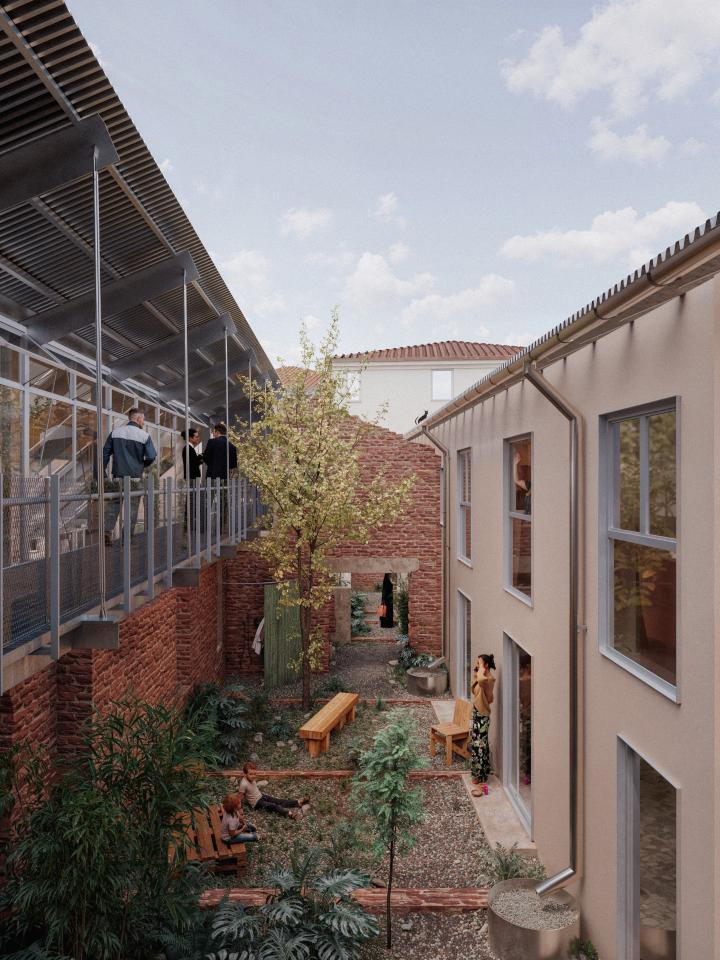
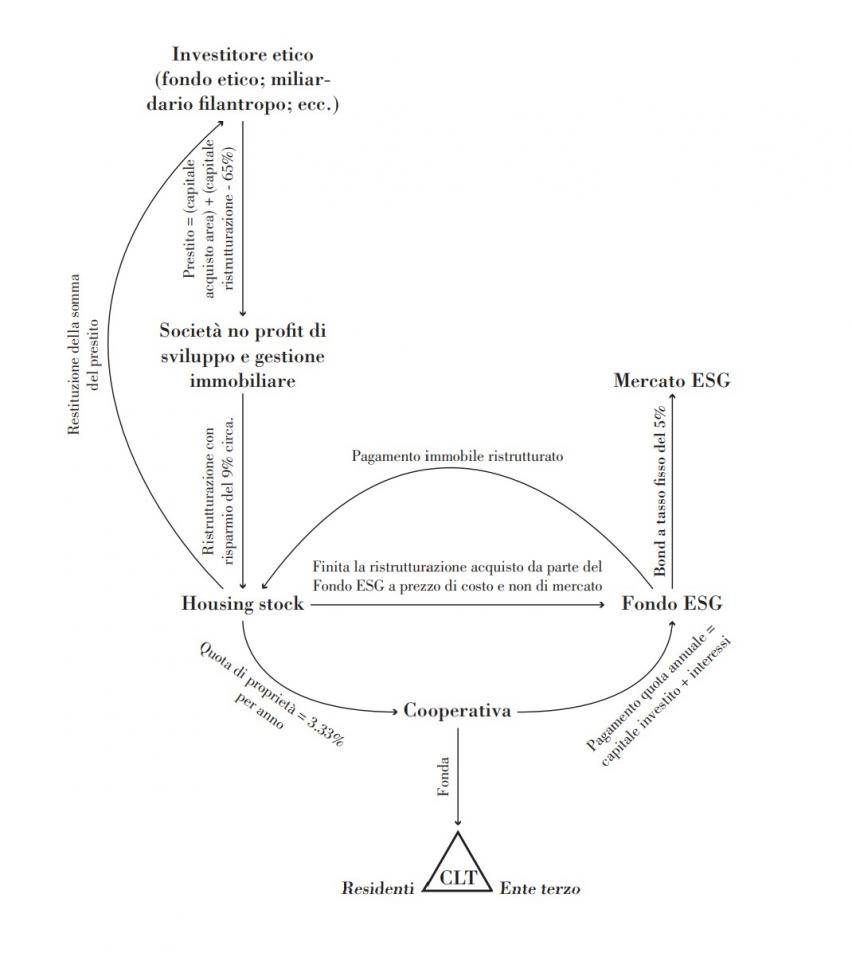
Design proposal is applied to a complex of building in Padova, with the aim of creating a replicable model. By preserving 85-90% of existing buildings and integrating modular additions (cross-laminated timber, polycarbonate), the model minimizes demolition waste, reduces embodied carbon by 62% compared to new builds, and revives disused spaces like former workshops into hybrid live-work units. A Community Land Trust (CLT) grants residents incremental ownership (3.33% annually), freezing speculative value increases for 30 years. Income-based rents (25-45% of earnings, 30% below market rates) ensure accessibility for precarious workers. The financial scheme is made possible by having construction costs of €1,250/m² (leveraging Italy’s 65% renovation tax incentives) and starting financing raised via ethical ESG bonds.
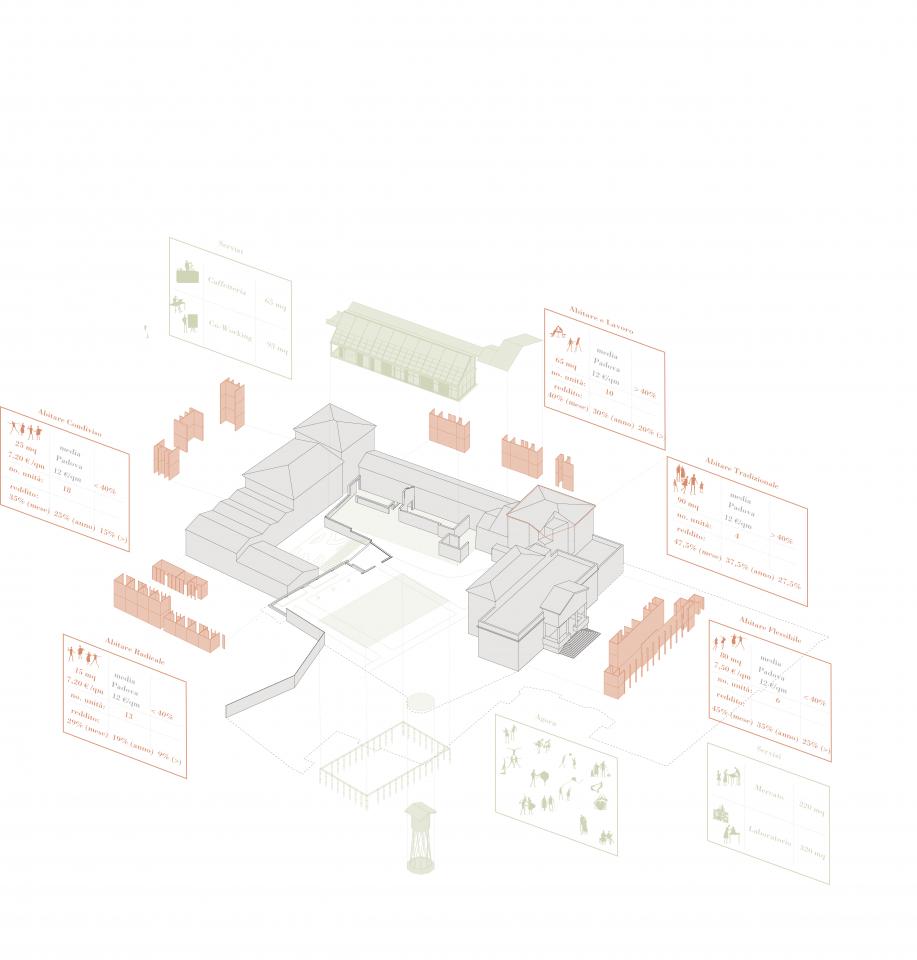
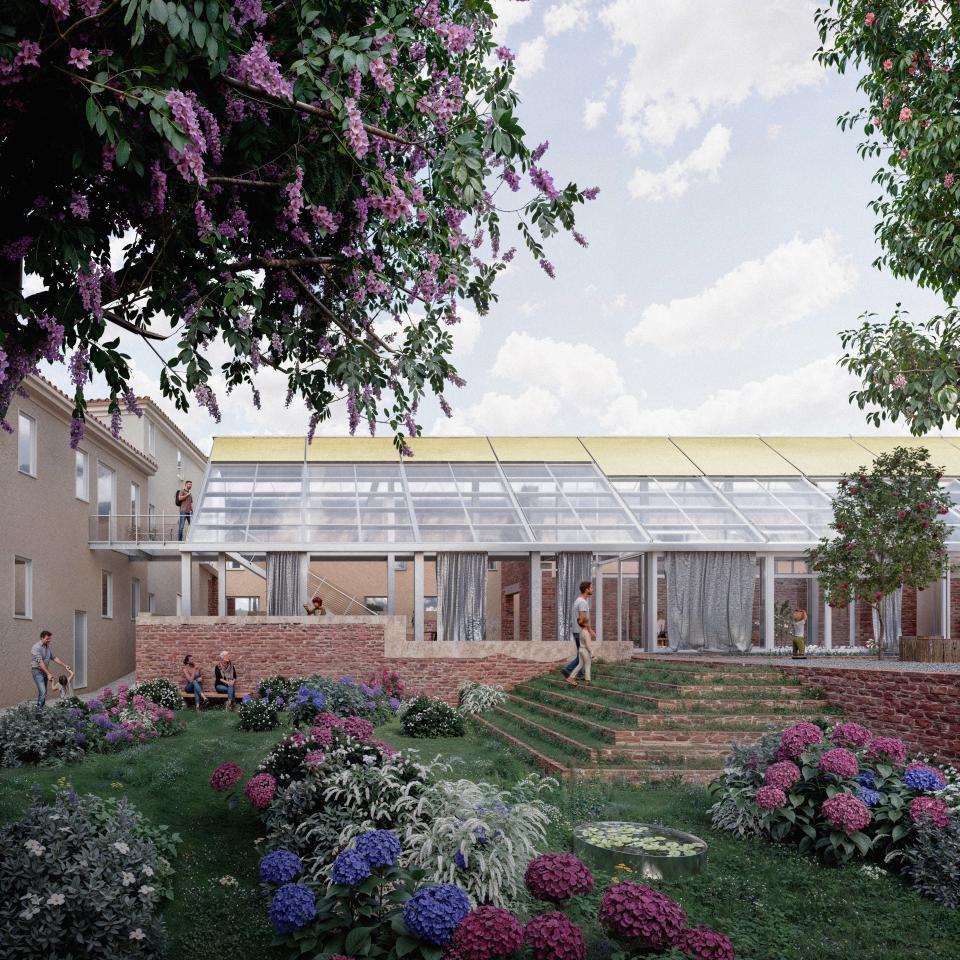
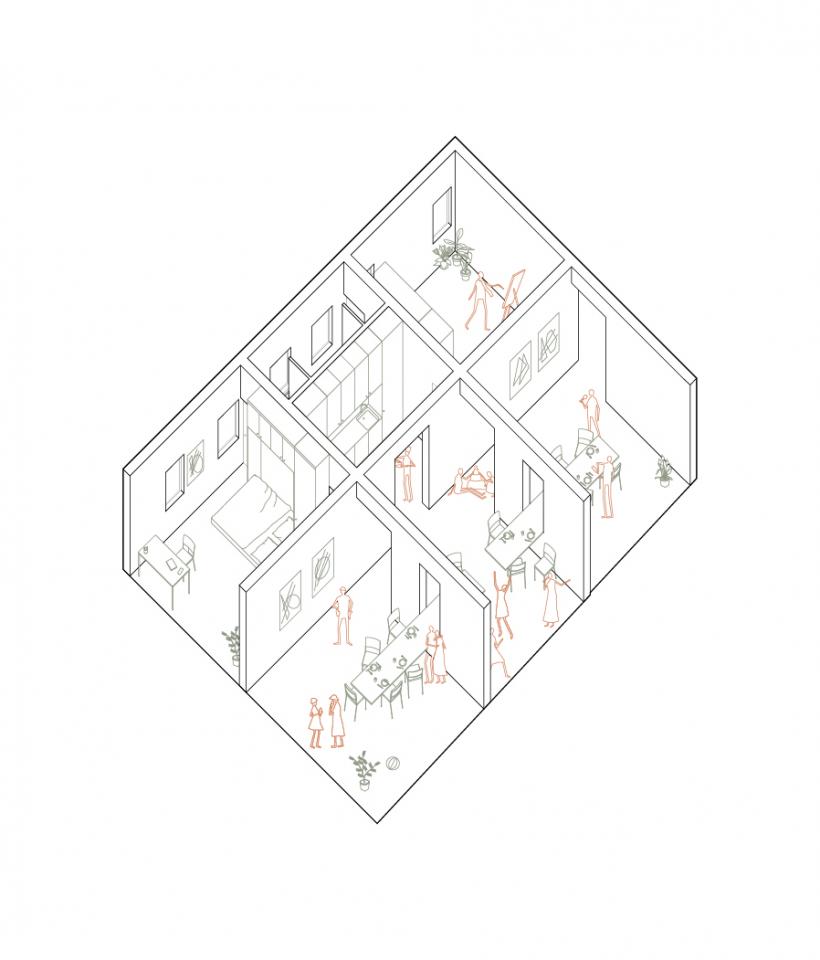
The architectural prototype proposes 5 different housing typologies linked together between through shared courtyards, coworking spaces, and a multifunctional agora—fostering intergenerational exchange. Recognized in an Italian design competition, "Das Radikal" merges circular design with policy-aligned financing, demonstrating scalable low-carbon retrofitting for European cities tackling housing crisis. By prioritizing low-income people and repurposing neglected spaces, it offers a replicable blueprint for inclusive regeneration in European cities—proving that beauty and sustainability emerge when housing becomes a collective right, not a commodity.
Key objectives for sustainability
Key objectives for aesthetics and quality
Key objectives for inclusion
The Community Land Trust (CLT) amplifies long-term affordability by granting residents incremental ownership equity (3.33% annually) for every year of residency, reaching full ownership after 30 years while locking the property’s market value to prevent speculation. Housing diversity directly addresses the crisis, in the various typology illustrated, from temporary dwellers to multigenerational households.
Financial inclusion is structurally embedded: the project is funded through ESG bonds, attracting ethical investors and philanthropic funds without privatizing gains. By purchasing properties at cost price (€2.8M land, €4.5M construction) and leveraging Italy’s 65% renovation tax bonus, the model redistributes wealth away from speculative markets toward community stewardship.
This cooperative framework transcends mere affordability—it redefines housing as a collectively governed right, where residents co-author shared spaces (agora, workshops, coworking areas) while retaining individual autonomy. By decoupling housing from extractive markets, "Das Radikal" offers a scalable blueprint for European cities: proving that dignified, permanently affordable living is achievable when communities reclaim control over urban space.
How Citizens benefit
Physical or other transformations
Innovative character
Unlike conventional development, which prioritizes profit maximization, Das Radikal merges radical architectural reuse (retaining 85-90% of existing structures) with a non-speculative financial model, ensuring affordability in perpetuity. The fusion of low-carbon retrofitting strategies with ethical ESG bonds (5% fixed return) disrupts standard investment practices, attracting capital aligned with social and environmental impact. The Community Land Trust (CLT) mechanism further ensures long-term affordability and community governance, a departure from standard public housing models reliant on government subsidies alone.
Unlike typical architectural projects, focused solely on spatial design, Das Radikal integrates cooperative management principles, empowering residents to shape communal spaces and program shared resources via participatory budgeting. This active engagement departs from passive recipient models common in social housing, fostering a sense of ownership and community resilience.
This integrated approach—merging circular design with policy-aligned financing—demonstrates scalable low-carbon retrofitting for European cities tackling housing shortages. By decoupling housing from speculative markets and integrating design with social equity and environmental sustainability, Das Radikal proposes a systemic alternative to mainstream actions that often perpetuate unaffordability and social fragmentation.
Disciplines/knowledge reflected
• Architecture & Urban Morphology: Informed spatial organization, building typologies, and adaptive reuse strategies, preserving historical character while integrating contemporary interventions.
• Urban Sociology: Guided the design of communal spaces (courtyards, agora, coworking areas) to foster social interaction and address needs of diverse demographics.
• Circular Economy & Reuse Architecture: Defined material selection (CLT, recycled steel), construction processes, and waste minimization strategies, maximizing resource efficiency and minimizing environmental impact.
• Urban & Economic Geography: Shaped the project’s integration within Padua’s urban fabric, connecting the site to local economic networks and infrastructure systems.
• Macroeconomics & Cooperative Housing: Drove the development of the non-speculative financial model (ESG bonds, CLT equity, income-based rents, renovation tax incentives), ensuring affordability and long-term sustainability.
This interdisciplinary framework fostered iterative design refinement: architects adapted spatial layouts based on sociological insights; economists assessed the financial viability of reuse strategies championed by circular economy experts; urban morphologists ensured contextual harmony between new modules and historical facades. The added value of this process was a holistic design grounded in both spatial innovation and social equity. By bridging architectural vision with economic and social realism, the project achieved a nuanced, context-specific solution to the housing crisis, integrating diverse knowledge domains to create a resilient and socially just urban ecosystem.
Methodology used
Radical Reuse is the project's foundational pillar, prioritizing the retention of 85-90% of the existing building mass. By minimizing demolition, the project reduces environmental impact and leverages existing resources.
Non-Extractive Economics refers to creating economic models that avoid traditional methods of extracting as much capital from a housing project as possible. This is achieved through ethical and social responsible methods.
Cooperative Management is essential to the project as it involves building and empowering those who need housing. It ensures residents are essential to project development and management.
Social Integration supports the creation of shared environments by creating spaces that are helpful to those to bring people together in areas where they can facilitate and encourage interactions in key zones.
The development of the overall method began with an urban analysis to identify the potential for adaptive reuse. The second phase was the construction of an economic model that could guarantee non-speculative housing accessible within current economic systems that is replicable and scalable. The project also is meant to offer a great approach to solving housing issues by integrating a vast array of perspectives that has been tested and can show strong economic viability that has strong elements for practical implication. This offers a strong path to creating a highly viable and extremely helpful path to dealing with affordable living in a wide varity of location.
How stakeholders are engaged
The authors are now advancing the model through an independent multi-year research initiative to assess feasibility in concrete contexts. This research will engage stakeholders—local municipalities, housing cooperatives, and ethical investors—to explore regulatory adaptability, funding scalability, and community participation frameworks.
Current added value lies in the competition’s validation of the model’s theoretical rigor. Future stakeholder engagement will focus on bridging conceptual innovation with practical application, ensuring the model’s viability beyond academia and research excercise.
Global challenges
The project addresses carbon emission concerns by reusing existing infrastructure, retaining over 85% of construction materials and building components. “Das Radikal” addresses this by reusing material and also addresses and lowers embodied carbon. Annual funds are used to support infrastructure through careful economic planning.
Overall, “Das Radikal” provides new economic structures with a wide variety of backgrounds that can be replicable. The main focus of the project is to provide a scalable model that is replicable and economically viable and provide solutions that can provide innovative resources to long-term economic systems and reduce housing shortages. The ultimate goal is to show affordable housing can meet sustainable needs while reducing global concerns.
Learning transferred to other parties
The methodology's core strength lies in maximizing existing structures and resources, making it inherently scalable. Cities across Europe facing challenges with aging building stock can leverage this model to revitalize underutilized assets while minimizing environmental impact. The emphasis on light modular construction for architectural reuse offers a low carbon footprint solution, ideal for replication in various urban settings.
The project's economic framework ingeniously leverages widely available policies, particularly tax incentive schemes, to secure funding. While it specifically references Italian bonus systems, similar practices exist in other EU member states, making the model adaptable. The non-speculative economic approach, centered on ethical financing and community land trusts, can be tailored to diverse regulatory environments, offering a replicable blueprint for sustainable urban development.
The CLT cooperative management structures are already familiar in several European countries, and can be readily adapted to local contexts. Given the expanding housing crisis across Europe, infact, this model presents a viable solution for mid-to-large cities in various EU member states, addressing common challenges of affordability and community cohesion.
Ultimately, "Das Radikal" offers a comprehensive, adaptable framework for providing innovative housing solutions that can address urgent needs across the EU. Its holistic approach—combining architectural innovation, economic sustainability, and social inclusivity—positions it as a highly transferable model for tackling the multifaceted challenges of urban housing in the 21st century European context.
Next steps
"Das Radikal" emerged from a design competition for Confcooperative Habitat in mid-2024, earning a special mention for its innovative approach. While this initial phase lacked direct implementation, the authors remain deeply committed to bringing the concept to fruition.<br />
Fueled by the competition’s validation, the design team is now pursuing an independent, multi-year research project to enhance the model and refine its practical application across diverse contexts. This ongoing effort involves rigorous analysis and adaptation to potential pilot sites, carefully considering local regulations, community needs, and financial feasibility.<br />
The research project actively seeks collaborations with key stakeholders, including municipalities, housing cooperatives, ethical investors, and potential residents, to refine the model's responsiveness and viability. The goal is to identify suitable sites and partners for future implementation, transforming the theoretical framework into a tangible, community-driven reality. By transitioning from conceptual design to iterative research and stakeholder engagement, the authors demonstrate a sustained commitment to translating "Das Radikal" into a practical and scalable solution for addressing the European housing crisis and promoting sustainable urban development.