Building a base for Facing the Glacier
Basic information
Project Title
Full project title
Category
Project Description
Current stage development
Geographical Scope
Project Region
Urban or rural issues
Physical or other transformations
EU Programme or fund
Description of the project
Summary
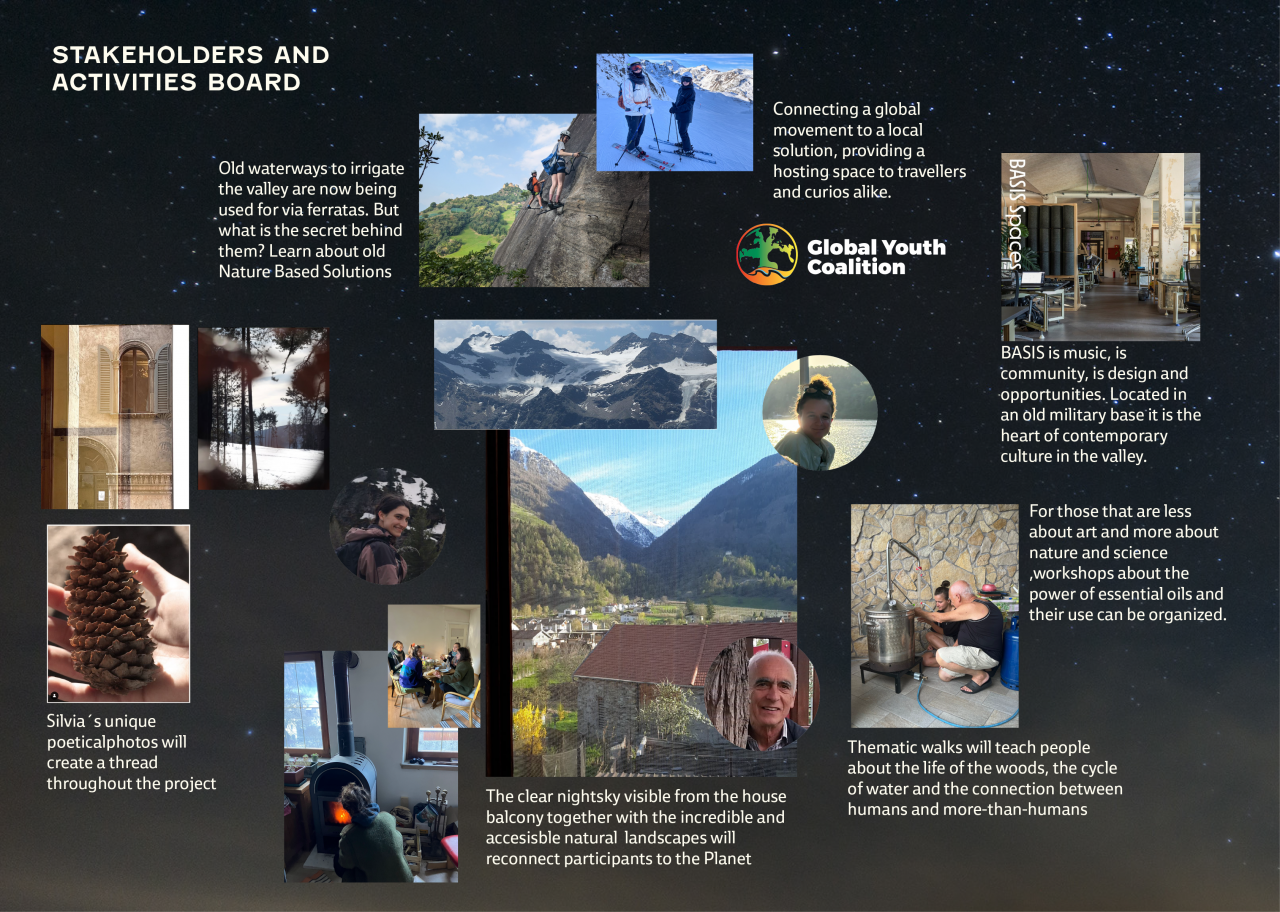
The idea behind the project is born from the realization that people in cities do not experience something as basic as a night sky, and hence it is difficult for them to understand what we are actually being deprived of. How to know which direction should a transition go, if you have never experienced a different way of living? May it be a pollution-free night sky or the view of eternal whiteness of the glacier admirable through the window, thanks to the unique setting and condition of the house the residency space enhances reconnection with our living Planet.
Data shows that in 15 years skiing in the Alps may become impossible, who will remember the feeling of winter sports? Who will stand testimony of the many months of white peaks?
Key objectives for sustainability
The workshops will focus on deepening the participants' relationship with the living and historical landscape (historically there are tensions between the local people of the area and the Italian state), adding to the social value of the project.
By offering a way to reconnect to nature (the national park is just 15 minutes away and from the balcony you can see incredible night skies) the Timo house stimulates people's capacities of looking at the present differently, allowing them to see a different direction than the merely city-oriented, resources rich way of living.
Key objectives for aesthetics and quality
The cultural experience will be tailored to the people the project attracts. The walks organized will be fairly easy and if specific equipment is needed this will be provided. Overall, the people that will access Timo house will access a long standing relationship opportunity to escape the city and develop a relationship with a place, significantly expanding the cultural borders of one's experience.
Key objectives for inclusion
Sense of shared responsibility over a space: because of the community governance and the trust-based relationship that this project needs, participants will explore a different sense of ownership and the result will be that Timo house will become not just the base for one person, but for a community. The way this will happen is inspired by the concepts of “comune” and their historical relevance in the italian cultural sphere, but it differentiates itself from them as no fixed number of peoples will need to permanently live there.
Accessibility: the house is reachable by train and there is a network of public transport that operates in the valley. Unfortunately the house is not currently ready to host people with wheelchairs. On the other side, in this sense BASIS is a fully accessible space.
Intergenerational space: thanks to the expertise of Vittorio Mascagno people will be able to access local knowledge from the Alpine area, a knowledge that is usually reserved to experts in the fields or transmitted inside the family. Particular care will be made to include knowledge holders and elders from the valley into the skill sharing aspects of the residencies.
Aesthetic: the visual narrative will be curated with poetry, power and gentleness at its core. An interior designer will be consulted to make sure the space is redressed efficiently and respecting the historical structures.
How Citizens benefit
Silvia, the photographer, will have an opportunity to extend her portfolio beyond the mainstream work she does in Milan and we hope she and Irene will continue collaborating
Physical or other transformations
Innovative character
Energy aspect embodied in the space itself: the use of our energy resources is becoming a key aspect in our life and geopolitics. Although we think of energy limitations as some of the features, Italy has already started to impose restrictions in summer times, as the lack of water is being a serious threat to our industries and health. Although the problem is fundamentally systematic, we have got used to our standards and we have never experienced something different. Timo house offers a way to challenge this paradigm: how do we rearrange our appliances, routine and costs when gas is not available? At Timo people can use fire to heat the shower for the water and to cook their meals. The electricity used in Timo house is produced through the hydro power of the local company, making it an example of a local energy production ecosystem.
Connection between mountain culture and innovation: we often hear of “indigenous knowledge” as a way to power climate innovation, but who are the indigenous of the Alps? What about the local knowledge that allowed people to live in the Alps for millenia? Through thematic workshops Facing the Glacier will connect the old to make space for new inventions, in particularly Nature Based Solutions.
A residency connected to global climate politics: thanks to the Global Youth Coalition and the Avocado Framework, the residency will be advertised to climate leaders worldwide.
Disciplines/knowledge reflected
Ecology and agronomy are connected because of what Vittorio Mascagno will bring to the game, although design is an important discipline in shaping the methodology, what are we without the understanding of the world around us? His prospective will be rooted in time, physical and political changes.
Methodology used
The methodology used to bring this together was: build on your resources, connect with pivotal actors and trust your experiences.
How stakeholders are engaged
Locally, the owner of the house and her family have helped so far in the correct running of the house, expanding the project would leave them with a renovated room in a house they were close to selling because it was not profitable.
The Global Youth Coalition could finally have an operating project in Europe, and could offer its network to bring the right people to the house or additional experts. Their role is limited as Irene is already part of the organization but their support will be used strategically.
Global challenges
Climate Change: learning more deeply about imminent threats especially related to water and connection between mountain ecosystems and cities.
Revival of local knowledge:creation of an environment for an effective transfer of knowledge among different generations
Learning transferred to other parties
The shared community governance of the space could be implemented in other housing, for example by creating similar spaces in cities: the costs would of course be different but it would be nice to explore how human mobility would be impacted if we started to act not as stationary species but one of nomads (as we have been for millennials of our history). The idea is that one day many “Timo houses” will be connected between each other, and members of the community will be able to move freely among these spaces.
Next steps
STEP 1: renovating the studio space <br />
STEP 2: document the renovation and Timo house at large, creating a body of work that can be used to advertise the residency programme<br />
STEP 3: Make a call for stipend residencies<br />
STEP 4: plan workshops<br />
STEP 5: carry on the residencies and workshop<br />
STEP 6: reflection and continuation with hosting programme (after first year)<br />
<br />
Direct beneficiaries: Irene Delfanti, Silvia Sirpresi, Vittorio Mascagno, 2 winners of residencies, workshops takers, house owner (for having a renovated space and a more constant income)<br />
Indirect beneficiaries: BASIS (for the project will give additional attention to their space), future guests of Timo house (as they will benefit from the physical improvements of the space), habitants of Laas (as businesses will benefit by having people living there and working), crafters and experts in the valley (depending on how residencies will be structure, further connections will be made with local enterprises to learn more about their crafts), Global Youth Coalition (as their project will have a foothold in Europe through which community based actions can grow)<br />
Non-human-beneficiaries: attention will be brought to the risks associated with the disappearance of glaciers and the change of flora and fauna which is envisioned happening due to climate change.