Break-up Lab
Basic information
Project Title
Full project title
Category
Project Description
Current stage development
Geographical Scope
Project Region
Urban or rural issues
Physical or other transformations
EU Programme or fund
Description of the project
Summary
The Break-up Lab focuses on the end of an emotional relationship: that between the textile and its previous owners. In collaboration with local research institutes and textile recycling actors, the lab develops sustainable recycling processes for used textiles with a polyester fiber component.
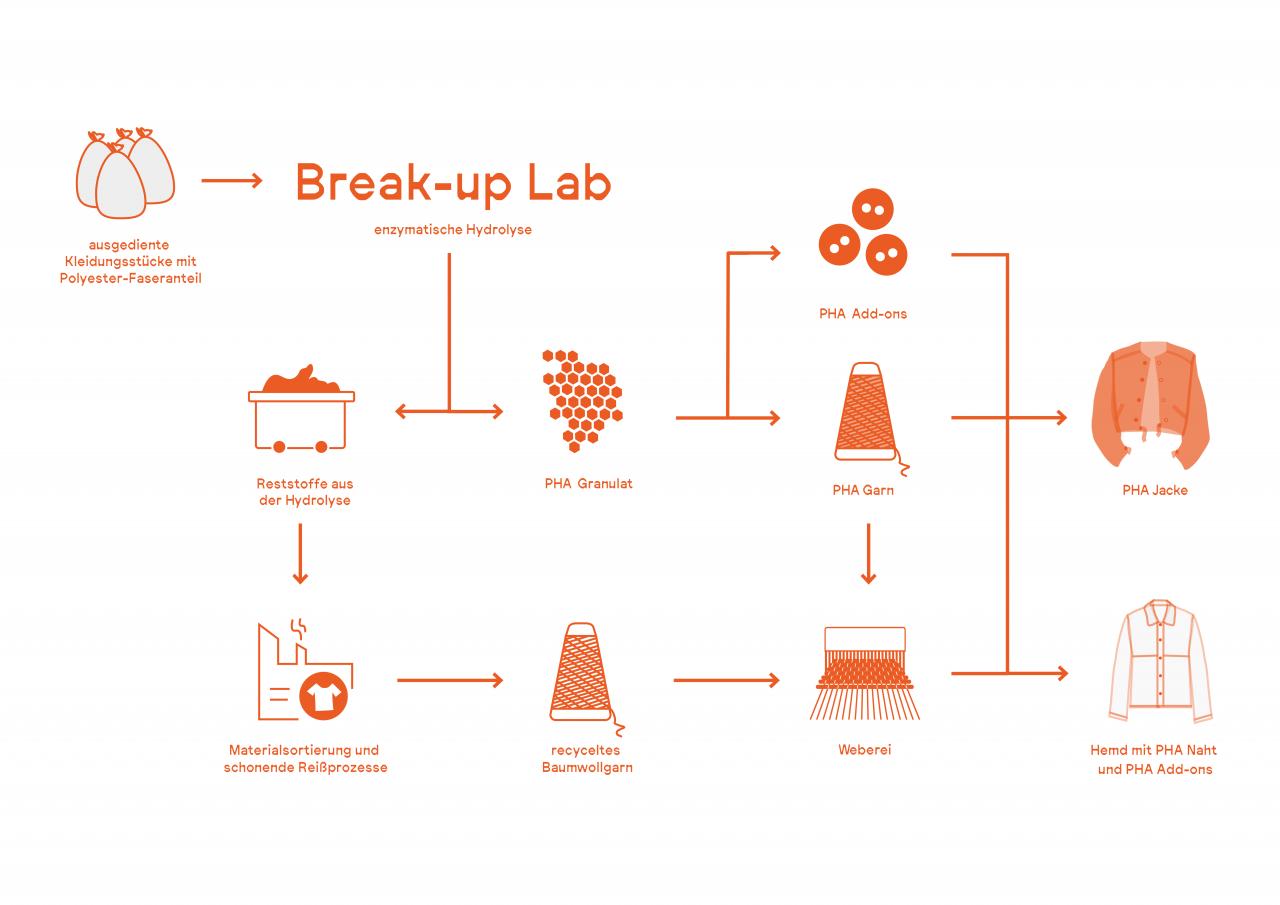
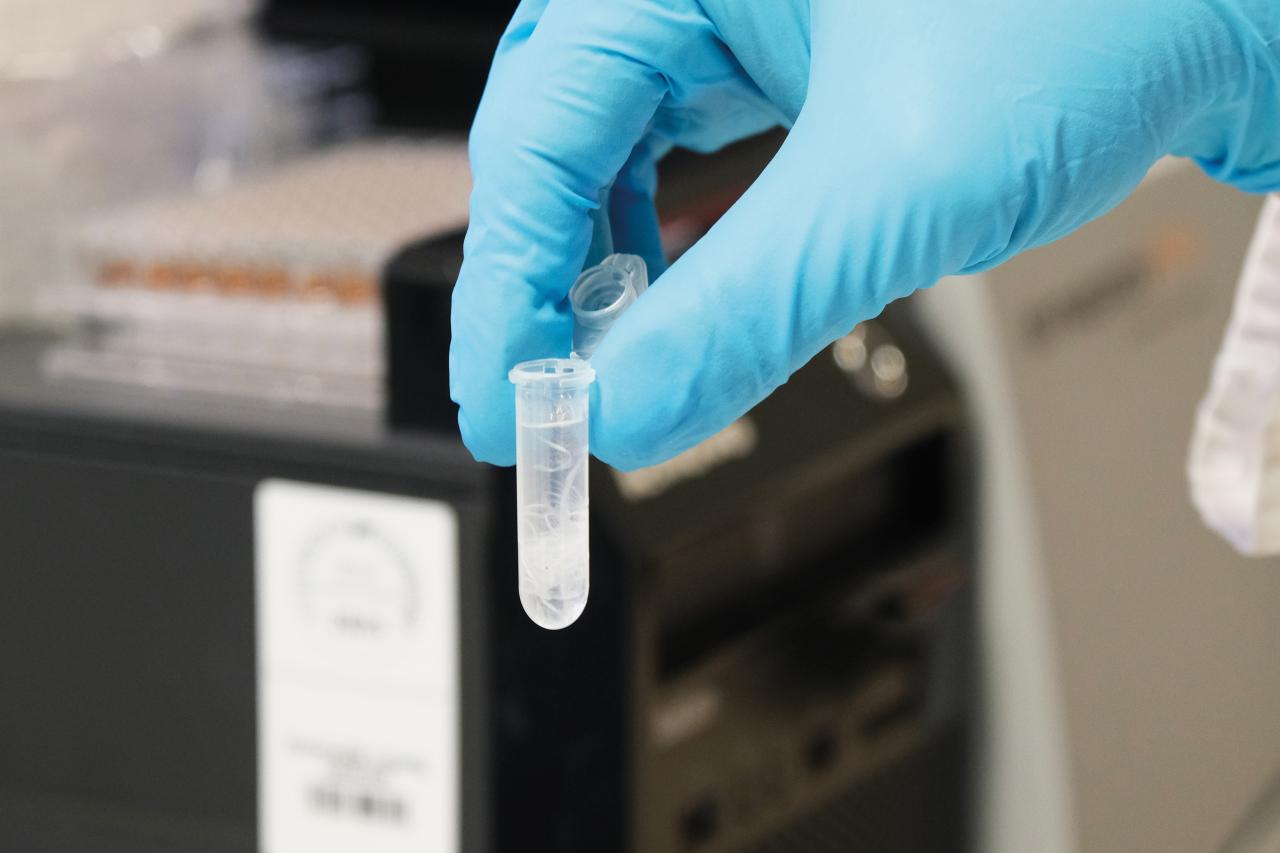
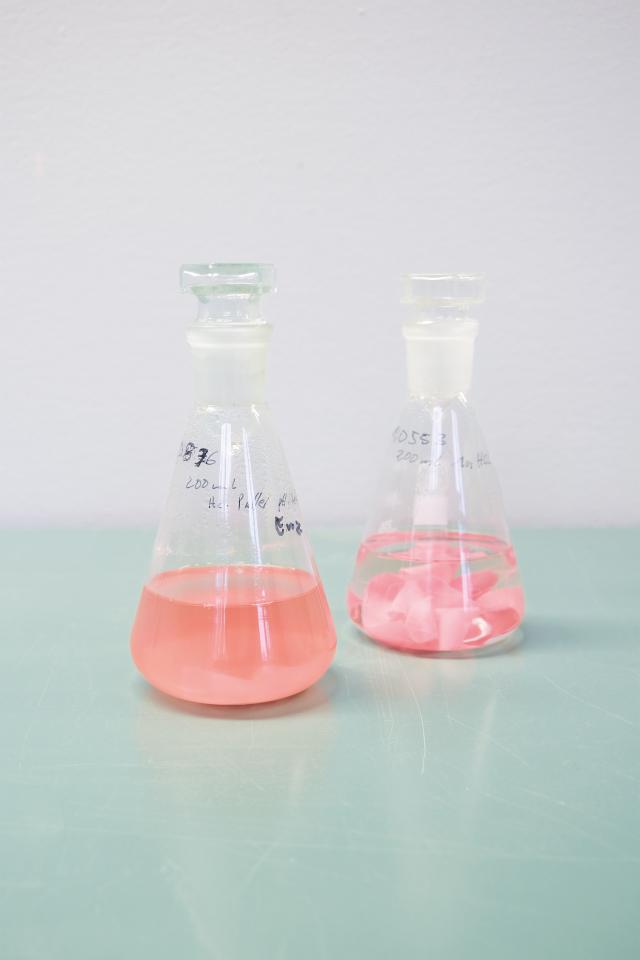
Through the enzyme PHL7, polyester fibers can be split in a biotechnological process within minutes. The recovered basic building blocks of the polymer are then metabolized bacterially into a biodegradable plastic (PHA).
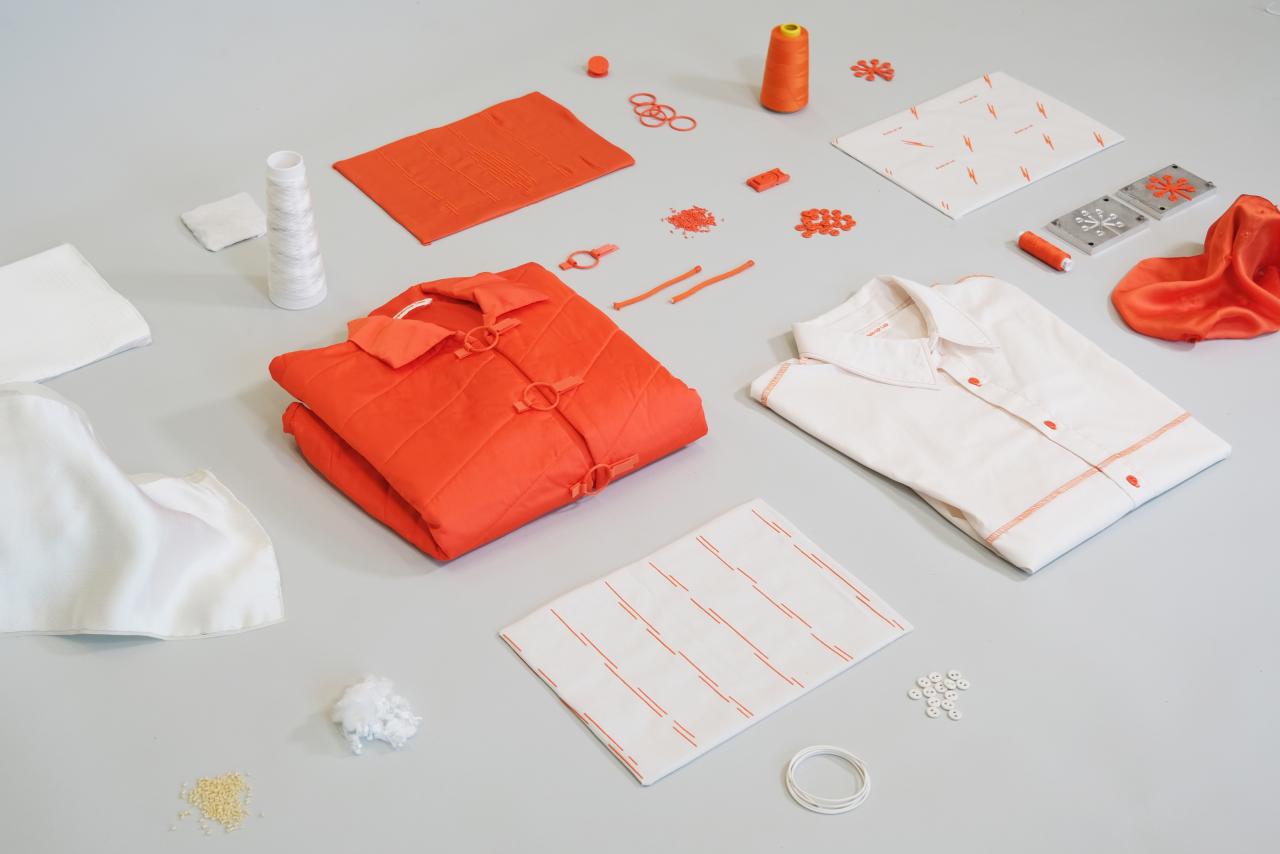
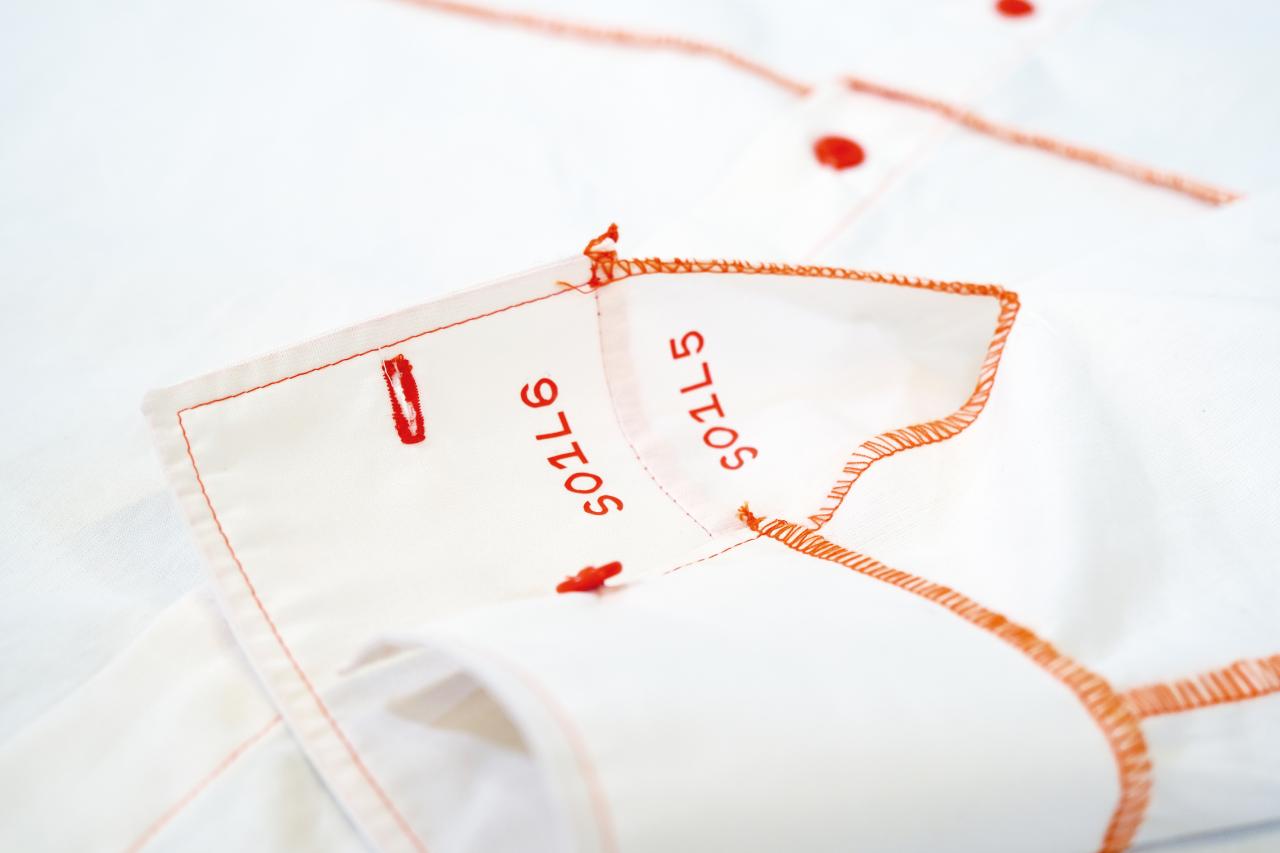
The Break-up Lab produces yarns and add-ons from PHA, enabling the separation of contaminants and thus resource-efficient fiber-to-fiber recycling processes. Using two garments, it is demonstrated how this process can close regional material loops for used textiles in the future. The components of the shirt are connected by PHA seams, allowing the construction to be disassembled after the end of use and reassembled individually. A jacket made solely from PHA showcases the design, economic, and ecological potentials of PHA.
Furthermore, the Break-up Lab develops holistic approaches for the implementation of EU-approved guidelines. Through the MEC collection system, consumers can take on the pre-sorting of their used textiles themselves. The transparent infrastructure for collecting discarded clothing also raises awareness of fiber compositions and informs about the further life cycle of textiles.
Key objectives for sustainability
How can future-oriented and resource-efficient recycling technologies be initiated? In what ways can we generate regional value through the recycling of our old clothes?
The use of recycled materials for garment production offers numerous environmental benefits compared to the energy-intensive manufacturing of textiles from virgin polyester and cotton fibers. In general, reusing discarded textiles reduces the demand for resources and the reliance on synthetic plastics. As a result, less agricultural land is required for cotton cultivation, significantly decreasing the use of pesticides and water. This also helps mitigate eutrophication. Additionally, energy consumption is lowered, as enzymes operate at around 70°C. Toxic chemicals for dyeing and bleaching fibers are also avoided, minimizing wastewater pollution.
Currently, polyester fibers require pre-treatment to accelerate enzymatic hydrolysis, but the necessary chemicals can be fully recycled within the process. In PHA biopolymer production, additives can be omitted since material properties are tailored directly within the bacteria.
Furthermore, utilizing locally sourced textile waste revitalizes regional textile industries, eliminating opaque supply chains and long transport routes. PHA fibers also do not release microplastics due to mechanical stress during use. At the end of life, modular patterns and take-back systems ensure repairability, value retention, and material reuse.
Key objectives for aesthetics and quality
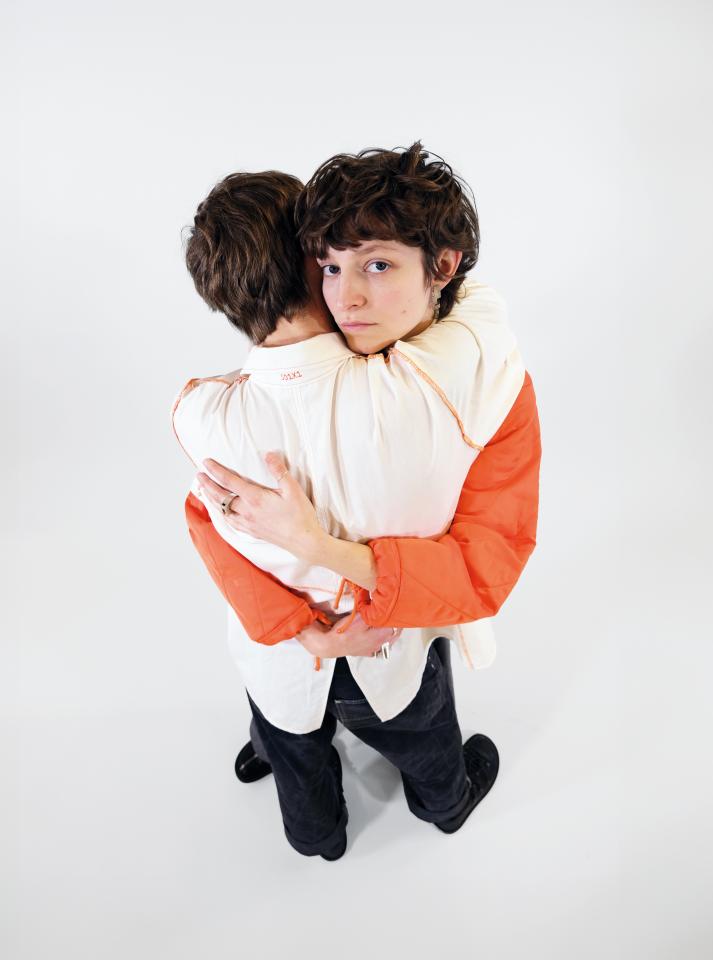
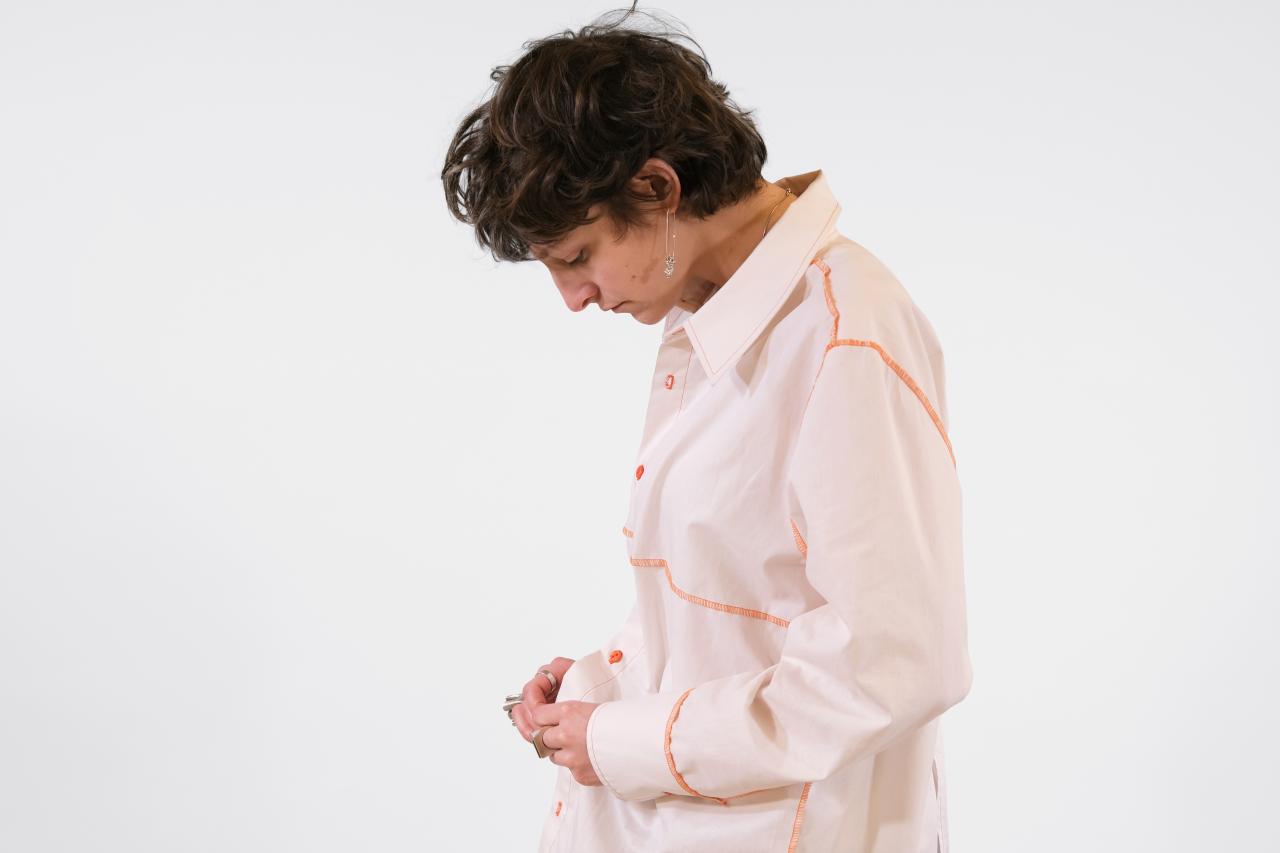
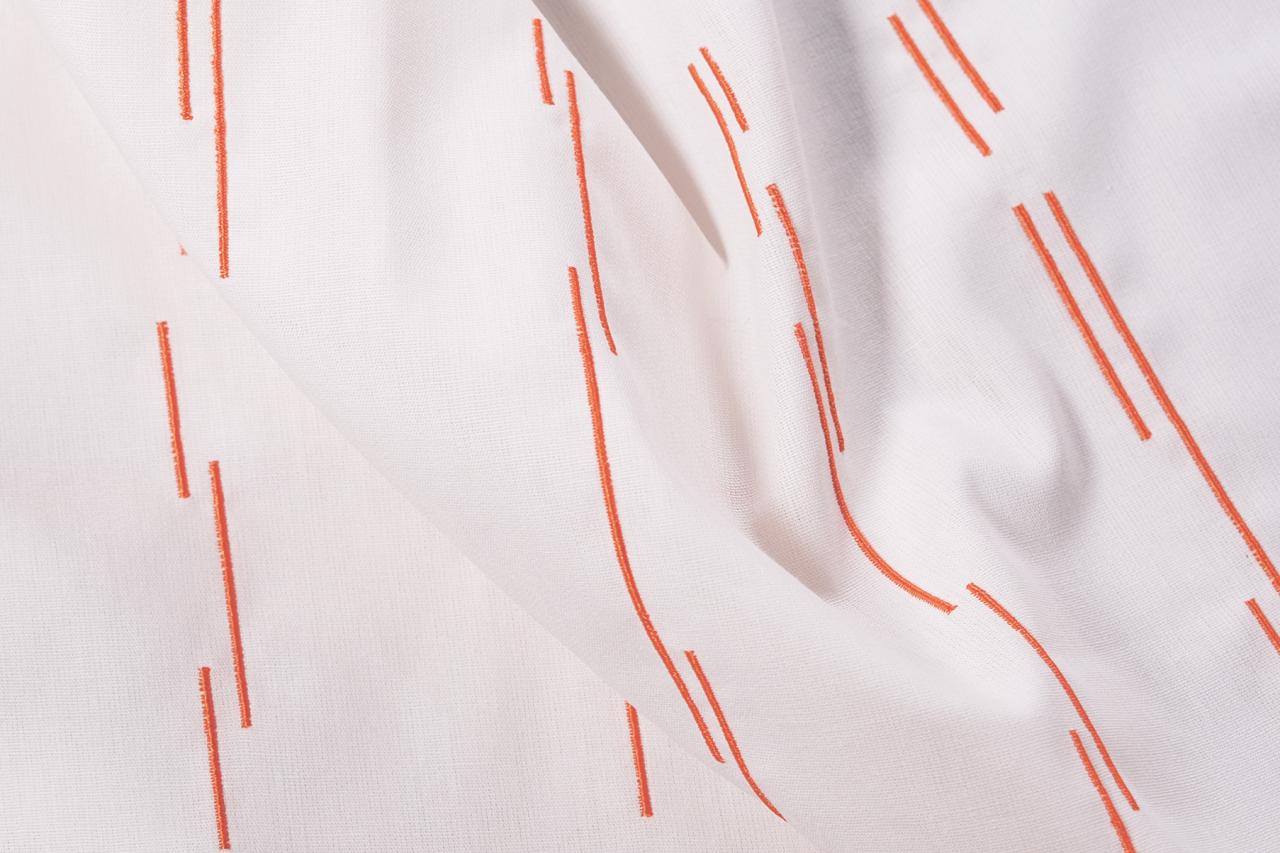
The shirt's cut construction features reversible orange PHA seams, allowing modules to be detached and reassembled after use. Biodegradable PHA embroidery and 3D-printed elements personalize garments without compromising recyclability. PHA also temporarily refines and functionalizes textiles. A jacket made entirely of PHA highlights the biopolymer’s design, economic, and ecological potential. Its mono-material construction ensures seamless reintegration into recycling systems, while its monochromatic aesthetic reinforces circularity.
A deposit-based return system encourages consumer participation in recycling, ensuring long-term material circulation. Local recycling infrastructures support regional economies and sustainable production. Durable, comfortable garments maintain high aesthetic and functional standards, proving sustainability does not compromise quality. The Break-up Lab models circular fashion by integrating biotechnology, fashion design, and user participation. Its modular design and biomaterial innovations offer scalable solutions across industries, promoting transparency, adaptability, and sustainability. By merging technology with thoughtful design, it proves circular fashion can be both visually compelling and functionally superior, setting a new standard where aesthetic excellence and ecological responsibility go hand in hand.
Key objectives for inclusion
Beyond recycling, the MEC Collection System strengthens local reuse networks by connecting secondhand shops with supply needs. Through a digital platform, shops can request specific items—such as black hoodies—which are set aside at collection points until the desired quantity is reached. This streamlines redistribution, reducing waste and fostering a more efficient circular economy.
Adhering to "design for all" principles, the Break-up Lab ensures garments are adaptable to various body types and personal needs. Modular elements, reversible seams, and adjustable components allow users to personalize their clothing, making pieces versatile and long-lasting. Additionally, biodegradable PHA buttons and seams simplify garment disassembly, enabling efficient recycling and reinforcing accessibility.
An inclusive governance model is essential to the project’s success. Break-up Lab engages designers, scientists, and local stakeholders in co-creating solutions, ensuring diverse input and fostering transparent decision-making.
To close the loop, the MEC Collection System repurposes deposit machines into textile collection points in supermarkets. Consumers pre-sort garments and receive a 5 to 50 cent refund based on material type, encouraging responsible disposal. A digital guide educates users on recycling processes, increasing awareness. As the EU’s Separate Collection Law takes effect in 2025, the MEC system ensures an efficient, decentralized infrastructure for textile recycling, promoting transparency and long-term behavioral change.
How Citizens benefit
One major impact of citizen engagement has been the increased willingness to recycle due to the convenience and financial return. By offering a deposit refund between 5 and 50 cents per garment, the system lowers barriers to responsible textile disposal . Moreover, the built-in digital guide educates consumers about recycling processes and the material value of their clothing, encouraging long-term behavioral change toward more responsible consumption .
Beyond individual participation, the MEC Collection System addresses broader environmental and social challenges. Currently, a significant portion of used textiles from Europe is exported to the Global South, where inadequate recycling infrastructure leads to environmental pollution and waste accumulation . By offering a transparent and localized collection system, MEC reduces dependency on exports and promotes regional material reuse. Additionally, collaborations with local secondhand shops enable direct reuse of high-quality textiles, preventing unnecessary downcycling .
The MEC Collection System transforms passive consumers into active participants in circular fashion, reducing waste, strengthening local economies, and fostering a more sustainable textile industry.
Physical or other transformations
Innovative character
Disciplines/knowledge reflected
Methodology used
A key aspect is enzymatic hydrolysis for polyester textile recycling. The enzyme PHL7 breaks down PET at 70°C within minutes, separating synthetic and natural fibers. This enables fiber-to-fiber recycling, preserving cotton for high-quality yarn production while PET is reprocessed into biodegradable PHA (polyhydroxyalkanoates) for garment components like buttons, seams, and 3D-printed add-ons.
Break-up Lab garments, including a modular cotton poplin shirt and a mono-material PHA jacket, are designed for reversibility and adaptability. PHA-based seams and buttons dissolve at low temperatures, allowing easy disassembly and reconfiguration. A unique recycling code, integrated with the Digital Product Passport (DPP), guides consumers in proper disposal and material recovery.
Industrial design plays a key role in fostering collaboration between stakeholders. By translating complex processes into physical prototypes and digital media, design connects science, industry, and policy, making circular textile innovations tangible and scalable.
The project actively involves citizens, policymakers, and businesses. The MEC Collection System repurposes old deposit machines in supermarkets, enabling citizen-driven textile sorting and incentivized recycling, reducing reliance on textile exports to the Global South. Local stakeholders—including weaving mills and social enterprises—support sorting, upcycling, and regional value chains.
By integrating biotechnology, industrial design, and citizen participation, the Break-up Lab pioneers a replicable model for sustainable textile economies, proving that circular fashion can be both innovative and accessible.
How stakeholders are engaged
Locally, citizens shape the MEC Collection System by depositing textiles in supermarkets for a refund. Their feedback improves accessibility, while secondhand shops request specific garments, keeping textiles in circulation and reducing waste.
Regionally, textile recyclers such as SOEX in Bitterfeld (Saxony-Anhalt) and TEXAID provide insights into sorting and recycling challenges. Through on-site visits and interviews, the Break-up Lab identifies technological and logistical barriers to fiber recovery. Cooperation with environmental specialists clarifies the impact of recycling on textile exports and the secondhand market, ensuring reuse remains viable.
Nationally, the project collaborates with research institutions, including Dr. Christian Sonnendecker of the University of Leipzig, whose enzyme research—already applied in PET packaging—advances fiber decomposition for textile-to-textile recycling. The initiative aligns with Germany’s Extended Producer Responsibility (EPR), holding manufacturers accountable for textile end-of-life management.
At the EU level, the Break-up Lab supports the Eco-design Directive and the Digital Product Passport (DPP) for transparent textile tracking. A proposed recycling code system ensures correct disposal even if QR codes degrade. Fully aligned with the EU Green Deal, the project aims to establish an efficient, sustainable textile collection system across Europe.
By integrating expertise from science, industry, policy, and environmental advocacy, the Break-up Lab proves that interdisciplinary cooperation and transparent governance are key to scaling circular fashion solutions.
Global challenges
Germany, and particularly Saxony and Saxony-Anhalt, where the Break-up Lab is based, was once home to a flourishing textile manufacturing industry. This region was a center for spinning mills, weaving factories, and textile innovations, which have largely disappeared due to globalization and offshoring. However, many of the old factory buildings and infrastructures still exist and could be reused and revitalized to support modern, sustainable textile production. The Break-up Lab envisions a future where traditional craftsmanship is rediscovered and revived, where historical textile knowledge is reinterpreted, and where new expertise is generated. By bridging past and future, the project has the potential to create local jobs, strengthen regional economies, and position Saxony-Anhalt as a hub for circular and regenerative textile industries once again.
Learning transferred to other parties
By utilizing enzymatic hydrolysis with PHL7, the Break-up Lab enables fiber-to-fiber recycling, making it more resource- and cost-effective. This process, along with PHA-based yarns and add-ons, promotes a closed-loop system that reduces dependency on raw materials and enhances recyclability. Collaborations with major fashion industry players will further drive scalability and industrial adoption, ensuring that PHA innovations become a standard in sustainable fashion.
The MEC Collection System, with pre-sorting by consumers, significantly reduces costs in textile sorting and recycling, making a pan-European textile recovery network more feasible. Projections indicate that Europe will need around 200 sorting and recycling facilities to efficiently process all collected used textiles for reuse and recycling. The Break-up Lab supports this transition by ensuring that consumers take responsibility for sorting their textiles at the collection point, reducing labor-intensive sorting costs at later stages.
An EU-wide task force is needed to implement the DPP for uniform textile tracking and transparency. The MEC Collection System takes a bottom-up approach, allowing citizens to create recycling codes at home for unlabeled textiles, accelerating textile recycling standardization.
The Break-up Lab’s system is decentralized, allowing for regional or city-level implementation as a first step toward a future EU-wide infrastructure. This approach makes it adaptable to local waste management systems while ensuring full transparency in material flows. By aligning with Extended Producer Responsibility (EPR) and Circular Economy Action Plans, the Break-up Lab paves the way for a Europe-wide transformation in textile recycling.
Next steps
The Break-up Lab will take its next steps by deepening scientific collaboration, securing funding, and launching real-world tests to bring its vision closer to reality. In the first year, the focus will be on advancing enzymatic hydrolysisthrough partnerships with scientists and engineers, making fiber-to-fiber recycling more efficient and scalable. This will lay the foundation for industry adoption, proving that biotechnological recycling can replace downcycling and wasteful disposal with true material circularity.<br />
To transition from research to impact, a company will be founded to drive implementation, attract investment, and position the project within Europe’s growing circular economy landscape. Funding will be sought from EU innovation grants and sustainability programs, ensuring the development of key infrastructures, from biopolymer production to textile sorting solutions.<br />
The first MEC Collection System prototypes will be tested in local supermarkets, allowing consumers to directly engage in textile circularity. This will not only prove the viability of decentralized pre-sorting but also serve as a blueprint for a future EU-wide infrastructure, demonstrating how automated, consumer-driven collection can revolutionize textile recovery.<br />
Beyond technical advancements, the Break-up Lab will actively shape policy discussions, advocating for the Digital Product Passport (DPP) and Extended Producer Responsibility (EPR). By creating a system where consumers can generate recycling codes at home, even existing garments without labeling will become traceable, reducing textile waste before new regulations take effect.