Bauhaus EUROACE Villages
Basic information
Project Title
Full project title
Project Description
Current stage development
Project Region
Municipality
EU Programme or fund
Which funds
Description of the project
Summary
• The rural EUROACE territory has suffered population and economic losses and urban and environmental erosion.
• Villages, as vital centres for the economic and social development of these rural territories, are particularly affected by these changes.
• This project is aimed at economic, social and environmental regeneration stemming from interventions in locally relevant villages that could serve as showcases.
• The process is therefore participative and involve specialists, officials and the local communities to clarify and explore the concepts of NEB as well as to jointly design and implement the proposed interventions, which will serve as catalysts of the intended transformation.
• The project team is multidisciplinary and include at least the following specialist areas: Architecture; Economy; Education; Digital Transformation; Ecology; Agriculture; Arts and Design.
• The landscaping of the identified public spaces is assumed to generate attractiveness, economic and social dynamism, favouring local initiatives and businesses, the sense of ownership and stimulate new uses. Moreover, the use of more sustainable materials, techniques and solutions will result in the creation of spaces that are more economically viable.
• Finally, the actions identified in intervention methodology should stimulate self-esteem and a sense of belonging in the area.
Key objectives for sustainability
The project encourages a holistic approach to sustainable development. It recognises that the well-being and prosperity of the villages and their residents are intricately linked to the health and resilience of the natural systems they inhabit. Therefore, the project seeks to implement strategies that balance the social, economic, and environmental aspects of sustainability.
One of the main priorities of the project is the sustainability of the territory: improvement of the transport and mobility network, promotion of sustainable mobility and accessibility, transformation of the environment into a market value and a transversal element; promotion of sustainable development, leadership against climate change; promotion of new jobs in green activities, clean energies and energy efficiency.
The project can be exemplary in terms of sustainability taking into account climate and circularity objectives, zero pollution and biodiversity and the reduction or elimination of environmental impact, circularity in production cycles, the introduction of the human and cultural dimension, and the economic viability of artefacts, services, places and territories.
NEB Compass:
Amb. I - rethink purpose, focusing on preserving nature and the biosphere, repairing damage
Amb. II - close the loop by reducing linear processes or transforming them into circular ones
Amb. III - regenerate, restore and enhance biodiversity, restoration of nature, valuing and preserving ecosystems and natural resourc
Key objectives for aesthetics and quality
It acknowledges that the charm and allure of these places lie in their unique integration with the surrounding natural environment and their rich cultural heritage. By valuing and protecting this inherent beauty, the project aims to foster a sense of pride, identity, and attachment among the local communities.
The initiative can be exemplary by creating a deeper appreciation and understanding of the value of beauty in rural settings. It seeks to inspire a renewed sense of stewardship and a holistic approach that recognises and respects the unique beauty that already exists. With this approach, the project wants to achieve that the villages continue to thrive as living landscapes of beauty, where residents and visitors could experience the harmony between nature, culture, and collective memories.
NEB compass:
Amb. I - (re)activating the qualities of the context and contributing to physical and mental well-being;
Amb. II - connecting people and places through experience and strengthening the sense of belonging;
Amb. III - creatively integrating new cultural and social values capable of fostering positive change.
Key objectives for inclusion
By valuing inclusion, the project fostered social cohesion and solidarity by considering the needs, aspirations, and concerns of all stakeholders. Through open dialogues and participatory workshops, decision-making processes and interventions were informed by a comprehensive understanding of the community, empowering individuals and communities to shape their future in an equitable and sustainable manner. This inclusive approach strengthens engagement, collaboration, and a sense of ownership, contributing to the creation of a more inclusive and participatory society and increasing the sense of belonging to the place.
The project can be exemplary showing that the only way of improving quality of life for villagers is working together and joining efforts in different sectors.
This participatory process that has been adopted with a multi-level engagement and a transdisciplinary approach will contribute to overcome the obstacles caused by demographic challenge in rural areas and will highlight the power of villages to address issues like climate change, food security, and sustainable development.
New networks and connections are being created and villages are using this principles and methodology in most of their activities.
NEB compass:
Amb. I - ensure equal treatment and access regardless of gender, racial or ethnic origin, religion, ability, age or sexual orientation; ensure accessibility and affordability.
Amb. II - consolidate, equalising relationships between people and communities, with equality and social justice.
Amb. III - transform, inspire new ways of living in community, foster solidarity and cooperat
How Citizens benefit
Local communities and actors were involved from the outset through meetings with AT staff - local visits and meetings - and were invited to participate in local participatory workshops where a detailed approach to each village was developed.
This process has enabled:
- empowered individuals and communities;
- allowed communities to analyse their challenges and potential;
- honoured the aesthetics of the human landscape they and their predecessors have created;
- recognised the role they can play in designing solutions for their Village;
- increased self-esteem;
- strengthened the sense of belonging;
- allowed the community to see a "light at the end of the tunnel", to feel that the Villages are viable and that the light can come from Europe and European policies. This realisation, for peripheral communities, brings the construction of Europe closer in every way.
The benefit of local communities recognising their role and taking control of their future has also had a contagious effect, both on local and regional politicians and on potential investors who have woken up to the potential of these areas.
It overcame inertia, created a movement that was felt to be imperative by political actors and contaminated and committed political decision-makers.
Recognising Europe's role.
Allowed recommendations for public policy and policy innovation.
Innovative character
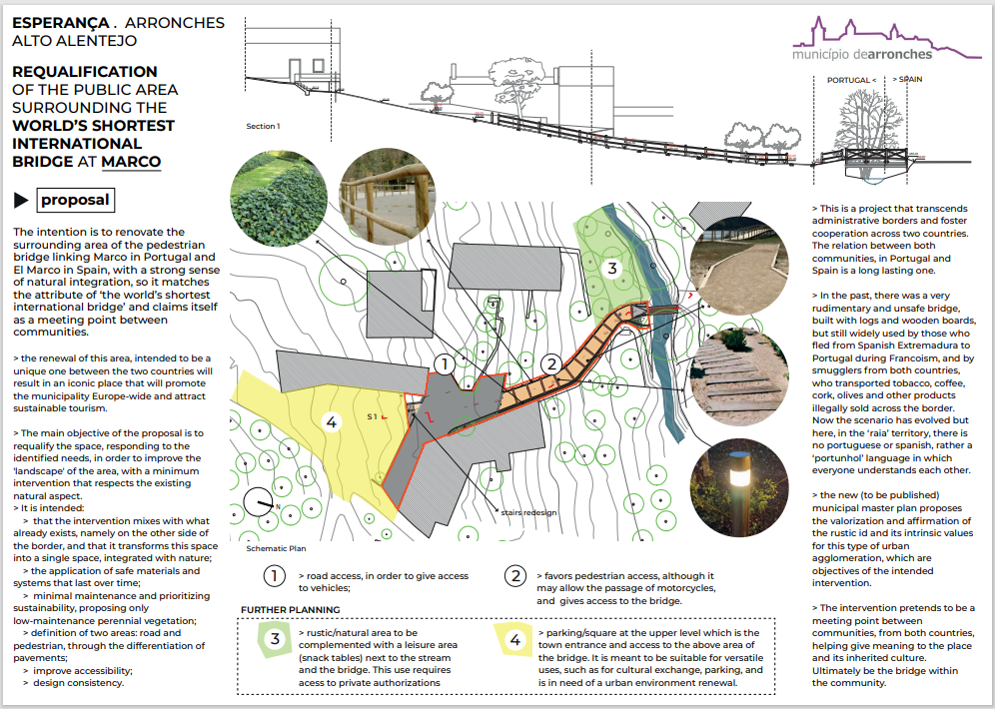
• Scale and focus: 6 villages, 3 regions and 2 countries; definition of a cross-border cooperation network based on the villages;
•Looking to the future through the lens of Villages rather than the most competitive territories or the sectoral approach;
•Confirmation that a combined policy approach is the right one for this type of territory and the internalisation of the concept by policy-makers; innovation in public policies.
Disciplines/knowledge reflected
From municipalities we had architects, engineers, economists, planning and development experts, teachers and archaeologists.
From the Polytechnic Institute of Castelo Branco we had designers and an environmental engineer.
Collaboration and coordination have been close and always complementary, both in terms of areas of specialisation and in terms of understanding the realities and vision of the future.
interdisciplinary approach enabled a more comprehensive and integrated vision, making it possible to connect knowledge from different areas and providing a more complete and in-depth understanding of problems and challenges.
Greater creativity and innovation, stimulating new ideas, approaches and solutions that would not arise within a single area of knowledge.
Improved problem-solving, facilitating the construction of more effective responses adapted to reality.
Methodology used
•The project keep to ensure the involvement of a diverse range of actors, creating opportunities for meaningful participation and actively seeking the input of community members, local organisations, government agencies, and other relevant entities;
•Valuing inclusion, keeping foster social cohesion and solidarity by considering the needs, aspirations, and concerns of all stakeholders.
•Using open dialogues and participatory workshops, decision-making processes and interventions informed by a comprehensive understanding of the community, empowering individuals and communities to shape their future in an equitable and sustainable manner;
•Co-creation methodologies;
•Awareness-raising with the various managing authorities to obtain financial support for the action plans defined.
How stakeholders are engaged
• Sponsors and co-sponsors: Municipalities of Pampilhosa da Serra (Dornelas do Zêzere),Sabugal (Sortelha), Arronches (Esperança), Reguengos de Monsaraz (Corval), Moraleja and Llerena; including policymakers and technical elements from different areas;
• at the regional level, the Centro and Alentejo Regional Coordination and Development Commissions and the Regional Government of Extremadura, as constituent entities of EUROACE (a cross-border Euroregion that includes the NUTS 2 regions Alentejo, Centro and Extremadura (Spain-Portugal https://www.euro-ace.eu/en)),involved in defining the strategy “EUROACE as Home” since 2021;
• Historical Villages of Portugal Association and Schist Villages Association, included in the “EUROACE as Home” process in 2021;
• Parish Council of Dornelas do Zêzere; Parish Council of Sortelha; Parish Council of Esperança; Parish Council of Corval;
• Local communities of each one of the Villages, specifically the users of the proposed space and public structures;
• Local artisans and craftsmen.
Entities involved in the first stage:
• Polytechnic Institute of Castelo Branco – realisation of participatory workshops in the 6 Villages; and the drafting of ‘EUROACE_NEB - EUROACE Strategy for Bauhaus Villages’;
• Local schools: 200 children from basic schools of the 6 Villages with their teachers were invited to design/dream their “Village of the future” with NEB values and to present them during the Celebration of European Day in Dornelas do Zêzere 2023;
• Cultural organisations: participation in various activities and in the EUROACE Bauhaus Villages public events
• Business and local associations, Associations of local producers: participation in local participatory workshops
• National Agencies and National Government participated on the Public Events of the Network of Villages for Future – Bauhaus EURAOCE Villages.
Global challenges
In essence, villages embody a promising vision for a more balanced and sustainable future, where the inherent charm of rural life can play a central role in addressing today's challenges.
The idea of the 'metamorphosis of the rural' encourages a shift in perspective, emphasising the potential of rural areas as catalysts for global change.
It highlights the importance of bridging the rural-urban divide, fostering cooperation and harnessing the unique strengths of rural communities.
This 'metamorphosis of the rural' recognises the changing landscape in which rural areas are no longer isolated, but interconnected between them and with urban centres.
It recognises that rural issues, such as population decline and environmental concerns, are intertwined with wider global issues.
By prioritising local efforts, rural communities can make an effective contribution to tackling issues such as climate change, food security and sustainable development.
Many Villages in the EU are located in ecologically important areas, such as nature parks, biosphere reserves or regions rich in biodiversity. Protecting and managing these natural landscapes in and around Villages is crucial for the EU's environmental objectives, such as preserving biodiversity, mitigating climate change and ensuring sustainable land use practices. Villages can serve as examples and models of sustainable living, highlighting the importance of environmental stewardship and promoting harmony with nature. Supporting villages’ development ensures that economic, social, and cultural opportunities are accessible to people in rural areas, reducing regional disparities and promoting cohesion across the EU.
Learning transferred to other parties
Two Village networks in the Centro region, the Association of Historic Villages of Portugal (12 Villages) and the Association of Schist Villages (27 Villages), were involved from the beginning of the process, with the aim that the remaining Villages in the networks would be able to transfer the results of the pilots to the Bauhaus Villages of EUROACE.
The methodologies used and the application of the NEB approach to rural and cross-border areas - common throughout Europe - are transferable.
The knowledge gained about this type of area and the identification of the combination of policies as an approach with a greater potential for success is also transferable; it can be used in other areas;
The results achieved in terms of empowerment and commitment of local communities and actors, as well as strengthening self-esteem and a sense of presence, confirm the potential involved and aroused the interest and attention of other communities in the surrounding area and the region, which demonstrates the action's potential for dissemination and replication.
Next steps
As outputs of the Network of Villages for the Future – Bauhaus EUROACE Villages (NEB Pampilhosa Project.10 ) we have:<br />
•Fueling Stakeholder Engagement <br />
•The Conceptual Framework <br />
•The Creation of the BAUHAUS EUROACE VILLAGES NETWORK <br />
•A Policy Brief<br />
In the context of the Interreg V-A - Spain-Portugal (POCTEP) Programme 2021-27, which includes Policy Objective 5 (PO5), in the cooperation Alentejo – Centro – Extremadura area, the identified Functional Area is centred on the Bauhaus Villages which comply with the Network of Villages for the Future.<br />
As a result, the EUROACE Bauhaus Villages Strategy - linked to PO5 (Cross-Border Functional Area) - has been created as a follow-up to the Network of Villages for the Future project, which will serve as a cap for specific calls for proposals for the 6 villages and the surrounding area, allowing the work to continue in an articulated and systematic way, and making it possible to implement some of the material projects identified. The approach advocated in this strategy is also based on the principles of the NEB.<br />
The call for proposals for OP5 is scheduled for April, so it will be possible to continue the activities of the EUROACE Bauhaus Village Network.<br />
In the case of some of the Villages in the network, specific action plans have been prepared within the framework of the NEB values, which also identify potential sources of funding and private investment.<br />
In the case of Centro Portugal Region Villages it is important to mention that they were included on the Regional Spatial Planning Plan as Pilot Projects of Regional Interest.<br />
Thus, with the strategic documents as working tools, always within the framework of the NEB, the interventions in the villages will continue.<br />