4th nature 5th facade
Basic information
Project Title
Full project title
Category
Project Description
Current stage development
Geographical Scope
Project Region
Urban or rural issues
Physical or other transformations
EU Programme or fund
Description of the project
Summary
Our project reinterprets tiled roofs as a platform for Nature to grow and evolve in a wild way, creating a self-sustaining, self-governing, adaptive layer that contributes to water and moist management, carbon sequestration, air purification, and interlinks natural sites, forming a continuous natural ecosystem.
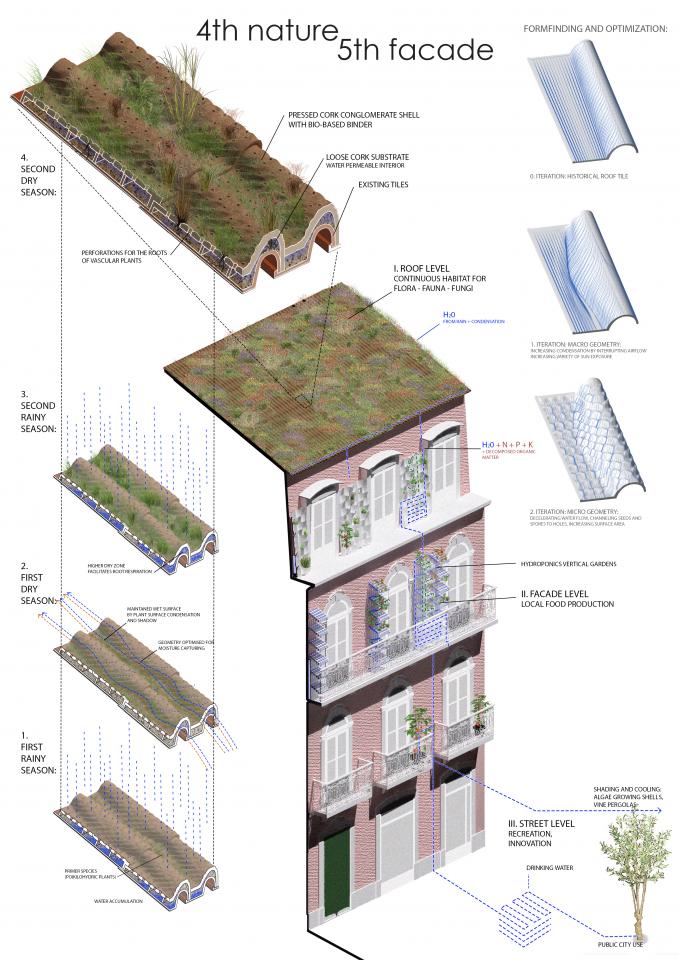
The project consists of a bio-receptive layer, which can be attached to the existing roof and provide for plant growth. The micro-surface is designed to capture and channel seeds and spores, while articulating areas in and out of waterflow. The macro-geometry channels airflow, increasing condensation in arid climates, and further decelerates rainwater rundown. Pioneer poikilohydric species form a primer ecosystem, stabilizing microclimate for further species to root into the substrate filled middle layer.
By following principles of distributed design and proposing locally available material, the solution can spread and a continuous ecosystem can form. The project intends to establish a new infrastructure, which can also serve as the base for additional future systems - such as urban food production - to plug in, promoting urban self-sustainability.
The project targets municipalities, local residents, communities, local businesses and other stakeholders. It invites municipalities to make policies and incentives towards owners. It can later welcome local resident communities to collectively manage resources, and reinterpret other urban spaces.
Key objectives for sustainability
1. Accelerate the sustainable transformation of the cities toward biomaterials, low-carbon technologies, and more inclusive and decentralized fabrication methods.
2. Improve the resilience of the city centers in the terms of human and biological livability
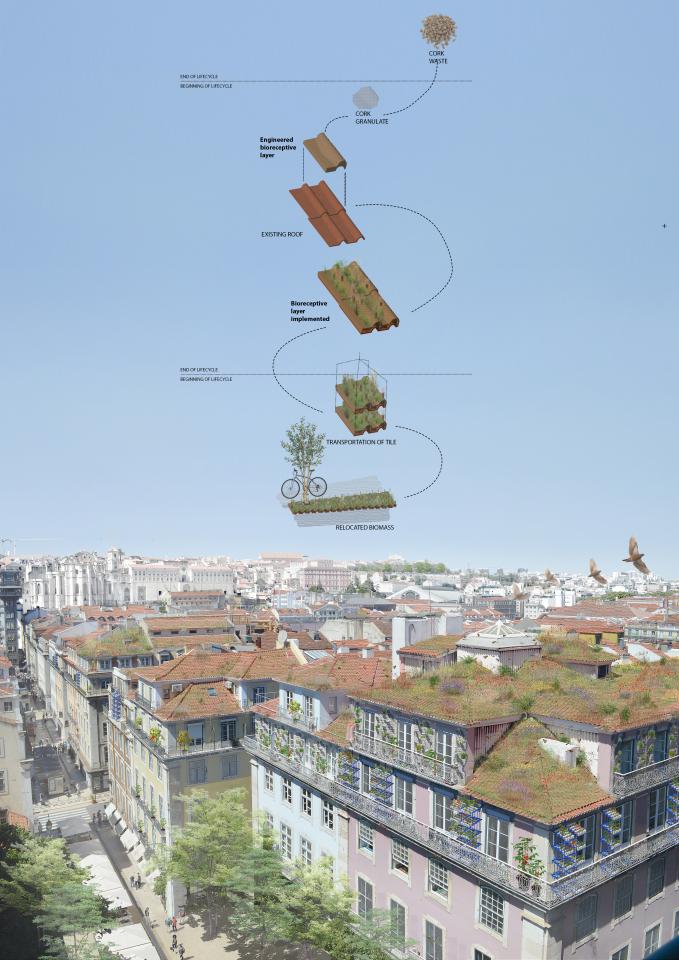
To promote the sustainable transformations of cities and to strengthen the circular economy, we use waste cork, existing ceramic tiles, and apply low-energy fabrication. We intend to work out a locally distributed production method to make the product, and an easy on-site application without dismantling the roof.
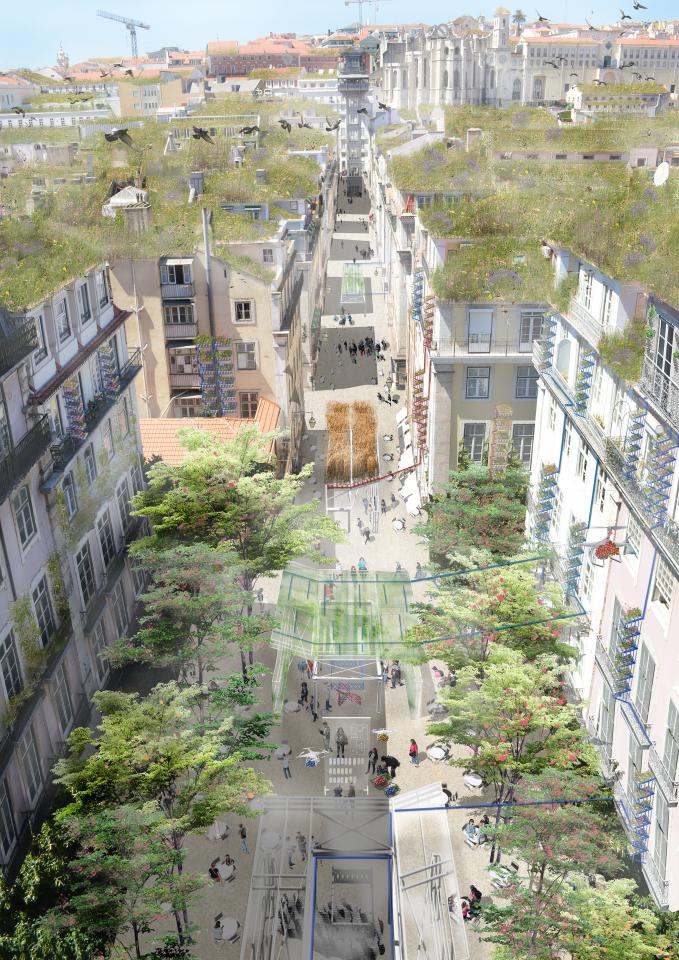
Our other objective is to sustain the quality of urban life. In the short term this includes delaying and distributing water rundown during heavy rain, while in the long term we hope that this new infrastructure can create a better local microclimate and provide possibilities to turn streets and neighbourhoods into self-sustainable communities. For example, by transforming the roof into a natural ecosystem, as a byproduct we gain nutrient rich water (decomposed carbon, fixed nitrogen, potassium, etc.) which could be used for food production on the facade and street levels (promoting local urban farming, reducing the use of transport energy, synthetic fertilizer, and all other disadvantages of intensive agriculture.) The green infrastructure also promotes the resident’s objective and subjective wellbeing, such as improved air quality, reduced urban heat island effect, visual contact with nature complexity and aesthetics, making urban life sustainable in the long term.
Beyond sustainability, the project promotes a regenerative approach, along which we give back to Nature.
Key objectives for aesthetics and quality
While our surface was engineered for bio-receptivity, water retention, and moisture capturing, we managed to match it with the geometry of the historic tile. It was important for us to come up with the design, which doesn’t result in the disruption of the built environment during the entire life cycle of the project - with or without plants. We tend to consider our approach rather a continuation of the existing.
Furthermore, after “wild life” developed on the surface, the urban landscape is enriched by a new source of beauty, where the designer and curator is Nature itself. The aesthetics of a “wild” meadow lies in the complexity and repetition of patterns, and the natural wisdom when it comes to composition.
Due to the topography of Lisbon, most of the roofs are visible from public places such as higher positioned streets or viewpoints, and from the private windows and balconies of the inhabitants. Gaining regular visual access to Nature also offers a deeper experience of beauty, which is the awareness of growth, change, cycles, movement and dynamics.
Key objectives for inclusion
To ensure a wide adaptation of the product, the design is going to be made open source, together with the results of the research, prototyping and test phases to invite future upgrades or reinterpretations by other researchers and developers. We use cork, as it is a locally accessible material in Portugal, and our aim is to develop a low-tech, low energy intake fabrication process, which can be executed in a fab-lab environment. This way we make the product cheap and accessible, as the goal is to scale it in a distributed manner, through local designers, makers, owners, municipalities and other stakeholders.
We also want to ensure that the product can be easily and safely implemented with no special tools or expertise. This add-on relies on the existing tiles, but not the other way around, behaving as an independent layer. Its modularity further increases its independence, as the intervention can vary from several tiles to the entire roof. This lowers the threshold of getting involved as a stakeholder, maximising inclusivity.
If the project is properly implemented, it also unlocks new resources, such as nutrient rich water, therefore it is essential to introduce inclusive governance actions. One could be the establishment of collectives of local inhabitants to make sure that everybody can equally benefit from the intervention.
How Citizens benefit
On the other hand the civil society is involved in the systemic reformation of the city. Top-down and bottom-up actions need to be taken in parallel with each other. While policy making and incentives help the project to be realised and empower the locals to claim and use urban surfaces in novel ways, inhabitants and local businesses should take advantage of these policies and resources establishing food production and other ways of water management individually or collectively. Their role is to promote the roof transformation, take action in participatory design of streets and other surfaces, and share knowledge.
Beyond direct benefits, there are also indirect benefits. The roofs acting as wildlife corridors also increase the biodiversity of urban parks, making them more resilient to change, requiring less human effort to maintain. These corridors can facilitate movement of animals, for example benefiting honey production, and provide habitat as well, for example to birds which feed on mosquitoes, while the physical separation of human and non-human living spaces - street level and roof level - reduces the change of confrontation.
Physical or other transformations
Innovative character
Compared to existing roofing solutions, our design is a major improvement on the aspects of sustainability, biodiversity and climate resilience in the cities. It also offers a chance for more local and community oriented production.
Disciplines/knowledge reflected
During the development of the project Biology, Material science, and Computational design were directed into a dialogue, where the microscopic and macroscopic requirements, behaviours, and formations interconnectedly evolved.
Methodology used
How stakeholders are engaged
After improving the concept, we contacted FabLab Lisboa, to start our physical research phase. We collaborate with them to bring the project further to a prototype stage. FabLab being an open source and distributed design hub, also contributes to open up the design and development process, and involve more individuals and stakeholders in the early stage. We aim to already include the municipality, as it operates FabLab.
In the prototype implementation phase we aim to cooperate with a local stakeholder (e.g. a local cultural and social cooperative, such as Largo Residencias), to build a test pavilion in a semi-public space (e.g. Jardins do Bombarda in Lisbon).
In the implementation stage the project relies on policymakers and municipality incentives. The owners should be incentivised by the municipality to make the improvements on the roofs. Local businesses, who already use the streets with tables and sun-umbrellas are incentivised to turn these into solutions combining shading with food production, as they receive the possibility to take advantage of nutrient rich water.
Global challenges
It is proposing a local design solution for rehabilitation and upgrade of roofing structure in the city of Lisbon and promotes circular economy through exploration of natural and recycled materials (cork and ceramic wastes).
The project is responding to the growing problem of disconnection between urban and natural habitats and its trying to regenerate natural ecosystems in the city centers with locally available resources and infrastructure.
Learning transferred to other parties
Next steps
Future development of the project envisages an involvement of different institutions and stakeholders. First step is to contact the local research institutions and companies in the field of engineering and sustainable design (ULisboa, Susdesign) to propose research projects investigating the potential of bio-receptive surfaces and development of the design prototype.<br />
<br />
We are planning to apply the product on a pavilion first, to be able to access and monitor. In this phase we can collaborate with the public sector (gardens, libraries, cultural centers, etc.) and build the pavilion in a semi-public outdoor space. This pavilion consists of the roof, connected to a vegetable garden around it.<br />
<br />
Further development includes dissemination of research results and design specification. Our functional prototype data will be published open source, together with papers showcasing the early research results. Final phase of the project includes building engagement and participation around transforming the city roofs into living spaces. <br />
<br />
We present the project to the public organizations and policy makers (Municipality of Lisbon). In this phase our aim is to collaborate with the property owners and other stakeholders to work out urban scale implementation.