+1,4°C
Basic information
Project Title
Category
Project Description
Current stage development
Geographical Scope
Project Region
+
Flanders (Tasibel Industry + Spinning Mill), Belgium
Urban or rural issues
Physical or other transformations
EU Programme or fund
Description of the project
Summary
My research on thermal comfort began in the summer of 2023 when I started questioning the use of survival blankets placed on the windows of buildings. This material, originally intended to save lives in emergency situations, caught my attention and strikingly illustrates here the need to protect ourselves from the heat.
As a textile designer, I sought to resolve these questions: What solutions can we consider to better insulate our buildings without compromising our luminous and visual comfort ? How can textiles meet the need to make our living spaces better insulated, viable, and adapted to tomorrow’s climate? How fabrics can be as a flexible, durable, "low-tech", economical, and low-carbon alternative against the heavy and rigid materials of architecture? What materials and fibers available in our territory could offer effective protection against heat? And finally, how does the aesthetic of each material influence or guide its use in a given context?
In this research, I have explored, experimented with, and prototyped two different materials. On the one hand, I worked with microperforated advertising tarpaulins made from synthetic fibers, as part of a reuse initiative applied in a precarious context within the premises at Recyclart (ASBL) in Brussels. On the other hand, I explored the weaving of sisal, a natural and biodegradable fiber, which I was then able to prototype on an industrial scale thanks to the Belgian company TASIBEL, specialized in the spinning and weaving of this fiber.
Key objectives for sustainability
My search for a textile with excellent thermal properties : resistant to the elements and permeable to air and light : led me to identify technical fabrics made in Europe from synthetic fibers. I noticed that their composition is similar to that of microperforated advertising tarpaulins, ubiquitous in our urban landscapes, which prompted me to work with this material. Although robust, these tarpaulins have a limited lifespan and, once their advertising campaign is over, they become waste that is often incinerated, thus contributing to pollution. Repurposing them into solar protections offers a sustainable solution, giving these materials a second life while reducing their environmental impact. Recyclart (an ASBL in Molenbeek) was the ideal place to experiment with this approach.
While repurposing advertising tarpaulins offers promising perspectives, it is equally essential to explore natural fibers qualities. A second research axis focuses on the efficiency of sisal fiber : a biodegradable, robust plant fiber resistant to tension and wear, with insulating properties able to protect us against heat waves. Reimagined to develop exterior solar protections, sisal is used in front of windows and terraces as a thermal architectural envelope. This work is carried out in collaboration with TASIBEL, an belgium company that has been spinning and weaving sisal fiber since 1923.
Key objectives for aesthetics and quality
The proposed aesthetic is both synthetic and industrial. According to the printed advertising message, a play of decomposition and recomposition of the surface is created, evoking the assembly of a giant puzzle. Building on this process, this part of the project could also take on a social dimension for the residents of a building by allowing them to redesign their façade. In the process of breaking down and reassembling surfaces, an additional enhancement is achieved by incorporating foil waste. Foil is a reflective metallized film used to adorn wallpaper. By integrating this foil onto the tarpaulins, I can create a reflective surface at will, which optimizes solar protection while artistically enriching the printed composition.
For sisal :
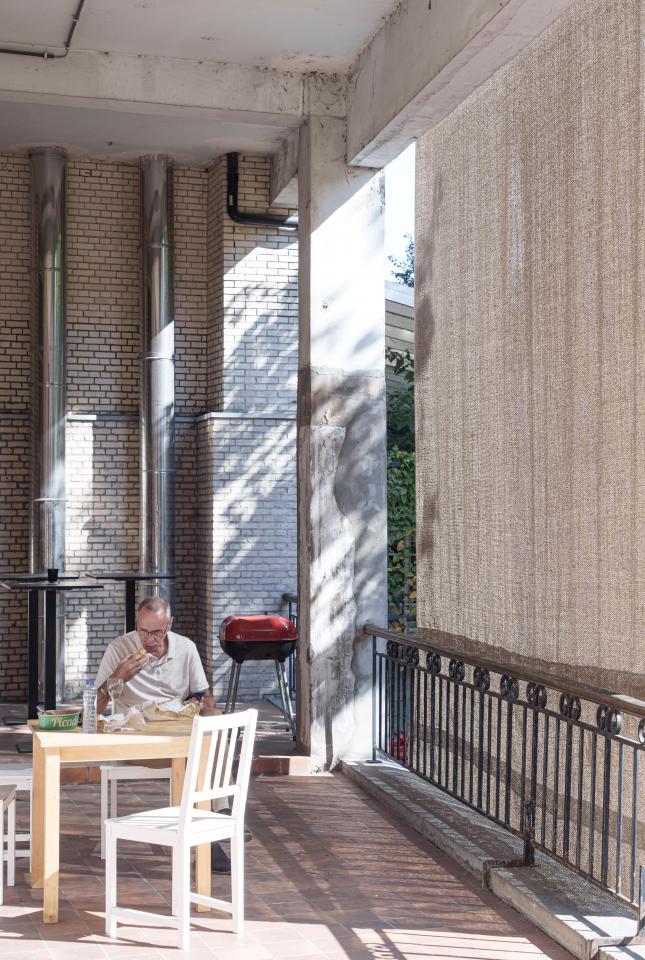
The use of sisal in this project is based on an ethical and aesthetic choice. In addition to its inherent thermal and insulating properties, this fiber stands out for its plastic, sensory, and olfactory qualities. As a truly living material, sisal reacts to climatic conditions: it stiffens in the rain and gradually softens under the sun. Its scent, evoking that of the sea or a wheat field, also intensifies with climatic variations. Moreover, when arranged vertically as a curtain and in the process of drying, the wet fiber, carried by the wind, enhances its cooling effect. The openwork in the weave promotes free airflow, creating natural ventilation that accelerates drying while providing visual permeability to the outside—allowing one to see without being seen, thus preserving privacy and diffusing a soft light within the inhabited space.
Key objectives for inclusion
How Citizens benefit
As for the first industrial sisal prototype, it was tested on two terraces in Brussels. From a sensory perspective, the weaving creates a cooler sensation, thanks to the shade provided by the textile and the fibers’ ability to block heat, thereby reducing the feeling of warmth. Users appreciated having lunch outdoors while being protected by this curtain.
Physical or other transformations
Innovative character
For Sisal : Sisal, a natural fiber traditionally used for ropes and carpets, is repurposed here for outdoor thermal curtains. Thanks to its insulating properties, durability, and thermal regulation, it offers an innovative solution for heat protection. As a biodegradable material, sisal has a significantly lower environmental impact than synthetic fibers. Derived from the agave sisalana plant, it requires minimal pesticides and fertilizers, making it a sustainable resource. Moreover, throughout its lifecycle, the plant absorbs more CO₂ than it emits, further increasing its ecological value.
Although sisal is not currently cultivated in Europe, it grows wild in some Mediterranean regions. With climate change, could its European cultivation become viable?
TASIBEL sources raw sisal from Kenya. The spinning mill produces yarns of varying thicknesses, enabling customized textiles.
+1.4°C project depends on key partnerships. ASBL Recyclart played a crucial role in building experimentation, while TASIBEL provided expertise in sisal processing. Specialized in sisal spinning and weaving since 1923, TASIBEL is renowned for its high-quality carpets and craftsmanship. It is among the few European companies managing the entire production process, from raw fiber to finished textile.
This project redefines the use of two materials—one synthetic, one natural—while promoting local, cooperative production within an ecological and social transition.
Disciplines/knowledge reflected
Methodology used
1. Theoretical research and exploration of locally available materials.
2.Selection of materials based on their thermal, structural, and aesthetic properties.
3. Plastic experimentation, including :
-Surface organization and colorimetry studies.
-Work on advertising tarpaulins: application of metallic films (foil), cutting and assembling surfaces, facade composition, and analysis of fastening and curtain opening systems to adapt to weather variations.
-Sisal: exploration of its thermal and structural properties (patterns research...), colorimetry studies, and investigation of architectural fastening systems (woven experiments).
4.Co-creation and collaboration with industrial and cultural stakeholders :
-Partnership with TASIBEL for the development of sisal prototypes,
-Real-world experimentation on a building with Recyclart.
5.Industrial prototyping of sisal, testing its performance and feasibility in production.
6.Architectural-scale experimentation, combining the installation and observation of tarpaulin and sisal-based systems in real-world conditions.
This methodological approach, which combines artisanal research and technological innovation, while adhering to circular economy principles and integrating external stakeholders, ensures a project that is flexible, sustainable, and adapted to the challenges of ecological transition.
How stakeholders are engaged
During my meeting with TASIBEL, I presented my samples as well as the project concept. Then proposed that they take on the challenge of rethinking the use of sisal—not as an interior floor covering, but as an exterior thermal curtain. TASIBEL expressed strong interest and great curiosity in this new perspective. The company became my sponsor for this research and enabled me to adapt my handmade weavings to an industrial Jacquard loom for the creation of the first prototype.
Global challenges
On the one hand, in response to climate change, this project aims to adapt our habitats to evolving climatic conditions, particularly by improving thermal insulation and reducing our dependence on energy-intensive systems. By reusing materials destined to become waste, such as advertising tarpaulins, and by promoting natural resources like sisal fiber, it follows a circular economy approach, contributing to the reduction of carbon footprint and the sustainable management of resources.
On the other hand, by actively involving businesses, citizens, and policymakers, the project addresses social issues and the need to include all stakeholders in the ecological transition. It supports a soft transformation of our buildings, encouraging the creation of collective works and thereby strengthening social cohesion.
This project demonstrates how local initiatives can come together to create a synergy of knowledge and take collective action to adapt to global challenges.
Learning transferred to other parties
Participatory Methodology and Inclusive Governance (tarpaulins) : A co-creation approach could actively involve citizens and local stakeholders from the outset, fostering collective ownership and adapting solutions to community needs.
Material Reuse and Circular Economy : Transforming waste materials (notably advertising tarpaulins) into solar protection solutions follows a circular economy model. This process can be replicated in cities facing similar waste management and resource challenges, and it applies to both urban and rural environments.
Transfer of Technological Know-How : Adapting artisanal techniques (such as hand weaving) to industrial processes (Jacquard looms for thermal curtains) creates opportunities for innovation. This production model, merging tradition and modernity, can be replicated by other stakeholders developing sustainable products.
Sisal was chosen for its strength and adaptability, particularly since the spinning mill can produce thick, weather-resistant yarn. Hemp is a strong alternative, as it grows naturally in Belgium. Its industrial production, long absent, is gradually reviving. Once hemp yarn is available in greater thicknesses, it could be explored for thermal protection applications.
Enhancing Local Resources : Through material recovery and the use of locally industrialized natural fibers, this model is replicable in other regions with similar resources.
The insights gained from experiments at Recyclart and TASIBEL provide a valuable framework to identify areas for improvement and serve as a reference for future projects. These elements form a versatile, adaptable model suited to various territorial contexts and available resources.
Next steps
Planning for the +1.4°C Project<br />
<br />
Advertising Tarpaulins : They will be reinstalled on the Recyclart building by late April - early May 2025. Recyclart and I are preparing a conference in collaboration with another climate change expert.<br />
I also aim to find a new location or an architecture firm interested in integrating this project into a participatory approach, involving co-creation workshops with citizens and urban planners. This will help refine the concept based on local community needs and strengthen engagement. Additionally, developing a reuse system for these tarpaulins with the municipality is a key objective.<br />
<br />
Sisal Development : I need to secure funding to refine the final product with TASIBEL. The first industrial prototype has shown promising potential, but further research is needed. I estimate this phase will take about two years to develop a marketable product.<br />
<br />
This period includes several research and development phases :<br />
-Technical evaluation of sisal properties: collaboration with engineers for thermal measurements with Centexbel (Ghent, Belgium).<br />
-Weaving tests on a manual loom: development of new prototypes.<br />
-Integration of fastening systems into the weaving process.<br />
-Color study: exploring its role in thermal performance.<br />
-Durability testing: assessing UV and weather resistance.<br />
-Finishing and edges: refining opening and closing mechanisms within the woven structure.<br />
-Scaling up prototypes for industrial production.<br />
-Collaboration with architects: integrating full-scale prototypes into architectural applications.<br />
-In-situ evaluation: monitoring how the material reacts to climatic conditions over a full year (summer/winter).<br />
<br />
Participating in your competition would allow me to promote and fund the project, expand my professional network, and potentially open the door to new opportunities in the coming years.