Tommasini Civic Court Building
Basic information
Project Title
Full project title
Project Description
The redevelopment of all structures within it, the monitoring and rehabilitation of green spaces, the inclusion of new spaces and services for playing, studying and working, and the launch of new community networks and public-private partnerships for the management of the full area and all buildings.
Current stage development
Project Region
Municipality
EU Programme or fund
Description of the project
Summary
The ambition of the project is to be able to re-functionalize all immaterial and fabricated elements, even the minimal ones, maintaining its memory and identity.
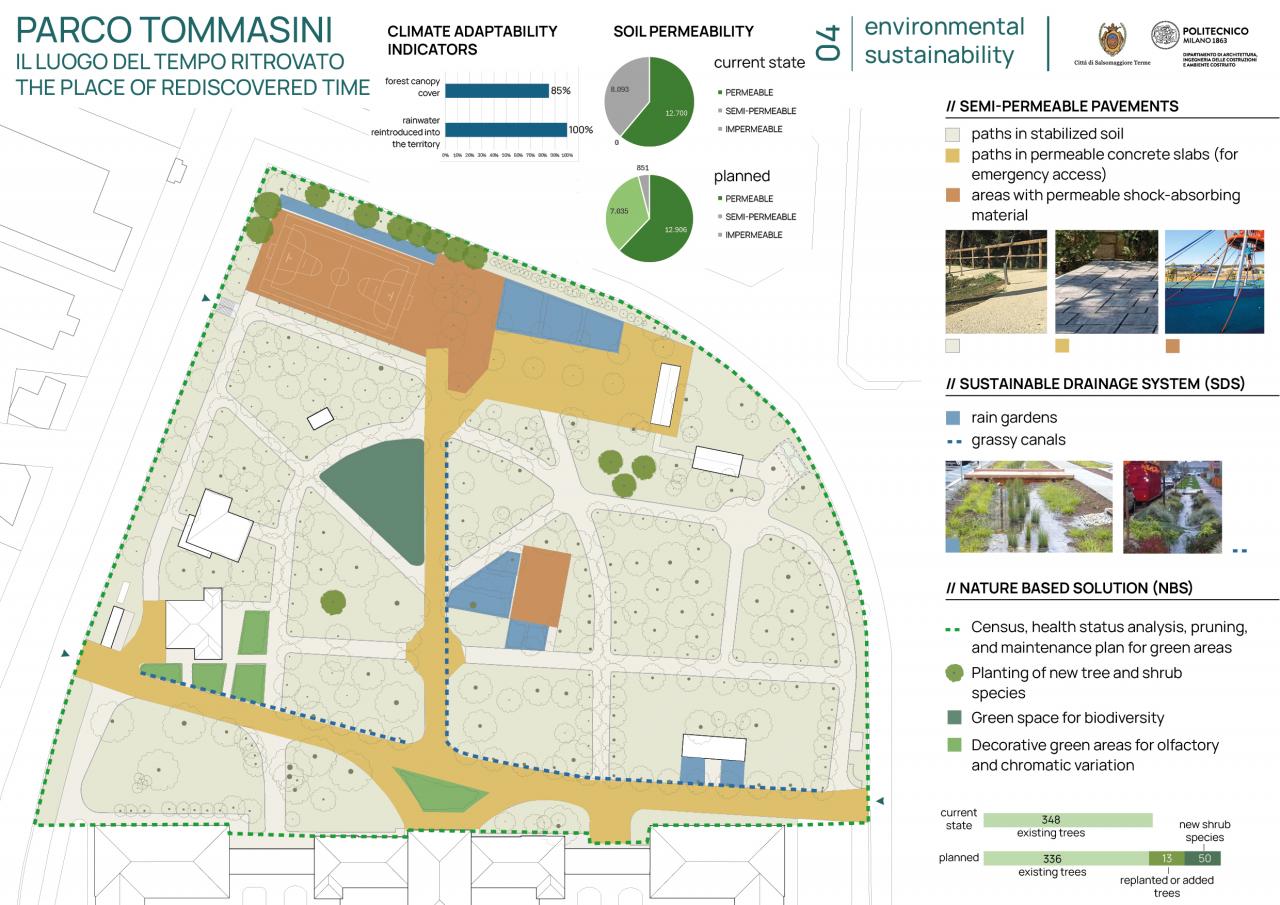
The historic green areas will also be monitored and upgraded, providing for an increase of biodiversity through the grafting of resilient essences, climatic devices for climate mitigation and water collection such as rain gardens and areas of spontaneous greenery.
A significant de-paving action also intends to increase the permeability of the soil, through the removal of asphalt paths that currently design the park, encouraging the use of semi-permeable materials.
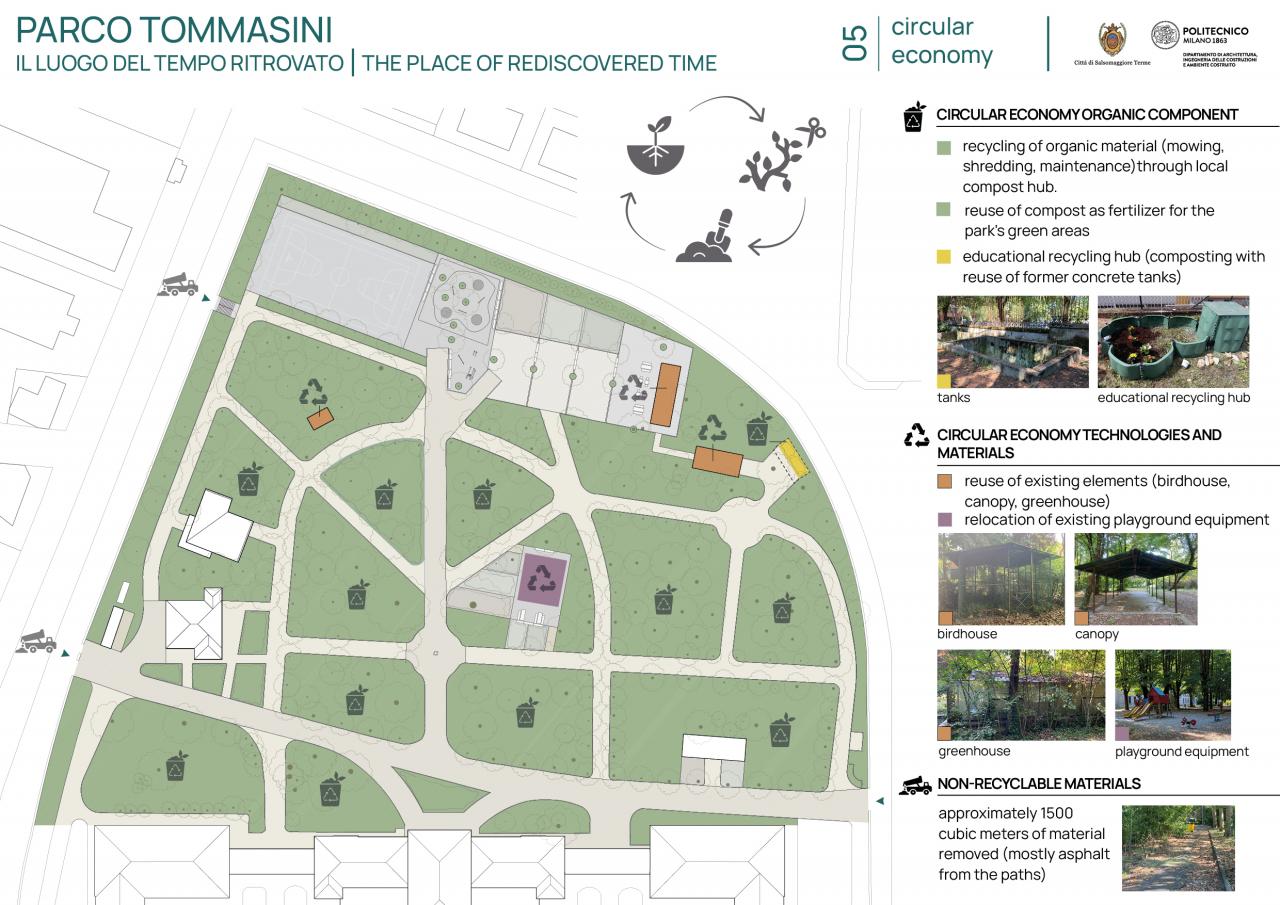
The project respects the principles of the circular economy, foreseeing the use of innovative and recycled materials, and applies the criteria of universal design in order to guarantee the usability of the park for all categories of users.
Among the expected results is the social regeneration of the neighbourhood, through the creation of a new meeting place, also multi-generational one, the promotion of unstructured sports activities, as well as a significant improvement in urban quality through planting and the inclusion of facilities for climate mitigation.
Key objectives for sustainability
The area facing the “Greenhouse” will consist of draining concrete slabs, in continuity with the main path.
Rain gardens and grassed channels will be created alongside the pathways, semi-permeable areas and re-used roofing to allow rainwater to infiltrate completely.
Analysis and census of the state of health of tree and shrub species with the elaboration of a maintenance plan to ensure their health.
Planting of new resilient tree and shrub species for botanical training. Conveyance of green waste to the local compost heap, producing a 100% natural compost to be re-used in the park maintenance service. Creation of a free-form area to encourage biodiversity.
The tree density will ensure a high adaptive capacity in relation to heat waves.
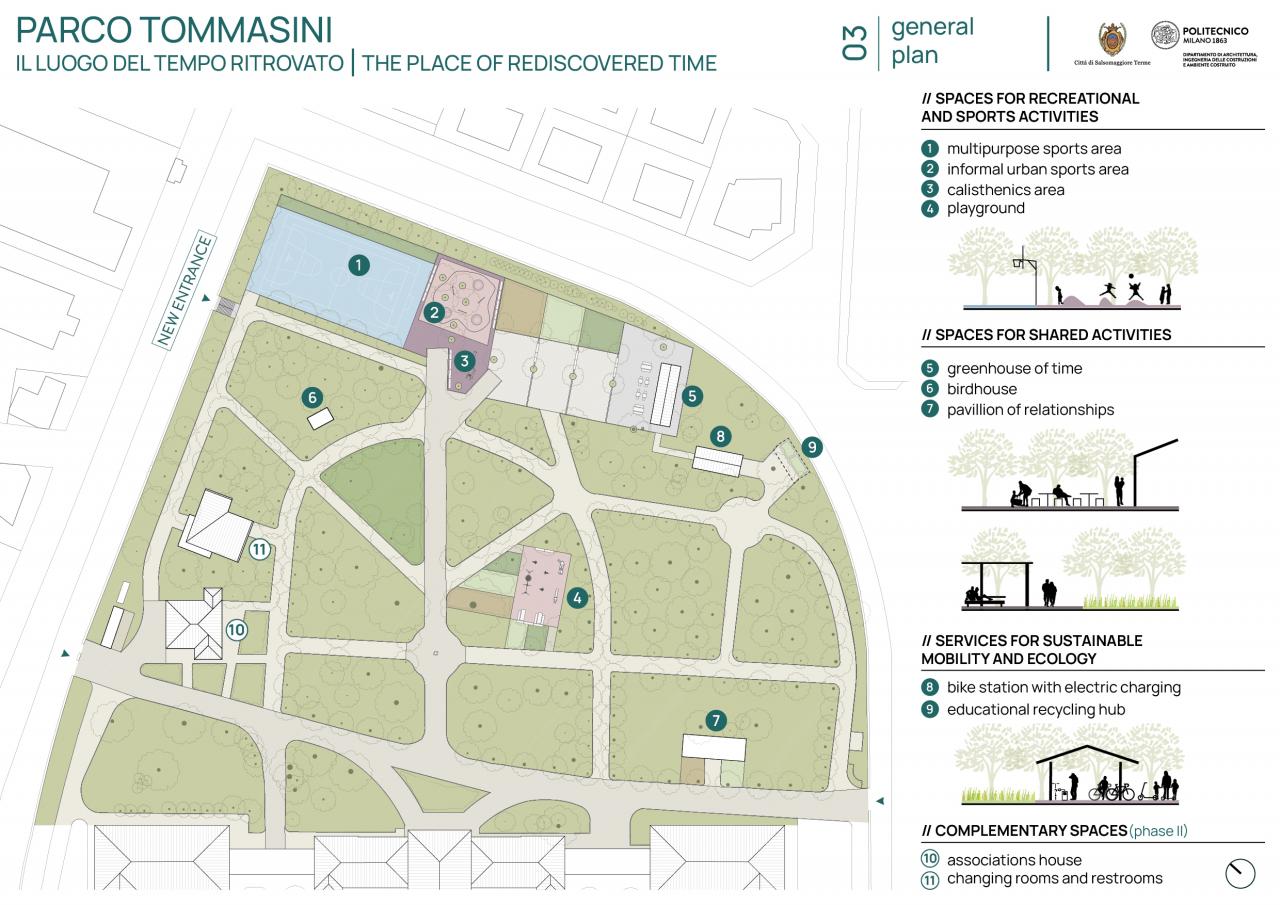
Installation of stand-alone photovoltaic street lamps for lighting without new electrification; creation of a small composting area for educational purposes.
The existing and well-maintained children's play equipment will be relocated to one of the new play areas.
Renovation of the existing aviary with conservation reuse and of the existing canopy with reutilisation of the original roof elements; use of recycled and recyclable materials where possible.
Any inert materials removed will be sent to the municipal recycling plant. The project will become an effective example of how it is possible to regenerate a space by minimising the impact in the production of waste, minimising the use of natural resources, creating a water cycle that is able to self-supply the park, exploiting the principles of the circular economy.
Key objectives for aesthetics and quality
Key objectives for inclusion
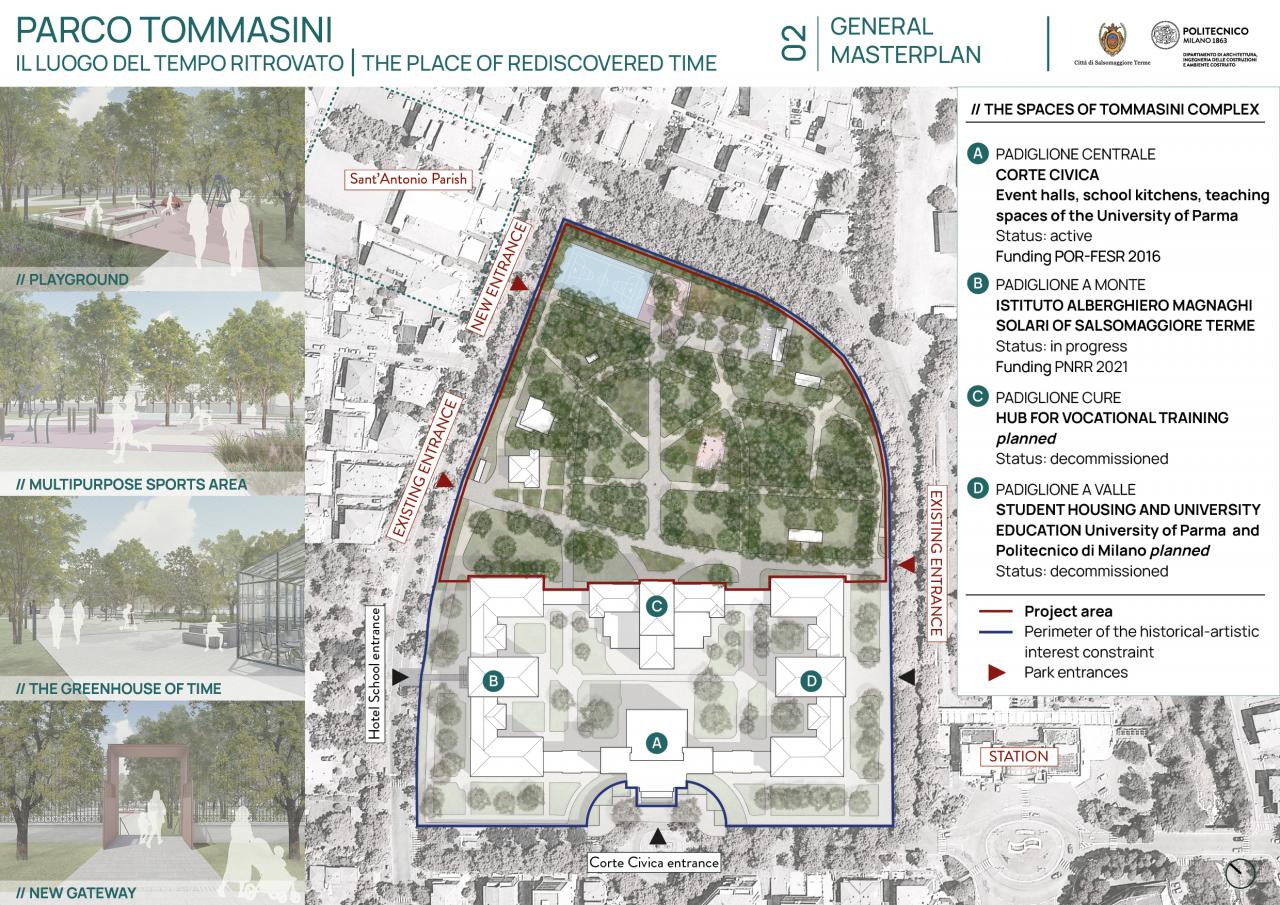
A multi-purpose hall called “the Greenhouse of time” will be created, reutilising an existing artefact that will initially be used for associative activities, co-working and small events. In the future, it will be able to host a commercial activity (bar or coffee shop), managed by the Istituto Alberghiero or by external operators.
A multifunctional indoor and outdoor pavilion will be created, surrounded by greenery, dedicated to study, reading and socialising.
It will be a relational place for all park users.
Since it is a public park, access will be guaranteed for all types of users as there will be no architectural barriers and it will be made more permeable to the city, creating a new openness towards it.
The use of the space will be encouraged by creating areas to forge social relationship between the students of the “Istituto Alberghiero” and the citizens, taking advantage of the public park characteristics of the space that the project intends to regenerate.
How Citizens benefit
Innovative character
This participatory process has allowed the definition of a shared management plan for the park that would be able to meet the needs that emerged during the meetings.
A solution was sought that, while being replicable, would respond to the specific needs of the village, preferring to opt for an approach that, while respecting the park, favoured co-participation and non-invasive planning so that the characteristics of the intervention area would be preserved, innovating and re-functionalising them where necessary.
Emphasis has been placed on inclusion and sociability among people, by envisaging place dedicated to sociability, such as the relations pavilion, the greenhouse of time, spaces for physical activity, the technologies necessary for activities to be carried out in groups or in cooperation, or for training through a space dedicated to viewing the methods of recycling organic components produced by the maintenance of the park.
It is planned to include a space, not currently present in the urban space and therefore relevant to the community, dedicated to renting and recharging electric bicycles.
Disciplines/knowledge reflected
The design has involved various professional figures within the Politecnico of Milan such as: urban architects in relation to the urban design of the park and its relationship with the surrounding environment; conservative architects as the park is part of a property complex subject to a Ministry of Culture restriction; landscape architects in relation to the design of the green spaces; circular economy experts in relation to the recovery and reuse of materials; environmental engineers in relation to water management and the choice of implementing the essences in the park.
Subsequently, agronomists will be involved for the management and maintenance of green areas.
The aim of the project, in addition to the involvement of citizens and the creation of new interpersonal connections, is also that of training, in synergy with the Istituto Alberghiero, the Politecnico of Milan and the University of Parma, professionals capable of managing anything related to tourism (conventions, catering, etc.) both in the Salsomaggiore area and outside it.
The involvement of these professionals has made it possible for realising an organic design proposal, capable of integrating itself into the context in which it will be inserted in a way to minimise in its execution, the relative environmental footprint for allowing a dialogue with the building complex in continuity with and broadening its scope, with the purpose behind the creation of the park
Methodology used
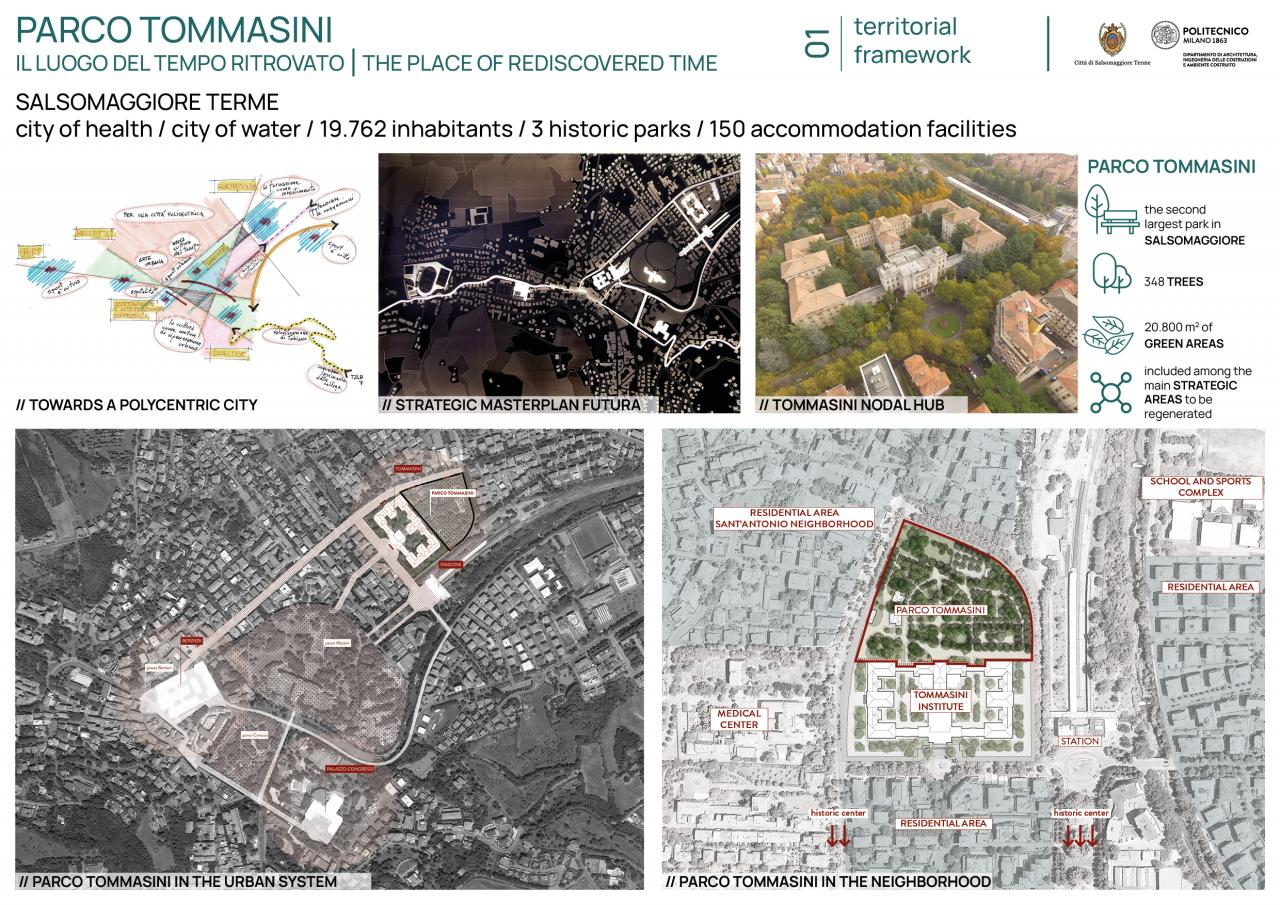
The project also had to relate to the peculiar context in that the park is part of the complex of buildings called Tommasini, which, as it is of cultural interest, is bound by the Ministry of Culture; this entails special attention in the design choices that must maintain and preserve the historical asset.
Technical choices were also subordinated to the requirements that emerged during the participatory process that extended the recovery of the various buildings of the Tommasini complex to the park.
The dialogue between different actors has sensitively and evidently conditioned the design choices in such a way as to allow the recovery of the area while respecting it, its historical value and the needs that have emerged.
How stakeholders are engaged
The recovery of the building structures was started in 2013 with the aim of creating a new pole for culture, education, and wellness, of which the park is an important piece for its completion.
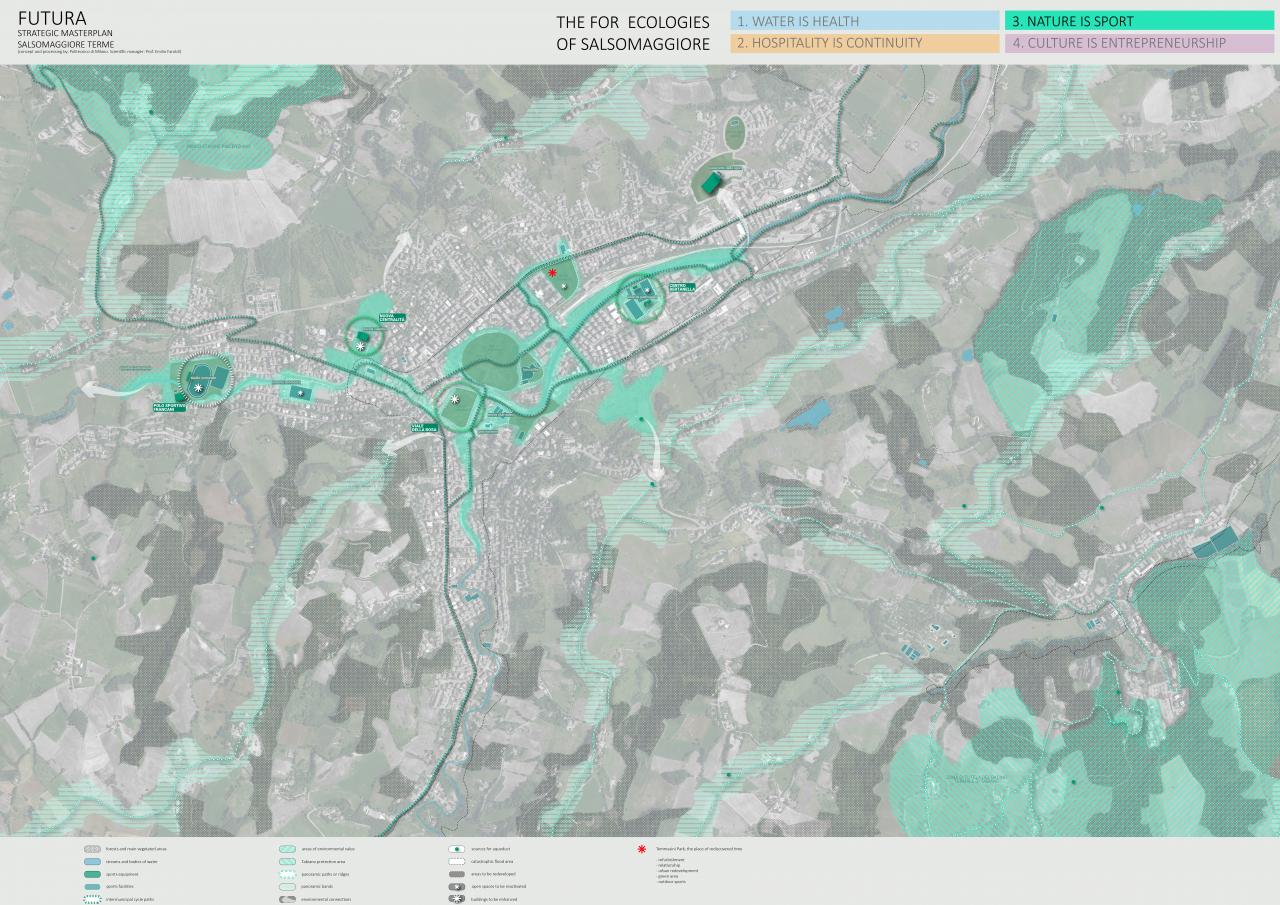
The above-mentioned aims have been highlighted in the urban planning instrument within the strategic master plan supporting the General Urban Plan of the city, called ‘Futura’ and, in addition to the Municipality and the Province of Parma, with the direction of the Faculty of Urban Planning and Construction of the Politecnico of Milan, a leader in the field of research in Italy and worldwide, as far as the design phase is concerned.
Subsequently, other subjects will be involved, of which the main ones are listed below: University of Parma, which is currently carrying out training activities in the spaces of the complex; Politecnico of Milan, which plans to organise and manage workshops and summer schools on the themes of health, sport and leisure time architecture; the main trade associations and some entrepreneurs and companies that have expressed their willingness, in order to improve the urban context in which they are inserted, to be involved in the project; the city associations with particular reference to those working in the spheres of social, leisure, ecology, etc.. the St. Antonio’s church, within which the park is located, in order to evaluate synergic uses; the sports society that currently manages the municipal infrastructure dedicated to sport.
Global challenges
The regeneration of the park and its opening to the citizenship, to both high school and university students, is also intended to contribute to the improvement of the city's social life, acting as a meeting place.
Learning transferred to other parties
The group of beneficiaries of the initiative is, potentially, very wide and therefore a restricted typology of users is not envisaged; this makes the project replicable and transferable wherever there is a need to rethink a public or private green space for public use.
The peculiarity of the project is that it is part of a broader recovery of a restricted container, but this does not preclude the application of its underlying principles (circular economy, involvement of beneficiaries and local entrepreneurs, recovery of the green heritage, etc.) to areas similar in function.
The project is innovative because of the emphasis placed on involving the area in an experimental path aimed at creating synergy between the park and the functions of the buildings, in order to promote hospitality, reception, inclusion, and also opening up the park to the holding of conventions, which, in addition to involving the Instituto Alberghiero for educational purposes, will allow a convention open to the city. This modality may also be replicated in other city parks.
Next steps
Within the park there are two buildings, which will be recovered in the near future, for social or educational uses.<br />
The structures will be repurposed according to the needs that may emerge over time, but at the moment it is imagined that they will be used as headquarters for local associations operating in the area and as changing rooms connected to the sports activities planned in the park.<br />
Since the design methodology is based on dialogue and listening, and the intervention area is a park, wellbeing, cultural interchange and social cohesion are promoted; the initiative is considered sustainable because it recovers as much as possible of the existing, does not envisage the extension of the current power grid and incorporates in it the principles of the circular economy; it is to be considered, precisely because it has as its object a park adjacent to schools of different grades, inclusive in that the project spaces and functions will allow cultural exchanges.<br />
The design was born as a result of the involvement of different actors (participation), involving different professional skills at several levels and thus favouring an interdisciplinary approach.<br />
The actions necessary for the recovery of the other buildings in the park will be carried out using the same listening methodology, which may also lead to different uses, always with a view to hospitality, inclusion and improvement of the accommodation, conference, school and leisure offer, in any case respecting the area, should the need arise over time.