The Dialogue Forum in Łódź
Basic information
Project Title
Full project title
Category
Project Description
Current stage development
Geographical Scope
Project Region
Urban or rural issues
Physical or other transformations
EU Programme or fund
Description of the project
Summary
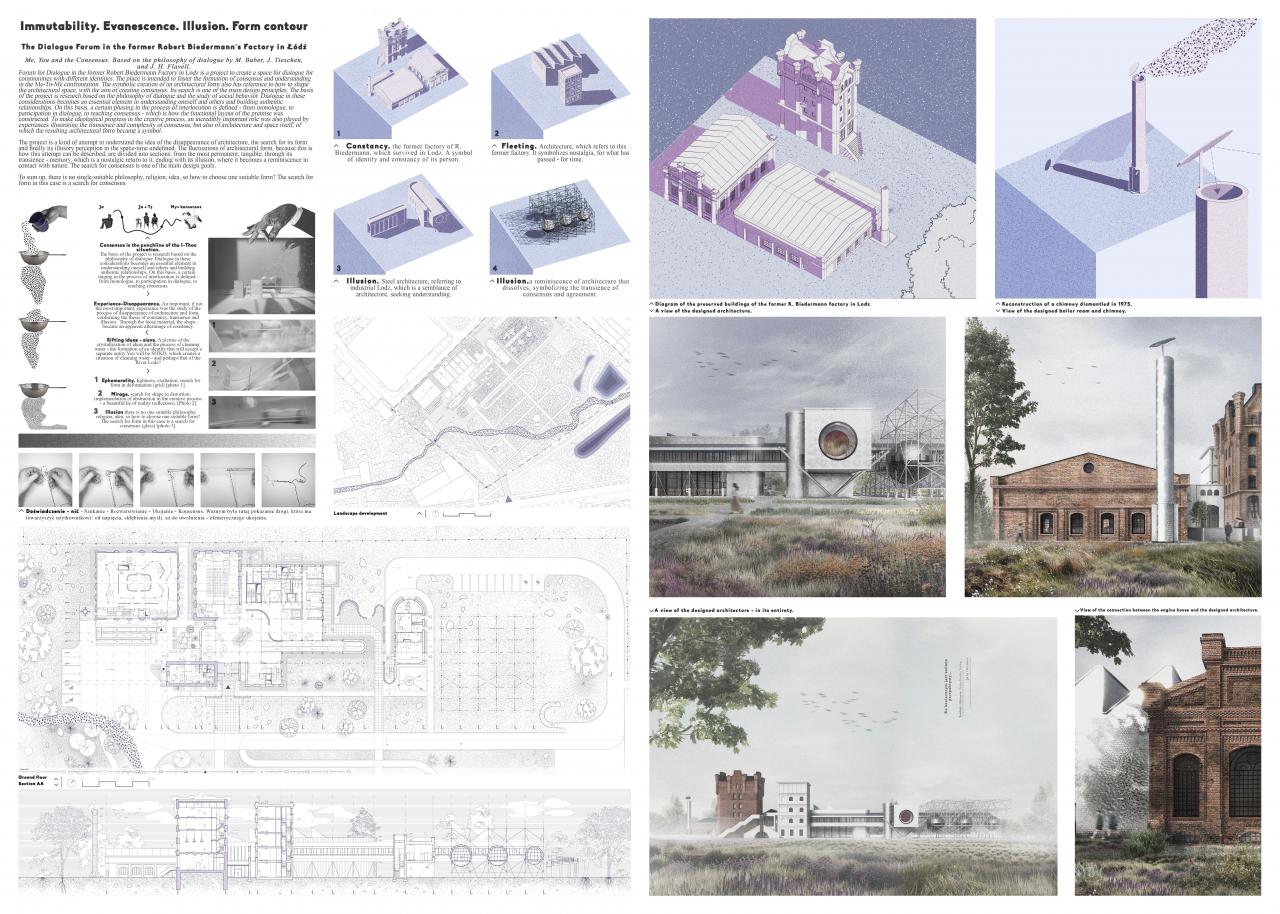
The Dialogue Forum in Łódź project envisions a space for dialogue among communities of different identities. It aims to foster understanding in the confrontation of I-You-We. The symbolic creation of an architectural form reflects how spatial design can support consensus-building - one of the project’s main goals.
Founded in 1863, the Robert Biedermann Factory grew in the late 19th century with Neo-Gothic and Neo-Romanesque buildings. After WWII, it was nationalized and later became part of the Szymon Harnam Textile Industry. The factory went bankrupt in 2001, and by 2008, the land was sold to new owners. The project proposes an adaptive reuse of the existing ruins, restoring the site’s significance in a contemporary context. Despite its deterioration, the complex remains a recognizable architectural landmark in Łódź, though currently underutilized by the local community.
The project explores social, architectural, and mystical dialogue—from interactions to the solitary monologue. The challenge lies in integrating these layers while creating a space that fosters communication between social identities and built environments—blending the existing architectural fabric with newly imagined forms.
Basing the project on social research, architectural studies, and philosophical reflections, we arrive at fundamental conclusions. Dialogue is a powerful tool. Its definition depends on the context in which it is used. The architecture itself becomes an active participant in the social dialogue it aims to create.
Key objectives for sustainability
The project uses an air heat pump and heat recovery ventilation system to efficiently exchange air, recover heat from exhaust air, and transfer it to fresh incoming air. The heat pump also heats or cools using external air, enhancing energy efficiency and reducing costs and environmental impact.
A water reservoir will be created using natural materials for its edges and water-filtering vegetation. It will also serve as a retention system, managing stormwater, preventing flooding, and supporting local biodiversity.
The project ensures continuity of urban greenery, connecting existing parks such as the Old Town Park, the park near Biedermann Palace, Hellenów Park, the Łódka River boulevards, and the Park of the Survivors. The former Biedermann factory site will link these green areas, creating a cohesive ecological corridor. Existing green spaces will be preserved and connected with new plantings, supporting local biodiversity and improving residents' quality of life.
The design maximizes the use of existing historic buildings, reducing the need for new structures and minimizing environmental impact. The adaptive reuse of the former machine room, boiler house, and water tower at the Biedermann factory complex reduces material and energy consumption, contributing to resource conservation and promoting sustainable urban development.
The project also features light tubes that bring natural light into the former boiler room basement, reducing the need for artificial lighting and energy use. These tubes also serve a ventilation function, ensuring effective air circulation and improving indoor air quality and user comfort.
Key objectives for aesthetics and quality
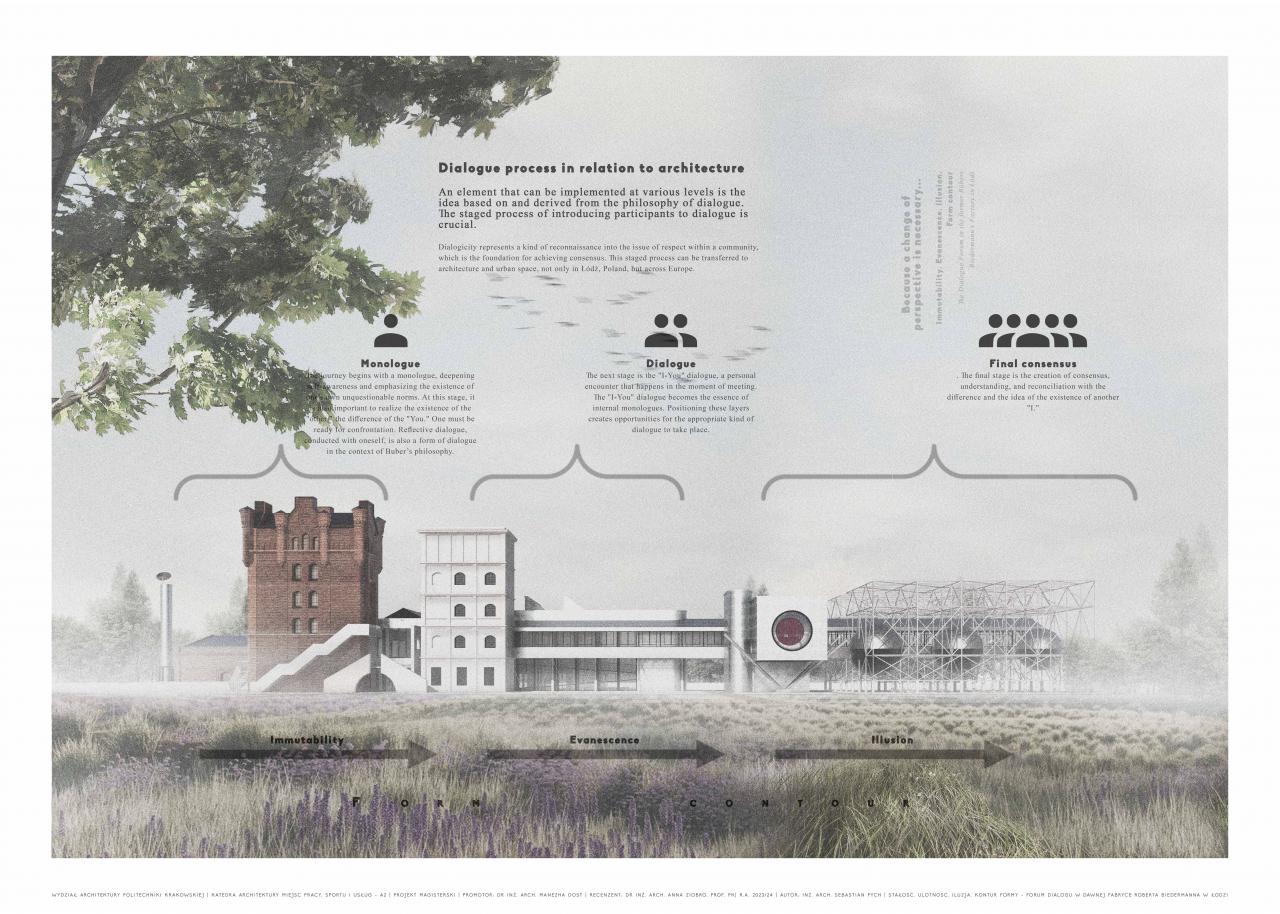
The process begins with monologue and self-awareness, recognizing one's own norms and the existence of the "Other." Reflection and introspection play a key role in this stage, with inner dialogue facilitating self-regulation and decision-making. The goal is alignment with one's own identity, with spaces like galleries and museums providing an environment for contemplation.
The next stage is the dialogue between "I" and "You," where recognition and respect for the other person's perspective are crucial. When both individuals acknowledge each other’s identity and uniqueness, meaningful dialogue can occur. These dialogues don't always require words; even shared space can be a form of communication. Spaces like workshops, main halls, and multifunctional rooms are designed to encourage personal dialogue, highlighting diversity and differences.
The final stage is achieving consensus and understanding of the "Other" in a community, fostering respect and social harmony. The architecture supports this process, providing spaces for dialogue that help create tolerance, acceptance, and community agreement. This journey towards consensus, like a gradual descent, represents the acceptance of diversity and the rejection of uniformity. Based on these considerations, a functional structure was constructed, ranging from monologue, through dialogue, to social consensus in group dialogue.
Key objectives for inclusion
Accessible toilets with grab bars and sinks are on the ground, first, and basement floors, with a 1.5m x 1.5m maneuvering space. The multifunctional hall includes wheelchair spaces, and corridors allow easy access. The building is adapted for older adults and those with mobility challenges.
For the visually impaired, Braille signs guide visitors, and tactile paths are installed. The museum and gallery offer audio descriptions. Staff receive disability training, and induction loops are available in key areas.
The goal of the project is to create an ideologically neutral space, a clean slate where users can express their ideas, identities, traditions, and cultural language. The space must not discriminate against any of the building's users. The building is meant to become a forum for discussion, exchange of thoughts, and experiences. The design includes numerous spaces, both small and large, specifically created for dialogue.
The goal of the project is to create an ideologically neutral space, a clean slate where users can express their ideas, identities, traditions, and cultural language. The space must not discriminate against any of the building's users. The building is meant to become a forum for discussion, exchange of thoughts, and experiences. The design includes numerous spaces, both small and large, specifically created for dialogue. The symbolic creation of an architectural form reflects the way architectural space can be shaped to foster consensus in a world where transnational and transcultural dialogue is needed more than ever.
How Citizens benefit
Special attention will be given to incorporating diverse perspectives—both from individuals involved in culture and education and from residents of the area where the project will be implemented. Their input will shape the design of both open and enclosed spaces that encourage interaction, meetings, and reflection. The final design will be enriched with solutions derived from these consultations, allowing for the creation of an inclusive space tailored to social needs.
As a result, the project will not only fulfill its architectural function but will also become a tool for building social relationships, fostering the exchange of ideas, and strengthening connections between users.
Physical or other transformations
Innovative character
1. Drawing on thinkers like Martin Buber and Józef Tischner, the design focuses on dialogue as a process of self-discovery and societal understanding. It fosters communication through spaces like galleries, workshops, and open areas, which promote both personal reflection and interaction.
2. The project merges existing structures of the former Robert Biedermann Factory in Łódź with new, transient forms, creating a contrast between permanence and impermanence. This interplay of materials and design elements evokes memory, nostalgia, and nature’s impact on architecture.
3. Abstract forms, like scaffolding for spheres, challenge traditional architectural principles, questioning perception and the essence of design
4. The architecture guides visitors through a journey of introspection, self-awareness, and interpersonal dialogue. This process symbolizes growth and societal change, creating an educational tool for both individual and collective development.
5. The design fosters an environment that transcends specific cultural or historical narratives, promoting dialogue across diverse perspectives. This inclusive approach contrasts with traditional spaces that prioritize particular identities or histories.
6. The architecture itself becomes an active participant in the social dialogue it aims to create. The metaphor of the factory extends beyond production to societal consensus-building and cohesion, making the space a catalyst for social transformation.
In essence, this project combines architecture with philosophical inquiry to create a space for reflection, transformation, and meaningful human interaction, offering a radical departure from traditional architectural practices.
Disciplines/knowledge reflected
The study employed a method of logical analysis and construction, which involved a detailed breakdown of the analyzed philosophical dissertations into their basic assumptions and principles. As a result of the analysis, key relationships between dialogue, definitional issues, architecture, and space were identified, allowing for the logical construction of a new model of dialogue in confrontation with architecture and the social model. Furthermore, an attempt was made to analyze the systems of dialogue philosophy, studies on social group dynamics, and the issue of social behaviors in space. The project was also consulted with a specialist in the revitalization of degraded areas, a graduate of environmental shaping engineering at AGH University of Science and Technology in Krakow. The design process also involved the structural engineering department at the Department of Architectural and Construction Design at Krakow University of Technology.
Methodology used
How stakeholders are engaged
At the local level, consultations will include residents and local social organizations, whose opinions and needs will influence the project's framework. Cooperation with local government authorities ensure that the project is adapted to the specific characteristics of the area and considers its historical and social context.
At the regional level, the project will receive support from cultural institutions and regional authorities, recognizing its value for the region’s development. Engaging regional partners will help integrate the project with existing initiatives and spatial development strategies.
At the national level, the project will be consulted with experts in architecture, urban planning, and philosophy, allowing for the verification of its assumptions and the introduction of innovative solutions. Collaboration with governmental and non-governmental organizations will ensure that social and educational aspects are incorporated as key elements of the project.
At the European level, the project will align with a broader context of intercultural dialogue and the exchange of experiences in architecture and public space. Cooperation with international institutions and partners will enable the implementation of best practices and ensure that the project meets European standards.
By involving various stakeholders, the project will not only address local needs but will also fit into a broader social and cultural context, creating a space open to dialogue and exchange of ideas on multiple levels.
Global challenges
Globalization has both positive and negative implications. It promotes the accumulation of cultural capital, intercultural exchange, and democratization of cultural access. However, it may also lead to homogenization and cultural erosion. In certain contexts, intercultural interactions can cause tensions due to differing norms and values. Rather than resisting these changes, our task is to adapt to the factors shaping new collective identities and redefine sociocultural relations globally.
Contemporary societies must develop mechanisms to balance the preservation of cultural identity with openness to globalization. One solution is fostering dialogue between cultural groups and social identities. Dialogue could bridge social dissociations. The challenge is integrating dialogue into physical space. Architecture, once an impersonal entity, becomes an active participant in dialogue with its context.
Creating a space that fosters intellectual exchange and prepares participants to confront differing ideas is a key challenge. Today, we face dehumanization of social consensus and spatial inefficiency. Questioning these issues is no longer justified given the current social crises. Dialogue, in this context, is a vital tool for building trust.
This project, based on social research, architectural studies, and philosophical reflection, concludes that dialogue is a powerful tool, and its meaning depends on the context in which it is employed.
Learning transferred to other parties
Next steps
In the context of the project's implementation in Łódź, the actions will involve intensifying cooperation with local communities, cultural institutions, and NGOs actively engaged in migration and integration issues. In particular, collaboration with the Mark Edelman Dialogue Center in Łódź will be of great importance. Emphasis will be placed on organizing workshops, panel discussions, and artistic events aimed at creating spaces for sharing experiences and reflecting on migration and intercultural dialogue. The project will serve as a platform enabling the meeting of various social groups while providing space for open and constructive dialogue.<br />
Given Łódź's history as a city of significant ethnic and cultural diversity, the project will gain particular importance. Planned activities will take into account the local context, referring to the city's diverse migration traditions, which will help better understand contemporary challenges related to the integration of different groups. Additionally, Łódź, with its rich industrial heritage, will play the role of a space where technology, art, and architecture intersect in the search for new solutions for social integration.<br />
The project will also be connected with existing initiatives, such as the Łódź Design Festival, which in the past focused on innovative solutions in public space design. The project may involve cooperation with local universities and research centers to deepen research on the impact of architectural spaces on social interactions and integration processes. As a result, the project will aim not only at the physical transformation of space but also at creating a new, dialogue-based social space where people from different cultures can meet, talk, and search for solutions together.<br />
The project plans a wide promotional campaign, including organizing events in public spaces and collaborating with local and national media to support the promotion of intercultural dialogue in Łódź.