Soft Infrastructure
Basic information
Project Title
Full project title
Category
Project Description
Current stage development
Geographical Scope
Project Region
Urban or rural issues
Physical or other transformations
EU Programme or fund
Description of the project
Summary
Soft Infrastructure explores how invasive species in aquatic ecosystems can be repurposed as raw material for erosion management structures. Conventional erosion management methods usually rely on synthetic materials, which are harmful for the environment. Our proposal offers an alternative using communal and ecological knowledge to create a local sustainable solution.
Our project draws inspiration from traditional methods using natural materials like brushwood to construct large-scale structures. One notable example is the fascine mattress, developed in the Netherlands to protect riverbeds. We are inspired by how these abundant, inexpensive materials can be transformed into resilient structures that withstand natural forces.
Soft Infrastructure focuses on the common reed (Phragmites australis), which thrives in entrophic waters such as the Baltic Sea, as its root systems filters efficiently nutrients. If left unharvested, the reed decays and releases trapped nutrients back into the water, continuing the harmful cycle.
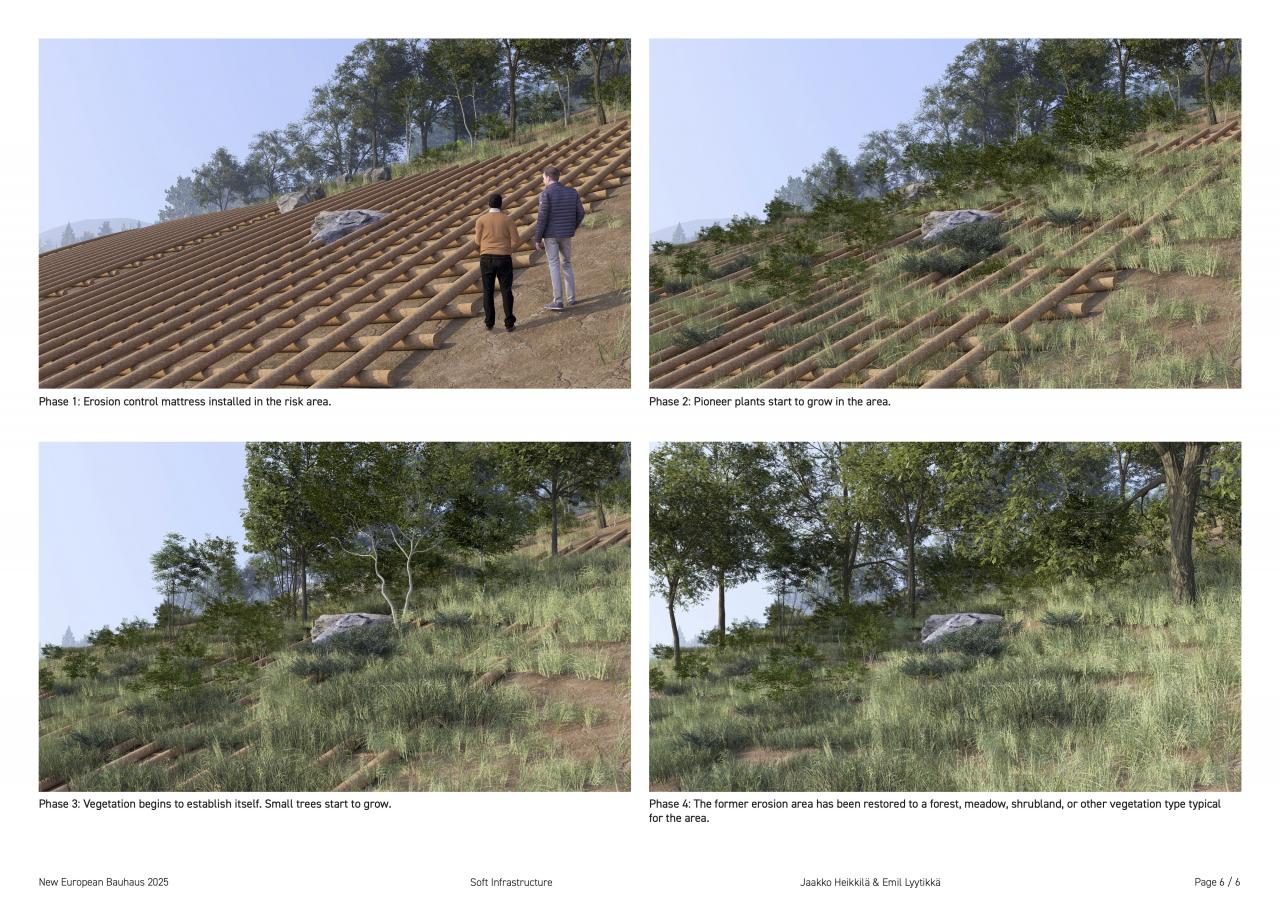
We aim to assemble reed bundles near shorelines and transport them to erosion-prone hillsides, where they are arranged into a grid structure to protect the ground. This temporary solution allows local flora to recover, eventually taking over the role of stabilising the ground.
The assembly requires manual labor, and we envision engaging local communities. The Finnish term “talkoot” represents community gatherings for the common good, central to our approach. This project also draws inspiration from traditional crafts like weaving and basketry, which we aim to adapt in a new context.
Key objectives for sustainability
Inspired by traditional techniques like the Dutch fascine mattress, the project reimagines historical practices of using natural materials for large-scale surface erosion prevention. The common reed, thriving in eutrophic environments such as the Baltic Sea, serves a dual purpose: mitigating eutrophication by removing excess nutrients and providing material for erosion control.
Reed grids act as temporary barriers, protecting soil from heavy rain and wind while enabling local vegetation to recover. This method aligns with broader trends in landscape architecture and ecological design, which emphasise adaptive, nature-based solutions over rigid, industrial approaches. By working with organic materials that decompose over time, the project supports a regenerative model where infrastructure facilitates ecological restoration rather than imposing a permanent, disruptive presence.
The concept emphasises community engagement, reflecting Finland’s tradition of talkoot—collective labor for the common good—and applies traditional craft processes to modern infrastructure. Beyond its environmental benefits, the project fosters a participatory approach to climate adaptation, empowering local communities to take an active role in restoring and maintaining their surroundings.
Key objectives for aesthetics and quality
The project has been developed in collaboration with Arcada University of Applied Sciences and the John Nurminen Foundation, an organization specializing in Baltic Sea conservation. Their involvement has been valuable in providing insights into the material, its sourcing, and potential future directions for the project.
The engagement of different stakeholders at local, regional, and national levels is crucial to the project’s success. We envision that local municipalities can play a key role in organising harvests and community workshops, while national environmental agencies can help integrate the method into broader conservation strategies. By involving institutions across multiple levels, the project ensures that its impact extends beyond a single intervention.
Key objectives for inclusion
With the guidance of the John Nurminen Foundation and Arcada University, we have incorporated knowledge from biology and material science, refining the method from both ecological and technical perspectives. Additionally, we have applied craft-based approaches at a larger scale, to a textile-like architectural structure.
How Citizens benefit
In practice, the project envisions local groups forming to harvest reed and assemble erosion control structures. This not only strengthens community ties but also provides a sense of empowerment—especially in times of ecological uncertainty—by allowing people to take meaningful action in their immediate surroundings.
By involving local citizens, municipalities, and environmental organisations, the project ensures that knowledge is transferred across different levels of society. Rather than relying on external experts to implement solutions, Soft Infrastructure enables people to take charge of their landscapes, fostering long-term stewardship.
Physical or other transformations
Innovative character
This project rethinks what infrastructure can be and who can produce it. Instead of relying on industrial manufacturing, it introduces a decentralised, hands-on process where communities play an active role in construction. This challenges the conventional notion that environmental restoration must be a top-down, expert driven projects. We see the specialists as guides/facilitors of the restoration.
We believe that our advantage lies in our creativity and diverse backgrounds, coming from architecture and design. This different perspective helps us come up with new types of solutions in an engineering-heavy field.
Disciplines/knowledge reflected
With the guidance of the John Nurminen Foundation and Arcada University, we have incorporated knowledge from biology and material science, refining the method from both ecological and technical perspectives. Additionally, we have applied craft-based approaches at a larger scale, to a textile-like architectural structure.
Methodology used
The method is inspired by historical practices, particularly the Dutch use of fascine mattresses for stabilising riverbeds. By adapting this concept to modern environmental challenges, the project combines traditional knowledge with contemporary sustainability concerns.
Prototyping and testing are integral to the approach. The project is currently in a research and development phase, with plans for a full-scale test to measure effectiveness and refine construction techniques.
How stakeholders are engaged
Global challenges
Eutrophication of water bodies, caused by farming and industry, fuels the growth of plants like common reed and algae, which, when breaking down, consume oxygen and burden local ecosystems. By using reed as raw material for our project, we are helping to reduce excess nutrients in these environments and support a healthier ecosystem.
Learning transferred to other parties
Beyond erosion control, the bundled reed technique has the potential for other applications. One potential area of use is the development of maritime oil barriers, where reed bundles could be used both as floating elements and absorbent material.
At its core, the project is about empowering people through collective action. By encouraging locally organised restoration efforts, Soft Infrastructure presents a scalable model for citizen-led environmental intervention.
Next steps
In the coming year, the focus will be on:<br />
<br />
* Producing and presenting the installation for the Venice Architecture Biennale 2025.<br />
* Constructing a full-scale prototype to test the method’s effectiveness. <br />
* Network and finding suitable organisations to partner with.<br />
* Securing funding to support field trials and to develop the project.<br />
* Exploring possible pathways for integrating the technique into broader environmental policies and conservation initiatives.<br />
* Start building a platform/ guide.<br />
<br />
If the prototype proves to be successful, the next step would be launching a pilot project in collaboration with municipalities and organisations, with the long-term goal of making this method widely accessible.<br />