Energy Communities Munich
Basic information
Project Title
Full project title
Category
Project Description
Current stage development
Geographical Scope
Project Region
Urban or rural issues
Physical or other transformations
EU Programme or fund
Which funds
Description of the project
Summary
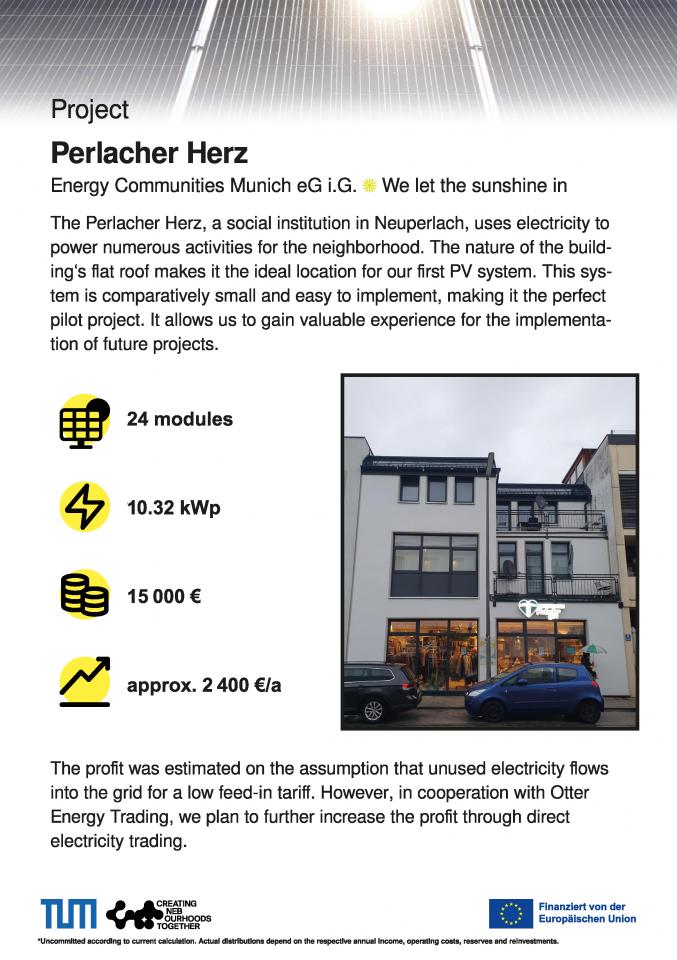
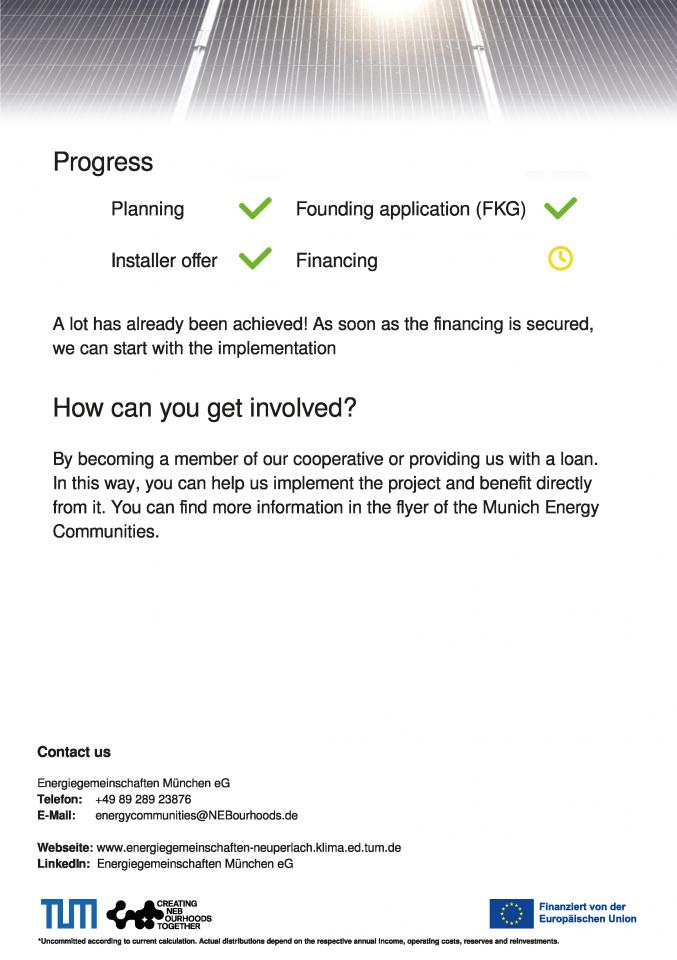
The first major milestone was the establishment of the founding team and the creation of a cooperative governance model that ensures equal participation. As we move forward, our pilot project at Perlacher Herz, a social facility, is a concrete step toward community-led energy production. The PV system has been designed, and 80% of the funding is secured.
Beyond local implementation, our model is designed for scalability and replication, allowing other neighborhoods to join without having to start from scratch. We integrate scientific research and innovation through our Academic Energy Cooperative (TUM), ensuring a strong connection between academia and practical implementation. Additionally, we are testing local energy trading models, as true energy sharing is currently not legally supported in Germany.
Future steps include finalizing the first project's funding, implementing energy trading mechanisms, expanding our membership base, and developing further social inclusion strategies. Through these actions, we aim to strengthen the local community, foster participation, and inspire others to take part in the energy transition.
Key objectives for sustainability
Reducing CO₂ emissions & energy independence
We empower citizens to own and operate renewable energy systems, reducing reliance on fossil fuels. Our first solar PV project at Perlacher Herz will directly lower emissions and set a precedent for further community-driven energy projects.
Making energy consumption & production visible
By increasing awareness of local energy flows, we enable behavioral shifts toward more conscious consumption. Future steps include testing dynamic electricity pricing, which encourages consumption when renewable generation is high, increasing grid efficiency.
Strengthening resilience against rising energy prices
Through our cooperative model, members gain direct control over local energy production, reducing vulnerability to external energy price fluctuations.
Integrating research & innovation
Through the Academic Energy Cooperative (TUM), we combine scientific research with real-world application, ensuring that innovative energy models can be tested, monitored, refined, and scaled.
Beyond local impact – a scalable model
Our approach is designed for replication. By documenting and publishing our methodology, we provide a blueprint for other communities to establish similar citizen-led energy initiatives. Through these actions, Energy Communities Munich serves as an exemplary model of sustainability, demonstrating how decentralized, citizen-driven energy systems can drive the energy transition from the ground up.
Key objectives for aesthetics and quality
Energy as a visible, collective experience
We make local energy production and consumption tangible by integrating community-driven solar projects into the urban environment. Our first installation at Perlacher Herz, a social facility, demonstrates how renewable energy infrastructure can be designed as a shared community asset, rather than just a technical necessity. The young people at the facilities will bring the locally produced electricity directly into the neighbourhood on e-scooters
Co-creative design of energy spaces
Through our co-creation workshops, citizens actively shape how energy is generated, used, and perceived in their neighbourhood. This process fosters a deep emotional connection to the shared energy infrastructure, reinforcing a sense of ownership and belonging.
Integration into the urban landscape
Rather than treating solar installations as isolated technical components, we explore ways to integrate them into architectural and public space design, ensuring that energy generation contributes to a more harmonious and inspiring urban environment.
Cultural and educational impact
By making energy visible and accessible, we demystify renewable energy technology and promote energy literacy among residents. Public engagement events, educational initiatives, and digital tools help turn local energy into a cultural and social experience.
A replicable model for citizen-driven energy aesthetics
By documenting and sharing our approach, we create a framework for other communities to implement visually appealing and socially engaging energy projects, reinforcing the idea that renewable energy belongs to everyone.
Key objectives for inclusion
Lowering barriers to participation
We strive to make membership as accessible as possible. To enable financially disadvantaged households to participate, we offer donation-based cooperative shares, allowing them to become co-owners of the energy community without financial burden.
Addressing economic disparities in energy access
A major challenge in Germany is that financial benefits from energy production (e.g., lower electricity costs) often require tax declarations, which can be a barrier for some low-income households. We are actively exploring alternative solutions to ensure that everyone can benefit from the energy transition.
Inclusive governance and co-determination
Our legal structure as a cooperative ensures that all members have an equal say in decision-making. Responsibilities are clearly defined, and regular hybrid meetings with varying schedules ensure broad participation.
Diversity and multilingual accessibility
We actively work to engage a diverse audience. Our goal is to provide multilingual resources and communication, ensuring that information about the energy community is accessible to all.
Beyond membership—ensuring energy affordability
We are committed to providing more affordable electricity for local residents by testing local energy trading models. This approach aims to reduce energy costs and make renewable energy a tangible benefit for the entire neighbourhood.
A replicable model for energy inclusion
By documenting and openly sharing our solutions, we provide a scalable model for other communities seeking to integrate social justice into the energy transition.
How Citizens benefit
Co-creation from the very beginning
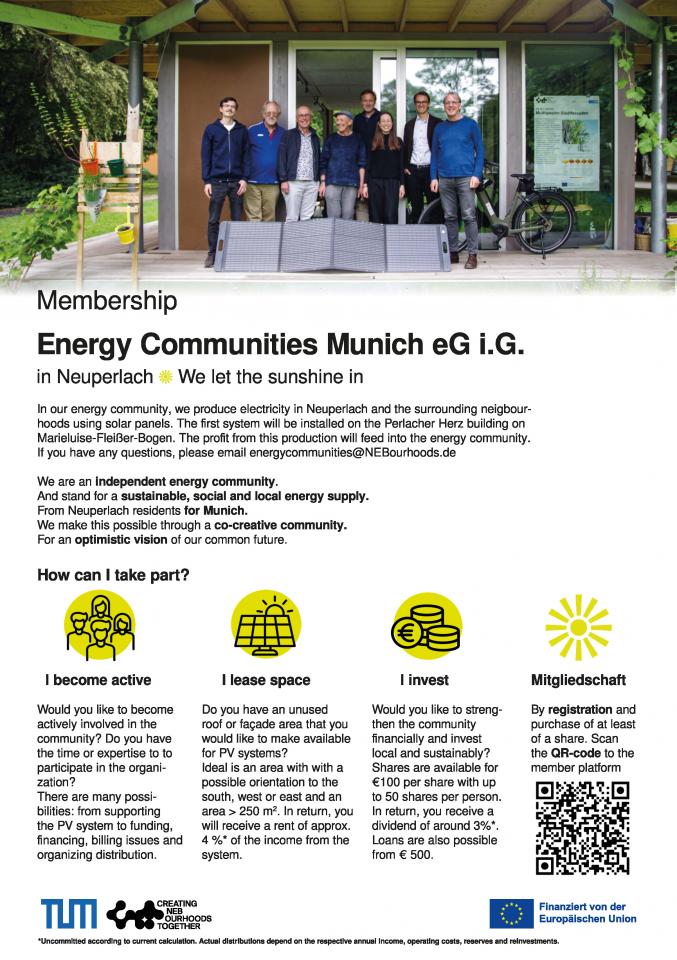
Our community was built through a participatory, co-creative process. The founding team of 9 members with interested people took an active role in designing the legal, financial, and technical framework. Since then, membership has expanded to 20 participants, with new members continuously joining.
Workshops as a key engagement tool
We held weekly workshops throughout the founding phase, covering topics such as strategy, financing, governance, and communication. These workshops were open to all, allowing citizens to shape the project’s direction. To encourage participation, we documented the process transparently and make it publicly available for others to replicate.
Inclusive decision-making
As a cooperative, every member has an equal say in decision-making. Regular hybrid meetings with alternating times and days ensure that more members can participate.
Encouraging active roles within the community
Members can take on tasks based on their expertise or interests—or learn new skills through collaboration. Dedicated working groups focus on specific areas, such as financing, technical implementation, and outreach.
Public events to engage the wider community
We organize public information sessions and community events to attract new participants and raise awareness about citizen-driven energy solutions.
Replication through an open-source approach
To make citizen-led energy accessible to more communities, we openly publish our methodologies, challenges, and lessons learned. This transparency lowers the barrier for other neighbourhoods to start their own initiatives.
Physical or other transformations
Innovative character
Testing local energy trading within regulatory constraints
Unlike traditional energy cooperatives, we aim to implement local energy trading, allowing members to exchange electricity within the neighbourhood. Since true energy sharing is not legally supported in Germany, we explore alternative business models that can still benefit local consumers.
A cooperative model designed for growth
Our structure allows other neighbourhoods to join without founding new entities, reducing the administrative burden and making expansion more accessible.
Strong integration of science and practice
Through our Academic Energy Cooperative (TUM), we embed scientific research directly into community-driven energy development. This unique collaboration allows us to test and improve scalable, data-driven solutions. Furthermore, we create practical teaching content and integrate many new innovative approaches with students and teaching.
Maximizing transparency and knowledge sharing
We document and share our entire founding process, business model, and governance structure, enabling other communities to replicate and adapt our approach with minimal barriers.
Social inclusion beyond affordability
We not only aim for lower energy costs but also actively address barriers for socially disadvantaged groups, such as administrative hurdles and tax-related complexities. This ensures broader participation than conventional energy initiatives.
By combining local energy trading, open-source governance, and interdisciplinary collaboration, Energy Communities Munich demonstrates a new way of organizing citizen-driven energy, paving the way for scalable, just, and decentralized energy solutions.
Disciplines/knowledge reflected
Interdisciplinary founding team & working groups
Our founding team and growing community include members from various disciplines, ensuring a broad knowledge base. Tasks are assigned based on both expertise and interest, encouraging learning-by-doing and knowledge transfer.
Academic collaboration – research meets practice
Through the Academic Energy Cooperative (TUM), we link scientific research with real-world implementation. This enables evidence-based decisions on business models, grid integration, and local energy trading. The connection to teaching ensures innovation and the disciplines are expanded with different fields of study.
Co-creation workshops for continuous learning
Workshops played a key role during our founding phase and continue through working groups and monthly exchange meetings. These spaces foster collaborative problem-solving across different disciplines.
Transparent documentation for knowledge transfer
We ensure maximum transparency by openly publishing processes, methodologies, and documents. This supports replication and lowers barriers for new energy communities.
Real-time communication & adaptive learning
Our members stay connected through digital platforms, ensuring quick knowledge exchange. This adaptability allows us to respond dynamically to challenges and opportunities.
Methodology used
Co-creative development process
From the beginning, we structured the energy community through a series of workshops, allowing citizens to shape the legal, financial, and technical aspects. This participatory approach ensures that the community remains adaptable and citizen-driven.
Step-by-step approach to implementation
We follow a phased development model:
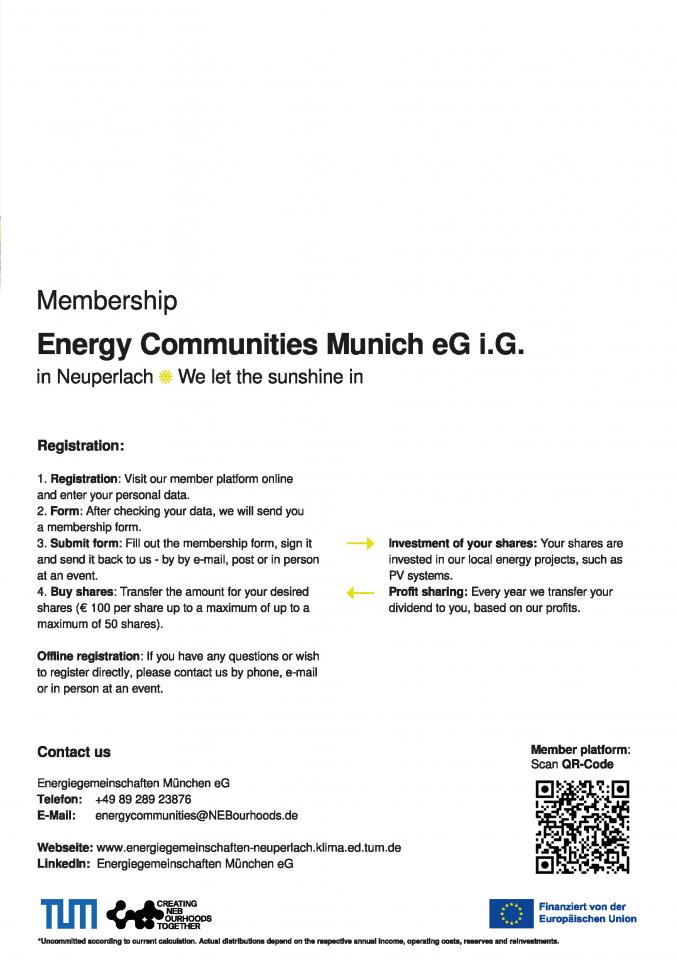
1️. Community building & governance setup – Founding the cooperative and defining transparent decision-making structures.
2️. Project acquisition & financing – Securing locations, planning installations, and mobilizing investments.
3️. Implementation & scaling – Installing PV systems, testing energy trading, and expanding membership.
Structured knowledge transfer & documentation
We document and publish all processes, legal structures, and financing models, allowing other communities to replicate our approach with minimal effort.
International knowledge exchange through EU Twinning
As part of an EU Twinning consultation, we exchanged best practices with other European energy communities, learning from their experiences and refining our own strategies. This collaboration strengthens our approach and enhances the scalability of citizen-led energy initiatives.
How stakeholders are engaged
Local engagement – residents, businesses & social institutions
At the core of our project are the citizens of Munich, who actively participate in governance and decision-making. We collaborate with local businesses, housing cooperatives, and social institutions, such as Perlacher Herz, our first solar project. These partnerships help us integrate community energy solutions into the local urban fabric.
Scientific collaboration – bridging research and practice
Through our Academic Energy Cooperative (TUM), we establish a direct link between academic research and real-world implementation. This collaboration allows us to test innovative energy models, evaluate their impact, and improve their scalability and efficiency.
Political & regulatory engagement
Given that energy sharing is not legally supported in Germany, we aim to showcase our model as a viable framework for future energy policy adaptations.
Collaboration with energy startups
We are working with a local energy trading startup to test new models for local energy exchange, ensuring that energy generated within the community can be used efficiently and fairly distributed among participants. We also cooperate with a membership software from Austria where they have already a lot of experience with energy communities.
Scalability through partnerships with other neighbourhoods
We are already expanding our model to a second district in Munich (Harthof). By documenting our approach, we make it easier for other communities to replicate and customize the concept without starting from scratch.
A blueprint for citizen-driven energy networks
By engaging stakeholders across multiple levels, Energy Communities Munich is a scalable framework that connects citizens, research institutions, policymakers, and businesses to shape the future of local, sustainable energy.
Global challenges
Fighting climate change through local renewable energy
By empowering citizens to produce their own energy, we reduce CO₂ emissions and dependence on fossil fuels. Our model promotes decentralized renewable energy, making the energy transition more resilient and accessible.
Reducing energy dependence and increasing resilience
Rising energy prices and geopolitical instabilities highlight the need for localized energy production. By keeping energy generation within the community, we reduce reliance on external suppliers and enhance local energy security.
Tackling social inequality through inclusive energy access
Traditional energy systems often exclude low-income households from benefiting directly. We address this through donation-based cooperative shares and by exploring fair energy pricing models to ensure broad accessibility.
Enhancing public awareness and energy literacy
Many citizens are unaware of their energy consumption patterns. Through real-time energy monitoring and education programs, we empower individuals to make informed decisions about their consumption, fostering long-term behavioral change.
Demonstrating the replicability of local energy models
Our structured approach serves as a blueprint for other communities, proving that small-scale energy initiatives can drive systemic change. The expansion to Munich-Harthof and the interest from other communities show the growing momentum of citizen-led energy solutions.
Learning transferred to other parties
A model that allows easy expansion
Unlike traditional energy cooperatives, our structure enables new neighbourhoods to join without founding separate entities. This lowers administrative burdens and makes participation accessible even for small local initiatives.
Comprehensive documentation & open knowledge sharing
We openly publish governance models, financial structures, and implementation roadmaps, allowing other communities to replicate the approach. Our step-by-step methodology reduces complexity and accelerates the setup process.
EU Twinning & cross-border learning
Through our EU Twinning consultation, we exchanged best practices with other European energy communities, refining our strategies and ensuring our model remains flexible and adaptable to different regulatory frameworks.
Testing local energy trading for broader application
Although true energy sharing is not yet legally supported in Germany, we experiment with local energy trading models, creating potential workarounds that others could adopt in similar regulatory environments.
Scaling in Munich – first steps already in motion
We are expanding our model to a second district (Harthof), documenting our experiences to facilitate future replication.
By combining scalable structures, transparent knowledge sharing, and innovative business models, Energy Communities Munich provides a replicable framework for decentralized energy transition, proving that community-driven solutions can be both localized and widely applicable.
Next steps
Energy Communities Munich has already taken significant steps toward implementation, demonstrating a strong commitment to turning our concept into reality. Our structured development process, growing community, and first pilot project highlight our ability to deliver tangible results.<br />
Legal foundation and cooperative structure<br />
Our founding team of 9 members established the legal framework, governance model, and operational structure. The foundation was completed in summer 2024 and the cooperative is currently undergoing a foundation audit. Today, the community has grown to 20 members, with increasing interest from new participants. The cooperative is set for official registration in 2025, ensuring long-term operational stability.<br />
First pilot project – Perlacher Herz<br />
We secured our first solar PV project at Perlacher Herz, a social facility. The system has been designed and planned, and 80% of the necessary funding is secured. Finalizing financing and completing installation is a key milestone for the next year.<br />
Expanding community engagement & membership<br />
We continue to grow our membership by organizing public events, workshops, and direct outreach. Our goal is to increase active participation, ensuring long-term sustainability and community-driven governance.<br />
Scaling the model to a second district<br />
We are currently expanding to Munich-Harthof, replicating our methodology and adapting it to a new urban context. This expansion demonstrates our scalability and serves as a template for other neighbourhoods.<br />
Next steps for the coming year<br />
1️. Finalize financing & install the first PV system<br />
2️. Develop and test energy trading models and social approaches<br />
3️. Increase community membership & participation<br />
4️. Expand documentation & share best practices