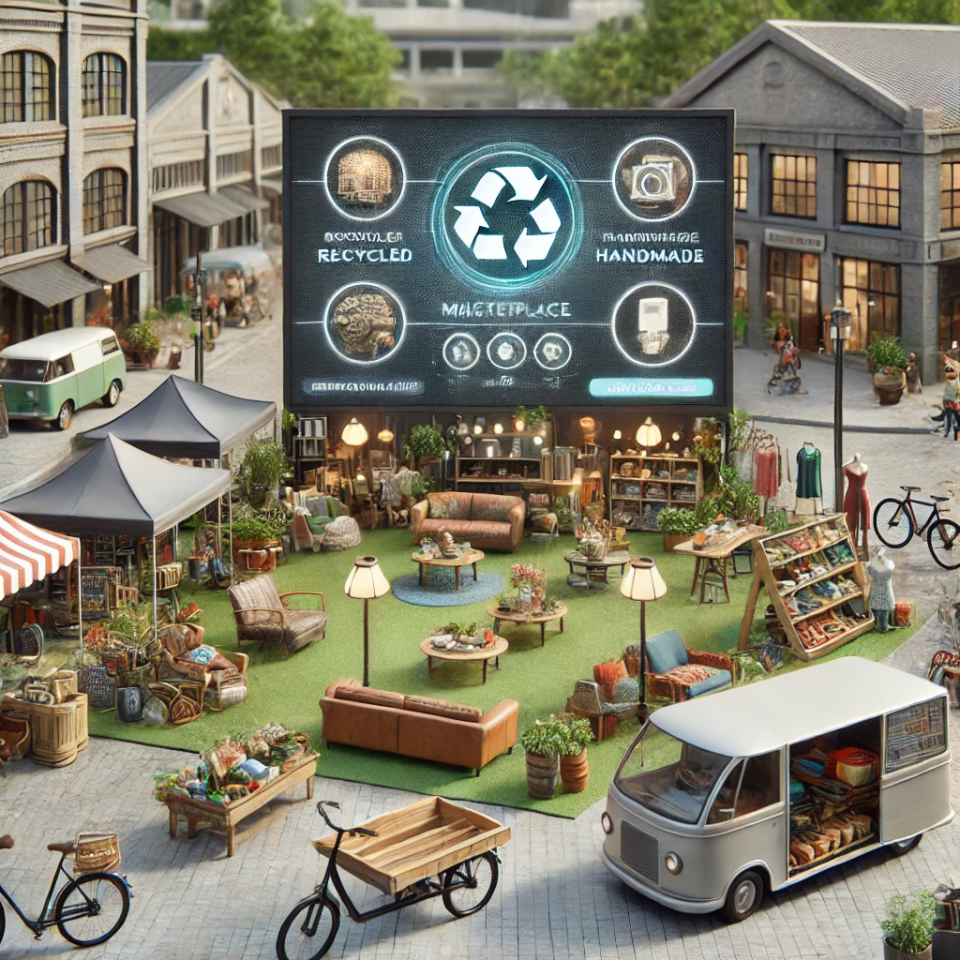
Circular Local Marketplace
Basic information
Project Title
Full project title
Category
Project Description
Current stage development
Geographical Scope
Project Region
Urban or rural issues
Physical or other transformations
EU Programme or fund
Description of the project
Summary
Aligned with the New European Bauhaus (NEB) values, the project integrates sustainability by promoting eco-friendly products and minimizing carbon emissions through optimized local distribution. Inclusion is embedded through accessible design (universal design principles) and digital training for small businesses to ensure participation. The marketplace’s aesthetic appeal highlights regional cultural elements, reinforcing a sense of local identity and belonging. Participatory governance ensures that local stakeholders actively shape its growth and evolution, reflecting NEB’s working principles.
In the longer term, the project will improve communities by creating sustainable livelihoods, fostering social cohesion, and reducing environmental degradation. It tackles specific challenges faced by rural and semi-urban regions, such as the digital exclusion of small businesses, the decline of local economies, and over-reliance on external markets. By bridging rural and urban areas, the platform promotes balanced territorial development, offering an innovative, scalable model that can be adapted across regions.
Key objectives for sustainability
To minimize environmental impact, the platform uses optimized distribution models that prioritize local delivery routes and encourage sustainable transportation. The marketplace also promotes regionally sourced goods, reducing dependency on long-distance logistics and supporting biodiversity through partnerships with local producers who follow environmentally responsible practices.
This project can serve as an exemplary model of sustainability by showing how digital innovation can drive local circular economies while maintaining environmental balance. It provides a scalable framework for other regions to replicate, demonstrating that integrating sustainability into a digital marketplace is achievable and impactful. Moreover, by incorporating sustainable consumption and production practices into everyday shopping, it raises public awareness and encourages behavioral changes among consumers and small businesses, contributing to long-term ecological benefits. The marketplace exemplifies how sustainable solutions can be embedded in digital ecosystems to reduce environmental harm while boosting local economies.
Key objectives for aesthetics and quality
The user interface is designed with simplicity, accessibility, and beauty in mind, applying universal design principles to ensure that people of all ages and abilities can navigate the platform easily. The interface blends modern minimalist aesthetics with culturally inspired visuals from the local region, creating an immersive environment that celebrates heritage while remaining user-friendly.
The marketplace also offers virtual events, such as artisan showcases and regional product storytelling sessions, to enrich the cultural experience. These initiatives go beyond commerce, providing a platform for cultural expression and interaction that reinforces local identity and traditions.
As an exemplary model, this project demonstrates how digital platforms can be more than functional spaces—they can become cultural hubs that connect communities, elevate local traditions, and create shared experiences. By intertwining design, culture, and functionality, the marketplace shows how aesthetics and cultural benefits can enhance user experience while promoting sustainable and local consumption practices. This approach can inspire other regions to adopt similar culturally driven design principles.
Key objectives for inclusion
The platform follows universal design principles, offering a user-friendly interface with customizable settings for individuals with disabilities, such as text-to-speech, high-contrast visuals, and multilingual options. Digital literacy training is provided to local artisans and small businesses, particularly those in rural areas or from underrepresented groups, helping them transition to the digital economy and increase their market visibility.
Affordability is addressed through low transaction fees (9%), making it accessible to small businesses and consumers alike. The marketplace also integrates a rewards system through the future implementation of a local digital currency, allowing users to benefit from discounts and circular savings. This feature ensures that sustainable and local products remain accessible to different income levels.
An inclusive governance model is embedded in the platform, giving vendors, consumers, and community stakeholders the opportunity to participate in decision-making processes. This is achieved through regular feedback forums, community meetings, and participatory design sessions, ensuring that the platform evolves in alignment with the community’s changing needs.
This project exemplifies inclusion by creating a marketplace that not only removes digital and economic barriers but also fosters collective empowerment. By integrating inclusive design, affordability mechanisms, and participatory governance, it demonstrates how digital innovation can build socially cohesive communities while ensuring fair access to opportunities.
How Citizens benefit
Role and level of involvement:
Co-design: Local stakeholders helped shape key aspects of the platform, ensuring relevance and user-friendliness.
Continuous feedback: Regular input is gathered through online feedback forms and community meetings, fostering continuous improvement.
Civil society partnerships: Local NGOs and cooperatives assist marginalized groups with digital training and outreach, promoting inclusion.
Impact of involvement:
Community involvement has guided the development of critical features, including low-cost transactions and culturally tailored content. Feedback from users has resulted in platform optimizations, such as expanded storytelling sections and eco-friendly delivery options. Civil society contributions have enhanced digital accessibility and outreach to vulnerable groups.
This participatory approach exemplifies the New European Bauhaus working principles by embedding co-creation, inclusion, and adaptability. The model is scalable, offering a replicable blueprint for sustainable and inclusive digital ecosystems.
Physical or other transformations
Innovative character
1. Circular economy integration: Unlike conventional platforms, it prioritizes second-hand and recycled products, promoting reuse and extending product lifecycles.
2. Localized, eco-friendly logistics: Instead of relying on centralized delivery networks, it optimizes local routes, reducing carbon emissions and fostering sustainable consumption.
3. Inclusive governance: Unlike top-down platforms, it is co-created through participatory design with artisans, businesses, and consumers, ensuring it evolves with local needs.
4. Digital accessibility: Tailored training and universal design principles make it accessible to marginalized groups, overcoming the digital exclusion common in mainstream systems.
5. Future innovations: Plans for a local digital currency and AI-powered recommendations enhance localized trade and sustainable product discovery.
This innovative approach integrates sustainability, inclusion, and technological advancement, providing a replicable model for regional sustainable development.
Disciplines/knowledge reflected
Disciplines and knowledge fields:
Digital technology: Developers ensured a user-friendly design with accessibility and AI-driven recommendations.
Sustainability: Experts integrated circular economy practices and eco-friendly logistics.
Economics: Business advisors optimized the financial model, ensuring affordability and scalability.
Local culture: Designers collaborated with artisans to incorporate regional heritage and storytelling.
Community development: NGOs and cooperatives helped design inclusive governance and training programs.
Interaction and collaboration:
Interdisciplinary workshops and meetings fostered continuous cooperation. Developers and sustainability experts aligned digital infrastructure with environmental goals, while designers and local stakeholders enriched the platform’s cultural aspects.
Added value:
This collaboration created a platform that seamlessly integrates technology, sustainability, and inclusion. By balancing economic growth, environmental responsibility, and cultural identity, it offers a replicable model for sustainable regional development.
Methodology used
1. Co-creation phase: The project began with workshops, surveys, and interviews involving local artisans, small businesses, and consumers. This ensured the platform design reflected their needs regarding accessibility, affordability, and cultural relevance.
2. Design and prototyping: Using input from stakeholders, developers and designers built an accessible, user-friendly prototype integrating circular economy features like second-hand product listings and optimized local logistics. Regular stakeholder feedback helped refine the prototype before broader deployment.
3. Pilot testing and feedback: The prototype was tested in a regional pilot involving selected local businesses and consumers. Feedback on usability, delivery optimization, and overall functionality was collected and used to improve the platform in real-time.
4. Continuous improvement and scaling: The platform is designed to evolve based on continuous community feedback. Feedback loops are built into the platform, allowing users to suggest improvements. Planned enhancements, such as the implementation of a local digital currency and AI-based recommendations, will be introduced gradually.
5. Cross-disciplinary collaboration: Experts in digital technology, sustainability, local culture, and business development collaborate throughout the project to ensure its holistic growth and alignment with environmental and social goals.
This methodology ensures that the marketplace remains adaptable, user-centric, and scalable, creating a replicable model for sustainable and inclusive digital ecosystems in other regions.
How stakeholders are engaged
Local level:
Small businesses, artisans, and local consumers actively co-designed core platform features, including product categories, affordable pricing, and delivery models, ensuring alignment with community needs.
Community organizations and cooperatives provide training, enabling digital access for marginalized groups, and support continuous feedback through local meetings.
Regional level:
Municipal and regional authorities assist with outreach and promotion, ensuring alignment with regional development strategies. They also support logistics planning to optimize local delivery and minimize environmental impact.
Regional business associations and chambers of commerce help onboard local producers and connect the marketplace to broader networks, enhancing its reach.
National and European level:
National trade organizations offer strategic advice on expanding the model, particularly regarding regulatory compliance and scalability across regions.
European networks and NEB-related initiatives provide best practices on integrating sustainability, circularity, and cultural identity into the platform’s growth strategy.
Added value:
The engagement of local stakeholders ensures the platform is user-centric and inclusive. Regional authorities enhance coordination, promoting cross-sector collaboration and logistical efficiency. National and European involvement fosters scalability and replicability, integrating the project into broader sustainability and circular economy frameworks. This multi-level approach makes the marketplace adaptable and transferable across different regions, making it a model of inclusive, sustainable growth.
Global challenges
1. Climate change and environmental degradation: The marketplace directly tackles environmental issues by embedding circular economy practices, promoting second-hand and locally produced goods, and optimizing eco-friendly local logistics to minimize carbon emissions. By reducing waste and promoting reuse, it helps address global sustainability goals at a community level.
2. Economic inequality and local resilience: Small businesses and artisans often struggle to compete against large e-commerce platforms. The marketplace empowers them by providing a low-cost digital platform for selling their products, fostering local economic growth and reducing dependence on external markets. This creates resilient, self-sustaining local economies.
3. Digital exclusion: Digital literacy gaps, particularly in rural and underrepresented communities, exacerbate economic inequality. Through training programs and accessible design, the marketplace enables marginalized groups to participate in the digital economy, providing long-term economic opportunities.
4. Over-consumption and waste generation: Linear consumption patterns contribute to environmental degradation and resource depletion. The marketplace addresses this by promoting sustainable consumption behaviors, such as buying recycled, second-hand, and locally sourced products, reducing waste while fostering local circular economies.
By addressing these challenges locally, the project offers a replicable, scalable model that contributes to solving global problems through community-driven actions. It demonstrates how local, sustainable solutions can create long-term positive impacts on environmental health, social inclusion, and economic resilience.
Learning transferred to other parties
1. Modular platform design: The digital infrastructure and localized visual elements can be easily customized to reflect different regional identities and needs.
2. Circular economy focus: Processes for promoting reuse, recycling, and local sourcing are scalable in both urban and rural settings.
3. Eco-friendly logistics: The localized delivery model, optimized to reduce carbon emissions, can be replicated with local partners elsewhere.
4. Participatory governance: The co-creation model, driven by community involvement, can be adapted to different regions to ensure local ownership.
5. Training programs: Digital literacy and business training modules for small businesses and marginalized groups are easily transferable to new contexts.
6. Technological features: AI-driven recommendations and the future implementation of a local digital currency can be scaled across regions to foster sustainable local trade.
These elements create a replicable framework for promoting sustainable, inclusive growth in regions with varied economic, environmental, and social needs.
Next steps
The Circular Local Marketplace is designed with a clear, phased implementation plan to ensure its successful development, promotion, and scaling, with significant milestones planned within the year following the application.<br />
<br />
1. Initial development and testing (Months 1-3):<br />
<br />
Finalize platform design, integrating stakeholder feedback gathered during the early concept phase.<br />
Develop core functionalities, such as product listings, user registration, and eco-friendly delivery options.<br />
Conduct small-scale testing with selected local businesses to ensure usability and functionality.<br />
2. Pilot launch (Months 4-6):<br />
<br />
Launch a pilot version in a specific region (e.g., Cabra, Córdoba) with a limited number of vendors and users.<br />
Collect real-time feedback on platform performance, delivery logistics, and user engagement.<br />
Provide training sessions to participating businesses on digital tools and sustainable product offerings.<br />
3. Expansion and refinement (Months 7-9):<br />
<br />
Scale the platform to include additional vendors and consumers, gradually expanding to nearby regions.<br />
Refine features based on pilot feedback, including improvements in user experience and logistics optimization.<br />
Begin promoting the marketplace through local networks, social media, and partnerships with community organizations.<br />
4. Technological enhancements (Months 10-12):<br />
<br />
Develop and integrate AI-powered product recommendations to promote sustainable, locally sourced goods.<br />
Initiate the first steps toward implementing the local digital currency, creating an incentive-based system to reward sustainable consumption.<br />
Monitor and evaluate performance using sustainability and inclusion metrics to ensure long-term impact.