build.ing
Basic information
Project Title
Full project title
Category
Project Description
Current stage development
Geographical Scope
Project Region
Urban or rural issues
Physical or other transformations
EU Programme or fund
Description of the project
Summary
With alarming data such as 50% of global raw material extraction being attributed to the overuse of materials and the generation of waste, build.ing's platform combats engineering excesses and drives the reuse of materials, ensuring compliance with EU sustainability targets such as the Green Deal, Level(s) and EPBD.
Its specific objectives are clear: reducing material use by 30% and embodied carbon by 50% through AI-driven design simulations, integrating real-time lifecycle analysis and regulatory compliance checks, promoting strategies that prioritise recycled and bio-based materials, supporting modular, prefabricated and reusable construction and providing tools for informed decisions with real-time lifecycle analysis (LCA).
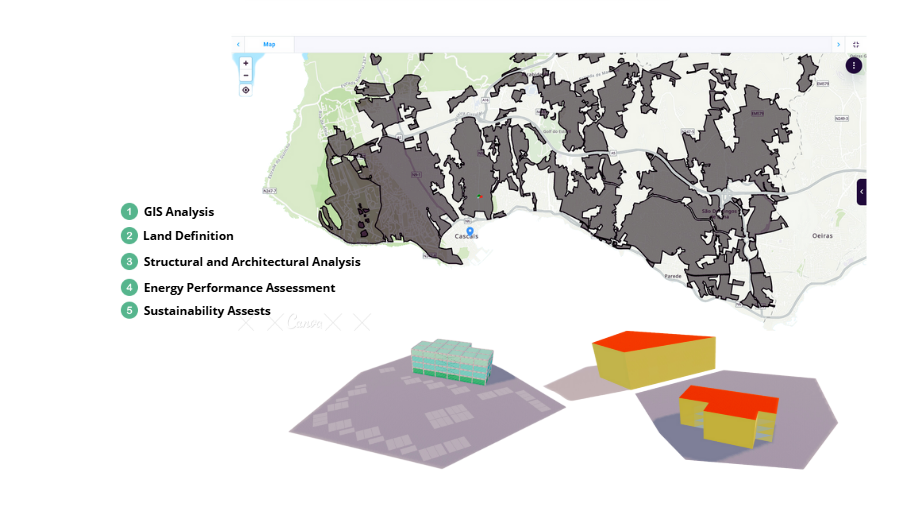
In pilot projects, such as that of Cascais City Council (Portugal), build.ing has demonstrated its potential by reducing construction waste by up to 30%, reducing the extraction of raw materials and the overall environmental impact. Our aim is to empower local governments with sustainability tracking tools and promote the adoption of circular methodologies throughout the construction sector.
This scalable platform in different urban and regional contexts, which automates life cycle assessments to ensure compliance with Level(s) and EPBD, represents a real breakthrough in the fight against climate change and in promoting a robust circular economy and circular construction.
Key objectives for sustainability
Designed to reduce material consumption, minimise waste and promote circular construction, the platform acts directly on the environmental footprint of this vital sector. By integrating AI-driven material optimisation, life cycle thinking and building and circular economy strategies, build.ing takes sustainable design to a new standard, reaffirming that sustainability should be the way forward, not the exception.
The environmental impact assessments are data-driven, automated life cycle assessments (LCA) that measure the carbon, energy and material footprint of each design decision, ensuring compliance with the EU's sustainable building levels, EPBD and taxonomy.
Based on climate resilience and resource efficiency, our system identifies energy-efficient design solutions, reducing operational carbon emissions and adapting buildings to local climatic conditions.
By embedding sustainability at the centre of the construction process, build.ing ensures that sustainable choices are affordable, accessible and backed by data, making it a scalable solution for cities, developers and policymakers. The project shifts industry norms towards efficiency and the circularity of materials, demonstrating how digital innovation can drive a climate-positive transformation in urban development.
Among the objectives achieved, the sustainability one is impactful, highlighting the reduction in the use of materials and embodied carbon, AI-based design simulations optimise the selection of materials, reducing construction waste by 30% and contributing to a 50% decrease in embodied carbon emissions, thanks to the prioritisation of recycled and low-carbon materials. In addition, the platform ensures the integration of circular economy and construction principles, guaranteeing the reuse of demolition materials.
Key objectives for aesthetics and quality
Among the main objectives achieved are:
Optimised design that balances form and function: AI-driven parametric design tools generate structurally efficient and material-conscious solutions, avoiding over-engineering and guaranteeing aesthetic integrity.
Use of natural, recycled and regional materials: The platform promotes bio-based, low-carbon and reused materials, aligning construction with local identity and cultural heritage.
Improved urban environments: By optimising the use of materials, build.ing enables the creation of lighter, more transparent and visually appealing structures, elevating citizens' well-being and spatial experience.
Human-centred, climate-adaptive spaces: By encouraging bioclimatic architecture, the system ensures that buildings integrate with nature, maximise daylight and support urban biodiversity.
Exemplary character: Serving as a bridge between innovation and tradition, build.ing empowers architects to integrate sustainability without sacrificing beauty or cultural relevance.
By ensuring that resource efficiency and circular design enhance rather than limit aesthetic potential, build.ing redefines building paradigms, demonstrating that resource efficiency and circular design can, far from restricting, amplify the aesthetic and functional potential of urban spaces. Offering a replicable model for cities looking to create sustainable.
Key objectives for inclusion
Among the main objectives achieved are:
Accessibility for professionals of all scales: Designed to be used by small architectural firms, city planners and large-scale developers, the platform removes technological and financial barriers, boosting circular construction.
Accessibility and cost optimisation: By reducing material waste, improving efficiency and automating sustainability compliance, build.ing makes low-carbon, highly resource-efficient buildings financially viable.
Participatory urban planning: The system allows communities and stakeholders to actively collaborate on the project, offering visual simulations of material-efficient solutions for public and private initiatives.
Inclusive governance and regulatory alignment: By ensuring automated compliance with sustainability targets, the platform supports policymakers in making informed decisions, helping cities implement low-cost, climate-friendly building policies.
Exemplary character: By uniting digitalisation and inclusion, build.ing demonstrates that sustainable construction is not a niche practice, but an accessible path for local governments, communities and professionals, creating affordable, climate-resilient and socially responsible urban environments.
This approach, which combines technological innovation with an inclusive commitment, redefines the urban landscape and demonstrates that sustainable transformation is within everyone's reach, marking a new paradigm in the development of cities.
How Citizens benefit
This participatory approach has materialised in municipal projects, where citizens have been able to visualise the efficiency of materials and debate the best sustainable construction options even before practical implementation. As a result, the costs and waste of materials have been reduced and sustainable housing has become more accessible to low-income communities.
Citizen involvement becoming tangible:
Participatory urban planning: In municipal projects, citizens have been integrated into the process through material efficiency visualisations, allowing comparison and discussion of sustainable construction options before implementation.
Local impact and housing affordability: By reducing costs and material waste, build.ing has contributed to lower construction costs, making sustainable housing more accessible to low-income communities.
Workshops and public consultations: In the pilot projects, local stakeholders took part in educational sessions, ensuring that community needs and sustainability priorities were reflected in urban development
Impact of citizen involvement: By making sustainability measurable and understandable, build.ing increased public awareness and acceptance of circular construction.
By making sustainability measurable and understandable, build.ing increases public awareness and acceptance of circular construction, improving the alignment of public policies with material efficiency and sustainable strategies. This project consolidates itself as a replicable model for civic participation in sustainable urban planning.
Physical or other transformations
Innovative character
Key innovations transforming the sector:
AI-based material optimisation: Unlike static design methods, the platform employs machine learning algorithms to simulate various design scenarios, maximising material efficiency and reducing both waste and over-engineering.
Automated Life Cycle Assessments (LCA): Overcoming costly and time-consuming manual calculations, build.ing offers real-time environmental impact assessments, ensuring that every design decision fulfils the strict sustainability standards of Level(s) and the EPBD.
Integration of circular economy principles: Breaking with the tradition of sourcing new materials, the platform prioritises reuse, modular construction and prefabrication, encouraging deconstruction rather than demolition.
Scalable digital transformation: build.ing consolidates sustainability, compliance and financial efficiency into a single decision-making tool, making sustainable construction not only practical and accessible, but also cost-effective.
Multi-stakeholder collaboration and transparency: By bringing together architects, engineers, municipalities and legislators in a shared digital environment, the platform facilitates everyone's interaction and collaborative decisions, and ensures regulatory compliance, transforming sustainability from an add-on into a fundamental principle, guaranteeing low-carbon, resource-efficient construction.
Disciplines/knowledge reflected
Main Pillars of Urban Transformation:
New Generation Architecture and Urban Planning
Projects that harmonise material efficiency with integrated aesthetics, where form and function merge into intelligent solutions for human and natural environments.
Structural and Environmental Engineering as Modern Alchemy
Reinventing construction, where pioneering systems that unite structural strength and optimise energy efficiency transform buildings into living organisms that interact with the climate.
AI and Data Science: The Architects of the Invisible
Decoding the future with algorithms that learn, predict and redesign the life cycle of materials, transforming raw data into circular strategies tailored to each project.
Circular Economy: From Demolition to Revolution
Breaking the linear logic, where innovations in creative reuse, urban mining and ‘regenerative metabolism’ that turn waste into resources and buildings into living material banks.
Public Policy as a Driver of Green Innovation
Turning bureaucracy into acceleration, with regulatory frameworks that not only comply with EU standards, but reinvent certifications as strategic tools for carbon-negative cities.
AI-driven sustainability insights have revolutionised decision-making in architecture and urban planning, transforming sustainability from an afterthought into a central pillar of design. Structural engineers and circular economy experts collaborated to reduce material consumption and integrate waste reduction strategies, while policy experts and municipal authorities contributed regulatory perspectives that remove bureaucratic barriers.
This integrated, multidisciplinary approach was key to developing an innovative and practical tool, ensuring that build.ing is widely adoptable across all sectors.
Methodology used
How stakeholders are engaged
Local level: Cities and municipalities, such as Cascais, have adopted pilot projects using build.ing to assess the efficiency of materials, reduce construction waste and align initiatives with local sustainability policies.
Regional level: Partnerships with urban planning agencies and property developers have made it possible to integrate circular economy principles into regional building codes.
National level: Collaboration with building federations and policy bodies has facilitated the adoption of sustainable practices across the sector.
European level: Alignment with EU regulatory frameworks - ensuring compliance with Level(s), the EPBD and the Green Deal - reinforces build.ing's contribution to Europe's climate-neutral building strategy.
This multi-scalar integration adds value in several ways:
- Cities benefit from cost savings and more sustainable infrastructure projects.
- Construction companies adopt more efficient workflows, significantly reducing waste and costs.
- Regulatory bodies rely on data-driven insights to shape policy incentives that promote circular construction.
- Cross-border knowledge sharing accelerates the adoption of best practices, making build.ing a scalable and transferable solution across Europe.
By uniting diverse actors and bridging the gap between local implementation and high-level policy, build.ing demonstrates that sustainable construction can and should be a regulatory priority and a practical reality for a more balanced future. And only with a multidisciplinary approach is it possible to develop an innovative and practical tool, ensuring that it is widely adoptable across all sectors while remaining in line with the latest advances.
Global challenges
The main global challenges addressed by build.ing:
Climate change and carbon emissions:
By reducing embodied carbon emissions by up to 50%, build.ing empowers cities to achieve climate neutrality targets, as established by the EU Green Deal and international climate agreements. In addition, the platform promotes energy-efficient construction projects, reducing operational carbon footprints.
Depletion of resources and waste of materials:
Reducing the excessive use of materials by 30%, build.ing ensures that buildings are designed to minimise the extraction of raw materials. By prioritising reuse and modularity, it supports closed-loop construction models, keeping materials in circulation and avoiding waste.
Sustainable urbanisation:
In a world where cities are growing rapidly, build.ing helps plan infrastructure with less environmental impact, ensuring that new developments prioritise sustainability and circularity. The platform provides policymakers with data-driven insights that incentivise green building, accelerating the transition to low-carbon urban development.
Affordability and equitable access to sustainable solutions:
By economically optimising the use of materials, build.ing makes sustainable design accessible to small businesses, municipalities and low-income housing projects. By supporting community participation in urban planning, it transforms sustainability from a technical objective into a social priority.
By uniting advanced digital technologies with real-world sustainability challenges, build.ing offers a scalable and practical model for cities around the world to reduce the impact.
Learning transferred to other parties
Key transferable elements:
AI-driven material efficiency modeling: The platform’s predictive analytics and generative design capabilities can be applied to any building project, regardless of location, to reduce waste and optimize resources.
Automated Life Cycle Assessments (LCA): build.ing’s real-time sustainability tracking and compliance automation is universally applicable and can be adapted to various regulatory frameworks worldwide.
Circular construction methodologies: The tool promotes deconstruction-ready designs, modular construction, and local material reuse, which can be adopted in both high-density urban areas and rural development contexts.
Digital policymaking support: Municipalities and government agencies can use the platform to simulate urban policies, assess sustainability targets, and plan material-efficient infrastructure projects, ensuring evidence-based regulatory decisions.
BIM and industry integration: build.ing is designed to seamlessly integrate into existing Building Information Modeling (BIM) and urban planning workflows, allowing easy adoption by architects, engineers, and construction firms.
Knowledge-sharing and open innovation: The platform facilitates data exchange and collaboration, enabling cities, research institutions, and industry players to learn from successful implementations and adapt best practices to their local contexts.
With minimal adaptation, build.ing can be used in both developed and emerging economies, supporting material-efficient urbanization, and green infrastructure.
Next steps
build.ing has already achieved significant milestones in research, development, and real-world application, demonstrating a strong commitment to implementing its innovative concept in practice. Recognized by the Portuguese National Innovation Agency, the project has established itself as a pioneer in AI-driven circular construction, with its brand registered at the European level.<br />
<br />
In September 2024, build.ing launched its first version, successfully conducting three pilot projects, including one with the Cascais Municipality, where the platform optimized material use in urban development. Building on these results, a new version of the platform will be released in February 2025, incorporating user feedback and enhanced AI-driven material efficiency capabilities.<br />
<br />
Planned Actions for the Next Year<br />
Scaling Deployment and Market Adoption:<br />
Expand partnerships with municipalities, construction firms, and urban planning agencies to implement the platform in new public and private projects.<br />
Engage with architectural and engineering firms to integrate build.ing into their design workflows, supporting material-efficient and sustainable construction.<br />
Continue collaborating with Portuguese and European regulatory bodies to align the platform with emerging sustainability regulations and incentives.<br />
Technological Advancements and Platform Enhancements:<br />
February 2025: Launch of the next-generation version of build.ing with improved AI-based material simulations, automated LCA (Life Cycle Assessment), and circular design features.<br />
Integration with Building Information Modeling (BIM) systems, enabling seamless adoption by industry professionals.<br />
Expansion of material impact databases, covering a broader range of low-carbon, recycled, and regional materials.<br />
Securing Long-Term Growth and Financing:<br />
A funding proposal has been submitted for the next two years to support platform scaling, R&D advancements, and broader industry adoption.<br />