E-commerce Farmers Market
Basic information
Project Title
Full project title
Category
Project Description
- to by-pass convectional supply chain of retailors and conduct business directly with local consumers/business.
- get an access to a ready to use supply-chain.
- sell their production with higher profit.
- optimize their production process through build in features and software designed to help manage farm.
- develop their own brand.
- reap their harvest accordingly to the demand while increasing productivity and preserving the rest of the harvest.
Current stage development
Geographical Scope
Project Region
Urban or rural issues
Physical or other transformations
EU Programme or fund
Description of the project
Summary
Target Groups:
Small and medium farmers: Those struggling with limited market power, spoilage, and access to efficient supply chains.
Local consumers: Individuals and families seeking fresh, high-quality food at competitive prices.
Local businesses: Food processors, restaurants, and other businesses looking to source local ingredients.
Specific Objectives: Empower farmers: By providing direct market access, supply chain solutions, and tools for farm management, branding, and data collection to improve profitability and optimise production. Enhance consumer access: Offer convenient access to fresh, local produce at competitive prices, promoting healthier food habits and reducing food waste.
Stimulate rural development: Incentivise economic activity and self-employment opportunities in rural areas, potentially reversing depopulation trends and encouraging infrastructure development. Disrupt the existing market: Challenge the current retail-dominated food system by offering an alternative model that addresses the power imbalance between farmers and large retailers.
Outcomes: Increased farmer income: Demonstrated through metrics like average income increase for participating farmers, reduced losses due to spoilage, and improved price negotiation power. Expanded market reach: Measured by the number of farmers and consumers participating in the platform, along with the volume of products sold. Reduced food waste: Quantified by tracking the amount of food saved from spoilage through the platform's efficient supply chain. Increased consumer access to local food: Measured by the number of consumers regularly purchasing local products through the platform. Positive social impact: Demonstrated through metrics like job creation in rural areas, increased economic activity in target regions.
Key objectives for sustainability
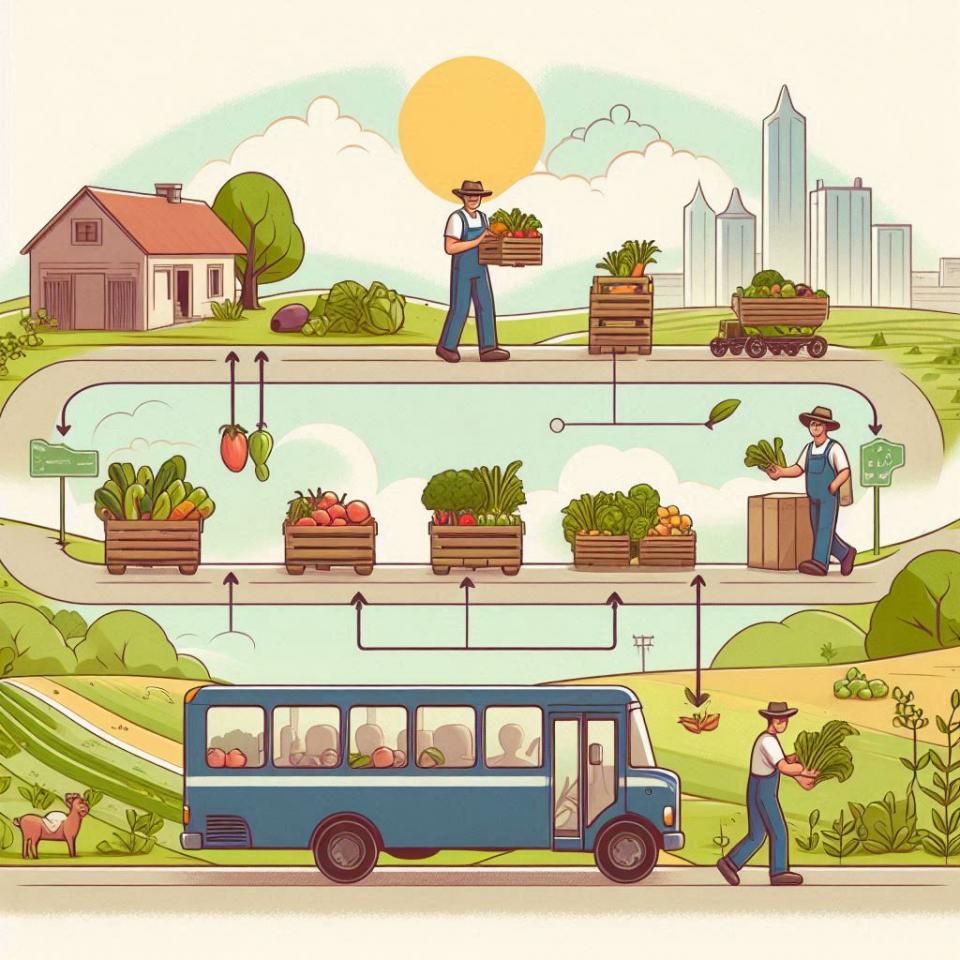
This concept is aiming to reduce the food waste buy introducing the two-sided platform that will bring consumers, and business in the cities together with local farmers and will allow them to build more efficient supply chains which that would include delivery of products on a daily basis from to the dark store through means of public transportation and consequently less food would be spoiled on the shelves and reduction of food waste generation.
In addition to that, another key objective to this project is reduce pollution through decreased consumption of electricity. it well established fact that, that are trade letter in the supermarkets are preserved in either warehouses or directly in the supermarkets, at the same time, in accordance with Eurostat warehouse consumes 896 PJ of energy, making up more than a fifth of energy consumption (21.1%). While this proposal is aiming in reduction of the time that foods spend on the shelves and therefore reduction of position that comes from energy production.
Last but not least, industrialized farming and it practices leads to the decline of biodiversity. While small and medium size farms have practices that promotes biodiversity not just through decreased use of the pesticides and herbicides and insecticides but also by having more diverse crops and vegetables. Which is more practical in terms of selling your products directly to the consumers.
Key objectives for aesthetics and quality
Besides, sells of local traditional foods from rural areas to cities will help to keep traditions alive in rural areas and will help to make a bridge between those communities.
In modern society, urbanization is getting stronger and more young people leaving the rural areas in order to live in the cities. However through this platform rural life-style can be popularized and rate of rural depopulation could be slow down.
Key objectives for inclusion
It will require some access to a smart phone or a computer with internet connection however due to introduction of the app the traffic requirement will be minimal.
At the same time beneficiary from this project will be not just a rural areas but also low income families in the cities which through the competition among farmers will get an access to the healthier food options with lower price.
in addition to that this project will create a new system where regardless of the income consumers will have access to fresh and good quality foods through consumers reviews.
How Citizens benefit
In addition to the aforementioned groups beneficiary from this project such as farmers, consumers, small business, food companies. This project also will benefit local public transport providers because it will introduce additional source of income obtained from logistics services.
besides that, this business model includes possibility of franchising. In this instance, possibility to open dark store will be opened to anyone who desires to join grow with the platform.
Physical or other transformations
Innovative character
Digital Transformation for Farmers
Unlike traditional agricultural marketplaces where farmers need to physically visit trading hubs or rely on intermediaries, our platform enables them to conduct business entirely online. This allows farmers to:
Sell their produce without leaving their farms, saving time and operational costs.
Access digital tools for farm management, pricing optimization, and contract management.
Expand their customer base beyond local markets, by including local busineses and increasing profitability.
Public Transport-Integrated Logistics
A unique feature of our platform is the integration of public transport providers into the logistics network. This innovation:
Reduces reliance on costly private logistics companies.
Optimizes transportation by utilizing existing public transport infrastructure for scheduled deliveries.
Dark Store Franchise Model
Mainstream food delivery and grocery supply models rely on traditional retail stores or warehouses. It introduces:
A franchised dark store model, where local entrepreneurs can open storage and pickup locations.
A decentralized distribution system that enhances accessibility and reduces last-mile delivery costs.
Greater efficiency in food distribution, reducing waste and improving freshness.
Consumer Choice & Pricing
Unlike most e-commerce platforms that offer fixed pricing from limited sources, platform allows consumers to:
Compare and select products based on quality and price directly from multiple farmers.
Make informed decisions based on freshness, farming practices, and price competitiveness.
The platform disrupts the conventional food supply chain, offering a more inclusive, efficient, and sustainable solution for farmers, businesses, and consumers. It not only empowers farmers but also enhances affordability and accessibility for consumers.
Disciplines/knowledge reflected
Key Disciplines Involved:
Business & Economics – Understanding market demand, pricing strategies, and business models is crucial in designing an efficient platform that benefits both buyers and sellers while ensuring profitability and sustainability.
Technology & Software Development – Software engineers and UX/UI designers will collaborated to develop a user-friendly app and web platform with secure payment processing, data analytics, and real-time contract management.
Agriculture & Supply Chain Management – Experts in agriculture and logistics will helped optimize the supply chain, ensuring that farmers and businesses could efficiently trade and manage inventory through the platform.
Legal & Regulatory Compliance – Legal professionals will ensured that agreements between users complied with relevant regulations, including contract law, consumer protection, and data privacy.
Marketing & Consumer Behavior – Specialists in digital marketing and behavioral economics will contributed insights into user engagement, trust-building, and effective communication strategies.
The collaboration between these fields created an user-centered platform. Business strategists worked closely with software developers to ensure that technical features aligned with market needs. Agricultural experts provided insights into supply chain constraints, which influenced platform design and logistics integration. Legal professionals ensured that automated agreements were compliant with relevant laws, reducing friction between parties.
This interdisciplinary approach resulted in a well-rounded, efficient, and legally sound platform that successfully connects consumers, farmers, and businesses, fostering transparency and trust in e-commerce transactions.
Methodology used
User-Centered Research & Design
Before development, conductment of extensive research to understand the needs and challenges of our key stakeholders:
Farmers – Assessed barriers to digital adoption, pricing strategies, and logistical challenges.
Businesses & Transport Providers – Studied how to integrate public transport networks into the supply chain.
Consumers – Evaluated preferences regarding food quality, price transparency, and pickup convenience.
Agile Development & Iterative Prototyping
Team will follow an agile development methodology, allowing for continuous improvement through iterations. The development cycle included:
Prototyping & Testing – Created wireframes and functional prototypes, gathering feedback from test users.
MVP (Minimum Viable Product) Launch – Deployed a functional version with core features, tested in a pilot market.
Smart Contract & Secure Transaction Integration
To streamline business agreements, our platform implemented automated smart contracts that:
Allowed farmers, businesses, and transport providers to enter legally binding agreements.
Ensured timely payments and deliveries with built-in compliance tracking.
Reduced risks associated with late deliveries or payment defaults.
Logistics Optimization & Public Transport Integration
Our approach to logistics was data-driven and partnership-based:
Partnered with transport providers, integrating their schedules into our logistics network.
Established dark store franchise models, ensuring efficient last-mile distribution.
Market Testing & Scale-Up Strategy
To validate the platform’s effectiveness, we:
Will conducted regional pilot tests with selected farmers, businesses, and transport operators.
Measured success through key metrics: transaction volume, delivery efficiency, and user satisfaction.
How stakeholders are engaged
Global challenges
Food Security & Supply Chain Inefficiencies. Many regions face food supply inefficiencies due to long distribution chains, high wastage, and lack of direct market access for producers.
The platform: Connects farmers directly with consumers and businesses, reducing dependency on middlemen.
Uses dark store franchises to improve last-mile food distribution, ensuring fresher produce and reduced spoilage.
Optimizes logistics with public transport networks, making deliveries more efficient and cost-effective.
Economic Empowerment for Farmers & Small Businesses. Small-scale farmers and food producers often struggle with market access, fair pricing, and business sustainability.
The platform: Enables farmers to conduct business online without leaving their farms, increasing productivity and profitability.
Provides transparent pricing and smart contracts, ensuring fair transactions without exploitative intermediaries.
Encourages franchise-based entrepreneurship through dark stores, creating new business opportunities.
Reducing Carbon Footprint. Traditional supply chains rely on costly and high-emission logistics systems, contributing to environmental degradation.
The model: Leverages public transport infrastructure for goods delivery, minimizing reliance on fuel-intensive private logistics.
Decentralizes food distribution through dark stores, reducing long-haul transportation and emissions.
Promotes direct sourcing from local farmers, cutting down on food miles and waste.
Learning transferred to other parties
Geographic Expansion & Adaptability
The platform’s core concept and digital infrastructure can be easily replicated in other regions or countries with similar agricultural and logistical needs. The key factors enabling this expansion include:
Flexible Business Model – The platform is designed to scale across different agricultural supply chains, allowing customization based on local conditions.
Public Transport & Logistics Integration – The model of utilizing public transport for deliveries can be adapted to various urban and rural transportation networks.
Expansion to Other Beneficiaries & Sectors
Beyond its initial focus the platform has the potential to support additional use cases:
Business-to-Consumer (B2C) Commerce – Retailers, wholesalers, and food suppliers can use the platform to sell directly to consumers, much like an online marketplace for fresh produce and grocery items.
Business-to-Business (B2B) Trade – The platform can facilitate businesses selling food products for further processing, allowing manufacturers, restaurants, and food processors to source raw materials efficiently.
Dark Store Franchises in Other Sectors – The dark store pickup model can be extended to other industries, such as pharmaceuticals, local artisan goods, or grocery solutions.
Transferable Technology
The technology stack, smart contract-based agreements used in the project are adaptable to various industries. Other sectors can replicate the methodology by leveraging:
Automated Smart Contracts – Useful for securing transactions in other sectors like wholesale trade or logistics.
Franchise-Based Pickup System – The concept of franchised dark stores can be applied to other goods beyond food.
Next steps
As the project is currently in the concept stage and seeking financial support, the next year will be dedicated to securing additional funding, developing a Minimum Viable Product (MVP), and establishing key partnerships. The following structured approach will ensure the effective launch and future scalability of the platform.<br />
Securing Funding and Strategic Partnerships (Months 1-6)<br />
Actively pursue investments, and funding opportunities to support the platform’s initial development and pilot implementation.<br />
Establish partnerships with public transport providers to integrate a cost-efficient logistics network.<br />
Engage with farmer cooperatives, food businesses, and franchise operators to build an early user base and validate the model.<br />
Conduct a market feasibility study to assess potential challenges and refine the business strategy.<br />
Platform Development and Testing (Months 3-9)<br />
Develop a MVP with core functionalities, including user onboarding, contract automation, and logistics management.<br />
Design and test a logistics coordination system to facilitate deliveries through public transport networks.<br />
Launch an initial pilot program involving a selected group of farmers, businesses, and consumers to assess usability and efficiency.<br />
Collect and analyze feedback to refine the platform and improve the user experience.<br />
Awareness and Market Expansion (Months 6-12)<br />
Implement a marketing and outreach campaign to attract early adopters, including farmers, food businesses, and franchisees.<br />
Develop a brand identity, website, and promotional materials to communicate the platform’s value proposition effectively.<br />
Initiate the recruitment and onboarding process for franchise partners to establish dark store locations.<br />
Pilot Expansion and Scaling Strategy (Months 9-12)<br />
Expand the pilot phase to additional regions, incorporating lessons learned from early adopters.<br />
Strengthen the B2B marketplace by integrating food processors and restaurant suppliers into the platform.