HUX
Basic information
Project Title
HUX
Full project title
Healthy User Expirience - Art, Health and Sciense
Category
Prioritising the places and people that need it the most
Project Description
The HUX (Health User eXperience) project is a groundbreaking initiative that merges art, science, and technology to tackle some of the most pressing issues facing contemporary society.
HUX seeks to foster meaningful connections between emerging artists, the local community, and experts from diverse fields, driving the development of creative and impactful solutions to today’s complex challenges.
HUX seeks to foster meaningful connections between emerging artists, the local community, and experts from diverse fields, driving the development of creative and impactful solutions to today’s complex challenges.
Current stage development
Early concept
Geographical Scope
Local
Project Region
Lisbon, Portugal
Urban or rural issues
It addresses urban-rural linkages
Physical or other transformations
It refers to a physical transformation of the built environment (hard investment)
EU Programme or fund
No
Description of the project
Summary
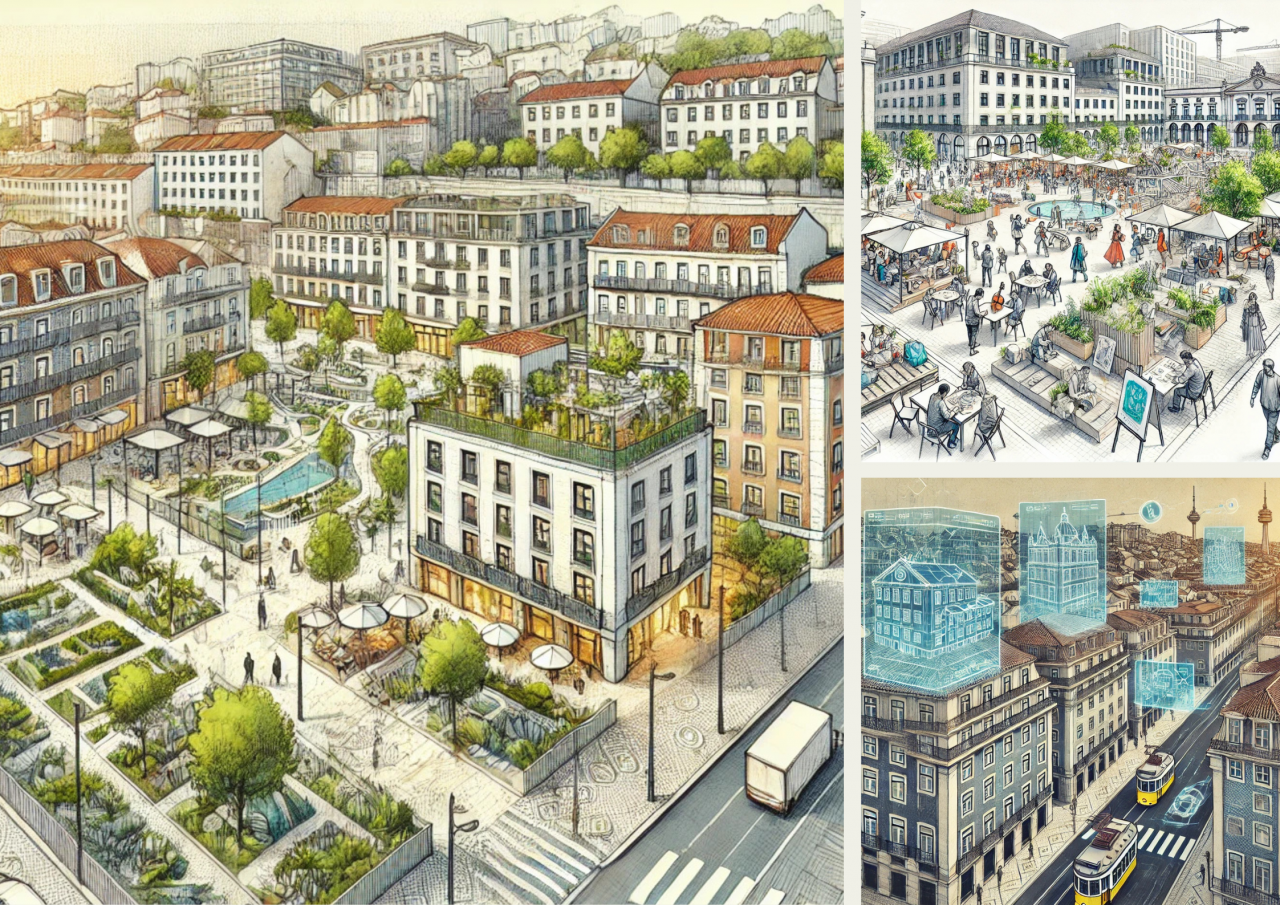
HUX (Health User eXperience) is a pioneering initiative that redefines urban regeneration, public health, and social equity through three key pillars:
1. Citizen Engagement through Arts & Cultural Events → Empowering communities to co-create healthier and more inclusive urban spaces.
2. Technology-Driven Urban Planning → Using Digital Twins to simulate and optimise sustainable regeneration of streets, housing, and health infrastructure (hospitals, clinics, gyms, retirement homes, etc.).
3. Holistic Health as a Core Urban Principle → Integrating well-being into housing, public spaces, and environmental policies.
HUX goes beyond traditional urban planning, it creates a movement where local arts, health, technology and architecture regenerate cities while combatting gentrification, ensuring inclusivity, and creating real impact.
By combining immersive events, participatory design, and AI-powered simulations, HUX empowers citizens, experts and decision-makers to shape healthier, more liveable cities.
Objectives
1. Transform underutilised spaces into thriving, people-centered environments through culture-led urbanism.
2. Use Digital Twins to simulate and test urban interventions before implementation.
3. Ensure housing and public spaces actively contribute to public health and well-being.
4. Engage communities through large-scale, interactive artistic events that gather insights for urban planning.
5. Develop a replicable model for inclusive, health-oriented urban regeneration.
HUX blends arts, technology, and participatory governance to build cities that heal, inspire, and empower.
1. Citizen Engagement through Arts & Cultural Events → Empowering communities to co-create healthier and more inclusive urban spaces.
2. Technology-Driven Urban Planning → Using Digital Twins to simulate and optimise sustainable regeneration of streets, housing, and health infrastructure (hospitals, clinics, gyms, retirement homes, etc.).
3. Holistic Health as a Core Urban Principle → Integrating well-being into housing, public spaces, and environmental policies.
HUX goes beyond traditional urban planning, it creates a movement where local arts, health, technology and architecture regenerate cities while combatting gentrification, ensuring inclusivity, and creating real impact.
By combining immersive events, participatory design, and AI-powered simulations, HUX empowers citizens, experts and decision-makers to shape healthier, more liveable cities.
Objectives
1. Transform underutilised spaces into thriving, people-centered environments through culture-led urbanism.
2. Use Digital Twins to simulate and test urban interventions before implementation.
3. Ensure housing and public spaces actively contribute to public health and well-being.
4. Engage communities through large-scale, interactive artistic events that gather insights for urban planning.
5. Develop a replicable model for inclusive, health-oriented urban regeneration.
HUX blends arts, technology, and participatory governance to build cities that heal, inspire, and empower.
Key objectives for sustainability
HUX makes sustainability actionable by:
•Using Digital Twins to reduce waste in urban development, testing building renovations, public space design, and green infrastructure before physical implementation.
•Promoting nature-based solutions, such as urban forests, permeable pavements, and rooftop gardens, to enhance environmental resilience.
•Prioritising circular economy principles in housing and infrastructure, using recycled materials and adaptive reuse of spaces.
•Using Digital Twins to reduce waste in urban development, testing building renovations, public space design, and green infrastructure before physical implementation.
•Promoting nature-based solutions, such as urban forests, permeable pavements, and rooftop gardens, to enhance environmental resilience.
•Prioritising circular economy principles in housing and infrastructure, using recycled materials and adaptive reuse of spaces.
Key objectives for aesthetics and quality
Through design, culture, and participatory engagement, HUX demonstrates how aesthetics and functionality can merge to improve quality of life. Namely, through:
•Art-driven regeneration: HUX integrates local artists and designers into urban planning, ensuring a culturally rich and visually appealing transformation of cities.
•Placemaking through community storytelling: Murals, installations, and interactive exhibitions will give identity to urban spaces, making them meaningful for local residents.
•Multisensory urbanism: HUX focuses on soundscapes, light, tactile elements, and green environments to improve mental health and well-being in urban areas.
•Art-driven regeneration: HUX integrates local artists and designers into urban planning, ensuring a culturally rich and visually appealing transformation of cities.
•Placemaking through community storytelling: Murals, installations, and interactive exhibitions will give identity to urban spaces, making them meaningful for local residents.
•Multisensory urbanism: HUX focuses on soundscapes, light, tactile elements, and green environments to improve mental health and well-being in urban areas.
Key objectives for inclusion
HUX is a new model of urban regeneration, one that is deeply inclusive and fundamentally community-led. HUX ensures inclusivity through:
•Urban regeneration without displacement: By involving citizens in decision-making, HUX ensures that gentrification does not push communities out but instead empowers them to shape their neighbourhoods.
•Health infrastructure designed for all: Digital Twins will simulate accessibility scenarios for health infrastructures, residential buildings and public spaces, ensuring inclusivity for all ages and abilities.
•Bridging gaps between disciplines: HUX creates a common language between citizens, artists, architects, and health experts, ensuring cities reflect diverse needs and aspirations.
HUX puts people in its centre ensuring cities are designed for, with, and by their communities.
•Urban regeneration without displacement: By involving citizens in decision-making, HUX ensures that gentrification does not push communities out but instead empowers them to shape their neighbourhoods.
•Health infrastructure designed for all: Digital Twins will simulate accessibility scenarios for health infrastructures, residential buildings and public spaces, ensuring inclusivity for all ages and abilities.
•Bridging gaps between disciplines: HUX creates a common language between citizens, artists, architects, and health experts, ensuring cities reflect diverse needs and aspirations.
HUX puts people in its centre ensuring cities are designed for, with, and by their communities.
How Citizens benefit
HUX revolutionises participatory urban planning by:
•Hosting immersive events where citizens experience and contribute to urban transformations.
•Using Digital Twins as an interactive tool, allowing communities to visualise changes in real time.
•Bringing together artists, urbanists, experts, and policymakers to co-create the future of cities.
HUX proves that urban planning is most effective when it is a collective, creative process.
•Hosting immersive events where citizens experience and contribute to urban transformations.
•Using Digital Twins as an interactive tool, allowing communities to visualise changes in real time.
•Bringing together artists, urbanists, experts, and policymakers to co-create the future of cities.
HUX proves that urban planning is most effective when it is a collective, creative process.
Physical or other transformations
It refers to a physical transformation of the built environment (hard investment)
Innovative character
HUX disrupts traditional urbanism by:
•Turning culture into an urban design tool rather than just a decorative element.
•Merging public health with architecture and sustainability, ensuring well-being is a core planning metric.
•Using real-time simulations to test community-driven urban changes before implementation.
This represents a radical shift towards data-informed, citizen-driven, and art-powered urban regeneration.
Unlike traditional top-down urban planning, HUX is:
✅ Data-driven & predictive → Digital Twins simulate, test, and optimise interventions before implementation.
✅ Art-powered & participatory → Local artists and events turn urbanism into a cultural movement.
✅ Health-first & holistic → Housing, public spaces, and environment designed explicitly for well-being.
HUX shifts urban development from functional planning to regenerative, people-centred design.
•Turning culture into an urban design tool rather than just a decorative element.
•Merging public health with architecture and sustainability, ensuring well-being is a core planning metric.
•Using real-time simulations to test community-driven urban changes before implementation.
This represents a radical shift towards data-informed, citizen-driven, and art-powered urban regeneration.
Unlike traditional top-down urban planning, HUX is:
✅ Data-driven & predictive → Digital Twins simulate, test, and optimise interventions before implementation.
✅ Art-powered & participatory → Local artists and events turn urbanism into a cultural movement.
✅ Health-first & holistic → Housing, public spaces, and environment designed explicitly for well-being.
HUX shifts urban development from functional planning to regenerative, people-centred design.
Disciplines/knowledge reflected
HUX unites:
•Architecture and urban health research to design livable cities.
•Environmental science to optimise urban climate resilience.
•Artificial Intelligence & Digital Twins to simulate solutions before implementation.
•Arts and culture as social drivers for urban transformation.
This cross-disciplinary model creates a blueprint for the cities of the future.
•Architecture and urban health research to design livable cities.
•Environmental science to optimise urban climate resilience.
•Artificial Intelligence & Digital Twins to simulate solutions before implementation.
•Arts and culture as social drivers for urban transformation.
This cross-disciplinary model creates a blueprint for the cities of the future.
Methodology used
HUX follows a three-phase implementation model:
1.Engagement & Data Collection
- Hosting immersive events where communities engage in urban transformation through arts and interactive experiences.
2.Prototyping & Simulation
- Testing proposed changes in a digital environment (digital twin) before execution.
- Evaluating environmental, economic, and social impact scenarios before physical implementation.
3.Implementation & Scaling
- Applying the most successful urban interventions, refining processes, and expanding the methodology to other European cities.
1.Engagement & Data Collection
- Hosting immersive events where communities engage in urban transformation through arts and interactive experiences.
2.Prototyping & Simulation
- Testing proposed changes in a digital environment (digital twin) before execution.
- Evaluating environmental, economic, and social impact scenarios before physical implementation.
3.Implementation & Scaling
- Applying the most successful urban interventions, refining processes, and expanding the methodology to other European cities.
How stakeholders are engaged
HUX follows a Penta Helix model, where:
•Academia: Universities/Research institutes provide research on sustainable urbanism and Digital Twin technology.
•Financial sector: Funds innovation grants and impact-driven cultural programming.
•Public sector: Municipalities integrate the project into city-wide regeneration policies, as well as data-sharing and policy alignment.
•Private sector: Businesses support art initiatives and provide sustainable materials, and tech companies support AI-driven analysis.
•Civil Society: NGOs, Associations, and citizens act as liaisons between the project and communities.
•Academia: Universities/Research institutes provide research on sustainable urbanism and Digital Twin technology.
•Financial sector: Funds innovation grants and impact-driven cultural programming.
•Public sector: Municipalities integrate the project into city-wide regeneration policies, as well as data-sharing and policy alignment.
•Private sector: Businesses support art initiatives and provide sustainable materials, and tech companies support AI-driven analysis.
•Civil Society: NGOs, Associations, and citizens act as liaisons between the project and communities.
Global challenges
HUX tackles:
•Urban decay by transforming neglected spaces into active, engaging, and artistic environments.
•Environmental health and inefficiency by using Digital Twins to predict and optimise resource consumption, reduce pollution, mitigate urban heat islands, and increase access to green spaces.
•Economic vulnerability by empowering local artists, businesses, and entrepreneurs in the creative economy.
•Housing and urban inequalities by preventing gentrification by ensuring community-led regeneration.
•Infrastructure inefficiencies by using Digital Twins to simulate, test, and optimise urban and health-related infrastructure before implementation.
•Social fragmentation: Bringing communities together through arts, events, and participatory urbanism.
•Urban decay by transforming neglected spaces into active, engaging, and artistic environments.
•Environmental health and inefficiency by using Digital Twins to predict and optimise resource consumption, reduce pollution, mitigate urban heat islands, and increase access to green spaces.
•Economic vulnerability by empowering local artists, businesses, and entrepreneurs in the creative economy.
•Housing and urban inequalities by preventing gentrification by ensuring community-led regeneration.
•Infrastructure inefficiencies by using Digital Twins to simulate, test, and optimise urban and health-related infrastructure before implementation.
•Social fragmentation: Bringing communities together through arts, events, and participatory urbanism.
Learning transferred to other parties
The methodology of the project can be replicated because:
1. Digital Twins allow cities to adapt the model to their unique needs.
2. Event-based engagement ensures citizen participation is scalable.
3. Cross-sector partnerships make the initiative financially sustainable.
By combining data, arts, and community participation, HUX offers a transformative urban model that can be replicated globally.
1. Digital Twins allow cities to adapt the model to their unique needs.
2. Event-based engagement ensures citizen participation is scalable.
3. Cross-sector partnerships make the initiative financially sustainable.
By combining data, arts, and community participation, HUX offers a transformative urban model that can be replicated globally.
Next steps
In the next 12 months, HUX will:<br />
<br />
✅ Develop a Digital Twin prototype simulating housing, green spaces, and health infrastructure.<br />
<br />
✅ Host pilot urban activation events gathering citizen-driven insights on urban health.<br />
<br />
✅ Secure partnerships and funding to launch small-scale demonstration projects.<br />
<br />
✅ Create a roadmap for replicability, making HUX a blueprint for holistic urban regeneration.<br />
Infrastructure or public space
No
Political support
No
Monetary value awarded
No